Industrial humidification offers two fundamental thermodynamic approaches: steam humidification (isothermal) and adiabatic humidification (constant enthalpy). Both produce the same outcome, raising the air's relative humidity, by different energy routes. The steam system pre-heats water and delivers it as vapour; air temperature is preserved, the process is energy-intensive, hygienic, and tightly controllable. The adiabatic system atomises or evaporates water at ambient temperature; it draws heat from the air and cools it, is energy-efficient, sensitive to water quality, and suits wide duct lines. This guide compares the two approaches across eight dimensions and maps applications using the NKT Nem Kontrol Teknolojileri portfolio, neither approach is absolutely superior to the other; the right choice follows the thermodynamic profile of the application.
Two Core Approaches
The humidification problem can be described in one sentence: raise the amount of water vapour in the air. Nature offers two routes to achieve that increase. The first route (steam (isothermal)) pre-heats water to its boiling point and injects the resulting water vapour into the air. The second route (adiabatic (constant enthalpy)) delivers water as liquid droplets at ambient temperature and lets evaporation pull heat from the air. Both routes end at the same outcome (the air becomes humidified) but the path curve is thermodynamically different.
This thermodynamic difference becomes clearer through dew point and absolute humidity. In the steam system the water has already changed phase, so the heat input to the air is high; air temperature stays effectively constant, absolute humidity rises. In the adiabatic system water transitions from liquid to vapour and draws its latent heat (2,260 kJ/kg) from the air; the air cools, absolute humidity still rises, and enthalpy (total energy) stays constant. On a psychrometric chart, the steam process appears as a vertical line up; the adiabatic process appears as a sloped line moving up and to the left along the constant-enthalpy (wet-bulb) line.
This thermodynamic difference simultaneously affects eight practical dimensions: energy consumption, hygiene profile, control accuracy, the cooling side-effect, capacity range, maintenance load, water-quality requirement, and the investment/operation cost balance. The right choice picks the approach whose alignment with the application's thermodynamic profile is strongest across those eight axes. If hygiene and a tight band are the priority, steam; if free cooling and low energy are the priority, adiabatic.
How Steam Humidification Works
The steam humidifier pre-heats water to 100°C and injects the saturated steam through a steam distribution manifold into an HVAC duct or directly into a space. As the steam mixes with the air, much of the latent heat stays in the air; the air does not cool. The process is practically isothermal, dry-bulb temperature shows no measurable change. On a psychrometric chart the air state moves vertically upward.
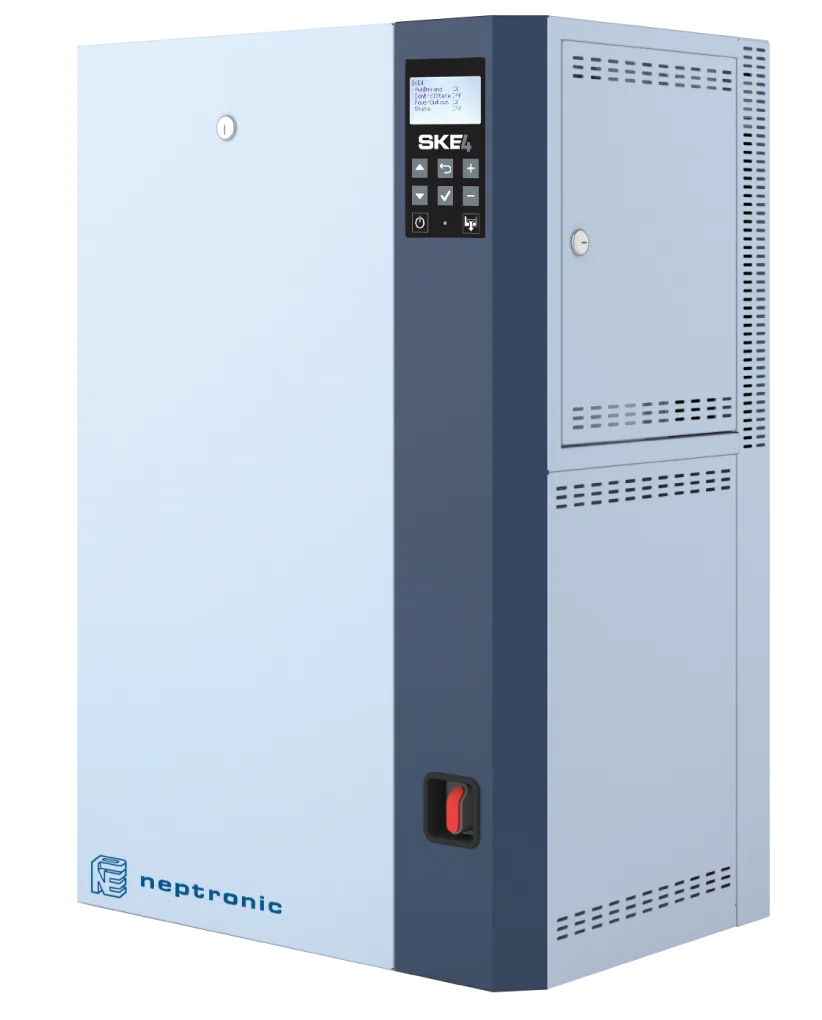
Four architectures exist by steam-generation energy source: electrode (Joule heating via water conductivity), resistive (Incoloy immersion heaters inside a stainless chamber), gas-fired (natural gas or LPG fuel), steam-to-steam (existing high-pressure boiler steam). The NKT catalogue includes resistive (Neptronic SKE4), steam-to-steam (SKS4), gas-fired (SKG4) and direct-injection (SKD); electrode units are not in the portfolio. Common to all steam solutions: isothermal process, high hygiene, tight control band (±1-2% RH), and relatively high energy consumption.
Electric steam solutions typically draw about 750 W per kg of steam; this is the thermodynamic minimum to heat water from 20°C to 100°C and vaporise it. A 45 kg/h unit draws roughly 34 kW. That is 6-10 times higher than adiabatic systems. Where natural gas is available, SKG4 gas-fired solutions shift this load to gas; where a high-pressure boiler already runs, SKS4 steam-to-steam produces clean steam without adding electrical load. "Steam systems are energy-intensive" is therefore an incomplete claim if architecture is not considered.
How Adiabatic Humidification Works
The adiabatic humidifier delivers water to the air as small droplets at ambient temperature. As soon as a droplet contacts the air, it starts to evaporate; vaporising each gram of water requires roughly 2,260 J of heat (latent heat of vaporisation). This heat is drawn from the air; the air cools, absolute humidity rises, and total enthalpy stays constant. On a psychrometric chart the process appears as a sloped line up and to the left along the constant-enthalpy (wet-bulb) line. Every 1 g/kg added drops air temperature by roughly 2.5°C.
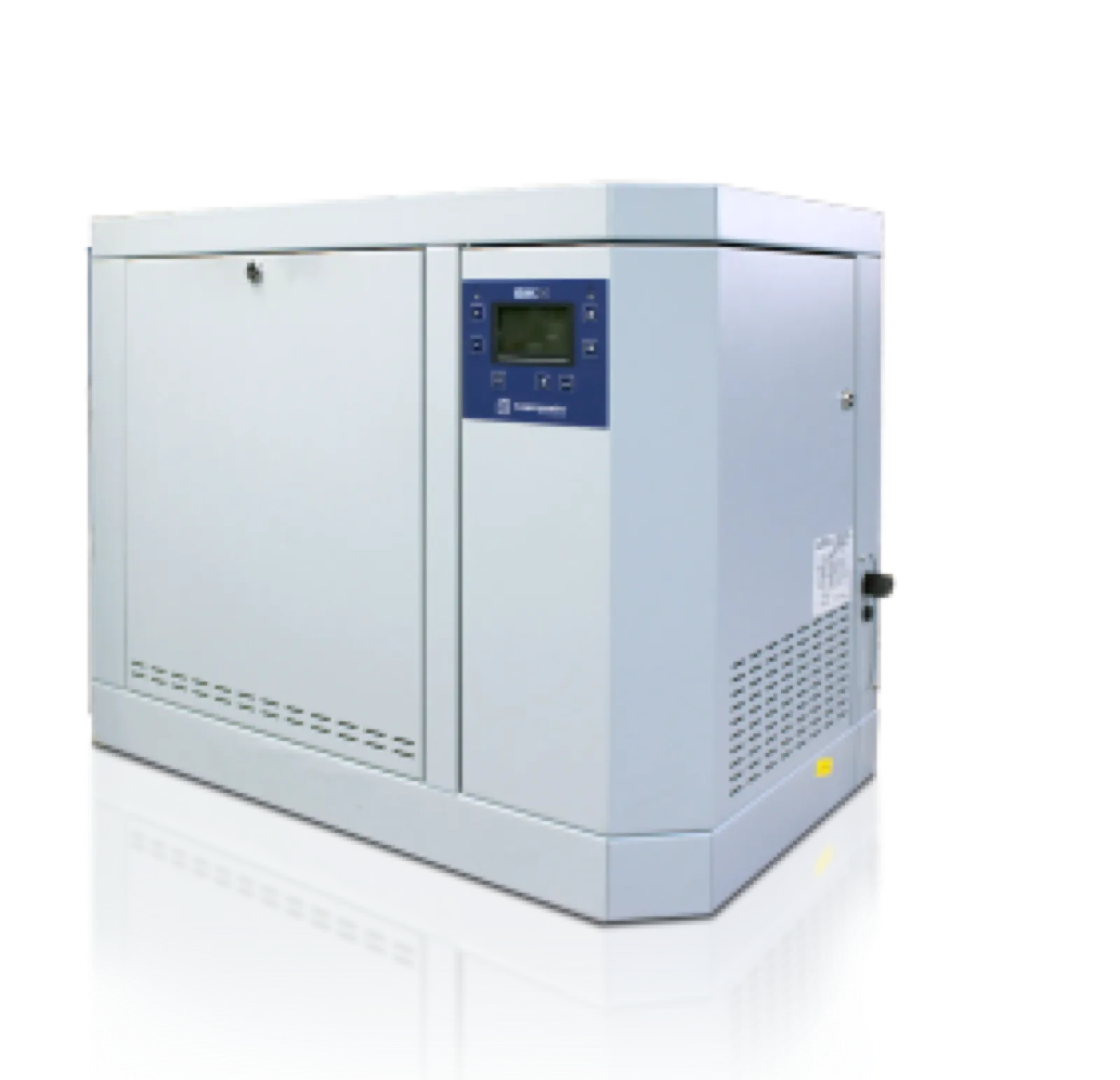
Adiabatic technologies split into four families: high-pressure atomisation (water atomised at a nozzle at 70-100 bar), evaporative panels (water flows over a cellulose / glass-fibre mat through which the air passes), ultrasonic (a piezo crystal vibrates the water surface at high frequency to produce mist), compressed-air + water atomisation (twin-fluid). The NKT catalogue includes high-pressure atomisation (Neptronic SKH), evaporative cooler (SKVF) and evaporative humidifier (SKV).
Adiabatic systems typically draw 50-90 W per kg of steam-equivalent, 1/8 to 1/15 of a steam system. That energy is spent only on water pressurisation or atomisation; no energy is spent heating the water, nature does that work for free by pulling heat from the air. On the water-quality axis, adiabatic systems must run on RO/DI feed; otherwise minerals in the water are released into the air stream and the system risks biofilm growth and mineral-dust accumulation. To manage Legionella risk, design integrates UV disinfection, filtration and stagnant-water prevention as a whole.
Energy Comparison
The most visible difference between the two approaches is energy consumption. Steam systems structurally must pre-heat the water; adiabatic systems leave the heating to the air. That difference can multiply the annual electricity bill on large-capacity sites.
Figure 1. Steam vs Adiabatic: Energy Flow
| Dimension | Steam (45 kg/h) | Adiabatic (45 kg/h) |
|---|---|---|
| Typical specific energy | ~750 W/kg | 50-90 W/kg |
| Unit energy load | ≈ 34 kW electric | ≈ 2.5-4 kW electric |
| Energy ratio | 1× (reference) | 1/8 to 1/15 |
| Thermodynamic process | Isothermal (vertical | Constant enthalpy) sloped up-left |
| Air-temperature effect | Stable | Cools (1 g/kg ≈ -2.5°C) |
| Summer side gain | None | Free cooling |
| Winter side effect | None | Reheat may be needed |
Hygiene Comparison
The two approaches differ structurally on hygiene. In the steam system water reaches 100°C; at that temperature bacterial and viral pathogens are thermally inactivated. The output steam is mineral-free and sterile. In the adiabatic system water is delivered as liquid droplets; there is no thermal inactivation. Therefore, in adiabatic design, water quality, biofilm prevention and Legionella control are core parts of the design.
| Hygiene Dimension | Steam | Adiabatic |
|---|---|---|
| Thermal inactivation | Yes (100°C) | None (ambient temperature) |
| Mineral content | Practically zero | Depends on water; RO/DI required |
| Legionella risk | Structurally absent | Managed in design (UV, filtration, heating) |
| Biofilm risk | None | Risk at stagnant-water points |
| Sterile-space suitability | Standard solution | Limited; specific applications only |
| Standard reference | ASHRAE 170, VDI 6022, EN 16798 | VDI 6022, REHVA Guidebook 8 |
Steam is standard in hospitals (ASHRAE 170), cGMP pharma, ICH stability cabinets, museum collection spaces and food hygiene-class areas. Adiabatic is preferred either in comfort spaces (hospital waiting halls, cafeterias) or in large-capacity specialised applications (textile spinning, wood drying); in every case the design integrates UV-C disinfection, RO/DI feed, automated drainage and periodic microbiological analysis per VDI 6022 and REHVA Guidebook 8.
Control Accuracy and Process Stability
Control accuracy (how tight a band RH can be held around set point) arises from the different mechanical response times of the two approaches. Steam systems continuously modulate the electrical or gas heat input via SCR or servo valves; response time is in seconds. Combined with a resistive SKE4, ±1% RH is structurally achievable. In adiabatic systems modulation comes from water flow at the atomising nozzles; response time is relatively slower, and tight bands depend on zoning, sensor placement and absorption-distance optimisation.
- ±1% RH need → Steam (resistive SKE4) is the structural pick; SCR + PID combination.
- ±2-3% RH need → Precision print, museums, cGMP rooms; steam is typical, well-designed adiabatic is also possible.
- ±5% RH need → Comfort, general HVAC, warehouse; either approach fits, decide on economics.
- ±5-10% RH band → Textile, wood, print conditioning, agriculture; adiabatic is widely used.
For process stability, steam systems are independent of water-quality swings (especially resistive SKE4); adiabatic systems can be affected by changes in feed-water TDS, hardness and temperature. RO/DI feed, pressure stability, and a nozzle-maintenance schedule preserve adiabatic stability.
Cooling Effect
The cooling side-effect of the adiabatic process turns into a gain or a loss depending on application. Every 1 g/kg added drops air temperature by roughly 2.5°C. In summer this is "free cooling", it offsets chiller load. In winter it requires reheat compensation, typically managed with an additional HVAC coil.
Δh ≈ 0 (constant-enthalpy process)
Example: 22°C / RH 30% (4.9 g/kg) → 22°C / RH 50% (8.2 g/kg)
Δx ≈ 3.3 g/kg → adiabatic T_out ≈ 22 - 8.3 ≈ 13.7°C
Figure 2. Psychrometric Chart: Steam vs Adiabatic Process
The steam system has no such side-effect; air temperature is preserved. In large-volume spaces (textile spinning, wood drying, greenhouses, logistics warehouses) the adiabatic cooling side-gain can be the main decision driver alone. In hospitals, museums, pharma and data centres, where temperature must also be held in a tight band, this side-effect is unwanted and steam is preferred.
Investment, Maintenance, Operation
The CAPEX/OPEX profile of the two approaches differs by capacity and application type. At small-to-medium capacities (below 50 kg/h) steam systems usually start at lower CAPEX; at large capacities (above 200 kg/h) adiabatic becomes substantially more economical. Both approaches require annual periodic maintenance, but the workload distribution differs.
| Dimension | Steam (SKE4) | Adiabatic (SKH) |
|---|---|---|
| CAPEX (45 kg/h) | Medium-high | High (pump station + nozzle line) |
| CAPEX (500+ kg/h) | Very high | Medium, scale economy |
| Annual energy cost | High (~750 W/kg × hours × tariff) | Low (~60 W/kg × hours × tariff) |
| Consumables | SKE4: none; electrode would need cylinders | Nozzle, filter, UV lamp |
| Annual maintenance labour | 1× chamber clean | 2-4× nozzle check + RO/UV service |
| Water consumption | 1 L water = 1 kg steam + drain | 1.1-1.2 L water / 1 kg moisture + bleed |
| 10-year OPEX direction | Energy dominant | RO/DI and nozzle maintenance dominant |
It is not correct to claim an approach is "always cheaper" across capacity scales. For a 45 kg/h print room SKE4 steam is economic; for a 600 kg/h textile spinning plant SKH adiabatic delivers roughly half the 10-year TCO. The right choice is made by looking holistically at capacity × tariff × hours × hygiene class × control band.
Steam: Which Applications?
Steam systems are the structural pick for the application profiles below; in these profiles adiabatic falls short on hygiene, control band, or temperature preservation.
- Hospital operating theatre: ASHRAE 170 and Turkish Ministry of Health Hygienic Class, clean steam mandatory, ±5% RH band.
- Pharma and cGMP production: Tablet, capsule, gelatin rooms; ICH Q1A stability cabinets; ±5% RH and mineral-free steam.
- Museum, archive, library: ISO 11799 and museum-conservation standards; ±5% RH/24h and ±2% RH control band.
- Precision print: Offset press room, paper storage; ±3% RH and static control.
- High-density data centre: ASHRAE TC9.9 tight tolerance → resistive + RO.
- Precision electronics: ESD protection and ±2% RH band.
- Lithium-ion battery dry room: Pre-stage conditioning for <-40°C dew-point applications.
- Optical / precision mechanical: ±2% RH and below; structural guarantee.
Neptronic SKE4 Resistive Steam: Product Recommendation
Adiabatic: Which Applications?
Adiabatic systems are the structural pick for the application profiles below, especially where high capacity, free cooling and low energy shift the balance.
- Textile spinning and weaving: 500-2,000 kg/h capacity, ±5% RH acceptable, summer cooling gain.
- Wood drying and conditioning: Large volumes, no tight band required, homogeneous droplet distribution.
- Paper production and print conditioning: Large production halls, ±5-8% RH acceptable.
- Greenhouse and vertical farming: Free cooling + humidity rise together.
- Logistics warehouse and cold storage: Balanced RH and temperature-lowering side-gain.
- Medium-density data centre: Adiabatic integrated into a free-cooling strategy.
- Large-area / large-volume: Industrial hangars, automotive paint shops, steel-mill cooling.
- Livestock and free-range housing: Summer cooling and humidity control.
Neptronic SKH High-Pressure Atomisation: Product Recommendation
Detailed Comparison Table
A side-by-side comparison of the two approaches across 11 dimensions follows. The table mirrors the consistency of the "approach comparison" page that NKT engineering proposals share with customers.
| Criterion | Steam (Neptronic SKE4) | Adiabatic (Neptronic SKH) |
|---|---|---|
| Thermodynamic process | Isothermal (constant T) | Constant enthalpy (T drops) |
| Typical specific energy | ~750 W/kg | 50-90 W/kg |
| Typical control band | ±1% RH (PID + SCR) | ±3-5% RH (tighter with zoning) |
| Hygiene profile | Thermal inactivation, sterile | Managed by design (UV/RO/filter) |
| Water-quality requirement | SKE4: every type incl. RO/DI | RO/DI required |
| Air-temperature effect | Stays constant | Cools (-2.5°C / g/kg) |
| Capacity range | 2.7-1,000+ kg/h | 5-2,000+ kg/h |
| Scale-economy direction | Small-medium advantageous | Advantageous at large capacities |
| Summer side gain | None | Free cooling |
| Winter side effect | None | Reheat may be needed |
| Typical application | Hospital, pharma, museum, print, data centre | Textile, wood, greenhouse, logistics, large volumes |
NKT Engineering Approach
NKT Nem Kontrol Teknolojileri provides end-to-end engineering across both steam and adiabatic portfolios; the two approaches are complementary, not competing. In a typical medium-to-large facility both technologies run together in different rooms of the same building: steam SKE4 for the operating theatre or cGMP room, adiabatic SKH/SKVF for packaging or general HVAC. The main portfolio solutions map as follows:
- SKE4, Resistive steam (2.7-136 kg/h). Hygienic, tight band, isothermal.
- SKS4, Steam-to-steam. Existing boiler steam; clean steam.
- SKG4, Gas-fired steam. High capacity + natural gas.
- SKD, Direct steam injection and distribution manifolds.
- SKH, High-pressure atomisation adiabatic. Large volumes, low energy, free cooling.
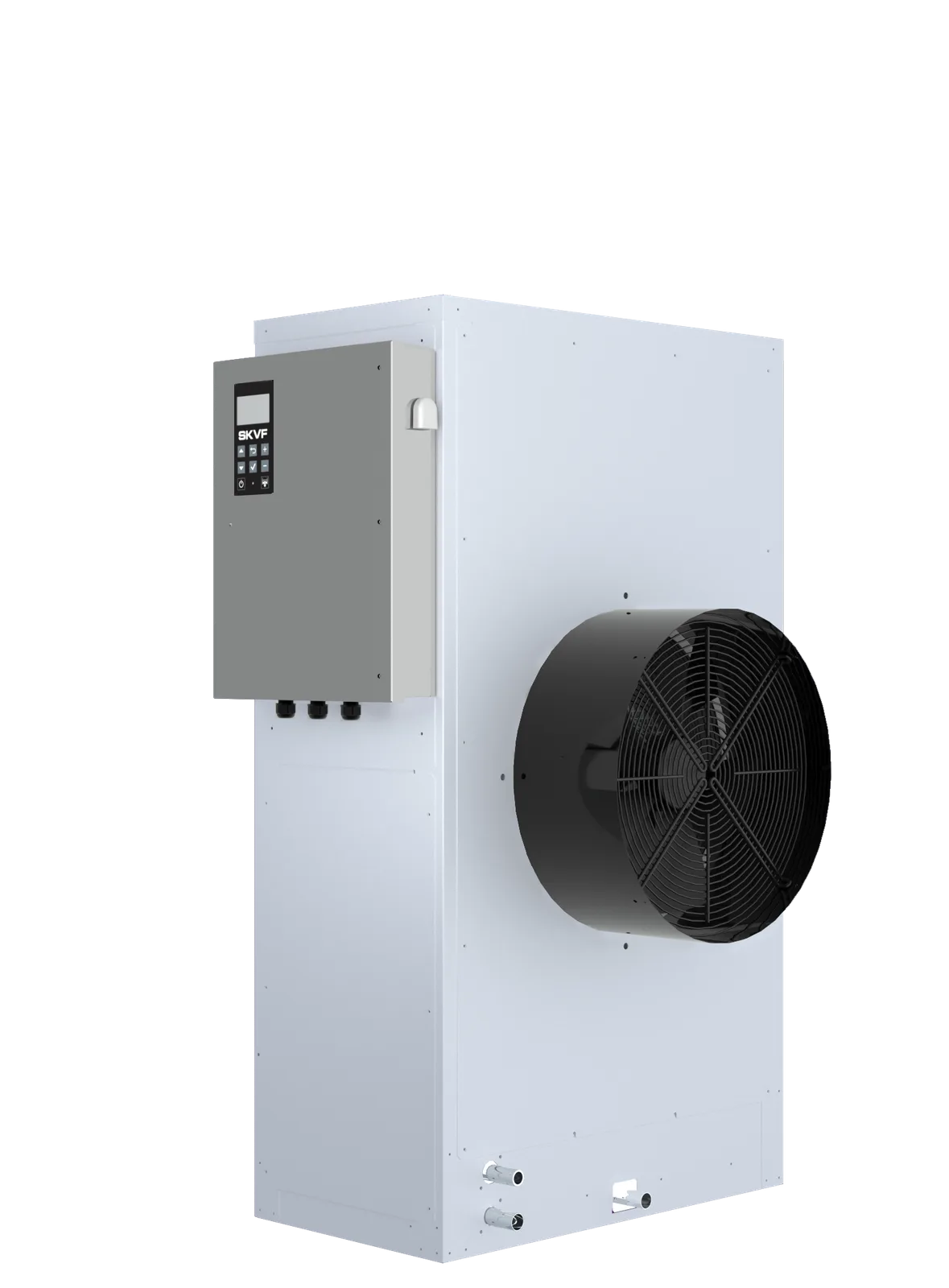
- SKV / SKVF, Evaporative humidifier and evaporative cooler. Wide duct lines, low-pressure.
The NKT project flow runs in six stages: (1) site analysis and water sampling, (2) target definition (RH band, hygiene class, temperature tolerance), (3) load calculation (psychrometric), (4) approach selection (steam / adiabatic / hybrid), (5) equipment selection and commissioning, (6) verification and warranty follow-up. On most projects both approaches are presented side by side; the customer's thermodynamic profile often shows that "hybrid" is the most suitable answer.
Engineering View for the Right Choice
Steam and adiabatic humidification reach the same target via different thermodynamic routes. "Which is better?" gives the right answer when phrased correctly: which one matches my application? Hygiene, a tight control band, temperature preservation and a mineral-free steam need point to steam; large volumes, low energy, the free-cooling side gain and large capacities point to adiabatic. The two approaches are not interchangeable, they are designed for different application profiles.
In a significant share of modern facilities a single approach is not enough; in a typical medium-to-large facility both technologies run together. NKT engineering positions this co-operation as part of the design from the outset: which room is fed by which approach, RH band tolerances, temperature-preservation conditions and the 10-year TCO equation are evaluated together. The right choice does not start with a device brand, it starts with reading the thermodynamic profile correctly. The device comes last, as the final step of the engineering analysis.