"Electrode or resistive?" is the most practical decision point in front of any steam humidification investment. The two architectures deliver similar capacity by different routes: in the electrode unit, water is part of the electrical circuit; in the resistive unit, water is a passive heat sink. This simple difference has cascading consequences across water-quality compatibility, maintenance profile, control band, initial investment, and 10-year total cost of ownership. The right choice does not come from comparing product spec sheets line by line, it emerges once three questions are answered: what is the facility water, what tightness does the process need, and how is the budget structured? This guide grounds the decision on those three axes and pairs NKT Nem Kontrol Teknolojileri engineering judgement with field data.
First Question: Water, Process or Budget?
The most common selection mistake is to start the decision with a catalogue comparison. The right order is the reverse: read the facility water first, then understand how the process consumes moisture, and only finally settle on a budget structure. The answers to those three questions narrow the product family directly and largely eliminate the need to compare candidate units feature by feature.
The first question (water quality) depends on the facility geography, mains source, and any existing treatment infrastructure. Hardness, electrical conductivity, TDS, silica, chloride and alkalinity are read together. These five parameters draw the "can run" boundary for the electrode unit; for the resistive unit they only modulate maintenance frequency. If the facility already has an RO water or deionised water source, the electrode option is off the table by default, the unit will not run.
The second question (process tightness) asks how narrow the relative-humidity control band must be. Comfort spaces typically tolerate ±5% RH; offices, retail and warehouses fall into this class. Critical print rooms, museums, pharma and cGMP rooms demand ±2% RH; precision mechanical and optical manufacturing pulls down to ±1% RH. Electrode systems sit at a typical ±5% RH band; resistive systems structurally hold ±1% RH via PID + SCR control.
The third question (budget structure) asks whether the decision is weighted on CAPEX (initial outlay) or OPEX (10-year operation). A low-CAPEX / high-OPEX profile maps to the electrode consumable economy. A low-OPEX / balanced-CAPEX profile maps to the resistive permanent chamber and long-lived heating elements. Where annual cylinder swaps exceed 1.5, the resistive solution pays back its CAPEX delta in 2-4 years.
How Electrode Steam Humidifiers Work
The electrode steam humidifier puts water directly into the electrical circuit. Two or three stainless-steel electrodes sit inside a plastic cylinder, connected to mains voltage (usually 380V three-phase). Water forms the conducting medium between the electrodes. Current flows through dissolved salts in the water via ionic conduction and converts to heat per Joule's law (P = I²R). The water reaches 100°C and steam exits the top of the cylinder.
A direct consequence of this principle is that steam generation rate is governed by water level and the contact area of the electrode surface. Higher water level means larger active electrode area and higher current. Control therefore relies on "water-level modulation": the unit opens and closes drain and fill valves automatically to reach the target capacity, adjusting water level in steps.
The architecture is directly bound to electrical conductivity. Manufacturers typically define 125-1,250 μS/cm as the working window. Below this band (RO or DI water) there are not enough ions for current to flow and the unit will not run. Above the band, current rises rapidly, triggering over-steam, foaming and overflow risk. During operation, mineral build-up from electrolysis continuously thickens the electrode surface; at some point the electrode is fully coated and the unit issues a cylinder-change warning.
The cylinder is, by design, a single-use plastic consumable; cylinder life ranges from 6-18 months depending on water hardness and TDS profile, usage intensity and drain frequency. In hard-water cities (Konya, Kayseri, Ankara) life falls to 6-10 months; on the Marmara/Aegean coast with softened feed it can approach 14-18 months. Initial purchase price is usually 15-25% lower than a resistive unit; but 10-year total cost of ownership tends to flip thanks to the cylinder swap frequency.
How Resistive Steam Humidifiers Work
The resistive steam humidifier keeps water fully isolated from the electrical circuit. Steam is generated by Incoloy 800 (or similar high-nickel alloy) immersion heating elements inside a stainless-steel evaporation chamber (typically AISI 304 or 316L). Current passes through the metal sheath of the element and never contacts the water. The element heats up from current, conducts and convects heat into the surrounding water, the water reaches 100°C and steam is produced. This simple separation removes water quality as an input to system performance.
The stainless body of the chamber is permanent; it is not a consumable. Scaling over time forms deposits on the heater surface; these deposits are cleared in a short maintenance cycle 1-2 times per year, via a tool-free cover. With RO/DI feed, scaling is practically eliminated and this cycle collapses to a single annual visual check. Heating element life is typically 5-7 years; replacement is a planned part renewal rather than a cylinder-style consumable cycle.
Resistive systems can modulate 0-100%. The heater is driven by SCR (Silicon Controlled Rectifier) phase-angle control; a PID controller continuously trims steam output. This structurally enables tight bands such as ±1% RH, well below the typical ±5% RH band of electrode systems. Because it is immune to water-quality swings, capacity stability is high; even with seasonal water-hardness drift, steam delivery stays flat. That stability is a structural guarantee for pharma stability cabinets, precision print rooms, optical labs and museum collection spaces.
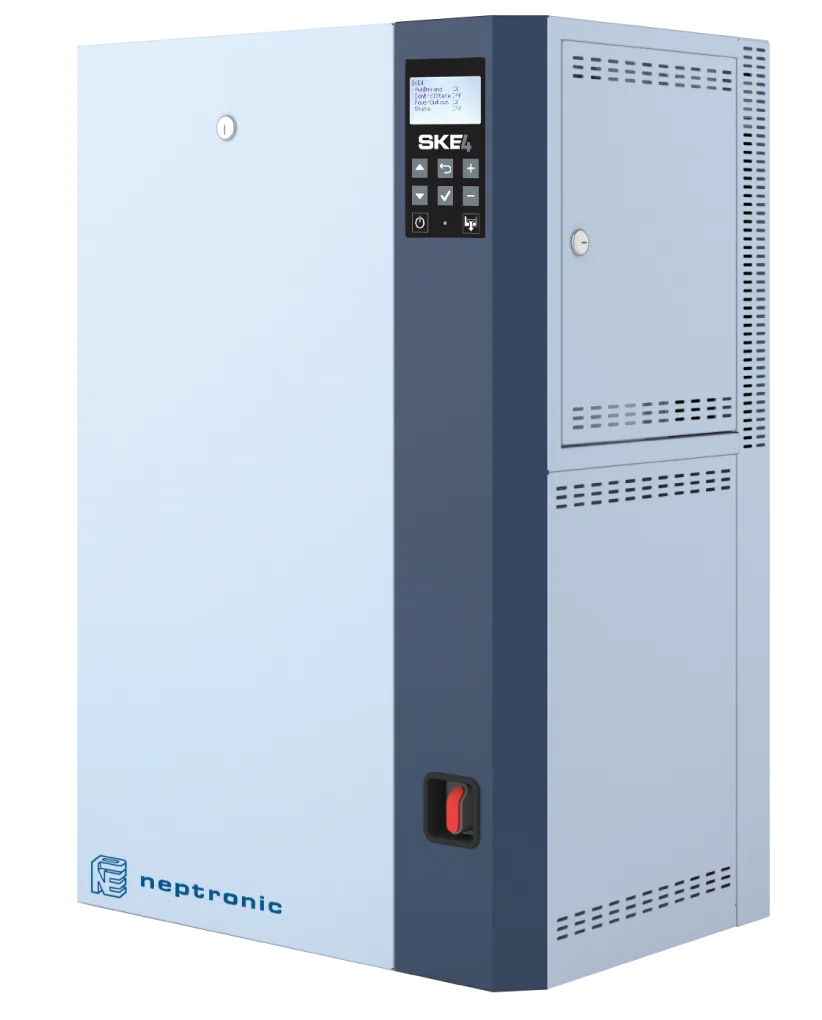
Neptronic SKE4 Resistive: Product Recommendation
The Neptronic SKE4 resistive steam humidifier runs independently of water quality thanks to its AISI 304 permanent stainless chamber, Incoloy 800 immersion heaters, tool-free cover and patented AFEC (Anti-Foam Energy Conservation) system. 2.7 – 136 kg/h ±1% RH RO/DI compatible No plastic cylinder BACnet / Modbus
Critical Difference: Conductivity Dependence
The single variable that really decides between the two architectures is the role of water in the electrical circuit. In the electrode system, water is a conducting active element, current flows through the water. In the resistive system, water is a passive heat sink, current flows through the metal sheath of the heater, never the water. This simple separation governs water-quality compatibility, maintenance load, control accuracy and 10-year TCO together.
Figure 1. Conductivity Dependence: Decision Flow
The cascading consequence of conductivity dependence is this: the resistive solution runs on every water type; the electrode solution runs in a narrow window. Below or above the window, the system either does not run at all or its consumable life drops below the economic break-even. Facility water quality must be measured before the investment decision is made; field data shows that selections made without analysis come back as 20-30% rework.
Water Quality and Maintenance Cost
Water quality is not only a "runs/does-not-run" input but also a "how often does it need maintenance" input. In the electrode system water quality directly drives cylinder life; in the resistive system it only modulates scale-cleaning frequency.
| Water Type | Conductivity (μS/cm) | Hardness (°fH) | Electrode Outcome | Resistive (SKE4) Outcome |
|---|---|---|---|---|
| Purified (RO / DI) | 5 – 25 | 0 – 1 | Will not run | Ideal (maintenance near zero |
| Softened (ion exchange) | 300 – 800 | 0 – 2 | Marginal) foaming risk | Compatible, annual visual check |
| Mains (Marmara/Aegean) | 400 – 700 | 10 – 25 | Cylinder life 12-18 months | One cleaning per year |
| Hard mains (Central Anatolia) | 700 – 1,200 | 25 – 45 | Cylinder life 6-10 months | Two cleanings per year |
| Very hard / well water | 1,200 – 2,000 | > 45 | Exceeds window, foaming | Compatible (RO pretreatment recommended) |
| High-silica water | 700 – 1,500 | 20 – 40 | Silica precipitation, life 4-6 months | Compatible with RO pretreatment |
Viewed through the maintenance calendar, the annual electrode workload is: cylinder procurement, planned downtime, old-cylinder removal and waste handling, new cylinder installation, current calibration after commissioning. The annual resistive workload is: open chamber tool-free, visually inspect heater surface, clean any light deposit, close chamber. The difference in time/work shapes the technical team's annual calendar in multi-unit facilities.
CAPEX vs OPEX: Investment and Operating Cost
Initial investment (CAPEX) and 10-year operating cost (OPEX) move on different curves. The electrode unit usually starts 15-25% cheaper; the resistive unit comes with a higher starting price. But the OPEX curve runs the other way every year: electrode cylinder-swap costs accumulate, while resistive consumable cost is practically zero.
| Cost Line | Electrode (10-year) | Resistive SKE4 (10-year) |
|---|---|---|
| Initial investment (45 kg/h) | Low (baseline: 100) | Medium (baseline: 120-130) |
| Cylinder / consumable swaps | €900-9,000 (water-quality dependent) | €0, permanent chamber |
| Heater element replacement | — | Once between years 5-7 |
| Annual maintenance labour | 2× cylinder swap cycles | 1× tool-free cleaning |
| Plastic waste handling | 5-30 kg / 10 years | 0 kg |
| Energy use (kW/kg) | ~0.75 | ~0.75 |
| Unexpected downtime risk | Foaming / current instability | Very low, water-quality independent |
+ (annual maintenance labour × 10) + (energy use × tariff × 10)
Once annual cylinder swaps exceed 1.5, the resistive CAPEX gap closes in 2-4 years. On 24/7 sites, or where hardness drives cylinder life below 8 months, payback shortens to 18 months. After that point, every additional year is net gain on the resistive solution.
Critical-Process Applications
For applications that must hold relative humidity inside ±2% RH or tighter, the electrode architecture hits a structural ceiling. Water-level modulation, thermal inertia and electrode wear from electrolysis lock the practical control band at about ±5% RH. Resistive systems structurally reduce that swing thanks to SCR phase-angle control and PID modulation.
- Pharma and cGMP production: 30-50% RH band in tablet and capsule rooms; ±5% RH on ICH Q1A stability cabinets; cGMP Class C/D spaces typically validate on resistive + RO.
- Museums, archives, libraries: ISO 11799 and museum-conservation standards specify a 45-55% RH band with a ±5% RH/24h change limit; resistive PID + SCR structurally delivers ±1-2% RH.
- Precision print rooms: ±3% RH on offset presses; paper dimensional stability and static control.
- Precision mechanical / optical manufacturing: ±2% RH and below; resistive is a structural guarantee.
- High-density data-centre rows: ASHRAE TC9.9 20-80% RH band with tight tolerance → resistive.
- Hospital operating theatres: ASHRAE 170 and the Turkish Ministry of Health Hygienic Class regulation require a ±5% RH band; for clean steam use resistive + RO or the steam-to-steam SKS4.
In these applications the electrode unit is unsuitable not only economically but also from a validation perspective. Validation processes (cGMP, ISO, ASHRAE) demand continuity and repeatability; capacity that drifts with water quality undermines the very basis of validation.
When Does Electrode Make Sense?
The electrode architecture still has economic meaning in a specific application profile. Facility water is softened (300-800 μS/cm) or medium-hard mains (400-700 μS/cm); the process band tolerates ±5% RH; the budget is weighted on CAPEX; and the facility runs on a "use, replace if needed" rather than 10-year operational view. This profile is typical of offices, commercial buildings, education campuses, retail centres and general HVAC.
In that profile, the electrode unit is economically meaningful thanks to its CAPEX advantage and plug-and-play installation. But once annual cylinder swaps creep above 1.2, or the water profile shifts toward hard water, the balance flips quickly to the resistive side. In the NKT proposal process this break-even point is calculated on facility data and shared with the customer.
When Does Resistive Make Sense?
The resistive architecture stands out structurally whenever at least one of three conditions holds: (1) the facility has or plans an RO/DI water source; (2) the process band requires ±2% RH or tighter; (3) 10-year TCO is the main budget axis on the table.
Electrode: Typical Cases
- Office, commercial, warehouse
- ±5% RH acceptable
- Softened / medium-hard water
- Low-CAPEX priority
- Short-to-mid-term horizon
- No RO/DI source
Resistive SKE4: Typical Cases
- Hospital, pharma, cGMP
- Museum, archive, library
- Precision print rooms
- Data centre, electronics
- Precision mechanical / optical
- RO/DI source or plan
- ±1-2% RH band required
- 10-year TCO-focused budget
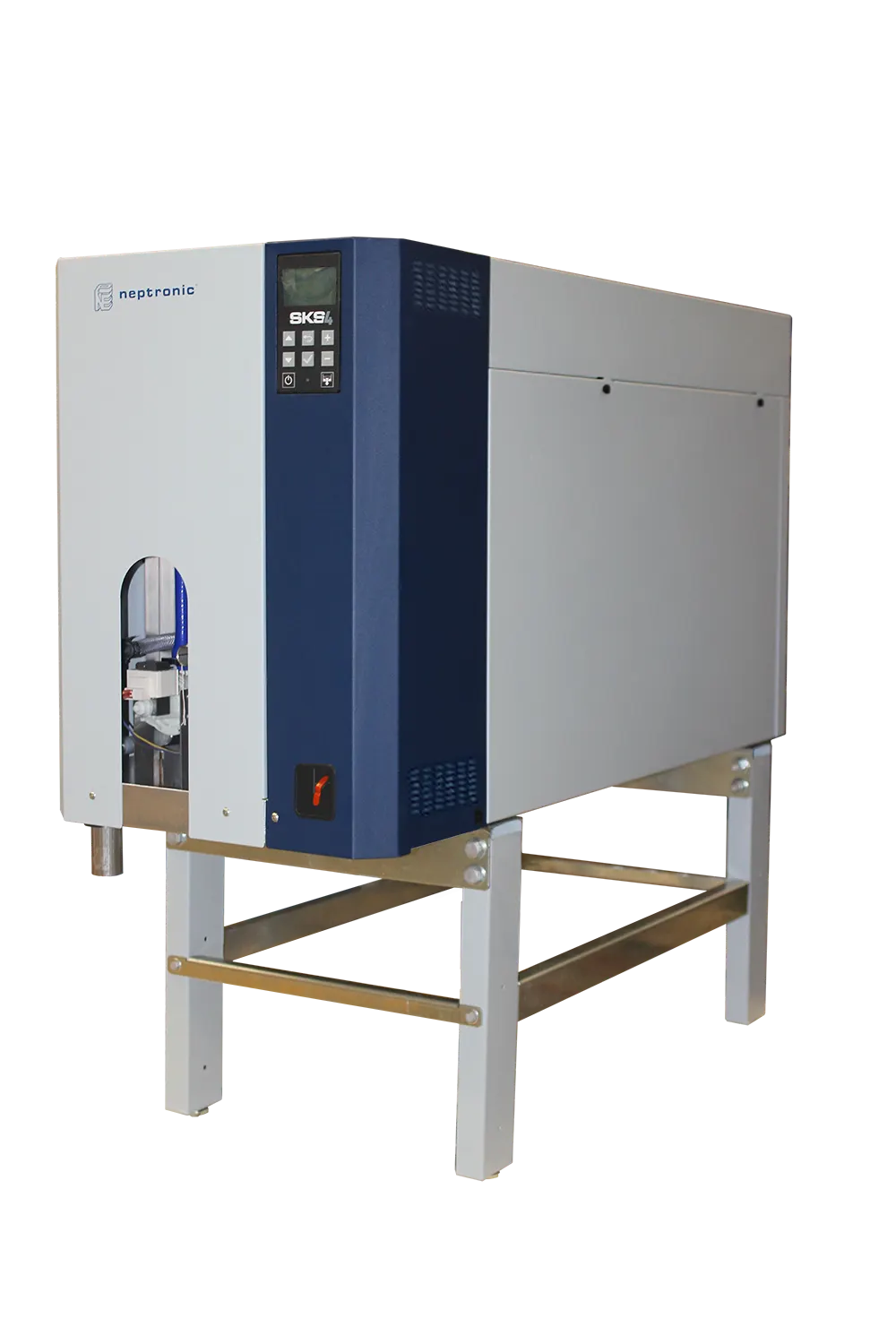
For critical-process applications, Neptronic SKE4 stands as the single pick. For fast-payback hard-water sites, the same unit closes the CAPEX gap in 18-36 months. If the facility already runs a high-pressure boiler, a second option enters the discussion: SKS4 steam-to-steam uses boiler steam to produce clean steam in a secondary RO/DI loop and largely minimises the added electrical load.
Neptronic SKS4 Steam-to-Steam: Alternative
Detailed Comparison Table
A side-by-side comparison of the two architectures across 11 dimensions follows. This table mirrors the "equipment comparison" page that the NKT engineering proposal shares with customers.
Figure 2. CAPEX/OPEX Curve: 10-Year Total Cost of Ownership
| Criterion | Electrode | Resistive (Neptronic SKE4) |
|---|---|---|
| Operating principle | Water is part of the circuit; Joule heating | Heater element direct heat transfer; water passive |
| Conductivity window | 125-1,250 μS/cm required | None (conductivity is not an input |
| RO/DI compatibility | Incompatible) unit will not run | Ideal, scale practically zero |
| Chamber / cylinder | Single-use plastic; replaced every 6-18 months | Permanent stainless chamber; tool-free annual cleaning |
| Typical control band | ±5% RH | ±1% RH (PID + SCR) |
| Initial investment (CAPEX) | Low (baseline 100) | Medium (baseline 120-130) |
| 10-year OPEX (hard water) | High (cylinder line €900-9,000 | Low) no consumable, only maintenance labour |
| Plastic waste | 5-30 kg / 10 years | 0 kg |
| Heater / element life | Cylinder 6-18 months | Heating element 5-7 years |
| BMS / communications | BACnet / Modbus standard | BACnet / Modbus / Ethernet standard |
| Typical application | Office, commercial, warehouse, medium-precision | Hospital, pharma, museum, print, data centre |
NKT Engineering Approach
NKT Nem Kontrol Teknolojileri, as Neptronic's official Turkish distributor, provides end-to-end engineering on steam humidification projects. The four core steam solutions in the portfolio map as follows:
- SKE4, Resistive steam (2.7-136 kg/h). Single-site facilities, hospital, pharma, print, museum, data centre.
- SKS4, Steam-to-steam. Facilities with an existing high-pressure boiler; clean steam.
- SKG4, Gas-fired steam. High-capacity sites with natural-gas infrastructure.
- SKD, Direct steam injection and distribution manifolds.
The NKT project flow runs in six stages: (1) site analysis and water sampling, (2) target definition (RH band, hygiene class), (3) load calculation (psychrometric), (4) technology selection (water + process + budget), (5) commissioning and verification, (6) 12-24 month warranty follow-up. The water-analysis result is combined with RO pretreatment to compute the 10-year TCO transparently; the customer proposal includes the "electrode vs resistive" scenario as a side-by-side comparison.
Engineering View for the Right Choice
"Electrode or resistive?" is not a product comparison, it is the answer to three questions: what is the facility water, how tight is the process band, and where is the budget weighted? If two of those answers point toward resistive, the decision is clear. If all three line up, no alternative is evaluated. "Lower initial price" alone is not enough justification for a modern facility; 10-year TCO and validation guarantee often flip that difference the other way.
Modern precision facilities (pharma, hospital, museum, print, data centre, lithium-ion battery dry room, optical manufacturing) trend structurally toward resistive + RO/DI feed. NKT engineering confirms this on the ground every day: new proposals trend toward resistive year over year, and existing electrode installations are typically converted to resistive after the third or fourth cylinder swap. The right choice does not start with product features, it starts with the sequential answers to three questions. The product comes last, as the final step of the engineering analysis.