Engineering Guide
In facilities that require tight relative humidity control, the question facility managers most frequently ask is not about capacity, it is "Can I know today what steam output the unit will deliver this afternoon?" A steam humidifier delivering the same flow at the same setpoint hour after hour, season after season and year after year is not the result of clever tuning; it is the result of the working principle's inherent nature. Resistive steam humidifiers deliver this predictability with a structural advantage over electrode architectures. This article explains the "why" at the thermodynamic, electrical and control-engineering level and grounds it in NKT Nem Kontrol Teknolojileri's Neptronic SKE4 in the catalogue.
What Means Predictable Steam Output?
In industrial humidification engineering, "predictable steam output" means a unit delivering the same steam flow over time without drift at the same setpoint, the same feed parameters and the same air conditions. Drift is evaluated on three different time scales: intra-minute (control band width), intra-hour (setpoint-change response) and intra-season/year (long-term stability).
In precision-process facilities (printing, pharmaceutical cleanrooms, hospital operating theatres, museum storage, data centres) tolerance is tight. In a print hall, drifting from 50% ± 2% RH to 50% ± 5% RH translates directly to colour-match failure, paper curl and print rejection on the production line. In a pharma cleanroom, ±1% RH drift can be reported as a cGMP deviation. For these applications, "running on average correctly" is not enough; the unit must run correctly every minute.
The three engineering metrics of predictability are:
- Control band width: Minute-scale deviation around the setpoint. Resistive: typically ±1% RH; electrode: ±5% RH.
- Capacity repeatability: Same flow at same demand. Resistive: constant year-round; electrode: drifts 20–40% with conductivity swings.
- Maintenance-calendar stability: Pre-knowability of intervention. Resistive: 1–2 planned cleanings per year; electrode: cylinder-fill time varies 3–18 months depending on water quality.
Working Principle
The working principle of a resistive steam humidifier derives from a fundamental thermal-engineering equation: Q = I²R · t, current squared × resistance × time = heat released. Immersed resistive elements of Incoloy 800 or AISI 316, placed inside an AISI 304 stainless-steel evaporation chamber, reach 110–130°C on their surfaces when current is passed through them. The surrounding water boils via heat transfer (primarily nucleate boiling and convection) from the resistive surface, generating steam.
Three points deserve attention in this architecture:
- Water is not part of the electrical circuit. Current flows through the metal body of the resistive element; no current enters the water. Whether the water's electrical conductivity is 0 or 5,000 μS/cm, resistive power is unchanged.
- Heat transfer is unidirectional. Resistor → metal surface → water boundary layer → bulk water → evaporation. The chain operates one-way without feedback loops; the system behaviour is stable.
- Control is direct. When the unit's PLC sees demand drop, it throttles the current to the element via SCR / SSR zero-cross switching; as current drops, power (Q = I²R) drops, and steam output drops. Response time is in seconds.
Figure 1: Heat-Transfer Chain in Resistive Steam Generation
Independence from Conductivity
The most decisive feature of a resistive system is that steam generation is independent of water conductivity. This engineering fact yields three concrete field consequences: (1) RO water, deionised water and mains water all deliver the same performance; (2) seasonal swings in conductivity do not affect device capacity; (3) water-source changes (well → mains, softener commissioning) do not interrupt operation.
Pure RO outlet water typically has a conductivity of 5–25 μS/cm. For electrode architecture this water does not work electrically, there are not enough ions to carry current. For resistive architecture the same water is an ideal feed: heat transfer from the resistive metal surface is fully effective, scale (scaling) is effectively zero, and the steam is mineral-free, keeping HEPA filters and hygienic distribution lines clean.
In the Turkish field, conductivity can swing 30–50% seasonally. Snowmelt, seasonal rain and drought change the mains-source ion profile. In electrode systems this swing changes steam flow appreciably; in resistive systems no effect is observed. On a year-long trend log, the resistive system's steam flow is a flat line.
Core Difference vs Electrode
The working principle of an electrode steam humidifier is fundamentally different from resistive: water is an active part of the electrical circuit. Two stainless-steel electrodes are immersed in a disposable plastic cylinder, with 200–400 V applied between them. Ions in the water (Ca²⁺, Mg²⁺, Na⁺, HCO₃⁻, Cl⁻) act as the electrical carriers. Per Current = Voltage / Resistance, water conductivity (1/resistance) directly determines current; current directly determines heat (Q = I²R · t); heat directly determines steam flow.
Every link in this chain depends on water quality. If ion concentration rises, resistance falls, current rises, steam flow rises, control runs away or the cylinder fills early. If ion concentration falls, resistance rises, current falls, steam flow drops, the unit cannot meet rated capacity. That is why electrode units have a 125–1,250 μS/cm "conductivity window", outside it, they do not operate.
Electrode: Water Active
- Architecture: Water is part of the electrical circuit
- Current path: Through the ions in water
- Capacity stability: Conductivity-dependent
- Window: 125–1,250 μS/cm mandatory
- RO/DI: Does not operate
- Seasonal effect: Steam flow oscillates
- Cylinder: Disposable plastic, 6–18 months
- Typical control: ±5% RH band
Resistive: Water Passive
- Architecture: Water receives heat from resistor
- Current path: Through the resistor metal
- Capacity stability: Water-independent
- Window: None (all water types compatible
- RO/DI: Ideal feed) zero scale
- Seasonal effect: Steam flow flat
- Chamber: Permanent stainless, tool-free cleaning
- Typical control: ±1% RH band (SKE4)
Figure 2: Electrode vs Resistive Steam Flow Stability (24-hour trend)
Why Advantageous in Critical Processes
In applications where RH precision tightens to ±2% or below, resistive predictability becomes a technical requirement. The following table summarises four core precision-process sectors with their RH specification bands and resistive/electrode suitability.
| Sector / Application | Typical RH Band | Tolerance | Standard / Cert. | Recommended Architecture |
|---|---|---|---|---|
| Pharma cleanroom (cGMP) | 30–60% | ±2% | EU GMP Annex 1, ICH Q7 | Resistive (SKE4) |
| Hospital operating theatre | 30–60% | ±5% | ASHRAE 170 | Resistive (SKE4) |
| Precision printing / offset | 50–55% | ±2% | ISO 12647 | Resistive (SKE4) |
| Museum / archive collection | 50–55% | ±3% | ISO 11799, AIC | Resistive (SKE4) |
| Data centre (Tier III/IV) | 40–60% | ±5% | ASHRAE TC 9.9 | Resistive (SKE4) |
| Electronics SMT line | 50% | ±5% | IPC-A-610, JEDEC | Resistive (SKE4) |
| Office / commercial (comfort) | 40–60% | ±10% | ASHRAE 55 | Either feasible |
Three technical reasons drive the resistive preference in sensitive applications:
- Control band: SCR/SSR zero-cross switching delivers proportional control to 1% accuracy. Electrode water-level modulation is slow and broad-band.
- Capacity repeatability: A "50% ± 2% RH every shift" clause in a precision-printing contract requires a system uncoupled from water chemistry. Resistive provides that guarantee structurally.
- Steam purity: Mineral-free, odourless, sterile steam (for HEPA + clean-steam-mandated facilities) is standard on resistive + RO feed.
Why Water Quality Still Matters
A resistive system operates independently of water conductivity, true. But the thermodynamic reality of steam generation does not change: when 1 L of water evaporates, only H₂O leaves, and all dissolved salts and minerals settle at the chamber bottom. Although these deposits do not stop a resistive unit, two things still matter:
- Scaling rate sets maintenance frequency. In soft water (≤ 7 fH hardness) one annual cleaning is typical; in hard water (> 18 fH) two per year. With very hard water or high TDS well water, cleaning frequency can rise to three.
- Steam purity can be application-critical. Hygienic facilities, HEPA filters, museums and pharma sites demand mineral-free steam. For those applications the combined RO pre-treatment + resistive system is the standard engineering choice.
In short: a resistive system runs independently of water quality, but water quality still drives the maintenance programme and steam purity. In the NKT project process, feedwater analysis is always the first step, regardless of device-type selection.
Maintenance Predictability
Maintenance-calendar predictability is a significant line item in the contract value of a resistive system. The comparison below shows the typical annual maintenance profile of both architectures:
| Item | Electrode (Typical) | Resistive (SKE4) |
|---|---|---|
| Annual planned maintenance | 1 general check + cylinder changes | 1–2 chamber cleanings (tool-free) |
| Cylinder replacement | 12–18 months in soft water; 3–6 months in hard water (surprise) | None, no plastic cylinder |
| Maintenance labour / year | ≈ 4–8 hours (cylinder + check) | ≈ 1–2 hours (chamber sweep) |
| Spare-parts inventory | 2 cylinders per unit in stock | None (resistor 5–10 yr life) |
| Plastic waste / year / unit | 3–6 kg cylinder + packaging | 0 (no waste line item) |
| Surprise-failure risk | Water-quality change → early cylinder fill | Low, resistor life is predictable |
| Downtime / year | ≈ 6–12 hours (cylinder changes) | ≈ 1–2 hours (planned cleaning) |
Energy and Control Perspective
The energy per unit of steam is roughly equal for resistive and electrode systems (≈ 0.75 kWh/kg steam at atmospheric pressure). The thermodynamic fact is unchanged: water absorbs the same latent heat of vaporisation (≈ 2,260 kJ/kg) crossing the liquid → vapour boundary. The real energy difference between the two architectures is in control quality and blowdown losses.
An electrode system performs hot-water blowdown before each cylinder change. Discharging 1 L of 80–95°C water is ≈ 0.1 kWh of heat lost; an annual 50–150 L discharge means 5–15 kWh thermal loss plus the load of reheating cold replacement water. In resistive systems these losses are lower, the chamber is cleaned periodically, no continuous blowdown is required.
On control quality, the gap between resistive SCR / SSR zero-cross switching and electrode water-level modulation is in minutes. The resistive system responds to a setpoint change within 10–30 seconds; the electrode system within 2–5 minutes. That gap directly affects the absorption distance calculation and the in-duct condensation risk.
Neptronic / NKT Product Positioning
In the NKT Nem Kontrol Teknolojileri catalogue, the predictable-steam-output position is filled by the Neptronic SKE4 resistive steam humidifier. The unit's architecture is the industrial-grade, finely-tuned implementation of the resistive working principle described in this article:
- AISI 304 stainless-steel permanent evaporation chamber, tool-free maintenance hatch, annual cleaning in minutes.
- Incoloy 800 immersed resistive elements, high-temperature / corrosion endurance; typical 5–10 year service life.
- SCR / SSR zero-cross switching, ±1% RH control band, setpoint response in seconds.
- All water types compatible (RO/DI included), no conductivity window; ideal scale-zero operation on pure water.
- Patented AFEC (Anti-Foaming Energy Conservation), auto-detection and prevention of foam formation; prevents surprise blowdowns.
- BACnet MS/TP, Modbus + optional Ethernet (BACnet IP / Modbus IP), BMS integration as standard, trend logs and alarms from a single point.
- Outdoor enclosure option, anti-freeze + overheat protection; installation flexibility without a plant room.
Key SKE4 features: 2.7 – 136 kg/h capacity ±1% RH control RO/DI compatible No plastic cylinder Mineral-free steam Sterile-compatible BACnet/Modbus 5–10 yr element life.
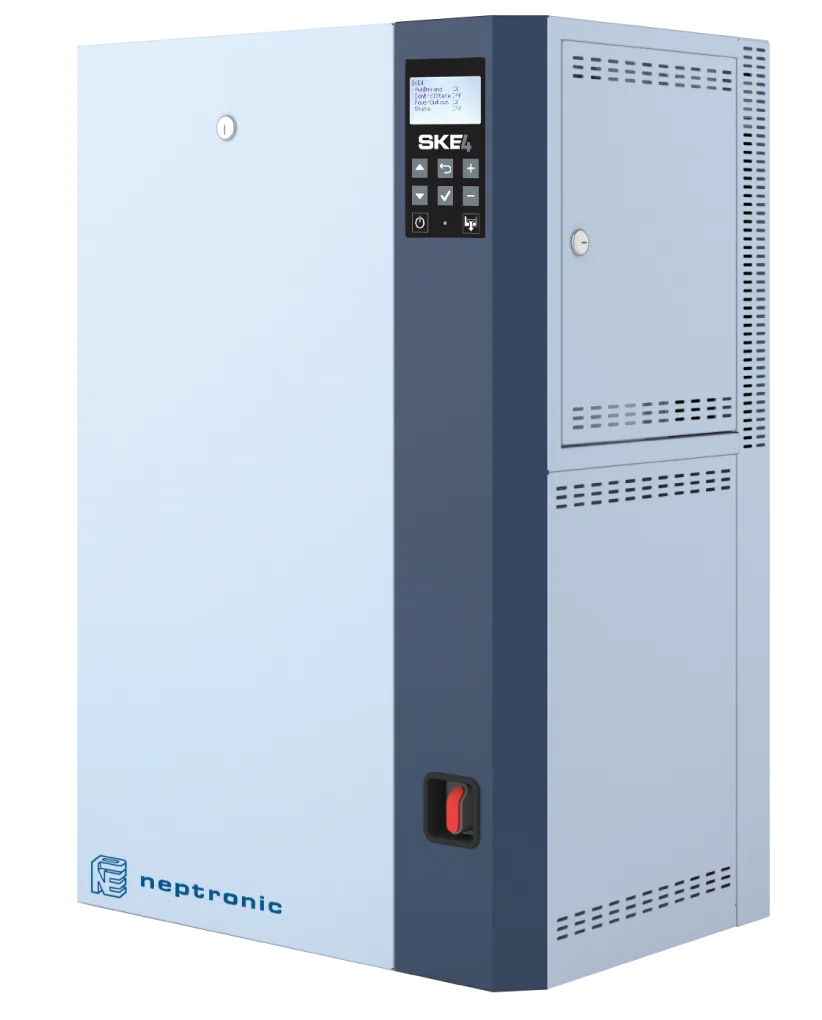
Where facility steam (boiler) already exists, the Neptronic SKS4 steam-to-steam alternative is also evaluated; it converts facility steam into mineral-free technological steam while delivering the same predictability profile. Neptronic SKD handles direct facility steam injection and Multi-Steam manifolds handle distribution as complementary solutions.
Which Facilities Should Consider Resistive?
Predictability is not equally critical for every facility. The guide below separates three scenarios in which a resistive choice is a technical mandate, a strong preference, or optional:
Technical Mandate (Resistive Only)
- RO/DI feedwater, electrode does not run.
- cGMP pharma cleanroom, ±2% RH band requirement.
- Precision printing, ISO 12647 + ±2% RH customer contract.
- Hygienic facility, mineral-free-steam requirement (HEPA, clean steam).
- Museum / archive collection, ISO 11799 stable-RH requirement.
- Tier III/IV data centre, ASHRAE TC 9.9 + high-reliability target.
Strong Preference (Resistive Recommended)
- Hard water (> 18 fH hardness), short cylinder life, high waste.
- Very soft water (< 7 fH), electrode cannot reach rated capacity.
- Source with seasonal conductivity swings (well water, mixed mains).
- 10+ year operating horizon + low-TCO target.
- ESG / sustainability-priority corporate policies.
Optional (Either System Feasible)
- Comfort applications (office, commercial), ±5–10% RH band sufficient.
- Typical municipal mains (250–700 μS/cm, 8–18 fH hardness).
- Low operating hours (seasonal use, partial-year operation).
- Investment-first, TCO-secondary sector projects.
The reason resistive steam humidifiers deliver more predictable steam output than electrode systems is rooted in one engineering principle: water is not part of the electrical circuit. This structural distinction decouples water-quality variation from steam flow, delivers ±1% RH band via SCR / SSR control, and fixes the maintenance calendar and waste profile. Facilities such as precision printing, pharma cleanrooms, hospitals, museums and data centres demand this predictability as a contractual technical condition.
Constant steam flow hour-to-hour, season-to-season and year-to-year is (beyond equipment-selection) a building block of production quality, certification compliance and long-term operational reliability. Resistive architecture grounds that guarantee not in tuning but in the nature of the working principle, surprise maintenance, surprise capacity drops and surprise cylinder fills are effectively eliminated.
NKT Nem Kontrol Teknolojileri, Neptronic's official Turkish distributor, places the resistive SKE4 family directly in the predictability position and applies the same engineering rigour across both steam and adiabatic architectures. Every project is delivered end to end (water analysis → architecture selection → commissioning → periodic maintenance) and documented transparently with a 10-year TCO and predictability scorecard.