What Is Laminated Glass?
Laminated glass is a type of safety glass produced by bonding two or more glass layers together under heat and pressure using a polymeric interlayer material placed between them. Thanks to this structure, when the glass breaks, the fragments remain adhered to each other, preventing large and sharp glass shards from scattering. The most commonly used interlayer material in laminated glass production is Polyvinyl Butyral (PVB) film. PVB creates an elastic bond between the glass layers, making the glass more durable. Additionally, PVB's ultraviolet filtration properties protect interior spaces from the harmful effects of UV radiation.
With these properties, laminated glass has become an indispensable component of modern architecture, automotive, defense, and maritime industries. The glass lamination process, which is one of the keys to producing durable, safe, and aesthetically pleasing glass products, is actually a process that appears simple but requires attention to many sensitive parameters. Among these parameters, humidity-controlled lamination room design stands at the forefront.
Today's Application Areas
The global laminated glass market is valued at approximately USD 26 billion as of 2024 and is expected to exceed USD 36 billion by 2030 with an average annual growth rate of 5.8%. The rise of electric vehicles, smart building regulations, and ballistic security demands are playing a decisive role in this growth.
The most critical quality factor in laminated glass production is the strong and homogeneous bond between the glass and the interlayer. The quality of this bond directly depends on the moisture content of the production environment. TFT, Tecnofrigo Tuscany Srl (Italian industrial dehumidifier manufacturer) – İtalya industrial dehumidifiers ensure production quality by providing precise humidity control in lamination rooms.
Lamination Materials and Moisture Sensitivity
Interlayer selection directly determines the mechanical, optical, and safety properties of laminated glass. Each material has a different relationship with moisture; therefore, production environment conditions must be optimized according to the material type.
PVB: Polyvinyl Butyral
PVB is the most widely used interlayer material in the glass lamination industry with a market share exceeding 80%. Chemically, it is obtained from the reaction of polyvinyl alcohol with butyraldehyde. The hydroxyl (-OH) groups of PVB have a strong hydrophilic character; free hydroxyl groups bind to water molecules, increasing the moisture content of the material. PVB film absorbs approximately 0.4–0.5% water by weight under standard atmospheric conditions (50% RH, 23°C); however, this value can exceed 1.2% in an 80% RH environment.
When PVB film moisture content exceeds 0.4%, adhesion strength begins to measurably decrease after autoclaving. At 0.7% and above, there is a serious risk of delamination. Therefore, precise control of ambient humidity using TFT – İtalya industrial dehumidifiers is mandatory during the storage and processing of PVB.
Ideal Storage and Processing Conditions
| Parameter | Storage | Processing (Clean Room) |
|---|---|---|
| Temperature | 4–20°C | 18–22°C |
| Relative Humidity (%RH) | <30% | 20%–35% |
| Packaging Condition | Vacuum-sealed PE bag | Controlled opening |
| Sunlight | Dark | UV filtered |
Once PVB rolls are removed from their original vacuum packaging, a race against time begins. Depending on ambient humidity levels, moisture-induced degradation can start within a short period. Therefore, opened rolls should be immediately processed or stored in humidity-controlled sealed containers.
EVA: Ethylene-Vinyl Acetate
EVA is an alternative interlayer material used particularly in solar panel encapsulation applications and architectural laminated glass. Due to its chemical structure, it is less hydrophilic compared to PVB, and its moisture absorption rate is significantly lower. During the EVA lamination process, ambient humidity should be kept below 55% RH. However, ideal production conditions are still below 40% RH, because moisture negatively affects EVA's cross-linking process, reducing optical clarity.
SGP: SentryGlas Plus (Ionomer)
SGP (SentryGlas Plus) is an ionomer-based interlayer material with approximately 5 times higher stiffness compared to standard PVB. It is preferred in high-rise building facades, bridge railings, and structural glass applications. SGP has the lowest moisture sensitivity among interlayer materials compared to PVB and EVA; short-term processing can be performed in environments up to 60% RH.
As NKT – Nem Kontrol Teknolojileri, we design specialized climate-controlled cabinets and dry cabinets for SGP interlayer processing. These special cabinets, equipped with TFT – İtalya industrial dehumidifiers, provide a controlled humidity environment during the opening, cutting, and placement of SGP material, maintaining production quality at the highest level.
Material Comparison
| Material | Moisture Sensitivity | Processing Humidity Limit | Exposure Time | Cost (relative) |
|---|---|---|---|---|
| PVB | High | ≤ 35% RH | ≤ 4 hours | 1× (base) |
| EVA | Medium | ≤ 55% RH | ≤ 8 hours | 1.1× |
| SGP | Low | ≤ 60% RH | ≤ 24 hours | 3–5× |
Why Is Humidity Control Mandatory?
Neglecting humidity control leads to both short-term and long-term serious quality issues in laminated glass production.
Aesthetic Defects
Mechanical Property Loss
Processing moisture-laden PVB in the autoclave not only reduces adhesion strength but also negatively affects impact resistance. In EN 356 impact tests, glass produced in humidity-controlled environments using TFT – İtalya industrial dehumidifiers demonstrates 15–30% higher performance compared to products from uncontrolled environments.
Production Efficiency
Moisture problems dramatically increase scrap rates and rework costs. In facilities producing in uncontrolled environments, scrap rates can reach 8–15%, while in well-designed environments equipped with TFT – İtalya dehumidifiers, this rate can be kept below 1%.
Production lines meeting ISO 14644 Class 7 clean room standards, controlled in the 25–35% RH range, maintain an average scrap rate below 0.8%.
Humidity-Controlled Clean Room Design
A clean room optimized for laminated glass production is formed by the integrated operation of dehumidification, filtration, ventilation, and pressure management systems.
Target Conditions
Filtration Cascade
| Stage | Filter Class | Captured Particles | Efficiency | Replacement Period |
|---|---|---|---|---|
| 1st Stage (Pre) | G4 / ISO Coarse 60% | >10 µm | 60–65% | 1–3 months |
| 2nd Stage (Medium) | F7 / ISO ePM1 60% | >1 µm | 80–90% | 6–12 months |
| 3rd Stage (Fine) | F9 / ISO ePM1 80% | >0.5 µm | 90–95% | 12–18 months |
| 4th Stage (Final – optional) | H13 HEPA | >0.3 µm | ≥99.95% | 2–4 years |
The filters in the ventilation system supplying air to the lamination room ensure the air remains clean. G4–F7 range filters capture larger particles and improve overall air quality. H13–H14 HEPA filters capture 99.95% of particles 0.3 micrometers and larger, minimizing contamination during the lamination process.
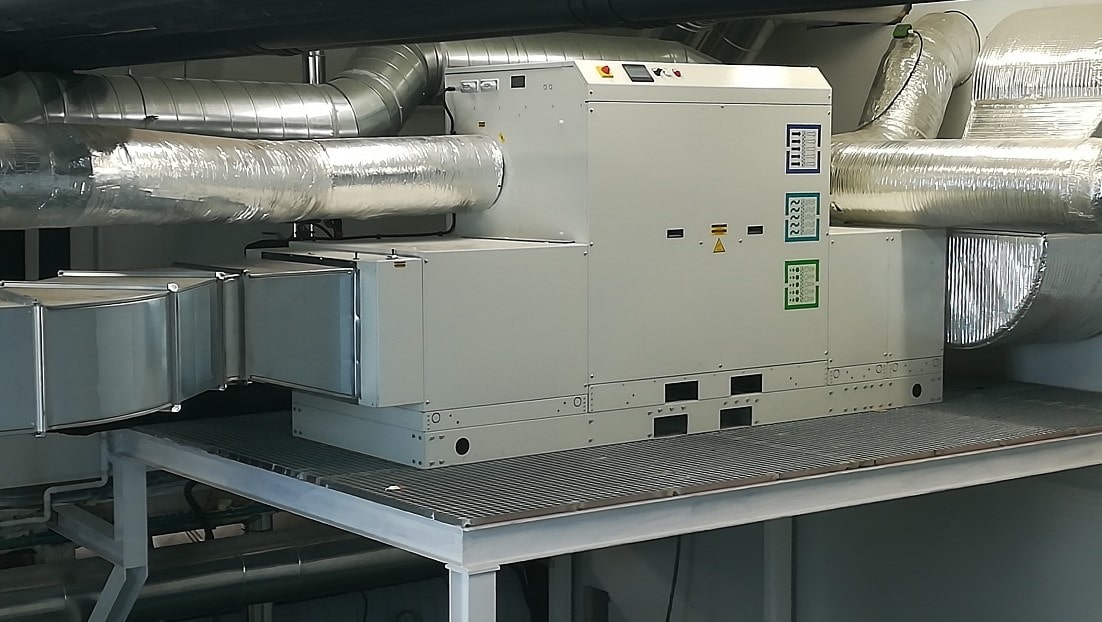
A lamination room equipped with TFT – İtalya industrial dehumidifiers ensures PVB film is processed in a dust-free and moisture-free environment.
Positive Pressure System
Maintaining air pressure inside the clean room +10 to +25 Pa higher than the external environment prevents humid and contaminated air from entering even during door openings. For this principle to work effectively:
- Room airtightness (including roof, wall penetrations, cable ducts) must be regularly verified with smoke tests
- Doors should have double sealants, with slow-closing mechanisms for sudden openings
- Personnel transitions should be made through airlocks (airlock/gowning room)
- Pressure differential must be continuously monitored, with alarms triggered when it drops below 8 Pa
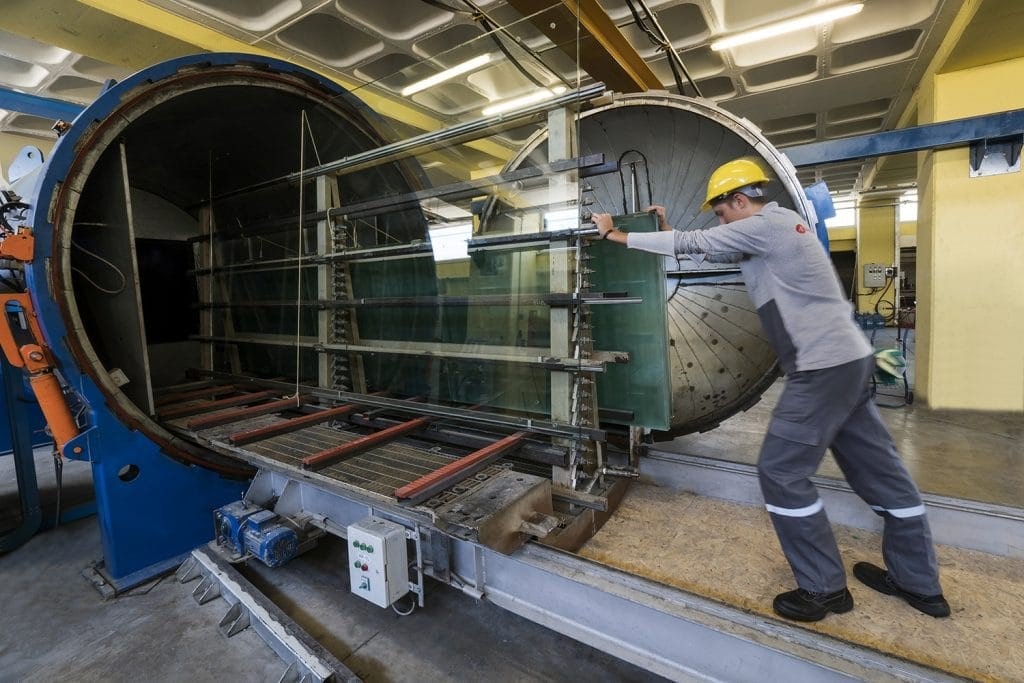
The positive pressure ventilation system prevents humid and contaminated outside air from infiltrating the lamination room, supporting the performance of TFT – İtalya dehumidifiers.
Equipment Selection: TFT – İtalya Dehumidifiers
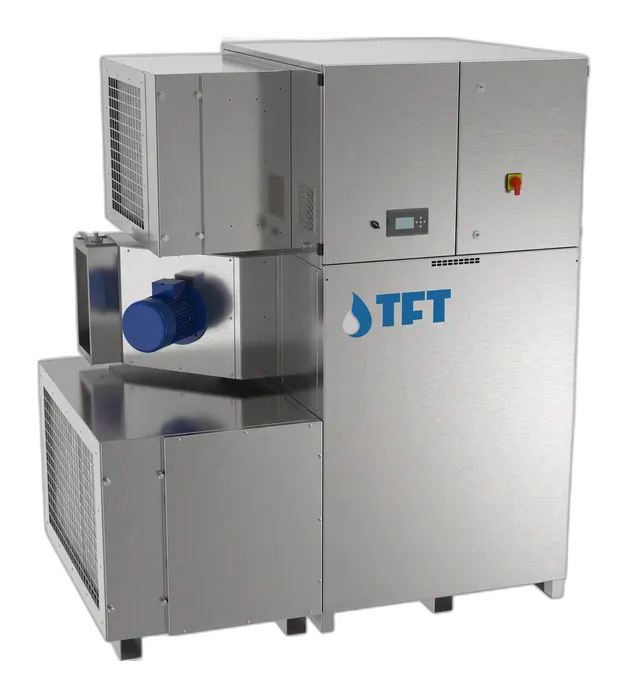
For PVB processing environments, silica gel rotor (desiccant) dehumidifier technology should be preferred. TFT – İtalya industrial dehumidifiers meet the low dew point requirement and can achieve very low humidity levels of 10–15% RH.
Technology Comparison
| Technology | Operating Principle | Min. RH | Energy | Recommended Use |
|---|---|---|---|---|
| Condensation Dehumidifier | Cooling below dew point | 35–40% | Medium | EVA line |
| Silica Gel Rotor (Desiccant) | Silica gel rotor adsorption | 10–15% | Medium-high | PVB line |
| Combined System | Condensation + rotor | 15–20% | Optimized | Preferred |
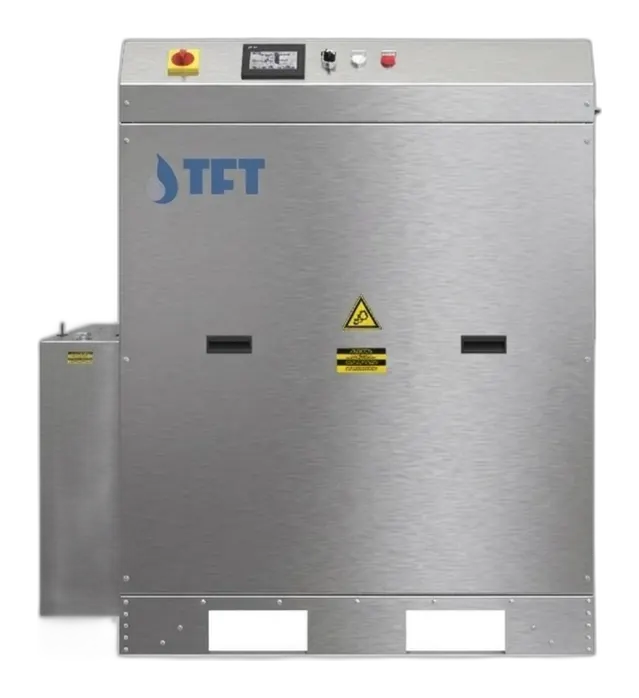
NKT – Nem Kontrol Teknolojileri recommends TFT – İtalya AD and ADP series industrial dehumidifiers for glass lamination facilities. These units are sized according to the lamination room volume and moisture load to provide the most efficient solution.
Capacity Calculation Principles
The capacity determination of TFT – İtalya dehumidifiers is calculated based on three moisture load components:
- Building infiltration load: Humid air leaking through walls, ceiling, floor, and door edges (depends on room size and insulation quality)
- Personnel load: Each active worker produces approximately 50–80 g of moisture per hour
- Fresh air load: Moisture carried by fresh air taken from outside
Equipment capacity is determined by adding a 20–30% safety margin to the total moisture load. Dehumidification systems of critical importance for production continuity should be designed with an N+1 redundancy principle: when one unit is under maintenance or has failed, the other unit must be able to handle the entire load.
Maintenance and Monitoring Protocols
Continuous Monitoring System
IoT-based continuous monitoring systems are critically important in modern laminated glass facilities:
- Humidity and temperature recording every 10 minutes (data logger)
- Alarm thresholds: critical alert for above 38% RH and below 18°C
- 30-day data archiving (for production quality records)
- Calibration: Sensors must be verified every 6 months with NIST/DKD traceable references
Periodic Maintenance Schedule
| Task | Frequency | Responsible |
|---|---|---|
| G4 pre-filter inspection/replacement | Monthly | Maintenance |
| F7 filter pressure differential measurement | Monthly | Maintenance |
| F9 filter pressure differential measurement | Monthly | Maintenance |
| Humidity sensor calibration | Every 6 months | Quality |
| TFT – İtalya rotor dehumidifier maintenance | Every 6 months | NKT service |
| Room airtightness (smoke test) | Annual | Quality/External audit |
| H13 HEPA replacement | Every 2–4 years | Specialist service |
Common Production Issues and Solutions
| Issue | Symptoms | Root Cause | Solution / Prevention |
|---|---|---|---|
| Delamination | Loss of transparency, visible separation | PVB moisture >0.5% | Moisture monitoring, control with TFT – İtalya dehumidifier |
| Bulging / Flowering | Regional swelling | Trapped air or moisture | Autoclave parameter revision |
| Haze (cloudiness) | Loss of optical clarity | Micro moisture entrapment | Target ambient humidity <20% |
| Edge yellowing | Yellow/brown band from edge | Long-term moisture diffusion | Edge sealant protection |
| Optical distortion | Light diffraction, reflection errors | Temperature non-uniformity | Autoclave profile verification |
| Inconsistent adhesion | Punch test variations | Humidity variation | Consistent clean room protocol |
Cost Analysis: ROI of Humidity Control
For a typical mid-sized laminated glass facility (daily production capacity of 500–1,000 m²), the humidity control system investment based on TFT – İtalya industrial dehumidifiers pays for itself in 18–30 months through annual scrap reduction and energy savings.
NKT – Nem Kontrol Teknolojileri offers TFT – İtalya silica gel rotor industrial dehumidifiers, HEPA-filtered air handling units, and IoT-based monitoring systems specifically designed for laminated glass facilities. By designing specialized climate-controlled cabinets and dry cabinets for SGP interlayer processing, we ensure production quality even in the most sensitive lamination applications.