Adiabatic humidification is the umbrella term for technologies that raise humidity by breaking water into liquid-phase micro-droplets or by passing air through a wetted surface. The process takes its name from a thermodynamic definition: no heat is exchanged with the surroundings, so the energy needed to evaporate the water is drawn from the air itself and the air cools. This makes adiabatic humidification the structural opposite of steam humidification, the steam system humidifies the air by adding heat, while the adiabatic system humidifies the air by cooling it. This article covers the definition of adiabatic humidification, the meaning of the word "adiabatic", the core difference from steam systems, the sub-technologies (high-pressure atomisation, evaporative cooler, evaporative humidifier), the free-cooling effect, the energy and hygiene profile, application matching, and the positioning of the SKH, SKV and SKVF families within the NKT Nem Kontrol Teknolojileri portfolio.
What Is Adiabatic Humidification?
Adiabatic humidification is the common name for technologies that raise humidity without adding heat to the air, either by atomising water into liquid-phase micro-droplets or by passing air over a wetted porous surface. The system does not deliver boiling steam to the air; it relies on the spontaneous evaporation of very small water droplets during their flight through the air. The energy required for evaporation (about 2,450 kJ/kg) is drawn from the air, so air temperature drops while relative and absolute humidity rise. The process is "adiabatic" in terms of heat transfer, no external heat is added to the system; energy is transferred from air to water in the form of water vapour.
By thermodynamic definition adiabatic humidification is an isenthalpic process: the total heat content of the air (enthalpy, h ≈ T + 2.45 × W) stays constant, only the split between sensible heat (temperature) and latent heat (humidity) changes. On a psychrometric chart this appears as a left-and-upward line along constant enthalpy, temperature falls, absolute humidity rises. In steam humidification the process is a straight vertical line: temperature stays the same (isothermal), absolute humidity increases.
| Dimension | Typical Range | Note |
|---|---|---|
| Single-line capacity | 20 – 2,000+ kg/h | For high-pressure atomisation |
| Electrical consumption | ~0.05 – 0.1 kWh/kg | Pump only; ~1/10 of steam |
| Air-temperature effect | -5 to -12 °C | ≈ -2.5 °C per 1 g/kg change |
| Droplet size | 3 – 50 µm | Varies by technology |
| Typical water-quality requirement | RO + UV | Controls mineral aerosol and microbial load |
| Control band | ±3% – ±5% RH | With proper sensor + modulation |
The Meaning of "Adiabatic"
The word "adiabatic" comes from the Greek a-diabatos, meaning "impassable". In thermodynamics a process is adiabatic if the system does not exchange heat with its surroundings. In the air-water-vapour mixture that defines humidification, this concept becomes concrete: the droplet absorbs heat from the air while it evaporates, but no extra heat is supplied to the air-droplet system. The latent heat of vaporisation needed for the phase change is taken only from the sensible heat of the air. Air cools, water evaporates, and total enthalpy stays constant.
An adiabatic process is the thermodynamic counterpart of the isothermal process of steam humidification. In isothermal humidification an external energy source (electricity or natural gas) is delivered to the water to produce steam; when the saturated steam is released into the air it gives up most of its latent heat to the space but does not change air temperature in practice. In adiabatic humidification all the latent heat is drawn from the air, so the process produces an evaporative-cooling effect.
Core Difference from Steam Humidification
Adiabatic and steam humidification deliver the same outcome (more humid air) along different thermodynamic paths. The two technologies are designed for different application profiles, not as substitutes. The most important distinction is where the enthalpy of the process comes from. The steam system produces enthalpy in the device and adds it to the air; the adiabatic system borrows enthalpy from the air and returns it as moisture.
Figure 1. Adiabatic Humidification Process Diagram: Droplet + Air + Evaporation + Cooling
Steam Humidification (Isothermal)
- Water is heated to 100 °C; saturated steam is generated.
- Air temperature is unchanged (isothermal).
- Absolute humidity rises; enthalpy rises.
- Electrical consumption: about 750 W/kg.
- Control band ±1-2% RH (tight).
- Typical: hospitals, pharma, museums, print, data centres.
Adiabatic Humidification (Isenthalpic)
- Water is atomised into liquid-phase micro-droplets.
- Air cools (5-12 °C); humidity rises.
- Enthalpy stays constant; temperature ↔ humidity conversion.
- Electrical consumption: about 50-100 W/kg.
- Control band ±3-5% RH (medium).
- Typical: textile, print, warehouse, greenhouse, woodworking.
Figure 2. Direction Difference on the Psychrometric Chart: Steam (Vertical) vs Adiabatic (Left-Up)
Adiabatic Technologies
Adiabatic humidification is not a single technology; it is the umbrella term for three families that move water into the air in different ways. Each technology works on the same thermodynamic principle (drawing heat from the air for evaporation), but mechanical architecture, droplet size, capacity range and typical application differ.
1. High-Pressure Atomisation (SKH)
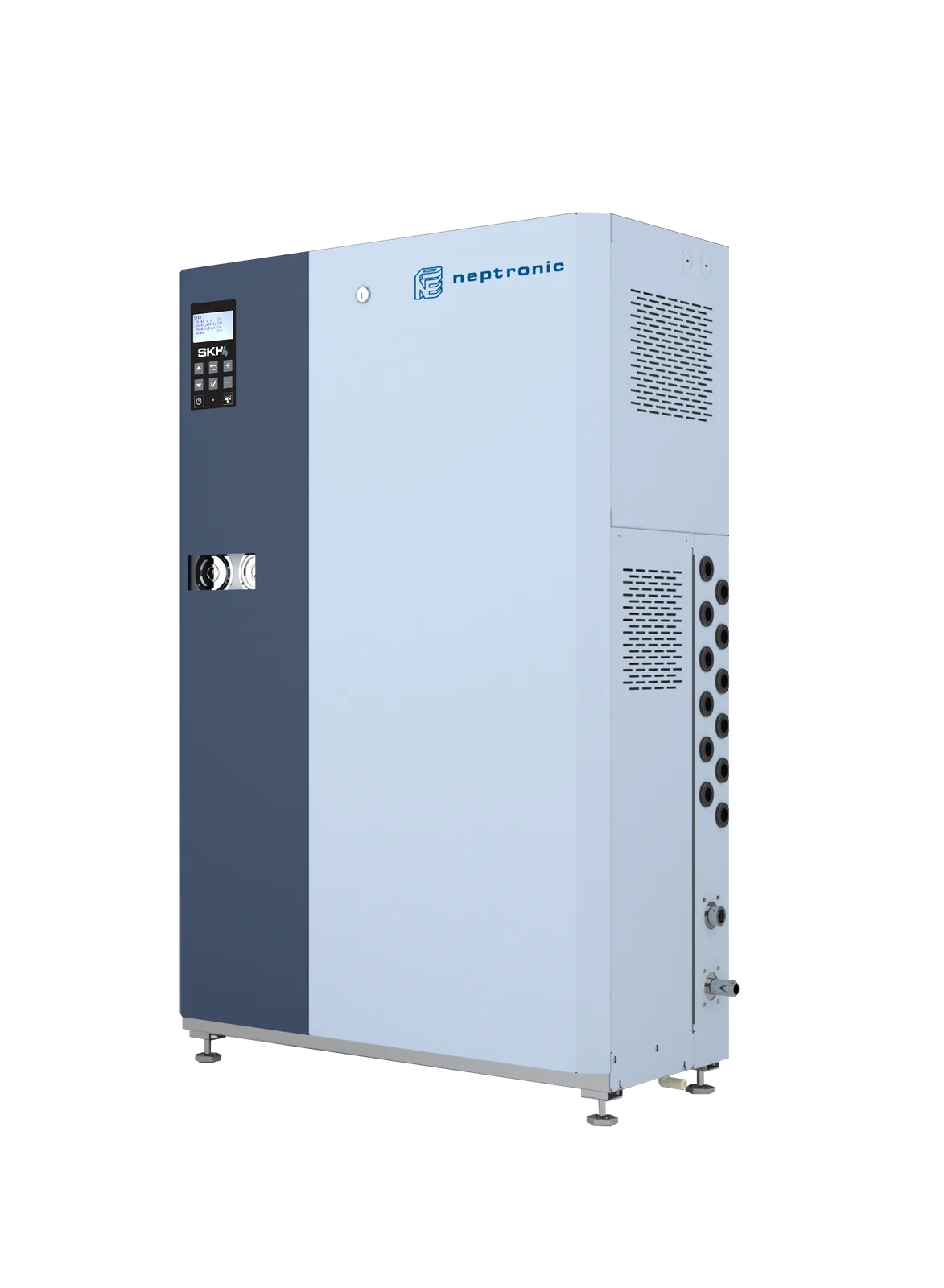
The most common industrial adiabatic technology. Water is delivered through dedicated stainless-steel nozzles by a 70-100 bar plunger pump and atomised into 5-10 µm micro-droplets. Because the droplet size is small, the surface-area-to-volume ratio is very high; the droplets evaporate fully in sub-second time. Typical single-line capacity sits in the 50-2,000 kg/h band. RO water and UV sterilisation are mandatory; scaling clogs nozzles within weeks otherwise.
2. Evaporative Humidifier / Evaporative Cooler (SKV / SKVF)
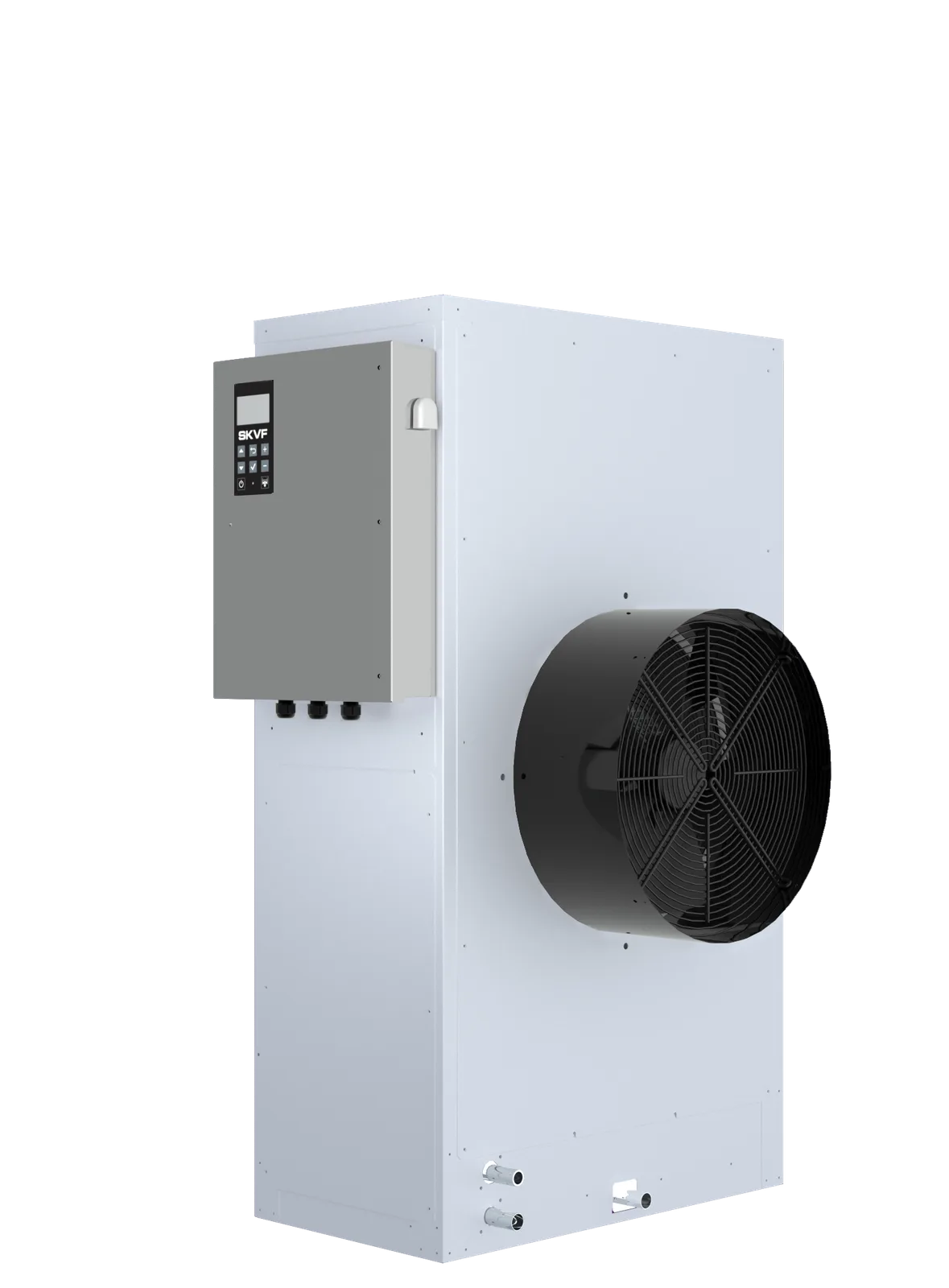
Air is passed through a wetted porous surface (wet media, usually cellulose or glass fibre). A water film on the surface contacts the airflow and evaporates. No droplets are produced; evaporation happens directly at the wet surface, so aerosol and microbial transport risk is far lower than in atomisation. The evaporative humidifier (SKV) is designed for AHU humidification; the evaporative cooler (SKVF) is a standalone unit that provides free cooling while adding humidity. ECM fan technology with variable speed control and a silver-ion antibacterial cartridge structurally protect hygienic operation.
3. Ultrasonic (Outside the Scope of This Article)
A technology that uses piezoelectric crystals to generate high-frequency (1.6-2.4 MHz) vibration and produces a 1-5 µm mist. Often preferred at small capacities (<50 kg/h); at industrial scale, high-pressure atomisation and evaporative systems are more common. For industrial scale the main adiabatic technologies in the NKT portfolio are SKH, SKV and SKVF.
| Technology | Droplet Size | Typical Capacity | Energy | Suggested Application |
|---|---|---|---|---|
| High-pressure atomisation (SKH) | 5 – 10 µm | 50 – 2,000 kg/h | ~0.05 kWh/kg | Textile, print, warehouse, greenhouse, livestock |
| Evaporative humidifier (SKV) | — | 20 – 1,000 kg/h | <1 kW + pump | AHU humidification + cooling |
| Evaporative cooler (SKVF) | — | Single module 5-40 kg/h | ECM fan + pump | Standalone area / room conditioning |
Cooling Effect
The most important side-effect of adiabatic humidification is the free cooling produced by evaporation. The latent heat of vaporisation of water is about 2,450 kJ/kg; this is roughly equivalent to 0.68 kWh/kg of cooling capacity. So if a system evaporates 200 kg of water per hour, it adds 200 × 0.68 ≈ 136 kW of free cooling to the space, comparable to a mid-size industrial chiller.
Free cooling is not an advantage year-round; in winter, in spaces where air is already cold, an adiabatic system can add a heating load. So adiabatic systems are normally positioned alongside a well-designed HVAC control strategy: humidification + cooling in summer, humidification ahead of a heating coil in winter (preheating the air before humidification).
Energy Advantages
Adiabatic humidification consumes structurally far less energy than steam humidification. A steam system spends about 750 W/kg to bring water to its boiling point; an adiabatic system only needs pump power (50-100 W/kg). The factor is 8-15× and over many years can drive the TCO (10-year total cost of ownership) calculation on its own.
| Parameter | Steam (resistive) | Adiabatic (atomisation) |
|---|---|---|
| Electrical consumption | ~750 W/kg | ~50-100 W/kg |
| Annual energy (150 kg/h × 8,000 h) | ~900,000 kWh | ~60,000 kWh |
| Annual energy cost (€0.12/kWh) | ~€108,000 | ~€7,200 |
| Free-cooling side-effect | None | ~100 kW (summer) |
| Chiller-load saving (annual) | — | ~€10-15,000 additional |
This energy advantage makes adiabatic the natural choice for high-capacity, year-round operation: textile weaving and spinning halls, paper and print plants, woodworking, greenhouses, livestock buildings and large warehouses. Payback typically reports at 6-18 months; with hard-water sites and added RO investment it can extend to 18-30 months.
Hygiene and Water Quality
Adiabatic humidification consumes less energy than steam, in return, hygiene management requires a structurally tighter design. Because water enters the air in liquid phase, the mineral content and microbial load can travel with it. Three core risks: mineral aerosol (limescale dust), bacterial contamination (Legionella), and nozzle clogging driven by water hardness.
Neptronic SKH and SKVF units come with silver-ion antibacterial cartridges; the SKV evaporative humidifier uses UL900 Class 1 certified inorganic and non-flammable media. In every adiabatic installation, the NKT project flow includes water analysis, RO sizing, UV sterilisation, tank circulation and a maintenance protocol as part of the standard package.
Applications
Adiabatic humidification leads in applications that need high capacity and have low-to-medium hygiene requirements. The sectors below are typical adiabatic-use profiles; in most of them, the energy and free-cooling advantage alone justifies the investment.
- Textile, weaving, spinning, knitting: 65-80% RH; static control, reduced yarn breakage, quality stability.
- Printing and packaging, offset, flexographic: 50-65% RH; paper dimensional stability, static control.
- Woodworking, furniture, parquet, musical instruments: 45-55% RH; wood moisture balance, crack prevention.
- Greenhouse and agriculture: 60-85% RH; plant growth, transpiration control, cooling.
- Livestock and poultry: 60-75% RH + free cooling; heat-stress reduction.
- Large warehouse and logistics: 40-60% RH; product protection + standalone area cooling (SKVF).
- IT-infrastructure outdoor units (limited): free-cooling support.
- Sports facilities, athletic halls (SKVF): standalone evaporative cooling.
Applications Requiring Caution
Adiabatic humidification is not appropriate for every application. Some sectors are sensitive to aerosol or mineral content; in these the steam system gives structural assurance.
Low-ceiling (<4 m) spaces also need design care; if droplets reach the floor before evaporating, wet floor and operator-safety risks appear. In these situations evaporative (SKV, SKVF) is preferred; because no droplets are produced, the ceiling-height constraint softens.
NKT Adiabatic Product Positioning
NKT Nem Kontrol Teknolojileri, as Neptronic's official distributor in the Turkish market, offers three core adiabatic technologies: SKH high-pressure atomisation, SKV evaporative humidifier and SKVF standalone evaporative cooler. In projects with higher hygiene and precision requirements, hybrid designs combining adiabatic units with steam solutions (SKD direct steam injection) are also common.
For AHU-integrated, wet-media-based evaporative humidification, Neptronic SKV is a modular solution custom-configured with Humidisoft software. Humidity is provided by water flowing over wet media while up to 12 °C of cooling is delivered at the same time; with under 1 kW of electrical consumption it is extremely efficient. It uses UL900 Class 1 certified inorganic and non-flammable media. On the steam side, the NKT Neptronic portfolio offers SKD direct steam injection for high-capacity, hygienic solutions in large duct cross-sections.
NKT Approach
NKT Nem Kontrol Teknolojileri applies a six-step standard engineering flow for adiabatic humidification projects: (1) site analysis (volume, air-change rate, T-RH profile, ceiling height), (2) humidification load calculation (kg/h), (3) technology matching (atomisation vs evaporative vs hybrid), (4) water-quality analysis + RO sizing + UV sterilisation, (5) control strategy (seasonal modulation, sensor location), (6) commissioning + performance validation. The complete flow is delivered under local engineering guarantee within the Neptronic technology partnership.
Adiabatic humidification raises humidity by atomising water into micro-droplets or by evaporating it from a wetted surface, without heat exchange with the surroundings (isenthalpic). It is the thermodynamic counterpart of steam humidification; the enthalpy comes not from the device but from the air. As a result the air cools and a free-cooling side-effect is produced. Energy consumption is about one-tenth of a steam system; that is why adiabatic is the natural choice for high-capacity, year-round, low-to-medium hygiene applications.
Correct technology selection starts with three questions: (1) What are the hygiene and control-band requirements of the application (steam for cGMP and hospitals)? (2) Are the room's ceiling height and airflow profile suitable for adiabatic? (3) Is the water quality acceptable and is RO investment capacity available? Combining these three questions with psychrometric calculation and a TCO analysis brings out the right technology. The NKT engineering approach makes equipment selection the last step, driven by engineering analysis.