Definition
A parameter expressing the combined calcium (Ca²⁺) and magnesium (Mg²⁺) ion concentration of water, reported in French degrees (Fr° or °fH) and ppm CaCO₃. 1 Fr° ≈ 10 mg/L CaCO₃ (calcium-carbonate equivalent). Water hardness directly determines the scaling rate and chamber-cleaning interval in steam humidifiers; in resistive systems, the tool-free cleanable stainless chamber preserves practical maintenance even without prior softening or RO.
Detailed Explanation
Water hardness is the sum of "temporary hardness" (calcium bicarbonate — precipitates as CaCO₃ on heating) and "permanent hardness" (calcium sulphate and chloride — does not precipitate on heating but still forms scale). Turkey's water profile varies geographically: Marmara networks typically 8–18 Fr° (medium-hard), Central Anatolia spring water 20–35 Fr° (hard / very hard), Aegean and Mediterranean coastal areas 12–22 Fr°. For steam humidifier feedwater, "soft" is below 7 Fr° and "very hard" above 30 Fr°.
Conversions: 1 Fr° = 10 mg/L CaCO₃ = 10 ppm. The German scale: 1°dH = 1.78 Fr°; the English: 1°eH = 1.43 Fr°. Hardness alone is not sufficient — it must be evaluated together with conductivity, alkalinity and chloride; but in steam humidification it is the dominant determinant of scaling rate.
Why It Matters
When water is heated to 100°C in a steam humidifier, the solubility of calcium bicarbonate falls and CaCO₃ precipitates onto the chamber surface. The reaction is inevitable — by chemical equilibrium, "hard water + heat = scale." The design question is not how to prevent scale but how to manage it.
In an electrode humidifier the scale coats the electrodes of the disposable plastic cylinder; conductivity is lost and the cylinder is discarded and replaced. In hard water (>20 Fr°), cylinder life drops to 3–6 months. In a resistive humidifier the scale collects on the floor of the stainless-steel chamber and is removed manually through a tool-free hatch; the chamber lasts for years and produces no plastic waste. Above 25 Fr° even a resistive system may need chamber cleaning twice a year instead of once, but this is a far simpler and cheaper operation than a cylinder change.
Practical Example
A printing facility in Konya: mains hardness 28 Fr° (very hard), conductivity 1,080 μS/cm. The legacy electrode system needed cylinder replacements every 4 months — 9 cylinders/year × 4 units = 36 cylinders × €320 = €11,520 annual cylinder spend. Plastic waste added a sustainability concern.
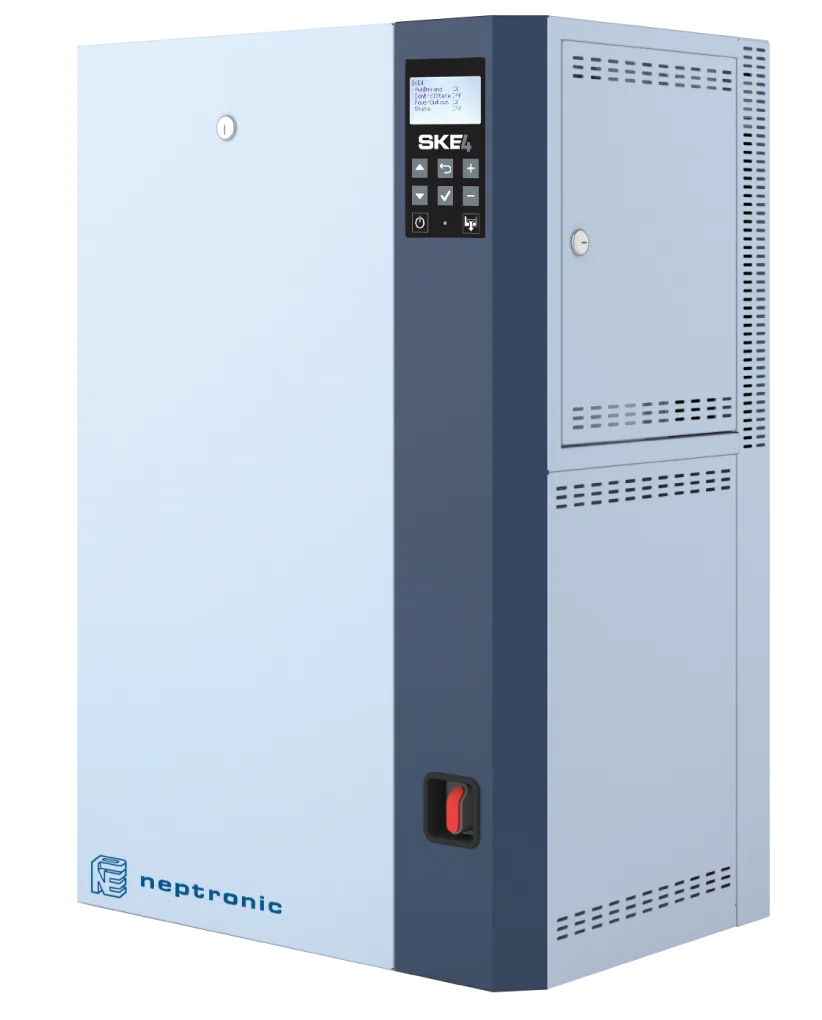
After switching to Neptronic SKE4 resistive units: the stainless chamber is cleaned twice a year tool-free (≈ 30 minutes of technician labour per cleaning), and cylinder spend is zero. The 5-year TCO comparison shows €47,000 in savings versus the electrode baseline. NKT proposals deliver this calculation up-front, parameterised on hardness and conductivity inputs.
Engineering Note
Hardness can be reduced with a water softener (ion exchanger): Ca²⁺/Mg²⁺ ions are exchanged for Na⁺ on the resin. But this does not change conductivity (sodium ions carry the same conductivity) — softened water still scales an electrode unit (as sodium carbonate) and remains within the conductivity window. A softener extends the cleaning interval of a resistive system from yearly to 2–3 years, but does not save an electrode unit.
The real solution is RO or DI — but those waters do not run an electrode unit (conductivity is near zero). This structural asymmetry leads to the conclusion: "electrode is not selectable for soft/pure-water sites, while resistive is the safest call for sites with hard or medium water." NKT applies this logic as a default decision template.
NKT Application Link
In NKT projects, where hardness exceeds 15 Fr° resistive selection (Neptronic SKE4) is preferred; above 25 Fr° an RO or softener integration is proposed in parallel. At sites below 7 Fr° an electrode unit is structurally disqualified — resistive is the only option. Where a tight RH band (±2% or less) is required, SKE4 is recommended regardless of hardness, because atomisation and electrode units cannot meet the control band.
Related Academy Articles
Related Products
NKT products related to this term