In vertical farming and hydroponic facilities, the control of environmental parameters such as temperature and humidity is a subject that deserves attention as much as cultivation techniques in terms of product quality and yield. Compared to conventional agriculture, production in closed and controlled environments makes it possible to achieve consistent and high yields independent of variable climate conditions throughout the year. However, providing the desired internal climate conditions requires comprehensive planning based on engineering disciplines and proper equipment selection. A correctly designed climate control system aims to create sustainable climate conditions for plants 365 days a year by maintaining parameters such as temperature, humidity, airflow, and CO₂ levels within optimal ranges. Indeed, the most important component in vertical farming facilities is the HVAC (cooling, ventilation, humidity control) system. This system is integrated into the plant cultivation facility by filtering and conditioning the air entering and leaving the environment to create an optimal atmosphere for crops. In vertical or soilless farming operations, the design of the HVAC system to be suitable and of sufficient capacity for the cultivation area will directly affect the success of cultivation, product productivity, and operational costs.
This article examines the fundamental elements of climate control in vertical farming and hydroponics environments and the details of engineering approaches.
The Importance of Humidity Control in Vertical Farming and Hydroponic Systems
In vertical farming applications, also known as Controlled Environment Agriculture (CEA), fixing the environmental conditions surrounding plants to desired values is the key to success. In a closed production area, when growing plants intensively in multi-layer shelving systems, precise control of factors such as temperature, humidity, and air quality is essential for rapid and healthy plant growth. Through climate control, producers can create "optimal growth" conditions with appropriate equipment in a container or room and obtain continuous production throughout the year. Thanks to stacked production and short growing cycles, the yield per unit of floor area can be far higher than in open-field farming; lettuce, for example, which is seasonal outdoors, can be harvested year-round in cycles of a few weeks on a well-controlled vertical farm. Today, with the increasing urban population and the reduction of farmland due to urbanization, rapid production and space conservation have become prominent factors. However, in a closed environment where thousands of living organisms that breathe and consume water exist, providing the desired climate conditions brings with it an extremely complex series of engineering problems. As plants grow, they release heat (from lighting and metabolic processes) and water vapor into the environment; the abundant presence of plants in a small volume strains the climate balance and consequently the climate control equipment (air handling unit and dehumidification unit). For this reason, understanding and accounting for the plant's effect on climate in the vertical farm facility design prevents irreversible mistakes later. Today, with industry experience, it is possible to design with correct capacity equipment by maintaining lower volumes in each shelf layer and anticipating plant-derived loads. Controlled environment also minimizes the risks of pests and diseases. For all these reasons, a successful vertical farming operation must develop a comprehensive climate control and environmental control strategy already in the planning phase. Indeed, correct climate and humidity control forms the basis of vertical farming's potential for year-round production and its high yield advantage.

The Use of Dehumidifiers: Technical Specifications and System Integration
In vertical farming processes, dense plant populations and large leaf surface areas continuously add water vapor to the environmental air. Plants take water through their roots and release a certain portion of it through their leaves via transpiration into the environment. For this reason, managing the humidity load in closed cultivation environments becomes a necessity that must be controlled. Dehumidification units (dehumidifiers) are equipment designed to remove excess humidity from the environmental air and help maintain the desired relative humidity range of the control volume. Especially during night cycles when lights are off, temperature drops and fresh air supply can be made to achieve proper gas concentration. In this case, relative humidity rises rapidly and if effective humidity control is not performed, condensation, mold, and disease problems can occur in plants and the structure.
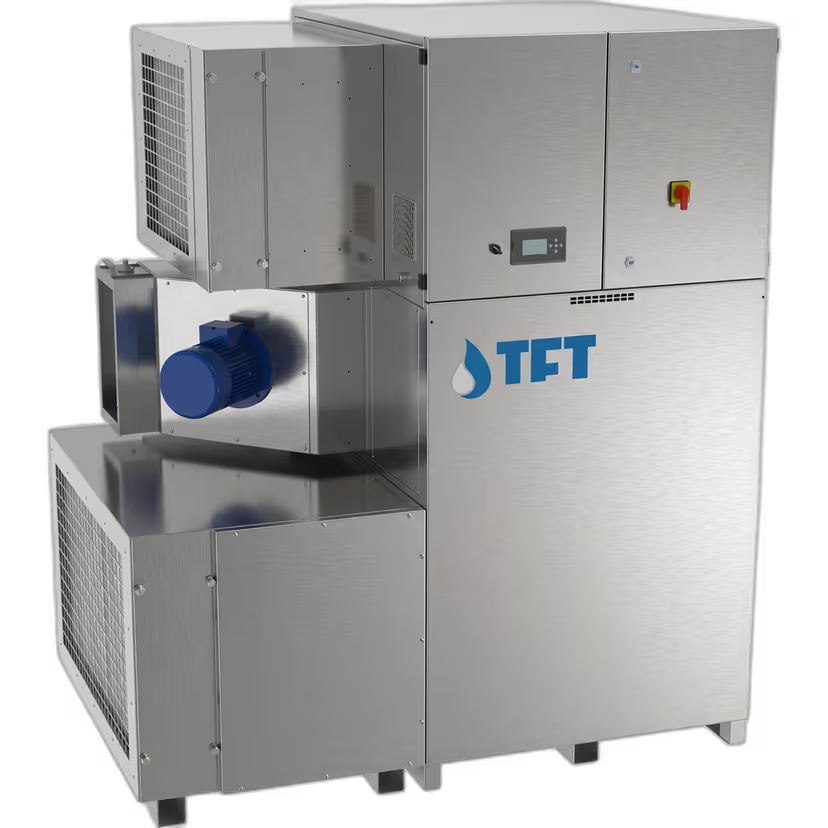
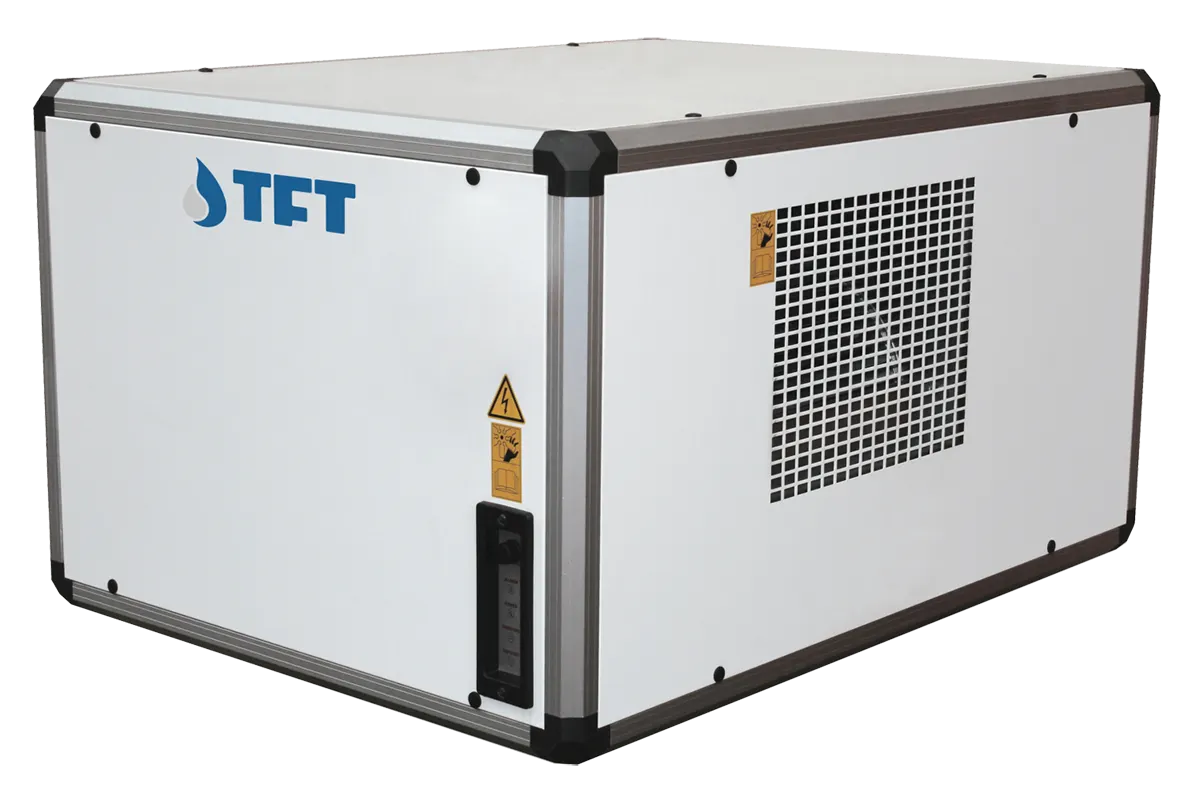
TFT - Tecnofrigo Tuscany S.r.l. is an Italian manufacturer producing both condensing and adsorption-type industrial dehumidification units and stands out with its high performance in humidity control of vertical farming facilities. Under typical grow-room conditions (22–26 °C, 60–75% RH) the dew point lies in the +14…+21 °C range, which is where condensing dehumidifiers work most efficiently. Base dehumidification in vertical farming is therefore done with condensing units such as TFT's CD and CDNP series, or with the air handling unit's cooling coil. Ducted condensing units can act as part of the HVAC system and remove moisture homogeneously between shelves through duct connections. TFT's AD/ADP silica gel rotor dehumidifiers are preferred for special cases such as low-temperature areas, or drying and seed storage rooms with very low humidity targets. Because the process air leaves a desiccant unit warmer, this heat must be added to the cooling capacity calculation. For automation system integration of the dehumidifier, relative humidity sensors and Modbus - TCP/IP connections are generally used. Data from relative humidity sensors placed at different points in the environment are transmitted to the central climate control panel via Modbus. The dehumidifiers then work automatically according to the target values determined here, stop, or enter gradual capacity control mode. In advanced systems, algorithms that can perform humidity control integrated into VPD (Vapor Pressure Deficit) calculations are used (for example: when air temperature rises, the target humidity ratio is also dynamically adjusted, thus keeping the VPD constant). Correctly selected and system-integrated dehumidifiers ensure the sustainability of the desired microclimate in vertical farming systems. They support maintaining ideal relative humidity ranges for both plant health and protection of facility structure (corrosion, mold, etc.).
Airflow and Internal Temperature: Ideal Values, Measurement Methods and Effects
In a vertical farming system, airflow circulation and humidity-temperature control are parameters that must be managed together for all plants to grow and remain healthy under homogeneous conditions. The typical target temperature in an indoor farming, vertical farming cultivation cell is usually in the 22-25°C range for most plants. For example, most leafy vegetables and herbs show good development around 22-24°C, while fruiting plants such as tomatoes and peppers may prefer 24-26°C levels. Dry bulb temperature directly affects plant metabolism. Very low temperature slows growth, while very high temperature causes heat stress and respiration losses. For this reason, the basic task of the climate control system is to carry away the heat generated by LED lights during daytime cycles, and maintain ideal values at night without over-cooling the environment, thus providing thermal stability. For most plants, night temperature is desired to be somewhat lower than daytime (for example, 4°C-6°C), but in vertical farming, some producers may target continuous growth by keeping night/daytime temperature constant. It is important for the system designer to determine an appropriate daily temperature profile according to the type being cultivated and program the HVAC control accordingly.
At this point, the relationship between relative humidity (RH) and temperature should never be overlooked. As temperature increases, the RH (relative humidity) value of air with the same absolute humidity amount decreases. As temperature decreases, the opposite occurs and RH (relative humidity) increases. For this reason, an environment with 60% RH at high daytime temperature can rise to 80% when cooled at night with the same absolute humidity. What matters for the plant is the difference between the saturated vapor pressure inside the leaf and the vapor pressure of the air. The concept called VPD (Vapor Pressure Deficit) explains the effect of the temperature-humidity balance on the plant. However, what is important here is the contribution of airflow to this balance. Good air circulation provided by dehumidifiers and climate control equipment helps equalize temperature and humidity across all areas and shelf layers. In vertically stacked shelves, heat rises through natural convection, lower shelves remain cool while upper shelves tend to heat up. Strategic airflow designs are needed to prevent this unwanted "chimney effect." For example, by using vertical air channels between shelves or internal circulation fans, air can be transported from lower to upper layers. Furthermore, horizontal airflow at each shelf level should disperse the stagnant air layer around the leaves. In closed control volumes like vertical farming applications, proper air production and proper distribution of this air are two inseparable important issues.
Although ideal airflow velocity varies depending on plant type and light intensity, generally a leaf-level air velocity of 0.3–0.5 m/s is required. This velocity sweeps away the humid air layer accumulating on the leaf surface, keeping transpiration continuous, and allows fresh CO₂-rich air to reach the leaf, supporting photosynthesis. In practice, while experts mostly recommend airflow around 0.5 m/s for greenhouses and closed areas, products grown under intense light (high PPFD) may require higher air velocities. The balance here is quite important. An airflow should be aimed at where leaves flutter slightly, but do not wilt in excessive wind, do not create wind burn, or do not cause local burns due to heat load created by LED lamps from low wind. For this reason, optimal airflow velocity for each plant should be experienced in appropriate ranges at minimal scales. For leafy vegetables such as lettuce, around 0.5 m/s is a good starting value.

Source: Zhang, Y., Kacira, M., & An, L. (2016). A CFD study on improving air flow uniformity in indoor plant factory system. Biosystems Engineering, 147, 193–205.
Measuring and monitoring airflow is often a neglected point. Although temperature, humidity, and CO₂ data are continuously visible on climate control panels, the same system may not have a sensor showing airflow velocity. For this reason, it is beneficial for producers to periodically measure air velocity at different points in the environment. Anemometers (wind speed meters) can be used for this work. Hot-wire anemometers are preferred because they can make more accurate measurements in low-speed ranges. If velocity remains low in certain areas, additional circulation fans are installed to ensure there are no "dead air pockets." These measurements also reveal performance loss in fans over time due to dirt accumulation or wear, providing a data set that timely informs users of maintenance needs.
Measurement of internal temperature and humidity is usually done easily with digital sensors and hygrostats. What should be noted here is the correct positioning of sensors. A temperature and humidity measurement value at a single point may not reflect the value of the entire area. For this reason, in large vertical farming rooms, control using the average of temperature and humidity sensor data from multiple points yields better results. Furthermore, in some advanced systems, leaf temperature sensors (using infrared thermometer or thermal camera) are used to monitor the actual temperature felt by the plant. Leaf temperature is generally close to air temperature, but leaves under light are slightly warmer, while leaves undergoing transpiration with evaporation may be slightly cooler due to heat withdrawal. Knowing leaf temperature is also a useful parametric value that can be used for accurate VPD calculation.

Source: Zhang, Y., Kacira, M., & An, L. (2016). A CFD study on improving air flow uniformity in indoor plant factory system. Biosystems Engineering, 147, 193–205.
The effects of airflow on plants are multifaceted. Thanks to homogeneous distribution, all plants receive equal CO₂ and development heterogeneity resulting from temperature and humidity differences is reduced. Additionally, air kept in continuous motion by the climate control system using a dehumidifier, directed by the system, prevents water droplet accumulation on leaf surfaces, preventing fungal infections. Especially in densely leafed plants, stagnant and humid air can create a film on leaf surfaces, inviting disease. On the other hand, if airflow is insufficient, hot and humid pockets can form in the middle sections of shelves; in these areas, plants may exhibit wilting, yellowing, or rot problems. At the same time, poor air circulation limits the amount of CO₂ per plant, restricting photosynthesis.
Climate control software should manage average conditions based on measurements from different points and alert the operator with alarm limits if necessary. With regular maintenance and monitoring, temperature and humidity control is maintained at optimal performance, establishing a balanced microclimate for plants.
VPD (Vapor Pressure Deficit): Calculation, Plant Physiology and Transpiration
One of the most discussed concepts in recent years in climate control of vertical farming environments is VPD (Vapor Pressure Deficit). VPD is a quantity, expressed in kPa, that describes how far the air is from saturation with water vapor. The VPD concept, which is a measure of how unsaturated the air is with water vapor, is the difference between the saturated vapor pressure at the leaf surface and the actual vapor pressure in the environmental air. From a plant physiology perspective, VPD represents the driving force necessary for the plant to extract water from its leaves (to evaporate via transpiration). Although transpiration rate is also dependent on stomatal conductance coefficient, it is largely determined by VPD. The higher the VPD, the faster the plant loses water (transpires), and the lower the VPD, the slower transpiration on the plant's leaves due to high partial vapor pressure over the leaves.
To calculate VPD, first the saturation vapor pressure (SVp - Saturation Vapor Pressure) dependent on air temperature is calculated. This value increases exponentially as temperature increases (for example, ≈ 2.33 kPa at 20 °C and ≈ 4.24 kPa at 30 °C). When the environment's relative humidity (RH) is known, the current vapor pressure is found using the formula Vp = SVp * (RH/100). We mentioned that leaf surface temperature may differ from air temperature. In precise calculations, saturation pressure is obtained using leaf temperature. Finally, VPD = SVp(at leaf temperature) – Vp(air) is obtained (in kiloPascals). For example, if the air is 25°C and 60% RH, then SVp(air) ≈ 3.17 kPa, Vp(air) ≈ 1.90 kPa, and VPD ≈ 1.27 kPa is found. This value shows that the plant is trying to remove water, in other words transpire, with an approximate atmospheric partial vapor pressure difference of 1.27 kPa. If the leaf is 2 °C cooler than the air, the VPD seen by the leaf in the same room is ≈ 0.91 kPa.

In controlled environment agriculture, VPD is generally kept within 0.8–1.2 kPa. This range varies with species and growth stage; lower values are preferred for seedlings and young transplants. The 25 °C / 60% example above (1.27 kPa) sits just above this range; raising RH to 65–70% at the same temperature brings VPD down to 1.1–0.95 kPa.
To fully understand the effects of VPD on plant physiology, it is necessary to recall the transpiration mechanism and its corresponding effects. Plants take water through their roots, transport it to their leaves, and release excess water as vapor through stomata on the undersides of leaves. This process simultaneously transports water and nutrients to plant tissues while cooling the plant through evaporation from the leaf surface (just as sweating cools humans). VPD is the driving force of this process. Since the water vapor pressure inside the leaf is always saturated (high), if the vapor pressure of the air outside the leaf is lower (that is, if VPD is positive), water vapor exits through stomata at a rate according to stomatal conductance. The larger the VPD, the faster transpiration occurs. In this way, the plant can actively pull water from its roots to its leaves during photosynthesis. The pull created by transpiration carries nutrient ions to the leaves together with the xylem water flow. However, if VPD is excessively high (air is too dry), the plant must close its stomata to prevent water loss, which both slows photosynthesis and weakens the plant's cooling mechanism. Conversely, if VPD is very low (air is very humid), water vapor inside the plant cannot escape, and transpiration comes to a halt. In this case, the plant cannot absorb sufficient water and nutrients, and leaf temperature rises.
The optimal VPD condition achieved through dehumidifiers is the ideal point where plants maintain cooling, water, and nutrient transport balance. Climate control systems are now developing to perform VPD-targeted control rather than controlling temperature and RH separately. For example, an intelligent automation system integrated with a dehumidifier gives the user the ability to directly "maintain VPD around 0.8 kPa" and automatically coordinates necessary adjustments (heating/cooling or dehumidification/humidification/fresh air intake). In this way, by keeping the vapor pressure difference that the plant actually needs constant, a more stable growth environment is provided. Especially in advanced facilities, it is possible to perform real-time VPD monitoring with leaf temperature sensors and sustainably optimize climate control. For practical VPD calculation, tables or online calculators are usually used. By downloading the "NKT Pro" application from the App Store or Google Play, you can easily calculate psychrometric values from temperature and relative humidity on your mobile phone.
Furthermore, VPD tables prepared for producers provide VPD values for different temperature and humidity combinations.

Transpiration
There is an organic relationship between transpiration and VPD. Transpiration can be thought of as the plant's "sweating," and VPD as the "dryness" provided by the dehumidifier. High VPD (dry air) → rapid transpiration, low VPD (humid air) → slow transpiration. Since transpiration rate is closely related to nutrient uptake, VPD indirectly also affects the plant's nutrition. In dehumidifier integrations, the VPD difference, transpiration rate, stomatal conductance coefficient, and total leaf surface area depending on the number of plants are referenced. Additionally, the fresh air requirement in the environment and the stable humidity load coming into the space through this fresh air line, along with the amount of moisture that needs to be removed from the air mass within the closed control volume through plant transpiration, must definitely be included in the humidity load calculation transferred to the environment.
Monitoring VPD in vertical farming environments is also useful for early detection of problems. For example, if VPD remains outside the target for a long time, the system can alert before stress symptoms appear in plants. In vertical farming VPD follows the lighting schedule rather than the sun: it rises when the lights come on, stays around the target during the light period, and falls as relative humidity rises when the lights go off and the temperature drops. If it drops very low during the night and nearly reaches zero (air becomes completely saturated), it is understood that the night humidity control strategy and thus the dehumidifier are insufficient. Thus, operational improvements can be made.

Problems Observed in Non-Transpiring Plants: Burn Formation and Growth Retardation
The situation where plants cannot transpire, that is, cannot release sufficient water vapor, is generally seen in environments where environmental humidity is excessively high or in other stress conditions that lead to stomatal closure. In vertical farming, this situation most often occurs in scenarios where RH (relative humidity) is very high and VPD remains very low. In such an environment the vapor pressure difference between leaf and air becomes very small and the leaf can hardly release water vapor, becoming "unable to transpire." As a result, a series of problems appear in plants:
Nutrient Transport Disruption and Burns
When transpiration decreases, the plant cannot draw water from its roots, and therefore nutrient elements such as calcium transported with water cannot reach the ends. Calcium deficiency occurs especially in rapidly growing tissues, and this creates necrotic lesions and burns on leaf edges or tips. Tip burn commonly seen in greens like lettuce is a typical example. If plants are grown under high-speed growth conditions (high light, abundant CO₂) but with low transpiration, sufficient calcium does not reach young leaf tips and burn spots form. Tip burns are not just a cosmetic problem but also reduce the product's market sales value and can halt growth if it progresses. Blossom end rot in tomatoes is likewise linked to insufficient calcium transport to the fruit; both persistently very high humidity and water stress can disturb this balance. That is, if the air is excessively humid, the plant cannot distribute necessary minerals and local burns and tissue deaths appear in tissues. Industrial dehumidifiers used in the environment maintain the VPD ratio at optimal levels, preventing problems likely to occur on leaves.
Prolonged Low VPD and Growth Retardation
If air humidity stays very high, transpiration, and with it the flow of water and nutrients from roots to leaves, slows markedly. At night, root pressure can push water droplets out at leaf margins (guttation). Slower nutrient transport can hold back new leaves and shoots, and because transpirational cooling is reduced, leaf temperature rises during the light period. The result of prolonged low VPD is growth retardation and yield loss.
Disease and Mold Risk
Plants that cannot transpire are generally coated with water films on leaf surfaces. Since the air is saturated, even vapor from leaves can condense and form a film layer. These wet surfaces are perfect breeding grounds for fungal and bacterial diseases. For example, fungi such as Botrytis cinerea (gray mold) and Alternaria develop rapidly under high humidity and rot leaves. In a vertical farming (hydroponic) system remaining at 95-100% RH overnight, seeing water droplets and mold spores on leaves in the morning is common. Relative humidity staying above 85–90% for long periods, together with leaf wetness, markedly increases this risk. Leaf lesions and rots both reduce the plant's photosynthesizing area and create dead tissue points, lowering yield.

In addition to vertical farming applications not using dehumidifiers and exposed to very low VPD (high humidity) conditions, there are also problems occurring in high VPD (low humidity) conditions. An oversized dehumidification system with on/off control can overshoot the target and drive VPD too high; modulating capacity control reduces this risk. In this case, plants transpire excessively and eventually cannot keep up with water supply. Stomata close, photosynthesis stops. Drying and burns appear on leaf edges.
If flowers or leaves experience high VPD shock, roasted-looking brown edges can form. Plant growth again stops until it recovers from this shock. If the environment is suddenly over-dried by the dehumidifier (for example, the dehumidifier works excessively or temperature suddenly rises but humidity does not increase correspondingly), plants cannot adapt to this sudden stress and undergo physiological shock. It is important that the dry air provided by the dehumidifier does not cause fluctuations in internal conditions and creates a stable humidity area. If the swing amplitude stays consistently wide, it can cause growth stoppages lasting for days. Another risk of high VPD is the risk of water column breakage (cavitation) in the plant's transport tissues, but in practice this rarely occurs in controlled environments because internal environment sensors never allow such dry air values to be reached.
Therefore, both very high and very low VPD are undesirable. Humidity control must definitely be performed to stay within the ideal VPD range. The basic strategies are not to drop VPD too much during the day under strong light (if humidification systems are used, proceed in balance) or not to bring VPD close to zero at night when cooled (configure dehumidifiers to operate under optimal conditions). For example, doing humidity control with an 80% RH target during night cycle can prevent rise to 100% and prevent leaf wetting. If plant transpiration problems are still observed, airflow can be increased to remove the humid layer on leaf surfaces. Indeed, strong air movement breaks the microclimate around plants, promoting transpiration and returning the balance to a stable level.
Effect of Day-Night Cycle on Dehumidifier Design
In vertical farming, plants are generally grown under a specific photoperiod (light-dark cycle) with artificial lighting. For example, while a 16-hour light/8-hour dark cycle is used for many leafy products, a 12-hour light/12-hour dark cycle (short day triggering) is applied for some flowering types. This night-day cycle regulates plants' physiological processes (photosynthesis, respiration, growth hormones, etc.) and significantly affects the climate dynamics of the cultivation environment. With night and day cycles, heat load, humidity generation, and gas exchange parameters acquire a cyclical character. The effects of this cycle must definitely be considered in dehumidifier system design and automation.
During the daytime (light on) period, plants perform intensive photosynthesis, consuming CO₂ and producing O₂. At the same time, artificial light sources (LED or HPS lamps) add heat to the environment. For this reason, there is both a temperature increase and a humidity increase in closed farming environments during the day (light opens the stomata and warms the leaves, so transpiration rises markedly). During this period, the climate control system's cooling capacity and dehumidification function can operate at full load. The cooling system must remove the heat coming from lights, while the dehumidifier must discharge the humidity produced by transpiration from the environment. For example, during midday hours when strong lights are on, the chiller attached to the cooling unit or the gas external unit runs the compressor at full capacity to maintain temperature at target value, while cooling the air in the internal unit (evaporator), it discharges the condensing water, assisting the dehumidifier. If the cooling system miscalculates these plant and light-source-derived loads, daytime temperature can rise above the target value or humidity can climb to 80-90%. For this reason, calculations are made for the hottest and most intense lighting scenario (for example, mid-summer, all layers full, and lights on) during the design phase, and cooling equipment is selected accordingly.
When the night (light off) period comes, the picture reverses. When lights turn off, heat input to the environment suddenly stops, and the environment even begins to cool (because the external environment is generally cooler and the structure may lose heat). Plants stop photosynthesis, this time producing CO₂ and consuming O₂ through respiration. Most importantly, transpiration rate generally decreases but does not stop completely. Plants release some water even in the dark (especially if the environment is still warm, transpiration continues for a while). As the temperature drops, the absolute humidity of the air does not fall by itself; because the amount of moisture the air can hold decreases, relative humidity rises rapidly, and plants continue to release moisture for a while, potentially bringing RH close to 100%. Water droplets (guttation fluid or condensation) can even form in places on leaves. The night period is the highest risk time for disease because stagnant and humid air is ideal for fungi. This is why controlling humidity throughout the night and preventing temperature from dropping too much are considered. The automation system can operate dehumidifiers with a "night mode" activated immediately after lights turn off, using a separate night RH setpoint (e.g. 80%) that keeps leaf surfaces above the dew point.
The effect of night-day change is not only in the temperature-humidity plane. It also has important effects on CO₂ and O₂ balance. During the dark period, plants will start producing CO₂, so CO₂ levels can rise at the end of the night in a closed system. In facilities with CO₂ enrichment, CO₂ must be monitored continuously and alarm limits defined for staff safety. For this reason, in many systems, automatic exhaust fans activate at night, refreshing the air, removing excess CO₂, and renewing O₂ levels. During the day, the opposite situation occurs. Because plants will rapidly consume CO₂, fresh air intake or CO₂ feeding is performed. All these processes, damper movements, and data from sensors must be synchronized through automation for night-day cycles.
Carbon Dioxide Level Management
Carbon dioxide (CO₂), which plants need for photosynthesis, is another important parameter managed in controlled farming to increase productivity. In open air, CO₂ levels are approximately 420 ppm (≈ 0.04%). In a closed vertical farm, plants can rapidly consume this CO₂, reducing levels. If CO₂ concentration falls below 300 ppm, photosynthesis rate slows noticeably, and plants virtually "run out of breath." For this reason, in closed systems, it is necessary to monitor CO₂ levels and actively perform CO₂ feeding (injection) if necessary. When properly managed, raising ambient CO₂ levels is a factor that significantly accelerates plant growth. However, CO₂ increase provides benefits as long as light, temperature, and VPD levels are sufficient. That is, other factors must also be optimal.
Engineering Calculations in System Design: Humidity, Airflow Rate, Equipment Capacities
For successful operation of vertical farming and controlled environment agriculture systems, all environmental control elements must be correctly sized and based on calculations.
The humidity load that will occur in the environment is largely related to plant transpiration. The most straightforward way to calculate it is the amount of water the plants take up. Plants transpire roughly 95% of the water they absorb through their roots. For example, if the plants take up 100 litres of water per day, the moisture load is about 95 L/day. Spread over 24 hours this is ≈ 4 kg/h on average; since most transpiration happens during the 16-hour light period, the daytime peak rises to ≈ 5 kg/h (latent load ≈ 3.4 kW). In recirculating systems, use the water added to the tank (what the plants actually take up), not the irrigation flow. Moisture brought in by fresh air and a 15–25% safety margin are added separately. In maximum conditions, for plants with large leaf areas, calculations are made using the plant's stomatal conductance coefficient, number of plants, and average leaf surface area per unit plant. In capacity calculations, not only total capacity but also time distribution is important. Generally, the most intense transpiration period is when lights are on, so hourly humidity generation will be higher during the day and lower at night. The dehumidifier must be able to keep pace with this fluctuation. Selecting fans with frequency control and units with modulating capacity control makes it easier to follow this fluctuation. At typical grow-room dew points the base load is covered by condensing dehumidifiers or the cooling coil; silica gel rotor units are considered only for special areas with low temperatures or very low humidity targets.
In condensing dehumidifiers and cooling coils, the moisture removed from the air is collected as liquid water. After filtration and disinfection (e.g. UV) it can be returned to the nutrient solution tank, closing the water loop so that the water transpired by the plants is recovered. Silica gel rotor units discharge the moisture with the reactivation air, so they do not allow this recovery.

The engineering calculations made during the design phase of a vertical farming climate control system will of course have variations specific to each project; for example, in an aquaponic system, evaporation from water surfaces must also be added to total humidity load. However, in principle, adopting a measurable and calculable approach for each variable is most correct. In vertical farming and hydroponic systems, climate control, humidity management, and environmental parameter management must be addressed comprehensively with an interdisciplinary approach. A correctly sized system based on engineering calculations will provide plants with optimal growth conditions year-round, offering high productivity, quality products, and a stable production process. With intelligent use of technology and automation, closed-space agriculture will play an important role in sustainable food production of the future, and engineering will continue to be the foundation of this process.
NKT – Nem Kontrol Teknolojileri supports its customers with the supply of dehumidifiers used in vertical farming and hydroponic systems, technical support in equipment selection, technical service and spare parts.