Jelly and gummy confectionery represents one of the fastest-growing segments of the global candy market. Whether built on pectin, gelatin, or agar, these products derive their colour, texture, gloss, chew, and shelf life almost entirely from a single late-stage step on the manufacturing line: the conditioning room. Following cooking and the mogul deposit operation, this stage removes excess moisture in a controlled fashion, stabilises the gel network, and brings each piece to its target water activity (aw). Most observers see only "drying", but in engineering reality, jelly conditioning is an advanced psychrometric problem, because pectin, starch, glucose syrup, and gelatin each follow distinct equilibrium curves with the surrounding air.
What makes the conditioning room uniquely sensitive is that the product is essentially left alone here, with success determined entirely by ambient conditions. After being deposited hot into starch-lined mogul trays, the gummy mass slowly releases moisture into the surrounding air over hours. If room humidity is held too high, the starch stays wet, products stick, and a dull surface bloom forms; if it is held too low, surface case hardening, shrink marks, and visual defects appear. As NKT — Humidity Control Technologies, we have prepared this guide to walk through the engineering principles, equipment-selection logic, and the most common field-level mistakes we encounter in jelly and gummy conditioning operations.
Jelly Production Process and the Role of Conditioning
The jelly/gummy production line breaks into five major stages: raw-material preparation, cooking, mogul deposit (moulding), conditioning, and finishing (oiling, coating, packaging). All five contribute to product quality, but the conditioning room is both the longest and the stage where the smallest deviation in ambient conditions is felt most directly in the final product. During cooking, the syrup is boiled at 105–115°C until it reaches its target Brix value, typically 75–82 Brix solids. The hot mass is then cooled to 65–70°C and discharged through the mogul depositor's nozzles into starch-lined trays. A modern mogul line operating at full pace deposits 600–1,200 kg of product per hour into trays — but at this point the mass still contains 18–26% moisture by weight. The final target of 14–16% is reached only inside the conditioning room.
Conditioning lowers aw in the product matrix, which delivers both microbiological stability and the desired textural properties. The critical concept here is water activity (aw): not the total moisture content of the product, but the degree to which water is free to migrate from the product matrix into the surrounding air. Mould growth is effectively halted at aw < 0.70; yeasts at aw < 0.85; bacterial growth at aw < 0.60. The target window for jelly/gummy products is therefore aw 0.55–0.70. To reach this window, the surrounding air's vapour pressure must remain below the product surface's vapour pressure — in plain terms, the conditioning room air must be drier than the product surface itself. At 28°C and aw 0.65 the product's surface vapour pressure is roughly 24.5 mbar, while a 28°C / 30% RH room has a vapour pressure of just 11–13 mbar. This sustained pressure gradient is what drives moisture out of the product, day and night.
Conditioning Room Design Parameters
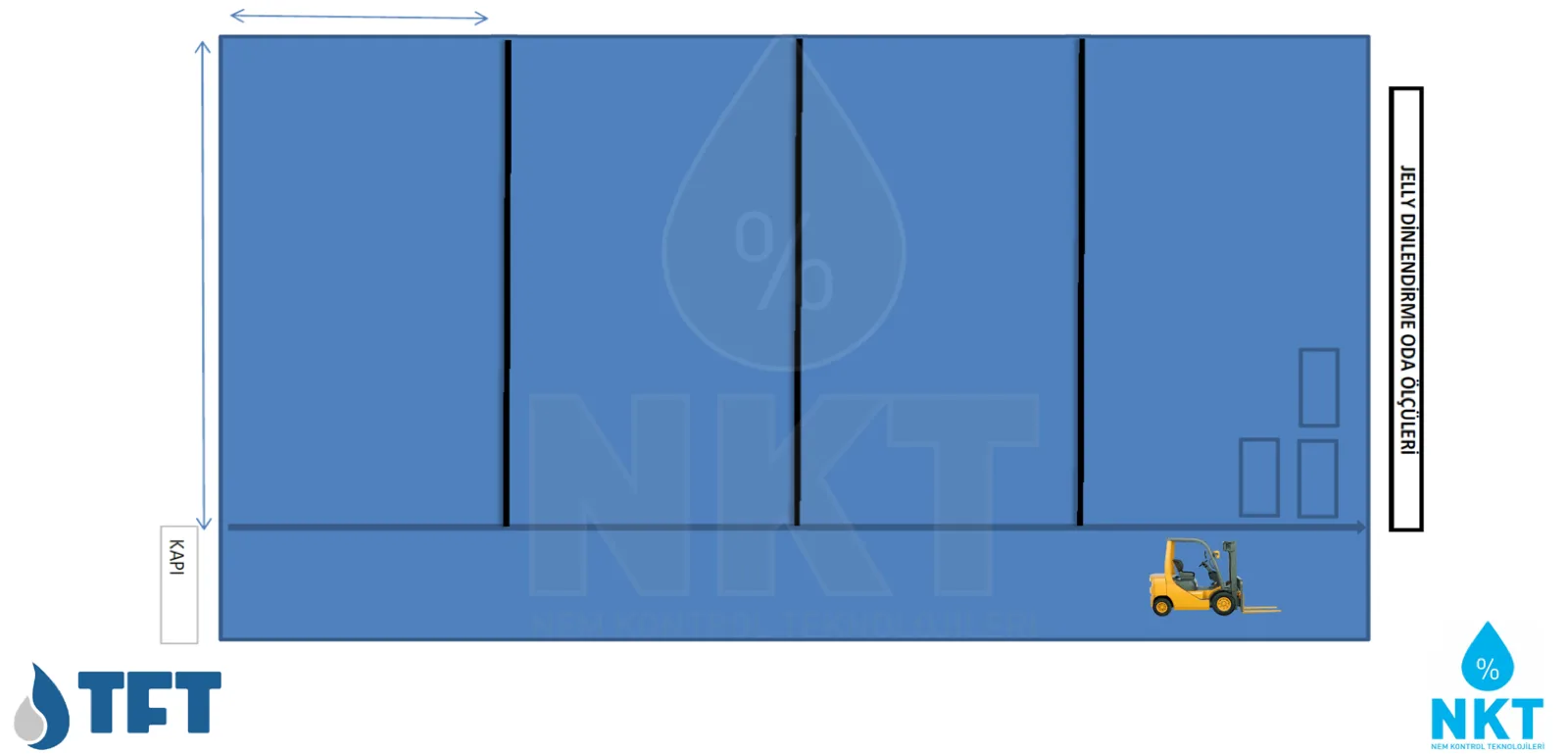
Engineering a jelly conditioning room starts with a small set of decisions: total room volume, trolley count, tray density, air circulation strategy, pressure balance, and door management. These parameters all feed into the moisture-load calculation and ultimately collapse into one number — the kilograms of water per hour that must be removed from the room. The most common design failures occur in rooms that pack in too many trolleys, undersize the airflow, or rely on a single dehumidifier with no redundancy.
Volume, Trolley Density, and Layout
A typical industrial gummy conditioning room is built as a modular space with two rows of mogul trolleys, a central walkway, and distribution panels lining the walls. A single mogul trolley carries 80–130 trays on a 6–8 tier rack, with each tray holding 3–5 kg of starch and 2–3 kg of freshly deposited product. A 100-trolley section therefore contains roughly 40 tons of starch — a massive thermal and moisture buffer that explains why the room's humidity reacts so slowly to setpoint changes. Maintain a minimum 60–80 cm spacing between trolleys, plus 25–35 cm of free air space below and above the trolleys. Without these clearances, the bottom trays over-dry and the top trays under-dry; the resulting aw spread within a single batch can reach 0.08, which translates to visible quality variation.
Air Circulation and Pressure Balance
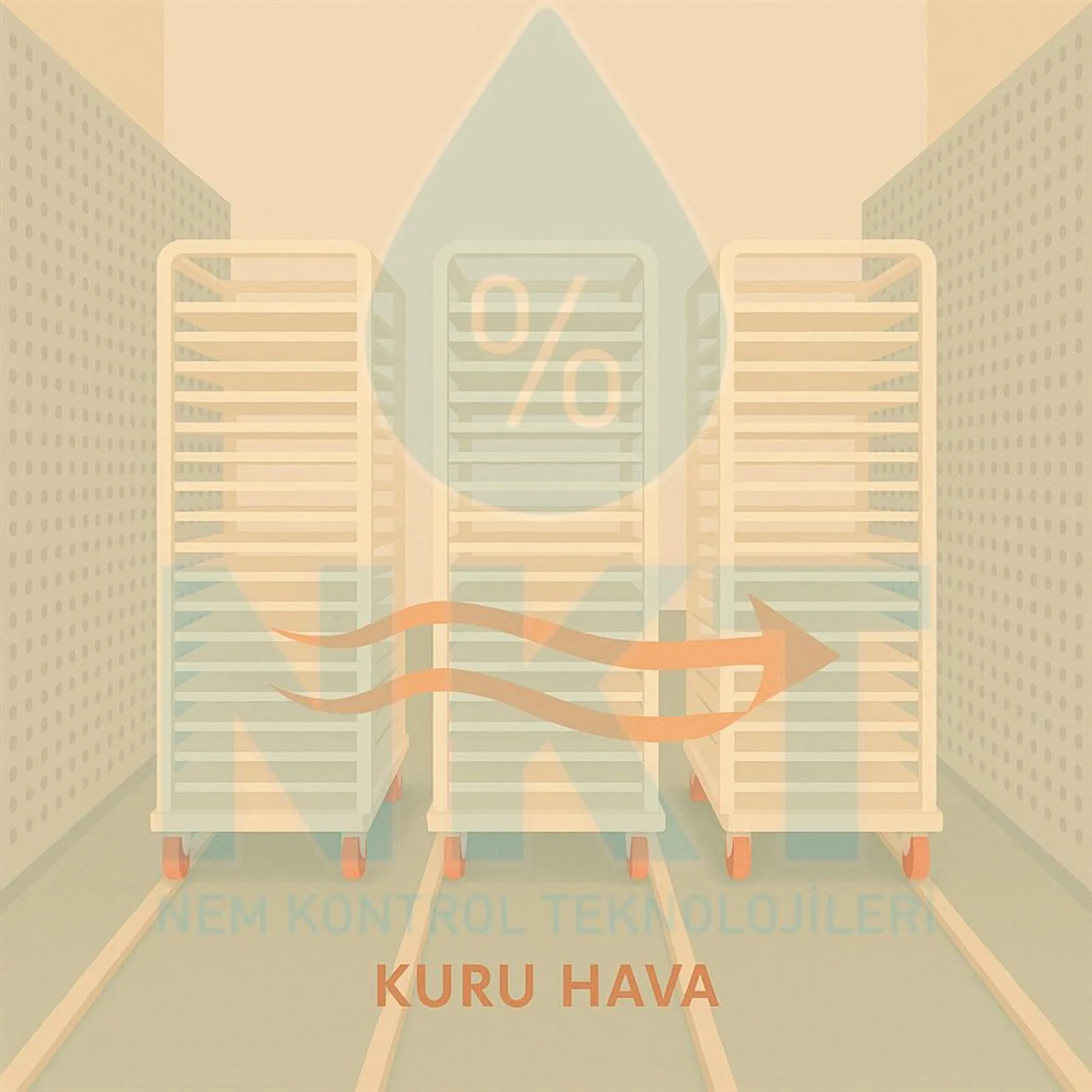
The preferred circulation configuration in modern jelly conditioning rooms is top-return + bottom/side-supply. Warm, moisture-laden air rising from the trays is drawn into a ceiling return plenum, processed through a silica-gel rotor dehumidifier, optionally trimmed for temperature through a heating/cooling coil, and redistributed through floor or side-wall distribution panels. Air-change rate (ACH) is typically 15–25 room volumes per hour; lightly loaded layouts can hold 15–18, but densely packed 130-tray-per-trolley layouts should not drop below 22–25. Local air velocity at the tray surface should sit between 0.3 and 0.8 m/s and should never exceed 1.2 m/s anywhere in the room. Above this threshold, "starch blowback" begins — starch fines lift off the trays, foul filters, contaminate ducts, and degrade rotor performance.
The most frequent pressure-balance error is keeping the conditioning room at positive pressure relative to the corridor. The correct configuration is the opposite: the conditioning room should be held at -5 to -10 Pa slightly negative pressure relative to the surrounding corridor. Under negative pressure, when a door opens or a trolley enters, corridor air flows into the room rather than dry conditioned air escaping into the corridor. The infiltrating air mixes with supply air and is dried by the rotor before reaching the product, so no direct exposure to humid air takes place. Door openings should be supplemented with a 2.2–2.5 m air curtain, which reduces corridor-to-room moisture transfer by 60–75%.
Moisture Load and Engineering Calculation
Correctly sizing the dehumidification equipment requires a careful estimate of the room's hourly moisture load — the kilograms of water per hour that must be removed from the air. This load has four components: moisture released by the product, equilibrium-moisture shifts in the starch bed, infiltration and makeup-air load from outside, and sensible/latent load from personnel and lighting. The dominant component is almost always product evaporation, since it scales directly with production capacity and cannot be designed away.
Here Mproduct is the total product mass simultaneously present in the room, ΔXproduct is the gap between initial and target moisture content (kgwater/kgproduct), and tconditioning is the time available to reach the target. For a 50 ton/day plant on a 48-hour conditioning cycle with ΔX = 0.07 (i.e. 20% → 13% moisture), product-side moisture load works out to roughly 145 kg/h. Add infiltration (20–40% of the total load) and personnel/lighting loads, and the dehumidifier should be specified to a design load of at least 200–230 kg/h. This margin is precisely why the industry rule of thumb — "size the unit to twice the calculated load" — remains good engineering practice.
| Component | Typical Range (50 t/day plant) | Share of Total |
|---|---|---|
| Product evaporation | 120–160 kg/h | ~60–70% |
| Makeup air load | 30–55 kg/h | ~15–25% |
| Infiltration (doors / trolleys) | 15–30 kg/h | ~8–12% |
| Personnel + lighting | 4–8 kg/h | ~2–4% |
| Starch equilibrium shift | 3–7 kg/h | ~2–3% |
| Design total moisture load | 200–230 kg/h | 100% (with margin) |
Target Humidity and Temperature Ranges
The "right" temperature/humidity combination for a jelly conditioning room depends on the product matrix and hydrocolloid type. The reference ranges below summarise widespread industry practice and align with ASHRAE Handbook (Refrigeration, Chapter 22) recommendations and confectionery-engineering literature. As NKT — Humidity Control Technologies, the two field problems we encounter most often are: (a) running gelatin gummies on the same room as pectin jellies without separating their cycles, and (b) driving the RH setpoint too low — under the misguided assumption that "drier is always better" — and triggering surface case hardening as a result.
| Product Type | Target Temperature | Target RH | Target aw | Conditioning Time |
|---|---|---|---|---|
| Pectin Jelly | 24–26°C | 28–32% | 0.60–0.68 | 24–36 h |
| Gelatin Gummy | 22–26°C | 28–32% | 0.55–0.65 | 48–72 h |
| Agar-Based | 20–24°C | 30–35% | 0.62–0.72 | 20–30 h |
| Starch Jelly | 25–30°C | 32–38% | 0.65–0.72 | 48–72 h |
| Sugar-Free Gummy (isomalt/maltitol) | 20–24°C | 22–26% | 0.50–0.60 | 36–48 h |
| Sugar-coated (sanding) | 24–28°C | 30–35% | 0.58–0.65 | 24–48 h |
The single most common reference setpoint across the industry is 28°C / 30% RH; at this point dew point sits around 9°C and absolute humidity is approximately 7.2 gwater/kgdry air. Achieving the same ΔX at 22°C / 30% RH stretches the cycle by roughly a factor of 1.4. Conversely, raising the room to 30°C / 30% RH shortens the cycle but pushes the pectin matrix dangerously close to its ~50°C structural breakdown threshold and risks aroma loss and incipient caramelisation. This is why 28°C / 30% RH is widely treated as the "sweet spot" for jelly conditioning.
Operators often act on the assumption that "drier is better" and pull the RH setpoint down to 22–25%. This drives surface moisture out of the matrix far faster than the interior can re-equilibrate, triggering case hardening. The end result is a hard, sealed outer shell with a sticky, wet core — both visually and texturally outside saleable quality. Outside of sugar-free formulations, dropping below 28% RH rarely improves outcomes.
Pectin/Starch Interaction and Moisture Behaviour
The two structural elements that most strongly govern moisture balance in the conditioning room are the pectin (or gelatin) gel network and the starch bed in the trays. High-methoxyl (HM) pectin builds a gel network that depends on high sugar concentration and low pH, while low-methoxyl (LM) pectin gels via calcium bridges. Both forms break down structurally above 50°C — the biochemical reason why conditioning-room temperature must be capped. Pectin's moisture-release behaviour is balanced between surface and interior, but if the room RH is held too low, interior-to-surface re-equilibration cannot keep pace and surface cracking begins.
Starch behaves more subtly. Corn starch (the most common moulding starch in mogul lines) enters the system at 7–9% moisture and absorbs both heat and a small amount of moisture on contact with the hot product. Throughout conditioning, the starch acts as the room's moisture buffer: if the room becomes too dry, the starch bed begins to release moisture back into the product; if the room becomes too humid, the starch begins to draw moisture from the product surface. This buffering is exactly why instantaneous responses to RH-setpoint changes appear so slow. A typical mogul-equipped conditioning room contains 25–40 tons of starch; for every 1% RH change in the equilibrium condition, roughly 0.8 kg of moisture migrates per RH unit. A 4-unit deviation from 28% RH to 32% RH therefore moves around 3.2 kg of additional moisture in the short term — significant even for a small system.
Gelatin-based formulations operate within a wider RH window than pectin, but gelatin gels release moisture more slowly, which is why gelatin gummies require longer cycles (48–72 hours). The terms "jelly" and "gummy" are sometimes used interchangeably, but from an engineering standpoint pectin jelly reaches target conditions in 24–36 hours while gelatin gummy requires 48–72 hours. If both are processed in the same room, the room must be designed around the worst-case product — or, ideally, the lines should be physically separated.
Silica-Gel Rotor Dehumidification: Why Condensation Type Falls Short
This is where the most consequential engineering decision is made: which type of dehumidifier should the room be equipped with? The industry offers two technologies — condensation-type (refrigerant cooling) and desiccant-type (silica-gel rotor). Both have legitimate applications, but for a jelly conditioning room operating at 30% RH and below, the laws of physics rule the condensation type out.
Condensation Type (Refrigerant)
- Practical dew point floor: ~+5°C; ~+1°C with extreme effort.
- At 28°C ambient, the lowest practical RH it can deliver is around 35%.
- 30% RH targets are physically out of reach; constant compressor loading wastes energy and generates vibration.
- Performance degrades visibly during summer months.
- Lower capital cost, but inadequate for the process.
Silica-Gel Rotor (Desiccant)
- Achievable dew point: down to -40°C and below.
- At 28°C ambient, stable supply at 15% RH or below is achievable; 30% RH setpoints are easily held.
- Performance is independent of outdoor air temperature.
- Modular design: 2,000–9,500 m³/h capacity range.
- Higher capital outlay, but the correct and sustainable solution for the process.
A silica-gel rotor dehumidifier works on adsorption: water-vapour molecules in the air are bound to the surface of silica-gel-coated channels mounted on a slowly rotating wheel. As the rotor turns, an adsorption sector captures moisture from the process air, while a separate regeneration (reactivation) sector uses 120–140°C hot air to drive the captured moisture out of the rotor and exhaust it from the building. The cycle then repeats. The key advantage is that this process delivers very low dew points independently of ambient temperature — the inverse of condensation cooling, whose efficiency drops as ambient temperature falls. For jelly conditioning, NKT — Humidity Control Technologies frequently specifies the ADP series silica-gel rotor dehumidifiers developed jointly with our Italian technology partner TFT, Tecnofrigo Tuscany Srl (Italian industrial dehumidifier manufacturer). The ADP series offers stainless-steel construction, PLC control, modular steam/electric/gas regeneration options, and Eurovent L1 leakage class — meeting the hygiene requirements of the food sector.
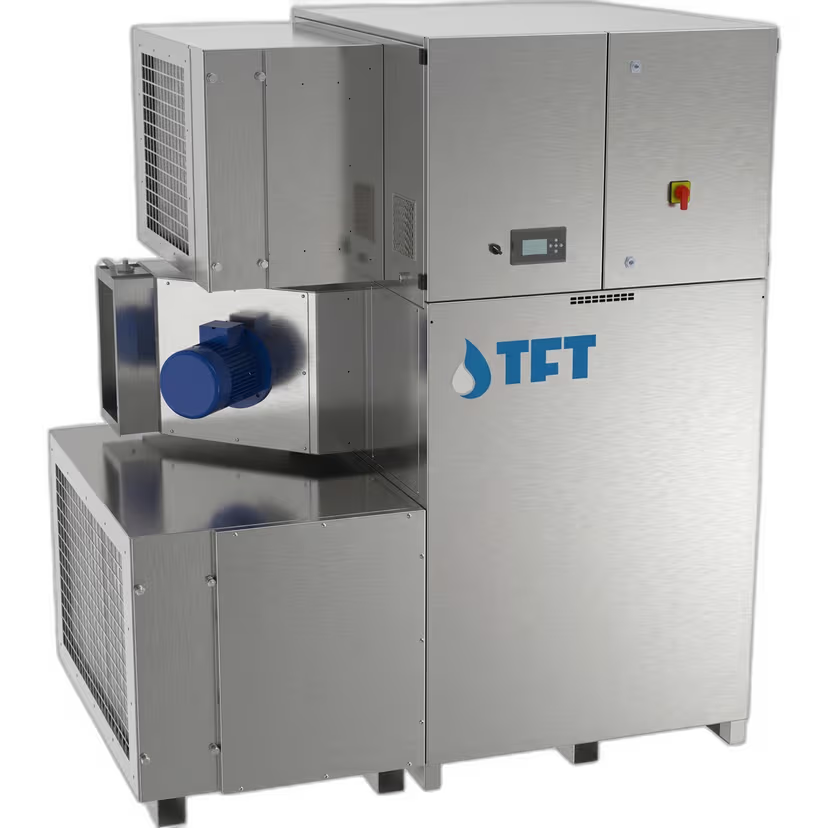
The ADP series dual-rotor configuration is particularly preferred for summer operation or for plants in humid climates (Black Sea region, Marmara coast, humid Mediterranean lowlands). The first rotor pre-dries the makeup-air stream; the second rotor pulls it down to the final dew point. This arrangement delivers 15–25% energy savings compared to a single large rotor and provides redundancy against rotor-aging performance loss. On the filtration side, the standard build uses a G4 pre-filter plus an F7 fine filter; an additional F9 stage is recommended in environments with significant starch dust load.
Case Study: 50 Ton/Day Jelly Production Plant
The case below represents the kind of mid-to-large gummy plant the NKT — Humidity Control Technologies engineering team typically works on. The plant has a single large conditioning area subdivided into 4 sections; each section accommodates 100 mogul trolleys, and each trolley carries 130 trays. Total tray capacity per room is 4 × 100 × 130 = 52,000 trays. With an average of 2.5 kg of product per tray, each conditioning cycle holds about 130 tons of product simultaneously; given a 48-hour conditioning cycle, real daily output stabilises at approximately 50–65 ton/day.
Sizing Steps
| Parameter | Value | Notes |
|---|---|---|
| Daily production capacity | 50 ton/day | Mixed pectin jelly + gelatin gummy |
| Number of sections | 4 sections | Each with its own distribution panel |
| Trolleys per section | 100 trolleys | Two rows × 50 trolleys |
| Trays per trolley | 130 trays | 8-tier rack, 16–17 trays per tier |
| Total room volume | ~3,200 m³ | 40 m × 16 m × 5 m net |
| Air-change rate | 22 ACH | ~70,000 m³/h total airflow |
| Target conditions | 28°C / 30% RH | Dew point ~9°C, AH 7.2 g/kg |
| Design moisture load | 225 kg/h | With margin, all components included |
| Recommended dehumidifiers | 2 × ADP 5500 + 1 × ADP 9500 | Section-based redundant design |
The most critical decision in this kind of design is "one large unit, or several mid-sized units?" NKT's preference is consistently the latter. Distributing the load across 3 × ~5,500–9,500 m³/h units rather than a single 12,000 m³/h block keeps production running when any one unit goes offline for service, and gives independent control over local moisture-load variation between sections (a section that has just been loaded with fresh batches always has higher moisture demand than a section near end of cycle).

Commissioning and Validation
Hand-over of a jelly conditioning room should always include at least a two-week performance validation period. During this window the engineering team verifies: (i) the 24-hour fluctuation envelope of room RH and temperature stays within ±1.5% RH and ±0.5°C, (ii) point aw measurements at tray level remain within ±0.02 units across the batch, (iii) recovery time after a door-opening event does not exceed 8–12 minutes, and (iv) the rotor exhaust runs in the 60–80°C band while the adsorption-side outlet stays at the target dew point. NKT engineers record all of these checkpoints with portable instrumentation and deliver a formal hand-over report to the customer.
Energy Efficiency and Operational Recommendations
Conditioning rooms are among the largest energy consumers in a jelly plant. In a typical 50 ton/day plant, conditioning-room energy consumption represents 15–25% of the facility's total energy budget; the bulk of this consumption is split between rotor-regeneration heating and circulation fan motors. Both of these are accessible to significant savings in a properly designed system.
Regeneration Heat Recovery
The regeneration sector of a silica-gel rotor dehumidifier operates at 120–140°C. After leaving the rotor, the exhaust air still carries 60–85°C of usable heat — energy that is wasted if dumped directly to atmosphere. Modern ADP series units offer optional plate heat exchangers that recover 40–60% of this exhaust heat by pre-heating the incoming regeneration air. The result is a 20–30% reduction in total regeneration energy. Payback period is typically 18–30 months for plants running on natural gas or steam.
Night/Weekend Mode and Holiday Schedule
During production downtime — for plants without third-shift operation, or during scheduled maintenance windows — running the system in low-load mode rather than shutting it down completely is the smarter choice for both equipment longevity and energy use. In this mode, airflow is reduced to 50–60% of nominal, the RH target is relaxed to 35–38%, and rotor regeneration temperature drops to 110°C. This strategy cuts energy consumption by 55–65% relative to normal operation, and recovery time on resumption of production is well under 25–40 minutes. PLC-based systems make these modes fully programmable; NKT typically delivers commissioned systems with a standard night/weekend/maintenance mode trio pre-configured.
VFD-Driven Airflow Control
Constant-speed fan motors waste energy during partial-load hours. A Variable Frequency Drive (VFD) that modulates fan output to actual moisture load brings substantial savings: because fan power scales with the cube of airflow (the Affinity Law), a 20% airflow reduction yields roughly a 49% reduction in fan power. In plants with variable conditioning-room occupancy — batch in/out hours mixed with low-density hours — this can lower annual energy spend by 12–18%.
NKT Engineering Solutions and Expertise
NKT — Humidity Control Technologies is Turkey's long-standing engineering company in industrial dehumidification and dry-room design, providing integrated humidity-control solutions for the food sector across jelly/gummy, chocolate, biscuit, dried-nut, and flour production lines. Together with our Italian technology partner TFT (Tecnofrigo Tuscany Srl), the ADP series silica-gel rotor dehumidifiers we deliver are fully compliant with food-sector hygiene standards (AISI 304/316 stainless-steel housing, CIP-compatible surfaces, IP54–IP65 protection class) and carry over a decade of field references across every climate zone in Turkey.
For a jelly conditioning room project, NKT's scope of services covers the following steps: (i) psychrometric analysis and moisture-load study for the existing facility, (ii) section count and air-handling layout design, (iii) dehumidifier sizing and equipment selection, (iv) ductwork, distribution panel, and filtration engineering, (v) PLC automation programming and remote-monitoring infrastructure, (vi) on-site installation, commissioning, and performance validation, (vii) operator training and post-warranty technical support. Because all of these steps are carried out by a single engineering team, the customer is freed from the burden of coordinating between multiple suppliers, and the chain of responsibility is clean and unambiguous.
References
- ASHRAE Handbook — Refrigeration, Chapter 22: Candies, Chocolates and Confectionery, 2022.
- Hartel, R.W.; Joachim, H. — Confectionery Science and Technology, Springer, 2018.
- Edwards, W.P. — The Science of Sugar Confectionery, RSC Publishing, 2000.
- Eurovent Certification Programme: Rotary Desiccant Dehumidifiers (L1 leakage class).
- DIN EN 1507: Ventilation for Buildings — Sheet Metal Air Ducts.
- SMACNA: HVAC Air Duct Leakage Test Manual, 2nd Edition.
- Labëll: Water Activity and Confectionery Stability, Manufacturing Confectioner, Vol. 92, 2018.
- Beckett, S.T. (ed.) — Industrial Chocolate Manufacture and Use, Wiley-Blackwell, 5th ed., 2017.
- TFT — Tecnofrigo Tuscany Srl, ADP Series Technical Data Sheets.