In the production of industrial hemp suitable for medical use, product quality is largely decided in two places: the climate of the indoor growing rooms and the post-harvest drying room. In Türkiye, hemp cultivation requires a permit, and the Regulation on Hemp Cultivation and Control of 31 January 2026 requires cultivation for medical and health products to take place in enclosed, climate-controlled, high-security areas. This guide explains how relative humidity (RH), dew point and water activity are managed in these areas and which dehumidification technology suits which room.
Hemp Life Cycle and Humidity Requirements
Hemp passes through four main stages from seed to harvest, and each stage calls for different climate conditions. The values below are typical bands used in indoor cultivation; the exact values depend on the variety, the lighting and the facility's own procedures.
Germination and Seedling Stage (1–3 Weeks)
During germination, seeds take up water and start their metabolic processes. Because the root system is not yet developed, the young plant's water loss must be limited, so ambient relative humidity is kept high.
Typical conditions:
- Relative humidity: 65–80%
- Temperature: 20–25 °C (dew point approx. +13…+21 °C)
- Light cycle: 18/6 (hours light/dark)
If humidity falls well below this band, young leaves may dry out and growth may slow.
Vegetative Stage (3–8 Weeks)
The vegetative stage is the phase of the most intensive branch and leaf production. Leaf area increases rapidly and the root system becomes fully functional.
Typical conditions:
- Relative humidity: 55–70%
- Temperature: 22–28 °C (dew point approx. +12.5…+22 °C)
- Light cycle: 18/6
Transpiration rises markedly at this stage. Most of the water the plant takes up through its roots leaves the leaf pores (stomata) as vapour. In an enclosed growing room, the daily irrigation volume is therefore the best indicator of the moisture load, and active dehumidification is needed to hold the room at its target.
Flowering Stage (6–12 Weeks)
Flowering is the most sensitive stage of cultivation. The plant forms dense, compact inflorescences and develops trichomes (glandular hairs). Because the inflorescences are tight, air movement inside them is weak and this is where moisture most readily accumulates.
Typical conditions:
- Early flowering: 50–60% RH, 20–26 °C (dew point approx. +9…+18 °C)
- Late flowering: 40–50% RH, 18–24 °C (dew point approx. +4…+13 °C)
- Light cycle: 12/12
If room humidity rises above the target band in late flowering, the microclimate inside the dense inflorescences moves towards the conditions Botrytis cinerea (grey mould) needs (relative humidity above 85–90% for long periods and wet surfaces). Botrytis can start inside the inflorescence and spread unnoticed from the outside. In production for medical use, this can cause a batch to fail its microbiological quality requirements and be destroyed.
Drying and Curing
Post-harvest drying and curing determine the final quality of the product and are the main subject of this guide. Conditions, water activity targets and equipment selection are covered in a separate section below.
Vapour Pressure Deficit (VPD): The Basis of Humidity Management in Growing Rooms
Relative humidity alone cannot fully describe plant physiology. Transpiration rate and stomatal behaviour depend on the vapour pressure difference between the leaf surface and the air, i.e. the VPD (vapour pressure deficit). At the same relative humidity, VPD changes as temperature changes, so temperature and humidity are assessed together. VPD is meaningful for the living plant; when drying the harvested product, relative humidity, dew point and water activity are monitored instead.
VPD Calculation Formula
Typical VPD Ranges by Growth Stage
| Stage | VPD range (kPa) | Meaning |
|---|---|---|
| Seedling / Cutting | 0.4 – 0.8 | Low transpiration, high humidity |
| Vegetative | 0.8 – 1.2 | Active growth, balanced transpiration |
| Early flowering | 1.0 – 1.4 | Increasing metabolism |
| Late flowering | 1.2 – 1.6 | Drier air, lower mould risk |
Example: Take a room at 25 °C and 60% RH with a leaf temperature of 23 °C. The saturation vapour pressure of the air is 3.17 kPa and the actual vapour pressure is 3.17 × 0.60 = 1.90 kPa. The saturation vapour pressure of the leaf at 23 °C is 2.81 kPa, so VPD = 2.81 − 1.90 ≈ 0.91 kPa, which lies inside the vegetative band.
When VPD is very low (<0.4 kPa), transpiration almost stops even though the stomata remain open, and nutrient transport is impaired. When VPD is very high (>1.6 kPa), the plant loses too much water, the stomata close under stress and photosynthesis slows down.
Humidity-Related Risks and Diseases
When humidity control is inadequate, the resulting risks threaten product safety as well as causing economic loss.
Mould and Fungal Infections
Botrytis cinerea (grey mould): Develops rapidly at 15–25 °C when relative humidity stays above 85–90% for long periods and plant surfaces are wet. Because humidity inside a dense inflorescence is higher than room humidity, room humidity is kept lower during flowering. Spores are airborne and spread quickly; in production for medical use, infected inflorescences are excluded from the product.
Powdery mildew: Appears as a white, powdery coating on leaf surfaces. It does not need free water and spreads at moderate-to-high humidity in areas with weak air movement.
Fusarium: Associated with an over-wet growing medium and high moisture in the root zone. It damages the vascular tissue and blocks water and nutrient uptake; in advanced infection the plant usually cannot be saved.
Pests
- Fungus gnats: Their larvae multiply in a growing medium that stays wet and damage the roots; the deciding factor here is irrigation and substrate moisture.
- Spider mites: Multiply rapidly in warm, dry conditions (low RH).
- Thrips: Cannot be controlled directly through humidity; integrated pest management is required.
Humidity-Related Risks: Decision Tree
Risk Analysis by Ambient Relative Humidity
General risk overview for the flowering stage
Post-Harvest Drying and Curing
Roughly three quarters of the mass of freshly harvested hemp flower is water. The aim of drying is to remove this water at a controlled rate, without degrading the chemical composition and aroma of the product and without allowing mould to develop. For hemp flower intended for medical use, monograph 3028 (hemp flower) of the European Pharmacopoeia limits loss on drying to a maximum of 12.0%. For water activity (aw), ASTM D8197 defines a range of 0.55–0.65 for dry flower: the upper limit prevents mould growth and the lower limit prevents the product from over-drying and becoming brittle.
Typical Drying and Curing Conditions
| Stage | Temperature | Relative humidity | Dew point (Magnus) | Duration |
|---|---|---|---|---|
| Drying | 15–21 °C | 55–65% | +6.0…+14.2 °C (18 °C / 60% → +10.1 °C) | Approx. 7–14 days |
| Curing (equilibration in closed containers) | 18–22 °C | 58–62% | +9.6…+14.4 °C | Approx. 2–8 weeks |
Air movement in the drying room is kept low to moderate, and the product is not exposed to a direct air stream. The aim is for moisture to decrease evenly between the surface of the flower and its interior and stem.
- Drying too fast (low humidity, high temperature): The outside dries quickly while the stem and the interior of the inflorescence remain moist, so drying becomes uneven. Because chlorophyll breakdown cannot be completed, the product may develop a hay-like odour. Losses of volatile terpenes also increase as temperature rises.
- Drying too slowly (high humidity): The product stays at a high water activity for a long time, giving moulds and yeasts time to grow.
- Curing: The dried product is held in closed containers so that the moisture remaining inside the inflorescence equilibrates towards the surface and water activity settles in the target range. The 55–65% relative humidity of curing and storage is in equilibrium with aw 0.55–0.65.
Water Activity, Mould and Mycotoxin Risk
Water activity is the relative humidity of the air a product is in equilibrium with, expressed as a fraction instead of a percentage: a product with aw 0.62 does not exchange moisture with air at 62% RH. Storage moulds (Aspergillus and Penicillium species) develop as aw rises, and some species can produce mycotoxins such as aflatoxins and ochratoxin A. Keeping aw below 0.65 in dry flower is the main way to limit this risk. Microbiological limits and mycotoxin requirements are set by the pharmacopoeia and licence conditions that apply to the product.
The second risk in the drying room is condensation. Air at 18 °C and 60% RH has a dew point of +10.1 °C; water condenses on every surface colder than this (a cold wall, an uninsulated duct, the area around a cooling coil) and creates a local mould risk.
Drying Room Moisture Load Calculation
The quantity of water to be removed from the product is calculated from the initial and target moisture contents (wet basis):
Water (kg) = Wet mass × (MCinitial − MCtarget) / (1 − MCtarget)
- Example: drying 100 kg of wet flower from 75% to 11% removes 100 × (0.75 − 0.11) / 0.89 ≈ 72 kg of water.
- Over a 10-day drying period the average load is ≈ 7.2 kg/day ≈ 0.3 kg/h. Because the evaporation rate in the first days is well above the average, the dehumidifier is sized for the peak load of the first days, not the average.
- The air-exchange load is added separately: V × ACH × ρ × Δw. For example, if outdoor air at 30 °C / 60% (16.0 g/kg) enters a 210 m³ drying room at 0.5 air changes per hour while the room is held at 18 °C / 60% (7.7 g/kg), this load is 210 × 0.5 × 1.2 × 8.3 / 1000 ≈ 1.05 kg/h. For a small batch the infiltration load can therefore exceed the product load, which is why an airtight drying room matters.
- A safety margin of 15–25% is added to the total load; oversizing above 50% leads to short cycling.
Large volumes of biomass intended for extraction may also be dried at higher temperatures in belt or drum dryers; this guide covers the climate-controlled rooms in which flower for medical use is dried.
Industrial Dehumidifiers and Technology Selection
By regulation, hemp cultivation and drying for medical purposes take place in enclosed, climate-controlled areas. In these areas humidity is controlled not by ventilation but by dehumidifiers working together with heating and cooling. The deciding criterion for technology selection is the room's target dew point and temperature.
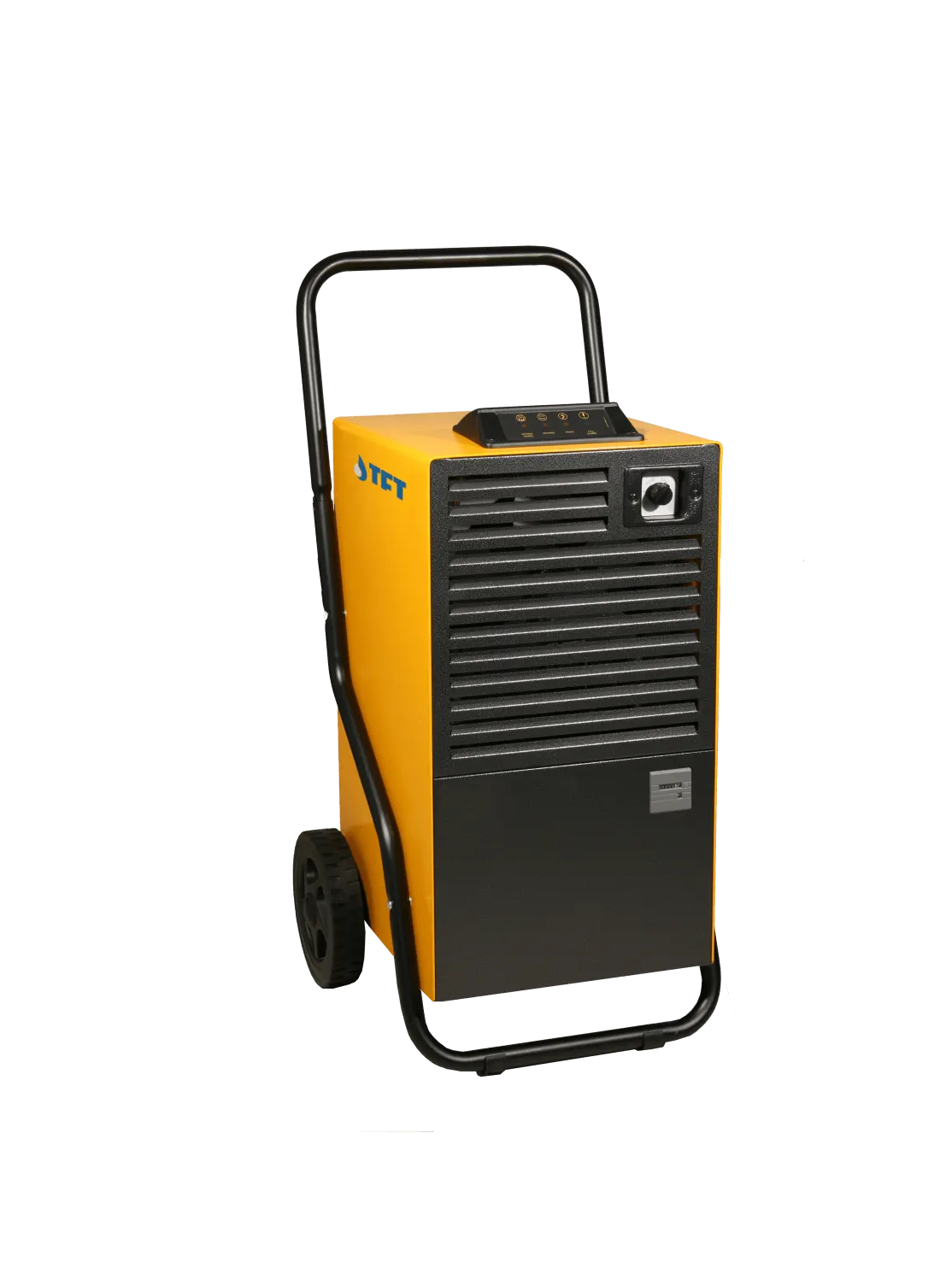
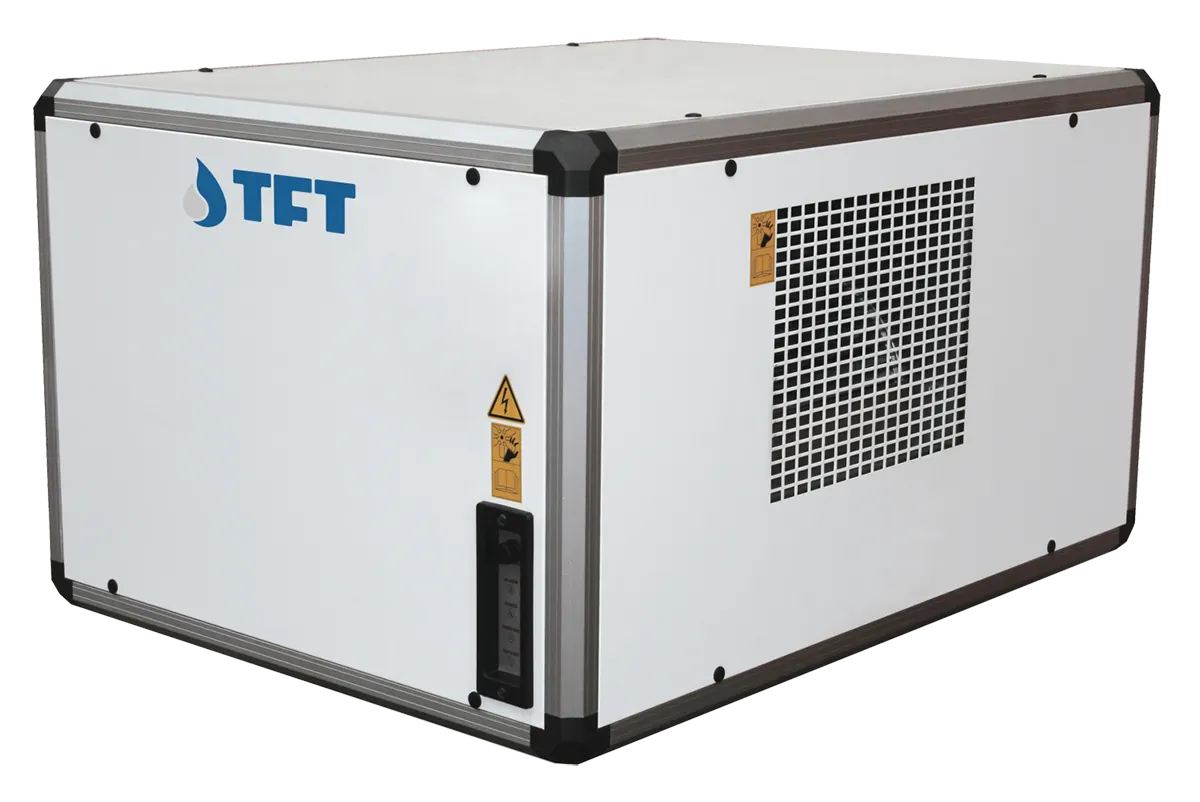
Condensing Dehumidifiers
Condensing (mechanical) dehumidifiers pass humid air over a cooling coil, cool it below its dew point and remove the water by condensation.
- They work efficiently when the target dew point is +10 °C or higher. Seedling, vegetative and lights-on flowering rooms lie largely in this zone.
- They also work in the +5…+10 °C dew point range, but capacity and efficiency fall because of evaporator icing and defrost; sizing uses the low-temperature capacity curve, and an energy comparison with a silica gel rotor or hybrid system is made.
- Capacity and COP drop markedly when room temperature falls below 15 °C. The TFT CD series operates at ambient temperatures of +10…+40 °C.
- The unit releases the latent heat of the removed moisture and the compressor energy into the room as heat, so room temperature must be controlled together with the cooling system.
Silica Gel Rotor (Desiccant) Dehumidifiers
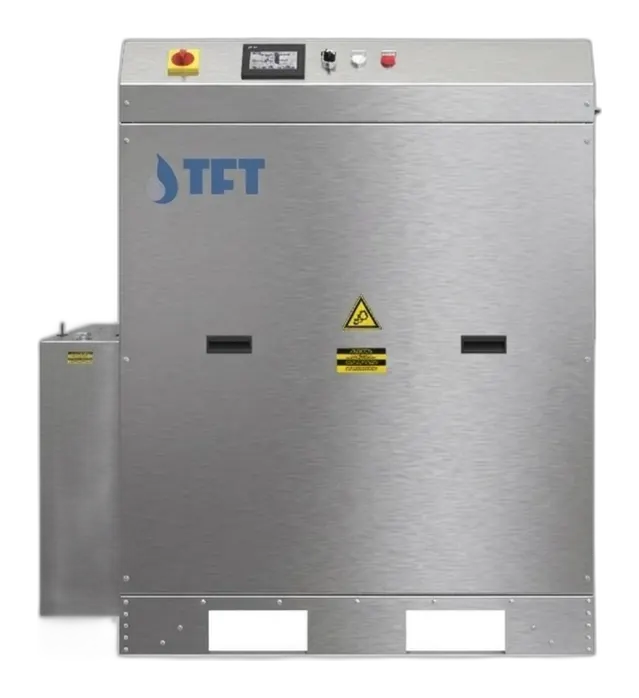
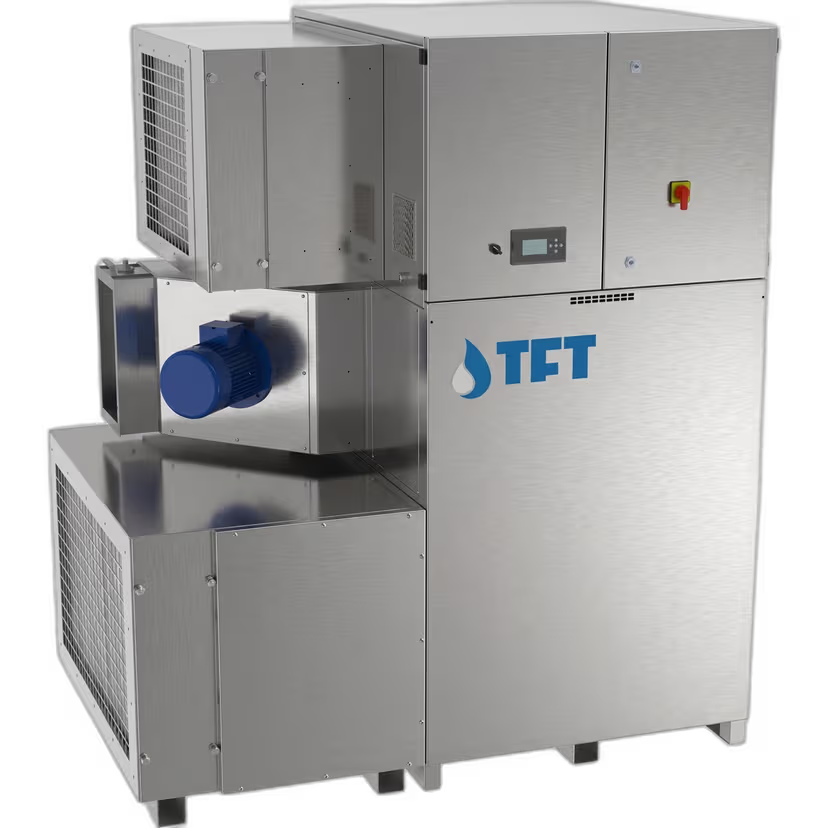
Silica gel rotor dehumidifiers work by physical adsorption. As humid air passes through a slowly rotating silica gel rotor, water molecules adhere to the rotor surface; in the reactivation sector of the rotor, air heated to 100–140 °C drives this moisture out.
- They operate at ambient temperatures of −20…+40 °C and remain effective at the low temperatures where condensing units struggle.
- They reach low dew points (below +5 °C) that condensing units cannot.
- The dried air leaves warmer, so post-cooling is needed in temperature-sensitive rooms.
- Reactivation energy is the largest part of the operating cost; reactivation with steam or natural gas typically reduces operating costs by 40–60% compared with electric reactivation.
Technology Selection by Room
| Room | Typical climate | Dew point | Recommended system |
|---|---|---|---|
| Seedling / cutting room | 20–25 °C / 65–80% | +13…+21 °C | Condensing dehumidifier; resistive steam humidifier if humidity falls below the band |
| Vegetative room | 22–28 °C / 55–70% | +12.5…+22 °C | Condensing dehumidifier |
| Flowering (early) | 20–26 °C / 50–60% | +9…+18 °C | Condensing dehumidifier together with cooling |
| Flowering (late, night) | 18–24 °C / 40–50% | +4…+13 °C | Condensing dehumidifier; energy comparison when the dew point falls below +10 °C, silica gel rotor or hybrid system below +5 °C |
| Drying room | 15–21 °C / 55–65% | +6…+14 °C | Condensing at 18–21 °C; comparison with a silica gel rotor or hybrid system at around 15 °C and below |
| Curing / storage | 18–22 °C / 58–62% | +9.6…+14.4 °C | Condensing dehumidifier; product in closed containers |
In a hybrid system, a cooling coil first removes most of the moisture by condensation and a silica gel rotor then brings the dew point down to target. This arrangement reduces energy consumption in rooms where low temperature and a low dew point are required together.
Air Circulation and Humidity Distribution
Even with sufficient dehumidification capacity, poor air circulation leads to local moisture pockets and disease risk. Uniform air distribution is as important as humidity control itself.
- Horizontal airflow (HAF): Fans above the canopy keep the air moving and thin the humid boundary layer on leaf surfaces.
- Under-canopy airflow: Gentle air movement from below the plants prevents moisture build-up in the lower canopy.
- Textile duct distribution: Delivers air uniformly at low velocity; because it avoids blowing air directly onto the product, it suits flowering and drying rooms.
Internal recirculation is highest in flowering rooms. In the drying room, air is distributed so that it moves gently and evenly around the product; exposing the product to a direct air stream makes the outside dry too fast.
Automation and Monitoring
Light-cycle changes, irrigation schedules and plant growth constantly change room humidity. Humidity, temperature and dew point should therefore be measured and recorded continuously.
Sensor Infrastructure
- Capacitive humidity sensors: Industrial type, typically in the ±2% RH accuracy class.
- Dew point measurement: Important for monitoring condensation risk, especially in drying rooms.
- Leaf temperature measurement: For accurate VPD calculation in growing rooms.
- CO₂ sensors: For assessing ventilation and humidity strategy together.
Measuring at more than one point in each room (canopy level, room centre, return air) is recommended.
Control Strategy
- Proportional control: Dehumidifier capacity is modulated according to deviations from the humidity set point.
- Schedule-based control: Anticipates the humidity spikes that occur when lights switch on and off.
- Alarm management: Sends an immediate notification when critical thresholds are exceeded (for example above 55% RH in late flowering).
Remote Monitoring
With the NKT – Climate Track system, measurements can be monitored in real time through the NKT – Pro mobile app:
- Live RH, temperature and dew point values
- Trend charts and historical data
- Energy consumption and consumption-to-moisture-removed ratio analysis
- Alarm management with push notifications
Energy Efficiency and Moisture Load
In indoor cultivation, lighting, cooling and dehumidification together account for most of the energy consumption, so the dehumidification system should be evaluated together with cooling and lighting.
Energy-Saving Strategies
- Reactivation energy: Supplying reactivation heat for silica gel rotor units from steam or natural gas typically reduces operating costs by 40–60% compared with electric reactivation.
- Variable frequency drives (VFD): Save energy on fan motors at part load.
- LED lighting: Because LEDs use less electricity for the same light output, they reduce the total heat released into the room and therefore the cooling load. Transpiration depends on light and plant size, so the moisture load does not fall to the same extent.
- Night cycle: When the lights switch off, temperature drops and relative humidity rises. Separate night set points manage both condensation risk and energy consumption.
Growing Room Moisture Load
Total moisture load = Transpiration + Evaporation from growing medium and floor + Air exchange + Moisture from people and equipment
Example (100 m² flowering room, 200 plants; assuming 3 L of irrigation per plant per day):
- Transpiration: 200 × 3 L/day = 600 L/day (assuming almost all irrigation water is transpired into the air)
- Evaporation from growing medium and floor: ~50 L/day (assumption)
- Leakage and other sources: ~30 L/day (assumption)
- Total: ~680 L/day ≈ 28.3 L/h
A safety margin of 15–25% is added when selecting equipment. The selected unit's capacity must be delivered at the room's actual condition (for example 24 °C / 50% RH), not at the catalogue rating point.
Legal Framework and Quality Requirements
Regulation in Türkiye
- Hemp cultivation is governed by the Regulation on Hemp Cultivation and Control (Kenevir Yetiştiriciliği ve Kontrolüne Dair Yönetmelik), published in the Official Gazette No. 33154 of 31 January 2026. It repealed the 2016 Regulation on Hemp Cultivation and Control and the 2024 regulation on hemp cultivation for the production of active pharmaceutical ingredients.
- Cultivation requires a permit. For cultivation for medical and health products, applications are handled through the Turkish Grain Board (TMO) and the permit is issued by the Ministry of Agriculture and Forestry.
- Such cultivation takes place in enclosed, climate-controlled areas with camera surveillance, alarm systems and high-security measures.
- Medicinal products are licensed under the human medicinal products legislation.
Good Practice and Records
For herbal starting materials intended for medical use, the Good Agricultural and Collection Practice (GACP) guideline applies in Europe to cultivation, harvest and primary processing such as drying; subsequent manufacturing steps fall under GMP. The exact requirements for a facility are set by its licence conditions and its customer. Common expectations for climate control are:
- Continuous recording of temperature, relative humidity and dew point
- Periodic, documented sensor calibration
- Corrective action procedures for deviations
- Appropriate air filtration in drying and storage areas
Microbiological Quality
Limits for total aerobic microbial count, total yeast and mould count, specified pathogens and mycotoxins (aflatoxins, ochratoxin A) are set by the pharmacopoeia (e.g. European Pharmacopoeia 5.1.4 and 5.1.8) and the licence conditions that apply to the product. Humidity management contributes to these limits by preventing Botrytis and powdery mildew during cultivation, bringing the product below aw 0.65 at a controlled rate during drying and keeping it there in storage.
Worked Example: 500 m² Indoor Cultivation and Drying Facility
The following example was prepared to show how the method is applied; the values are not taken from a real facility design.
Facility characteristics:
- Total area: 500 m²
- Flowering rooms: 3 × 100 m² (200 plants each)
- Vegetative room: 1 × 100 m²
- Seedling / cutting room: 1 × 30 m²
- Drying / curing room: 1 × 70 m²
| Room | System type | Capacity (at room condition) | Target RH |
|---|---|---|---|
| Flowering (×3) | Condensing, together with cooling | ≈ 35 L/h (each room; 28.3 L/h + 20%) | 40–60% (by stage) |
| Vegetative | Condensing | ≈ 20 L/h (example) | 55–70% |
| Seedling / cutting | Condensing + resistive steam humidifier | ≈ 5 L/h (example) | 65–80% |
| Drying / curing | Condensing at 18–21 °C; silica gel rotor or hybrid at 15 °C and below | Calculated from batch size and air exchange (see drying load) | 55–65% |
Growing rooms total: ≈ 130 L/h (≈ 3,120 L/day). The drying room load is calculated separately from the harvest batch size and the airtightness of the room.
Monitoring infrastructure:
- Several humidity and temperature sensors per room
- Leaf temperature measurement in growing rooms (VPD monitoring)
- Dew point monitoring in the drying room
- Remote monitoring with NKT – Climate Track and the NKT – Pro mobile app
Key Recommendations
- Target water activity when drying: Dry under control at 15–21 °C and 55–65% RH, then cure to bring the product into the aw 0.55–0.65 range and within the loss-on-drying limit of the applicable monograph.
- Think in dew points: Select technology by the room's target dew point and temperature; condensing units are efficient at dew points of +10 °C and above, and a silica gel rotor or hybrid is needed below +5 °C.
- Monitor VPD in growing rooms: Track VPD together with leaf temperature, not relative humidity alone.
- Ensure uniform air distribution: Sufficient capacity cannot compensate for the local moisture pockets created by poor circulation.
- Prevent condensation: Insulate surfaces in the drying room that are below the dew point (cold walls, ducts).
- Keep records: Record climate data continuously and calibrate sensors regularly.
NKT – Nem Kontrol Teknolojileri supplies TFT (Tecnofrigo Tuscany, Italy) condensing and silica gel rotor dehumidifiers and Neptronic (Canada) resistive steam humidifiers, and provides equipment selection support, technical service and spare parts.
References
- Regulation on Hemp Cultivation and Control (Kenevir Yetiştiriciliği ve Kontrolüne Dair Yönetmelik). Official Gazette of Türkiye, 31.01.2026, No. 33154.
- European Pharmacopoeia, Monograph 3028 (07/2024).
- ASTM D8197: standard specification for maintaining an acceptable water-activity (aw 0.55 to 0.65) range for dry flower.
- EMA/HMPC: Guideline on Good Agricultural and Collection Practice (GACP) for Starting Materials of Herbal Origin.
- European Pharmacopoeia 5.1.4 and 5.1.8: Microbiological quality of non-sterile pharmaceutical preparations / herbal medicinal products.
- Runkle, E. "VPD and Plant Growth." Michigan State University Extension.