High-pressure misting systems atomise water at 70-100 bar through dedicated stainless-steel nozzles, producing 5-10 µm micro-droplets that evaporate fully in sub-second time. The process is a form of adiabatic humidification, the latent heat for evaporation is drawn from the air, so the space gains humidity and is cooled by 5-12 °C at the same time. The architecture is built from four core modules: a high-pressure pump, a water-conditioning line (filter + RO + UV), an insulated high-pressure manifold with a nozzle matrix, and a control panel (PLC + humidity sensor). This article reviews the components, the working principle, why droplet size matters, the typical industrial applications (textile, print, woodworking, greenhouse, agriculture), hygiene and water-quality requirements, the control strategy, the maintenance protocol, and the positioning of Neptronic SKH within the NKT Nem Kontrol Teknolojileri portfolio.
What Is High-Pressure Misting?
High-pressure misting is an adiabatic humidification technology that delivers water through purpose-built stainless-steel nozzles at 70-100 bar pump pressure, producing micro-droplets that evaporate quickly in the air and raise humidity. Because evaporation draws heat from the air, the process also produces an evaporative-cooling effect. Typical capacity ranges from 20 to 2,000 kg/h; it is sized on a single line with a matrix of 8-200 nozzles.
The misting process is clearly distinct from the two other large humidification families (steam and wetted-media evaporative). The steam system heats water to boiling and produces isothermal steam; the wetted-media system passes air through a porous wet surface and evaporates without producing aerosol. High-pressure misting uses mechanical energy (pump pressure) directly to break water into droplet form. The result is very low energy consumption, high capacity + free-cooling side-effect, and stricter water-quality requirements.
| Dimension | Typical Value | Note |
|---|---|---|
| Pump pressure | 70 – 100 bar | Plunger pump; frequency-inverter driven |
| Droplet size | 5 – 10 µm | Critical for sub-second evaporation |
| Nozzle flow | 4 – 25 g/min | Per nozzle; 8-200 in matrix |
| Capacity | 20 – 2,000+ kg/h | For a single pump line |
| Pump electrical power | 1.5 – 7.5 kW | By capacity band |
| Water-quality requirement | RO + UV | Hardness target <5 ppm; microbial control |
| Typical ceiling height | > 4 m | Minimum for droplet evaporation path |
System Components
A high-pressure misting system consists of four core modules: water-conditioning line, high-pressure pump, high-pressure distribution + nozzle matrix, and the control panel (PLC + sensors). Correct sizing of each module and proper interaction among them directly drive system performance.
Figure 1. High-Pressure Misting System: Component Block Diagram
1. Water-Conditioning Line
Feed water for high-pressure misting must be specifically prepared. The standard configuration is: (1) pre-filter (5 µm + 1 µm sediment + activated carbon, chlorine removal), (2) RO unit (hardness <5 ppm, TDS <30 ppm target), (3) UV sterilisation (microbial control, Legionella-risk management), (4) tank + circulation pump (prevent stagnant water). These four components are what truly make a misting system "hygienic"; missing any of them undermines field reliability.
2. High-Pressure Pump
The plunger-type high-pressure pump is the heart of the system. 70-100 bar nominal pressure, stainless-steel (AISI 316) body, ceramic plungers and variable speed control via a frequency inverter form the standard configuration. Pump power varies from 1.5 to 7.5 kW by capacity band; a typical 200 kg/h system needs a 5 kW pump. Inverter control modulates pump speed to the room's humidification load, delivering both energy savings and a tight control band.
3. High-Pressure Distribution + Nozzle Matrix
The line from pump outlet to nozzles is drawn in AISI 316L stainless steel or PA12/PEX rated for high pressure; every joint must be a threaded, sealed pull-tight fitting. Nozzles are typically stainless-steel (AISI 303/316) bodied with ceramic or tungsten-carbide internal chambers. Each nozzle flows 4-25 g/min; total flow is single-nozzle × matrix count. Nozzle layout considers the airflow pattern; for large areas CFD simulation is standard design practice.
4. Control Panel (PLC + Sensors)
Modern misting systems are managed from a PLC-based control panel. The standard sensor set includes: (1) room/duct relative humidity sensor (capacitive, ±2% accuracy), (2) temperature sensor, (3) high-limit humidity sensor (prevents post-duct condensation), (4) flow/pressure sensor (pump protection). The control strategy is PID modulation + zone solenoid-valve control; the typical control band is ±3-5% RH.
Working Principle
The core working principle of high-pressure misting is the use of mechanical energy (pump pressure) to break water into micro-droplets. The process moves through these steps: (1) conditioned water is fed from the tank to the plunger pump, (2) the pump raises water pressure to 70-100 bar, (3) the pressurised water is distributed through the high-pressure manifold to the nozzles, (4) the nozzle's ceramic/carbide internal chamber spins the water flow and sprays it from the orifice as very fine droplets, (5) the droplets evaporate spontaneously during flight; the required energy is drawn from the air, (6) air humidity rises, temperature drops; the PID controller modulates pump speed and solenoid valves based on the RH target.
Figure 2. From Nozzle Spray to Evaporation: Droplet Path
Why Droplet Size Matters
The whole design goal of a high-pressure misting system is to produce the smallest possible droplets. The reason is simple: evaporation time is proportional to the square of droplet diameter (t ∝ d²). So a 5 µm droplet evaporates 100× faster than a 50 µm droplet. Low-pressure (5-15 bar) atomisation systems typically produce 50-100 µm droplets; these travel an average 10-30 m before fully evaporating, and in low-ceiling spaces they fall to the floor, creating wet-floor + slip + humidity-distribution problems.
| Droplet Size | Typical Evaporation Time | Path (1.5 m/s air) | Risk |
|---|---|---|---|
| 5 µm (HP misting) | ~0.2 s | ~0.3 m | None, instant evaporation |
| 10 µm (HP misting) | ~0.8 s | ~1.2 m | Low, under control |
| 25 µm (medium pressure) | ~5 s | ~7.5 m | Medium (suitable for large rooms |
| 50 µm (low pressure) | ~20 s | ~30 m | High) wet-floor risk |
| 100 µm (sprinkler type) | ~80 s | > 100 m | High, not suitable for misting |
Textile Applications
Textile (weaving, spinning, knitting, dyehouse) is historically the first and largest industrial use of high-pressure misting. Textile-line efficiency is directly tied to relative humidity: cotton fibre has its highest flexibility and tensile strength at 65-75% RH; as RH drops below 50%, static electricity rises, yarn-break frequency rises 20-40%, and quality faults increase.
- Weaving halls: 65-80% RH; fewer yarn breaks, smoother weft transitions, static control.
- Spinning (ring + open-end): 55-70% RH; sliver strength rises, breakage softens.
- Knitting halls: 60-70% RH; needle friction drops, fabric surface improves.
- Dyehouse and finishing: 50-65% RH; fabric dimensional stability, drying-profile control.
Textile halls typically range from 5,000 to 30,000 m²; humidification load for these volumes is 150-1,000 kg/h. High-pressure misting handles this load with a single pump line + a 50-300 nozzle matrix; pump electrical consumption sits at 5-15 kW. Covering the same capacity with a steam system would take about 500-1,500 kW of electricity, a 60-100× difference.
Printing and Packaging
In print and packaging, paper changes dimensions as RH changes (every 1% RH change creates roughly 0.01% size change). In multi-colour offset printing the paper must stay dimensionally stable, otherwise colour registration suffers. The 50-65% RH band is typical; static electricity control is achieved in the same band.
- Offset printing halls: 50-60% RH ± 3%; dimensional stability + static control.
- Flexographic and gravure printing: 55-65% RH; ink flow + friction control.
- Paper storage: 50-60% RH; roll-geometry stability.
- Carton packaging manufacturing: 45-55% RH; corrugated-board adhesive flow.
Wood and Furniture
Wood is in dynamic equilibrium with relative humidity. At low RH wood loses water, shrinks and cracks; at high RH it absorbs water, expands and warps. Furniture manufacturing, parquet production, musical instrument shops, and precision wood-working facilities must maintain a stable 45-55% RH band. High-pressure misting is the natural low-energy, high-volume solution for delivering this band.
- Furniture manufacturing: 45-55% RH; adhesive cure, finish-coat compatibility, crack prevention.
- Parquet manufacturing and storage: 45-55% RH; parquet board dimensional stability.
- Musical-instrument production (piano, guitar, violin): 45-55% RH ± 3%; soundboard resonance + wood stability.
- Precision carving and restoration workshops: 50-55% RH; artefact preservation.
Agriculture, Greenhouse, Cooling Support
Greenhouse and agriculture applications are the one area where both the humidification and the cooling side-effect of high-pressure misting are used together. The 60-85% RH band, transpiration control and 10-15 °C of summer interior cooling are delivered at the same time. For livestock buildings and poultry houses, the same system improves egg yield and animal welfare directly through heat-stress management.
- Vegetable and floral greenhouses: 60-85% RH; plant growth + transpiration optimisation + cooling.
- Mushroom production: 85-95% RH; mycelium development + fruiting bodies.
- Poultry (egg + broiler): 50-70% RH + cooling; summer heat-stress relief.
- Dairy-cow housing: mist + free cooling; protects milk yield.
- Large warehouse + logistics areas: 40-60% RH + area-cooling support.
Hygiene and Water Quality
The most critical design decision for high-pressure misting is the water-conditioning protocol. Feeding mains water directly to the high-pressure pump creates two problems: (1) limescale clogs nozzles within 2-4 weeks, (2) mains water is not microbiologically sterile, and aerosolisation from a stagnant water column without tank circulation creates Legionella pneumophila risk.
Control Strategy
High-pressure misting is managed by a PID-modulation-based control strategy. The standard control architecture is three-layered: sensor layer (RH + temperature + high-limit), PLC layer (PID + zoning + alarm matrix), actuator layer (pump inverter + zone solenoid valves).
Sensor Placement
The main relative-humidity sensor is placed in the room, at the air-mixing area, L_evap + 2-3 m downstream of the nozzle matrix. A single sensor is insufficient for large areas; spaces over 1,000 m² are typically managed with 2-4 sensor zones. The high-limit humidity sensor watches the 85% RH ceiling at the duct exit or the most distant room point; it stops the pump in cases of condensation or overshoot.
PID Modulation and Zoning
The PID controller continually computes the deviation between measured and target RH and modulates the pump inverter 0-100%. On large textile lines, zones (for example weaving area vs knitting area) are fed by separate solenoid valves; each zone has its own sensor and independent target RH. Typical control band ±3-5% RH; with proper sensor calibration ±2% RH is reachable.
Maintenance and Operation
High-pressure misting consumes little energy, but neglected maintenance quickly degrades field reliability. The standard maintenance programme is scheduled at four frequencies: daily, monthly, six-monthly and annual.
| Frequency | Action | Duration |
|---|---|---|
| Daily (automatic) | Tank circulation check, UV lamp status alert, pump pressure log | — |
| Monthly | Pre-filter status check, visual nozzle check, control panel alarm log review | 30-45 min |
| Quarterly | Pre-filter replacement (5 µm + 1 µm), activated-carbon filter change | 1 h |
| 6-monthly | Nozzle matrix cleaning (pressure drop + leak check), tank disinfection, sensor calibration | 3-5 h |
| Annual | UV lamp replacement, pump seal/gasket set check, system performance validation | 1 day |
| 24-36 monthly | RO membrane replacement | 1 day |
NKT Approach
NKT Nem Kontrol Teknolojileri, as Neptronic's official distributor in the Turkish market, delivers end-to-end engineering for high-pressure misting projects. The standard project flow consists of six steps: (1) site analysis (volume, ceiling height, airflow pattern, target RH), (2) humidification-load calculation (kg/h), (3) pump + nozzle matrix sizing, (4) water-quality analysis + RO + UV pretreatment package design, (5) control strategy (PID + zoning + high-limit), (6) commissioning + 6-month performance validation.
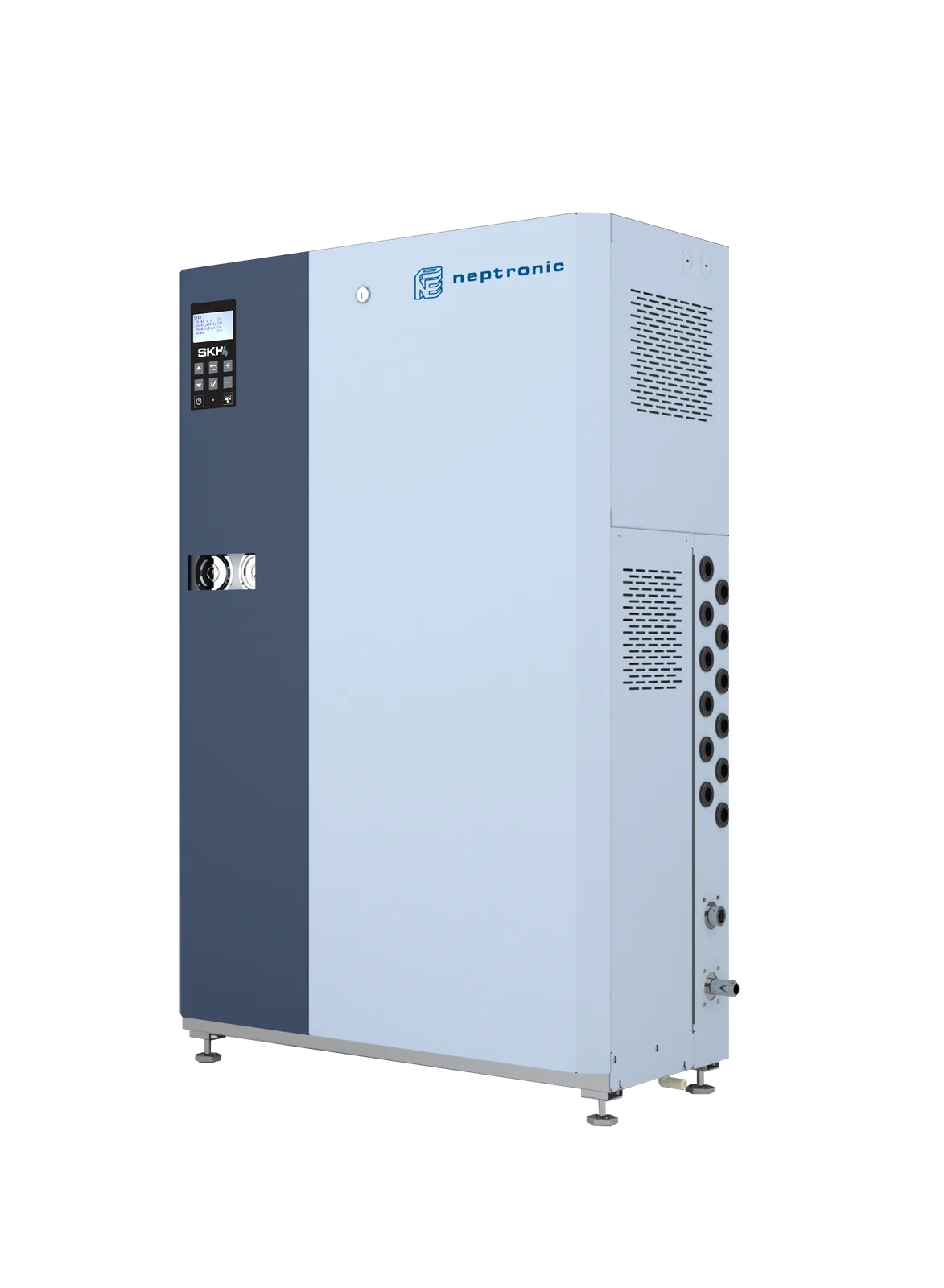
The Neptronic SKH family of high-pressure atomisation humidifiers is the adiabatic flagship of the NKT portfolio. With plunger pump (1.5-7.5 kW), 70-100 bar pressure, 5-10 µm droplets, silver-ion antibacterial cartridge and VDI 6022 hygiene-standard compliance, it is the natural choice for textile, print, wood and greenhouse applications. Complementary evaporative options are also available in the same portfolio: SKV (AHU-integrated) and SKVF (standalone area conditioning).
High-pressure misting systems atomise water at 70-100 bar pump pressure into 5-10 µm micro-droplets and draw evaporation energy from the air, producing both humidification and free cooling as an adiabatic technology. Compared with a steam system, they consume about one-tenth of the energy; they are structurally the natural choice for high-capacity, year-round, low-to-medium hygiene applications. Correct water conditioning (RO + UV + tank circulation), correct droplet size (<10 µm) and the correct control strategy (PID + high-limit + zoning) are the three pillars of field reliability.
Typical applications are textile weaving and spinning, offset and flexographic printing, wood and furniture, greenhouse and agriculture, livestock buildings and large warehouses. Borderline cases (pharma cleanrooms, hospital theatres, ICH stability chambers, sensitive print rooms with <±2% band) call for a steam solution. NKT Nem Kontrol Teknolojileri delivers high-pressure misting system design, pretreatment sizing, commissioning and periodic maintenance as a single package, anchored by the Neptronic SKH family.