Definition
A humidification approach in which the heat needed to evaporate water is drawn from the air. High-pressure atomisation, evaporative (wetted-media) humidification and evaporative coolers are adiabatic technologies; the air cools as it is humidified (roughly 2.5 K per 1 g/kg of added moisture). Unit electricity is used only for the pump or fan, while the evaporation energy comes from the air: a cooling gain in summer, requiring make-up heating in winter. RO water and regular hygiene maintenance are basic requirements.
Detailed Explanation
In an adiabatic process no heat is supplied from outside; the heat of evaporation is drawn from the air. The process strictly follows the constant wet-bulb line and, in practice, the constant-enthalpy line; the air can cool at most to its wet-bulb temperature. Enthalpy is calculated as h = 1.006·T + x·(2501 + 1.86·T)/1000 (x in g/kg).
Example: air at 30 °C / 30% RH (x ≈ 7.9 g/kg, wet bulb ≈ 18 °C) humidified adiabatically down to 24 °C reaches x ≈ 10.4 g/kg (+2.5 g/kg) and ≈ 56% RH; enthalpy stays almost constant.
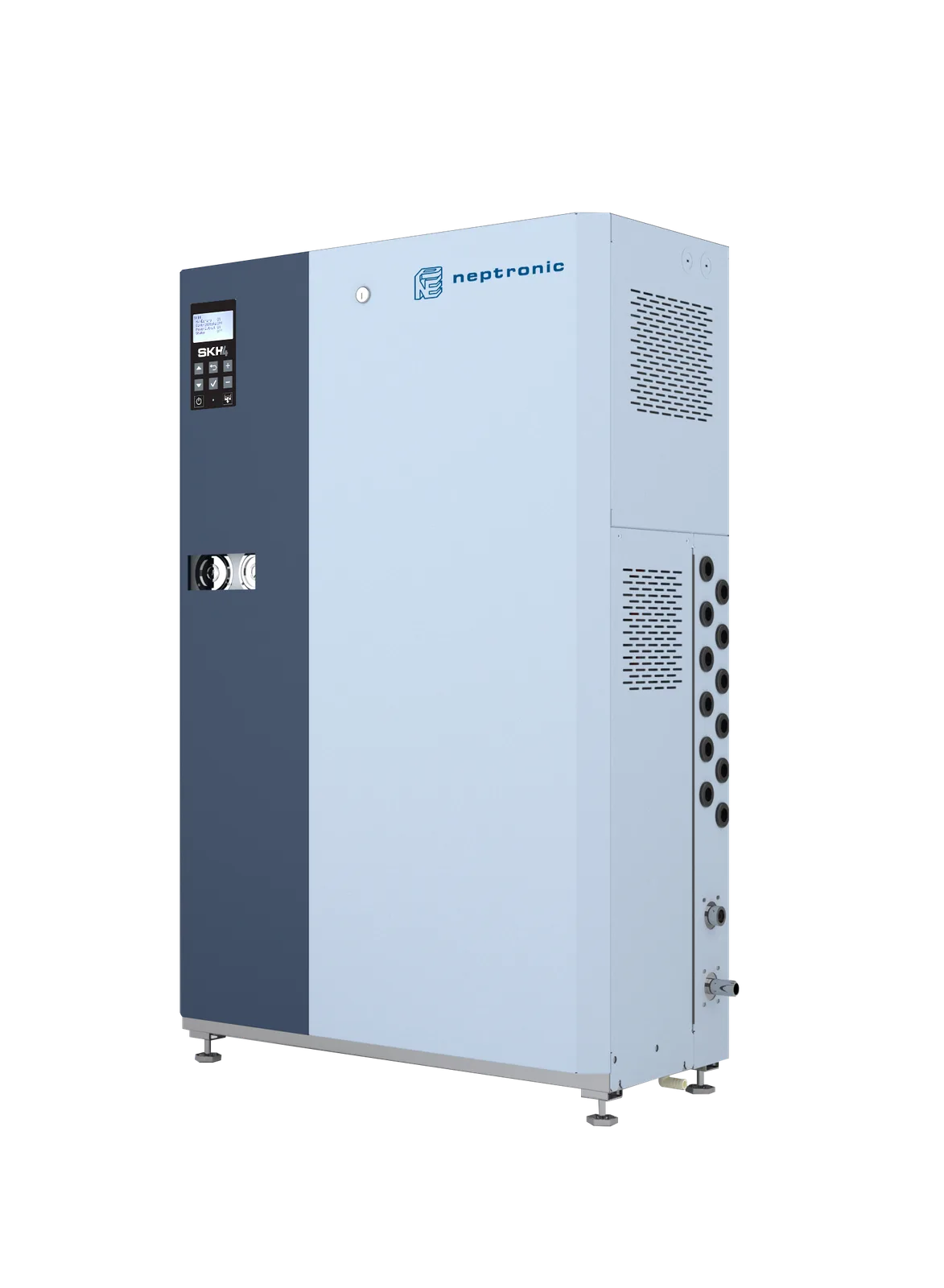
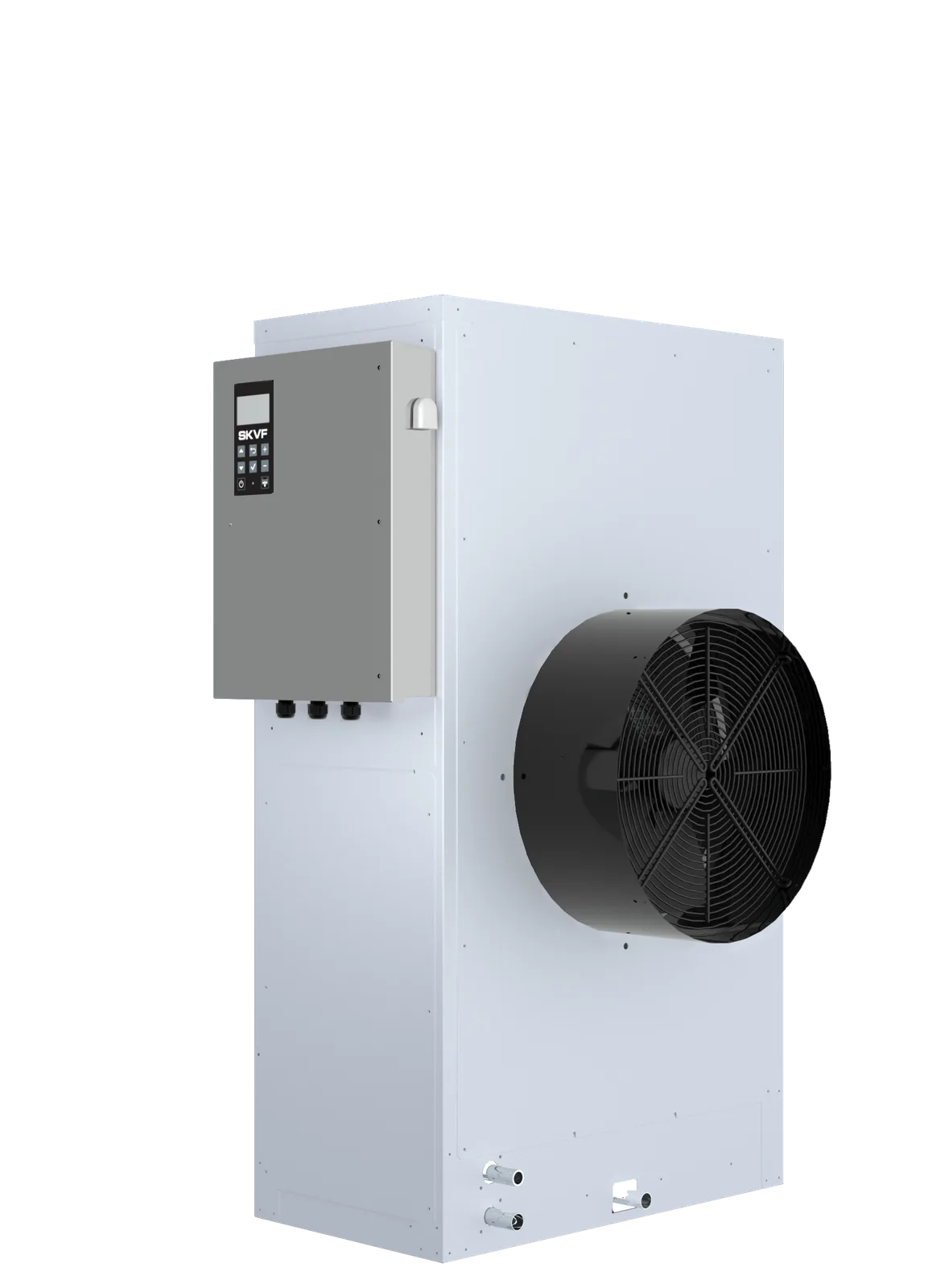
Technologies (Neptronic): • SKH high-pressure atomisation — 70 bar, droplets below 20 µm, 20/50/100 kg/h, in-duct, in the AHU or free space • SKV evaporative humidifier — wetted media inside the AHU, configured per project • SKVF standalone evaporative cooler — ECM fan, 3,000–10,194 m³/h
Energy Balance
An electric steam humidifier uses ≈ 0.75 kWh/kg of electricity. In an adiabatic unit electricity is used only for the pump/fan; the heat of evaporation (≈ 2,450 kJ/kg ≈ 0.68 kWh/kg at around 20 °C) is drawn from the air.
Example: at 150 kg/h an electric steam unit draws ≈ 113 kW of electricity; an adiabatic system draws ≈ 100 kW of heat from the air. In summer this heat comes off the cooling load; in winter, if indoor temperature is held constant, it is made up by heating. The advantage is that the energy comes from a cheaper heat source than electricity, or from the air in summer; payback is calculated per site.
Engineering Note
• Winter sequence: preheat → adiabatic humidification → reheat if needed. • Water quality: RO water is standard for atomisation (SKH: hardness ≤ 50 mg/L CaCO₃; mandatory on the 100 kg/h model). • Hygiene: a design that leaves no stagnant water, periodic cleaning and disinfection, UV where needed. VDI 6022 (Germany's ventilation-hygiene guideline) is the common reference. • Control band: typically ±3–5% RH. Pharmaceutical cleanrooms, operating theatres, laboratories and museums that need a tight band and high hygiene generally prefer steam humidification.
NKT – Nem Kontrol Teknolojileri provides equipment supply, unit-selection support, technical service and spare parts; design, installation and commissioning remain with the facility's designer and contractor.