Definition
The concentration of dissolved chloride ions in water (mg/L or ppm); the parameter that directly drives stainless-steel corrosion risk in steam humidifiers.
Detailed Explanation
Chloride (Cl⁻) is one of the most common dissolved ions in water. Natural sources, saline groundwater, seawater intrusion in coastal areas and wastewater are the main sources. It is measured by titration (e.g. the Mohr method) or with an ion-selective electrode. The Turkish drinking-water regulation and EU Directive 2020/2184 give an indicator value of 250 mg/L for chloride; WHO sets no health-based value and notes that chloride above 200–300 mg/L can give water a taste.
Why It Matters
Chloride can locally break down the protective chromium-oxide layer on stainless steel and cause pitting corrosion; under high temperature and stress there is also a risk of stress-corrosion cracking. The risk increases with chloride concentration, temperature and low pH. Molybdenum-bearing grade 316 resists chloride better than grade 304. Because chloride does not leave with the steam, it reaches a higher concentration in the boiling tank than in the feedwater; drain cycles limit this build-up.
Engineering Note
The permissible chloride level for a humidifier cannot be given as a single general number; it is checked in the manufacturer's feedwater requirements. For high-chloride water, the drain setting and, if needed, RO pre-treatment are evaluated; RO membranes reject most of the chloride.
How Nem Kontrol Teknolojileri Applies It
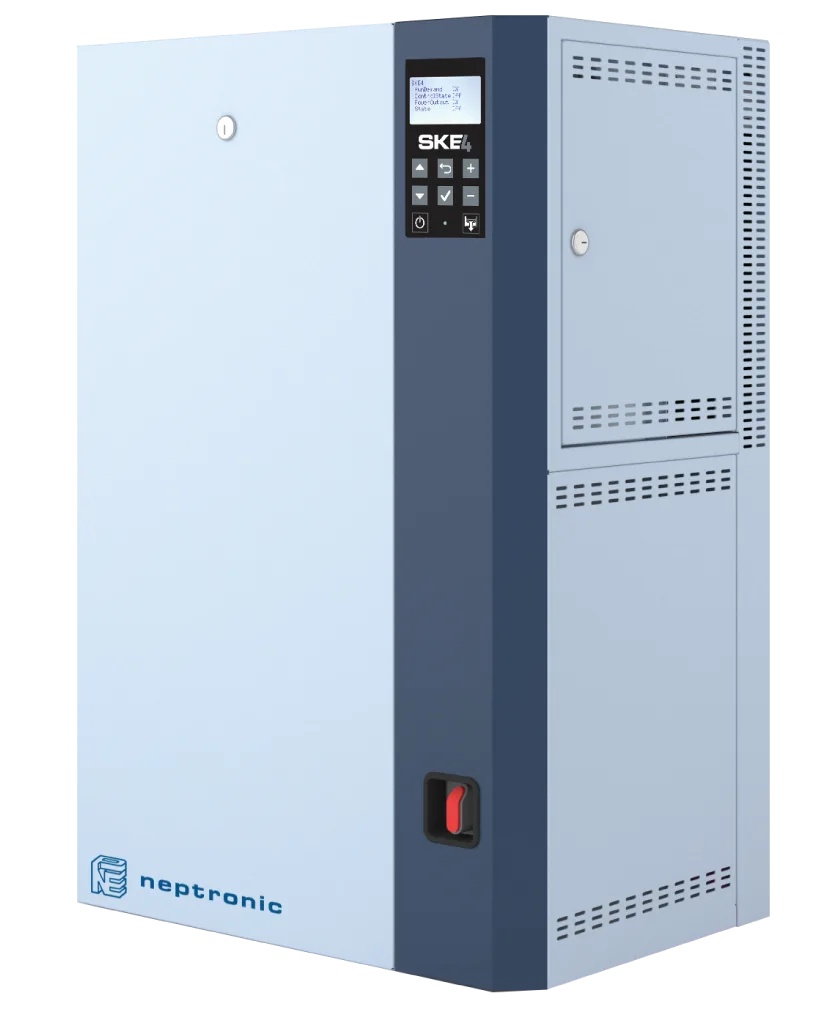
As Neptronic's authorised distributor in Türkiye, Nem Kontrol Teknolojileri asks the customer for a recent water analysis from an accredited laboratory when selecting a steam humidifier and compares the values with Neptronic's feedwater requirements. The resistive Neptronic SKE4 runs on any water, RO and DI included; water quality only affects maintenance frequency. Pre-treatment systems are designed and installed by specialist water-treatment companies.
Related Academy Articles
Related Products
NKT products related to this term