Sectoral Relative Humidity Design Conditions Guide: ASHRAE Table 4 Adapted for Türkiye Industry
This reference guide is the Turkish-industry-adapted, English-language edition of Table 4, Design Indoor Conditions for Various Places, Products, and Processes from the ASHRAE HVAC Applications Handbook. For each sector it provides the indoor design temperature and relative humidity set point, process-level sub-applications, and critical control notes. For mechanical engineers, it is the primary reference for the equipment sizing step; for production and quality teams, it is the starting point for defining indoor set points. The NKT — Nem Kontrol Teknolojileri team has enriched the guide with field notes from over 25 years of projects across Türkiye — sector-specific NKT notes appear under each topic, drawn from print, textile, food, pharmaceutical, museum, lithium battery and electronics manufacturing sites we have commissioned. All calculations from this guide can be performed in seconds with the NKT Pro mobile application, and the sector-selection assistant routes you to the right Neptronic device. The intent of the guide is two-fold: to provide the input data for engineering design, and to act as a reference document that ends set-point arguments during commissioning.
How to Use This Guide
Used correctly, the sectoral design-conditions guide serves three main functions. First, as the input data for engineering design. In a new facility, or in the retrofit project of an existing one, the sectoral set point is the very first step — without it neither the load calculation nor equipment sizing can proceed. Second, as preparation for audits and certification. The HACCP plan, GMP audit, ISO 22000 certification process, TÄ°TCK inspection, FDA inspection — all of these processes require the design condition as a written specification. The sectoral guide is the tangible document showing which standard you reference and why the chosen set point was selected. Third, at commissioning and performance verification. After commissioning, does the ambient condition stabilize and meet the table over the long run? Sectoral reference values are the continuous comparison baseline that answers this question. In all three roles, no single table is enough on its own — each of the 10 sector groups below must be evaluated together with its process needs, regulatory framework and Türkiye field experience.
About ASHRAE Table 4 and the Türkiye Adaptation
The ASHRAE HVAC Applications Handbook is updated every four years by the American ASHRAE society; Table 4 lives in the Industrial Air Conditioning chapter. Its values rest on decades of international research, manufacturer feedback and field observation. That said, ASHRAE values default to North American conditions — product-quality standards, average climate, atmospheric pressure and operator practice can differ in nuance. In Turkish industry, local adaptation is required especially for (a) Turkish (Oriental-type) tobacco, (b) hazelnut (Black Sea hazelnut), (c) traditional cheeses (kashar, tulum, beyaz peynir), (d) historic-building / museum conditions, and (e) high-altitude facilities (Erzurum 1,850 m, Konya 1,020 m, Kayseri 1,050 m). This guide is the English-language, Türkiye-industry-adapted edition of ASHRAE Table 4, with references to Turkish standards (Turkish Food Codex Notifications, TS EN norms, TS 825 climate zones) where applicable.
Food and Beverage Manufacturing
Food and beverage manufacturing is one of the broadest industry segments in Türkiye. Each sub-process requires its own relative humidity (RH) level; the table below covers the main production lines for bread, dough, brewing, candy, chocolate, cheese, mushrooms, meat and fish, and fruit storage. When choosing design conditions, not only process yield, but also water activity (aw), microbial safety (HACCP) and Turkish Food Codex requirements must be observed. In food lines, the stability of room moisture matters as much as the average set point; a ±3% RH band is typically targeted.
| Process / Application | Temperature (°C) | Relative Humidity (% RH) | NKT Note |
|---|---|---|---|
| Bread — Flour & Powder Storage | 21–27 | 60 | Unstable RH ruins flour flowability and dosing accuracy |
| Fermentation (Dough Mixing) | 27 | 75 | Critical band for yeast activity |
| Dough Resting (Cold Retarder) | 0–4 | 85 | Cold + high RH; condensation control is critical |
| Final Proof | 35–49 | 85–90 | High temperature + high RH; atomization recommended |
| Counter-flow Cooling (Post-baking) | 24 | 80–85 | High RH to prevent crust cracking |
| Brewing — Hop Storage | 0–2 | 50–60 | Cold + moderate RH to slow hop oxidation |
| Yeast Culture Room | — | 80 | High RH for cell viability |
| Candy — Chocolate Pan Supply Air | 13–17 | 45–55 | Low RH reduces fat-bloom risk |
| Enrober Room | 27–29 | 25–30 | Very low RH for coating gloss |
| Chocolate Cooling Tunnel Supply Air | 4–7 | 70–85 | Detailed reference: chocolate cooling tunnel guide |
| Hand Dippers | 17 | 45 | Low temperature + low RH; manual-line ergonomics |
| Molded Cooling | 4–7 | 70–85 | Filling contamination control |
| Chocolate Packaging & Stock Storage | 18 | 50 | Sugar bloom and fat bloom prevention |
| Centre (Center) Tempering | 24–27 | 30–35 | Low RH for crystal stabilization |
| Marshmallow Setting | 24–26 | 40–45 | Tackiness control |
| Hard Candy Cooling Tunnel | 16–21 | 40–55 | Stable structure below glass-transition (Tg) |
| Hard Candy Packaging | 21–24 | 35–40 | Low aw for shelf life |
| Caramel Room | 21–27 | 40 | Crystallization and flow control |
| Jelly & Mogul Line | 20–24 | 30–40 | Detail: jelly resting guide |
| Cheese Type | Temperature (°C) | Relative Humidity (% RH) | NKT Note |
|---|---|---|---|
| Cheddar | 7–13 | 85–90 | Long-term stable; RH protection via atomization |
| Swiss | 16 | 80–85 | Propionic-fermentation balance for eye formation |
| Blue / Roquefort | 9–10 | 95 | Cross-link: kashar ripening guide |
| Limburger | 16–18 | 95 | Surface mold development; tight RH control |
| Camembert | 12–15 | 90 | Penicillium camemberti activation |
| Kashar / Tulum (Turkish Cheeses) | 4–14 | 85–92 | Seasonal band shift; NKT field standard |
| Stage | Temperature (°C) | Relative Humidity (% RH) | NKT Note |
|---|---|---|---|
| Sweat-out | 49–60 | — | Pasteurization-like heating; RH not measured |
| Spawn Added (Inoculation) | 16–24 | Near saturation | High RH for mycorrhizal growth |
| Pin / Crop Growth | 9–16 | 80 | Fruiting-body formation; atomized humidification |
| Storage (Post-harvest) | 0–2 | 80–85 | Cold storage; dehydration control |
| Product | Temperature (°C) | Relative Humidity (% RH) | NKT Note |
|---|---|---|---|
| Fresh Beef | 0–1 | 88–92 | Prevents dehydration and case hardening |
| Frozen Meat | -23 / -18 | 90–95 | Freezer burn prevention |
| Fresh Fish | 1–3 | 90–95 | High RH preserves surface moisture |
| Apples (Cold Storage) | -1 to 4 | 90 | Combined with controlled-atmosphere (CA) storage |
| Lemons / Citrus | 14–16 | 86–88 | Peel dehydration; browning prevention |
| Banana Ripening | 14–18 | 85–95 | Ethylene-controlled ripening room |
| Potato Storage | 4–10 | 90–95 | Sprout suppression vs. moisture preservation |
Textiles and Garment Manufacturing
Textile is Türkiye's traditional export workhorse. To preserve the natural moisture balance of fibers and to prevent yarn breakage and static electricity, the sector requires high relative humidity. The hygroscopic behavior of cotton, wool and synthetic fibers differs significantly: cotton and wool readily absorb ambient moisture, while synthetic fibers (polyester, nylon) require RH for static-charge balance more than surface moisture. The table below lists every step of textile production by fiber type, in line with ASHRAE Table 4.
| Process Step | Fiber Type | Temperature (°C) | Relative Humidity (% RH) |
|---|---|---|---|
| Opening & Picking | Cotton | 24–27 | 55–70 |
| Wool | 24–27 | 60–70 | |
| Synthetic | 21–24 | 50–55 | |
| Carding | Cotton | 24–27 | 50–55 |
| Wool | 24–27 | 60–70 | |
| Synthetic | 21–24 | 50–60 | |
| Silver / Ribbon Lapping | Cotton | 24–27 | 55–60 |
| Synthetic | 21–24 | 55–65 | |
| Combing | Cotton | 24–27 | 55–65 |
| Wool | 24–27 | 65–75 | |
| Synthetic | 21–24 | 55–65 | |
| Drawing | Cotton & Wool | 24–27 | 50–60 |
| Synthetic | 21–24 | 50–60 | |
| Roving | Cotton | 24–27 | 50–60 |
| Synthetic | 21–24 | 50–60 | |
| Spinning | Cotton | 24–27 | 35–60 |
| Wool | 24–27 | 50–55 | |
| Synthetic | 21–24 | 50–65 | |
| Winding & Spooling | Cotton | 24–27 | 55–65 |
| Wool | 24–27 | 55–60 | |
| Synthetic | 21–24 | 60–65 | |
| Twisting | Cotton | 24–27 | 50–65 |
| Synthetic | 21–24 | 50–65 | |
| Warping | Cotton | 24–27 | 55–70 |
| Wool | 24–27 | 50–65 | |
| Synthetic | 21–24 | 50–65 | |
| Knitting | Cotton | 24 | 60–65 |
| Synthetic | 24 | 50–60 | |
| Weaving | Cotton | 24–27 | 70–85 |
| Wool | 24–27 | 50–60 | |
| Synthetic | 21–24 | 60–70 |
Printing and Graphic Arts
The printing industry relies on stable relative humidity because of the hygroscopic nature of paper. Paper loses dimensional stability with even ±2% RH excursions; this causes color registration errors, curl, static electricity and ink-transfer issues. The table below presents the printing-and-graphic-arts section of ASHRAE Table 4 in English with NKT field notes.
| Application | Temperature (°C) | Relative Humidity (% RH) | NKT Note |
|---|---|---|---|
| Platemaking | 24–27 | Max. 45 | Low RH for photo-chemical stability |
| Lithographic Press Room | 24–27 | 43–47 | Narrow band; ±2% RH precision required |
| Letterpress & Web Offset Press Room (Paper Storage) | 24–27 | 50 | Most Turkish print houses operate at this set point |
| Multicolor Sheet-Feed Lithography — Paper Storage | 24–27 | 5–8 points above press room | Storage RH = press room RH + 5–8 points |
| Bindery and Finishing | 24 | 50 | For glue cure time and paper flexibility |
| Digital Print & Laser Toner Lines | 22–24 | 40–55 | Critical static-electricity management |
The RH delta between the paper-storage room and the press room dramatically influences paper performance during printing. The ASHRAE convention is to hold the paper-storage RH 5–8 points above the press room; this delta lets newly-arrived paper gradually equilibrate before entering the press. Without it, paper absorbs or releases moisture during printing — causing grain-direction curl, ink spread and static issues. For a detailed case study see Humidification Load Calculation — Konya Print Shop Case.
Pharmaceutical and Healthcare Facilities
Pharmaceutical manufacturing and healthcare facilities sit at the tightest end of the RH-control spectrum. GMP (Good Manufacturing Practice), cGMP Annex 1, ICH Q1A stability testing, ASHRAE Standard 170 (ventilation of health-care facilities) and ISO 14644 cleanroom standards form the regulatory frame of set-point selection. In Türkiye, the Turkish Medicines and Medical Devices Agency (TİTCK) audits cite these standards directly. The table below lists typical design conditions for pharmaceutical production lines.
| Process / Application | Temperature (°C) | Relative Humidity (% RH) | Standard Reference |
|---|---|---|---|
| Manufactured Powder Storage & Packaging | 24 | 35 | cGMP, ICH Q1A |
| Milling Room, Tablet Compression and Coating | 24 | 35 | cGMP |
| Effervescent Tablets & Powders | 24 | 20 | Ultra-low RH required |
| Hypodermic Tablets | 24 | 30 | cGMP |
| Colloids (Colloid Suspensions) | 21 | 30–50 | cGMP |
| Cough Syrups | 27 | 40 | cGMP |
| Glandular Products | 24 | 5–10 | Very low RH against biological deterioration |
| Ampoule Manufacturing | 24 | 35–50 | cGMP, ISO 14644 |
| Gelatin Capsule Manufacturing & Storage | 24 | 35 | Critical for hygroscopic gelatin |
| Microanalysis Laboratory | 24 | 50 | USP <1058> reagent stability |
| Biological Manufacturing & Liver Extracts | 24 | 35 | cGMP |
| Serums (Serum Production) | 24 | 50 | cGMP, biocontamination control |
| Animal Rooms | 24–27 | 50 | AAALAC + ISO 14644 |
| Area | Temperature (°C) | Relative Humidity (% RH) | NKT Note |
|---|---|---|---|
| Operating Room (OR) | 20–24 | 50 | ASHRAE 170 + Turkish Ministry of Health regulations |
| Cystoscopic Room | 20–24 | 50 | OR-class standard |
| Fracture Room | 20–24 | 50 | OR-class standard |
| Patient Rooms | 24 | 40–50 | Comfort + IAQ balance |
| Intensive Care Unit (ICU) | 24 | 40 | Lower RH; mucosal dryness prevention |
| Administrative and Service Areas | 21–27 | 30–50 | Comfort band |
| Neonatal / NICU | 22–26 | 30–60 | Infant comfort and skin-moisture balance |
| Delivery Room | 22–26 | 30–60 | NICU-like profile |
| Isolation Rooms (AIIR / PIR) | 21–24 | 30–60 | Negative/positive pressure + RH |
Electronics and Precision Manufacturing
Electronics manufacturing lives at the intersection of static-electricity (ESD) management, moisture-sensitive components (MSL) and cleanroom classification. The ASHRAE Table 4 sections for electrical products and cleanrooms span design conditions from micro-electronics to high-power systems. In high-precision production areas, holding ambient moisture within ±2% RH is critical both for static control and component moisture absorption. Applications requiring very low dew points (such as the lithium-battery dry room) sit beyond this section in their own category.
| Process / Application | Temperature (°C) | Relative Humidity (% RH) | NKT Note |
|---|---|---|---|
| Coil & Transformer Winding | 22 | 15 | Very low RH; insulation stability |
| X-ray Tube Assembly | 20 | 40 | Vacuum-tube process |
| Instrument Manufacturing & Laboratory | 21 | 50–55 | Calibration stability |
| Thermostat & Humidistat Assembly & Calibration | 24 | 50–55 | Sensor reference point |
| Close-Tolerance Assembly | 22 | 40–45 | Dimensional stability |
| Meter Assembly and Test | 24 | 60–63 | High RH; mechanical-strength testing |
| Fuse & Cutout Assembly, Capacitor Winding | 23 | 50 | General electrical component |
| Conductor Yarn Coating | 24 | 65–70 | Surface-coating uniformity |
| Lightning Arrester Assembly | 20 | 20–40 | High-voltage test environment |
| Thermal Circuit Breaker Assembly | 24 | 30–60 | Calibration precision |
| Runner Hopping (Meter Production) | 21 | 30–50 | Mechanical tolerance |
| Selenium & Copper Oxide Plates | 23 | 30–40 | Semiconductor plate |
| Computer Room & Data Center | 21–27 | 40–60 | ASHRAE TC 9.9 (2021) |
| Cleanroom — General | 21–23 | 40–60 | ISO 14644 Class 7–8 |
| Cleanroom — Critical (QC) | 22–22.5 | 43–47 | ISO 14644 Class 5–6 |
| Lens Fusing (Optical) | 27 | 45 | Optical-component production |
| Lens Grinding | 27 | 80 | High RH; coolant composition |
| SMT (Surface Mount Technology) Line | 22–24 | 35–55 | MSL component protection |
| Wafer Fab (Semiconductor) | 22 ±0.5 | 40–45 | ISO 14644 Class 1–3; ultra-stable |
Museums, Archives and Libraries
For paper, leather, wood, textile and metal artifacts, RH stability matters at least as much as the average set point. ASHRAE Class A / B / C / D classification governs long-term archival storage; Class A collections require stable protection within ±5% RH. Temperature is secondary but still relevant: thermal expansion/contraction cycles stress glue and bonding lines. The table below presents the museum/archive section of ASHRAE Table 4.
| Area | Temperature (°C) | Relative Humidity (% RH) | NKT Note |
|---|---|---|---|
| Normal Reading and Viewing Rooms | 21–23 | 40–50 | Balance between visitor comfort and artifact preservation |
| Rare Manuscript Storage | 21–22 | 45 | ±3% RH band required |
| Art Storage Areas | 17–22 | 50 | Wood, canvas, frame stabilization |
| Painting / Art Exhibition Hall | 20–22 | 45–55 | Class A collection requirement |
| Digital Data Archive (Tape / Disk) | 18–22 | 30–40 | Magnetic-media stability |
| Photo Archive (Color Negatives) | 2–5 | 30–40 | Slows color fading |
| Photo Archive (B&W) | 10–15 | 30–40 | Silver-gelatin stabilization |
| Microfilm Archive | 16–20 | 30–40 | Acetate / polyester preservation |
| Numismatic Collection | 18–21 | 40–45 | Corrosion and oxidation control |
The most critical figure for long-term preservation is the ±3% RH band; wider excursions cause dimensional damage, micro-cracks and fatigue in organic materials (wood, leather, glue). For this reason, controller resolution, sensor placement and control strategy of the humidifier matter at least as much as nominal capacity in museum and archive applications. The gold-standard target for museum environments is an average RH of 50% with day-night and seasonal variation held within ±3%.
Raw Material and Component Storage
Raw-material storage stabilizes ingredient input into production lines and underpins dosing and blending precision. The ASHRAE Table 4 raw-material-storage section covers typical commodities — nuts, chocolate, butter, dates, corn syrup, tea — and their storage design conditions. Hazelnut, one of Türkiye's traditional exports, is a major sub-application of this section.
| Product / Material | Temperature (°C) | Relative Humidity (% RH) | NKT Note |
|---|---|---|---|
| Nuts (insect control) | 7 | 50–60 | Turkish hazelnut-exporter standard band |
| Nuts (mould & aflatoxin control) | 1–3 | 50–60 | Long-term storage; lipid-oxidation slow-down |
| Eggs | -1 | 85–90 | Shell-dehydration prevention |
| Chocolate Plates (Block / Slab) | 18 | 50 | Fat-bloom prevention |
| Butter (Frozen) | -7 | — | Frozen storage; RH is secondary |
| Dates, Figs, Raisins, etc. | 4–7 | 50–60 | Sugar crystallization vs. moisture balance |
| Corn Syrup | 32–38 | — | Hot storage; prevents crystallization |
| Liquid Sugar | 24–27 | 30–40 | Brix stability |
| Tea Packaging | 18 | 65 | Aroma and moisture preservation |
| Coffee Bean Storage | 15–20 | 50–60 | Aromatic-compound preservation |
| Spices & Dried Herbs | 15–20 | 55–65 | Essential-oil preservation |
| Milk Powder | 15–20 | 30–40 | Caking prevention |
Plastics and Rubber Manufacturing
The plastics and rubber industry needs RH control both on the production line and in raw-material storage because of polymer feedstocks' moisture sensitivity. Engineering plastics — PA (nylon), PET, PC, ABS — are hygroscopic; they absorb ambient moisture, which then breaks polymer chains by hydrolysis — causing surface bubbles, flow marks and mechanical-strength loss during injection molding. For rubber products, vulcanization is also moisture-sensitive.
| Process / Application | Temperature (°C) | Relative Humidity (% RH) | NKT Note |
|---|---|---|---|
| Plastic Manufacturing Thermoset Areas | 27 | 30–35 | Curing stability |
| Plastic Molding Compounds | 24–27 | 45–65 | Pellet mixing and conditioning |
| Plywood Hot Press | 32 | 60 | Adhesive cure kinetics |
| Plywood Cold Press | 32 | 15–25 | Low RH for wood stabilization |
| Rubber Dipped Goods — Cementing | 27 | 25–30 | Adhesion control |
| Surgical Dipped Goods (Gloves, Catheters) | 24–32 | 25–30 | Hygienic grades |
| Pre-manufacturing Raw Material Storage | 16–24 | 40–50 | Pellet moisture balance |
| Test Laboratory (ASTM Standard Conditioning) | 23 | 50 | ASTM D618 standard condition |
| PVC Processing (Extrusion) | 24–27 | 40–55 | Extrusion stability |
| PA / PET Injection Line | 22–25 | 30–40 | Hydrolysis prevention + static control |
| PVB (Polyvinyl Butyral) Processing — Glass Lamination | 20–24 | 15–30 | Detail: humidity control in glass lamination |
In plastic production, RH control matters both for raw-material stabilization and for finished-product quality. Drying polymer pellets to below 0.02% moisture before injection (residence-time dependent) directly determines surface quality and mechanical strength. For detailed process analysis, see our use of dehumidifiers in plastic production guide.
Tobacco, Leather and Miscellaneous Industries
This section covers the ASHRAE Table 4 entries for tobacco, leather, matches, paint, distilling, gum, abrasive, recreation and general comfort applications. The common thread of these sectors is that ambient moisture is interwoven with the material-conditioning process itself.
| Process | Temperature (°C) | Relative Humidity (% RH) | NKT Note |
|---|---|---|---|
| Cigar / Cigarette Manufacturing (General) | 21–24 | 55–65 | Leaf elasticity |
| Softening | 32 | 85–88 | Steam-conditioning process |
| Stem & Stripping (Vein Separation) | 24–29 | 70–75 | Leaf-separation elasticity |
| Filler Tobacco Casing & Conditioning | 24 | 75 | Aroma and moisture fixation |
| Filler Tobacco Storage & Preparation | 26 | 70 | Long-term stabilization |
| Wrapper Tobacco Storage & Conditioning | 24 | 75 | Leaf integrity is critical |
| Process | Temperature (°C) | Relative Humidity (% RH) | NKT Note |
|---|---|---|---|
| Leather — Drying | 21–49 | 75 | Controlled drying; prevents cracking |
| Leather — Storage | 10–16 | 40–60 | Balance of stiffness vs. flexibility |
| Leather — Post-tanning Conditioning | 20–25 | 50–55 | Dye-uptake capacity |
| Process | Temperature (°C) | Relative Humidity (% RH) | NKT Note |
|---|---|---|---|
| Match Manufacturing | 22–23 | 50 | Adhesive and phosphorus stabilization |
| Match Drying | 21–24 | 60 | Controlled drying |
| Match Storage | 16–17 | 50 | Controlled environment for fire safety |
| Application | Temperature (°C) | Relative Humidity (% RH) | NKT Note |
|---|---|---|---|
| Oil-Based Paint Spraying | 16–32 | 80 | Solvent-evaporation control |
| Distilling — Grain Storage | 16 | 35–40 | Fungus and insect control |
| Distilling — General Manufacturing | 16–24 | 45–60 | Fermentation |
| Distilling — Aging / Maturing | 18–22 | 50–60 | In-cask alcohol-concentration control |
| Animal Fur Storage | 2–5 | 45–55 | Microorganism control |
| Gum Manufacturing — Rolling / Stripping / Breaking | 20–24 | 30–35 | Tackiness balance |
| Gum — Wrapping | 20–23 | 30–40 | Prevents foil sticking |
| Abrasive Manufacturing | 25 | 50 | Binder cure |
| Bowling Alley (Recreation) | 23–24 | 50–55 | Wood-floor and rubber-ball stability |
| Billiard Hall | 23–24 | 40–50 | Billiard-table surface moisture |
| Comfort Air Conditioning (General) | 24–27 | 50–60 | ASHRAE 55 comfort envelope |
| Swimming Pool Hall | 26–29 | 50–60 | Evaporation vs. comfort balance |
| Ice Rink Air Volume Above Ice | 10–15 | 40–55 | Dew point < ice-surface temperature rule |
From Table to Calculation: In Seconds with NKT Pro
The sectoral design conditions in this guide are only the input data for engineering design. To bring the table to life on site, follow this 4-step discipline:
- Select the sector + sub-application row — Identify the exact process step in the table (e.g., "Textiles — Cotton Spinning").
- Read the temperature + RH set point — These define the indoor design condition (point B in Article 1).
- Apply the humidification load calculation — Use the L = (B − D) × V formula from the Humidification Load Calculation guide to compute hourly load.
- Add a safety margin to the device capacity — Apply a 15–25% service margin to the calculated load; the result gives the nominal capacity of the humidifier/dehumidifier to be selected.
1. Set point = Table 4 row (T °C / RH %)
2. Indoor absolute humidity (B) = saturated_vapor(T) × RH/100
3. Outdoor absolute humidity (D) = ASHRAE 99% / TS 825 (driest month)
4. Air volume (V) = ACH × room volume (natural/mixed/makeup)
5. Load (L) = (B − D) × V
6. Device capacity = L × (1 + safety margin)
Device capacity = L × 1.20 (example: 20% margin)
NKT Engineering Tools — Quick Access
To process the sectoral design conditions in this guide, use NKT's free web-based engineering tools:
- Humidification Load Calculation Guide — Step-by-step bridge from design conditions to kg/h load.
- Psychrometric Calculator — From temperature + RH inputs: dew point, absolute humidity, enthalpy, wet bulb, vapor pressure, specific volume.
- Industrial Dehumidification Calculator — Dehumidifier capacity sized to sectoral design conditions.
- Air Mixing Calculator — Output temperature and humidity for a mixing box.
- Engineering Unit Converter — SI ↔ imperial, kg/h ↔ lb/hr, °C ↔ °F, Pa ↔ psi.
- Humidification Capacity Calculator — Humidifier-capacity sizing.
- NKT Pro Mobile App — Fast on-site report, device-selection assistant, PDF delivery from your phone.
- Contact NKT Engineering Team — Request a sector-specific design-condition study or an on-site survey.
Matching Set-Point Band with Control Precision
The set point you read in the table is only the average value; the second critical design parameter is the tolerance band (e.g. ±2% RH vs. ±5% RH). Band width directly determines the device technology and control strategy. The guide below summarizes the typical tolerance bands for sectoral applications and the corresponding device-technology recommendation:
| Band Width | Typical Sector | Recommended Technology | Control Strategy |
|---|---|---|---|
| ±1% RH (ultra-precise) | Printing, pharma, museum, calibration lab | Neptronic SKE4 (resistive, SCR modulation) | PID + dual-set (T + RH) + BMS monitoring |
| ±2–3% RH (precise) | Fine-yarn textiles, electronics SMT, hospital OR | Neptronic SKS4 / SKE4 hybrid | PID + duty-cycle modulation |
| ±5% RH (standard) | Textile weaving, food packaging, office comfort | Neptronic SKH (atomization) or SKG4 (gas-fired) | On/off relay + band control |
| ±10% RH (broad) | General storage, workshop, greenhouse | Condensation dehumidifier + atomization | Upper/lower threshold (hysteresis) control |
Defining the tolerance band depends on more than process needs alone — sensor placement, number of measurement points and sensor calibration discipline also enter the equation. With a single-point measurement system, even when the target band is ±2%, local variations across the space (door openings, machine load, airflow patterns) may run ±4% or wider. NKT — Nem Kontrol Teknolojileri recommends 3–5-point data collection and an averaged or worst-case control strategy in critical applications.
Neptronic Humidification and Dehumidification Family
Starting from sectoral design conditions, the device(s) you select will fall into one or more Neptronic product families based on your process RH band and precision needs. Through our Neptronic Canada technology partnership, NKT — Nem Kontrol Teknolojileri brings the full product family to Türkiye.
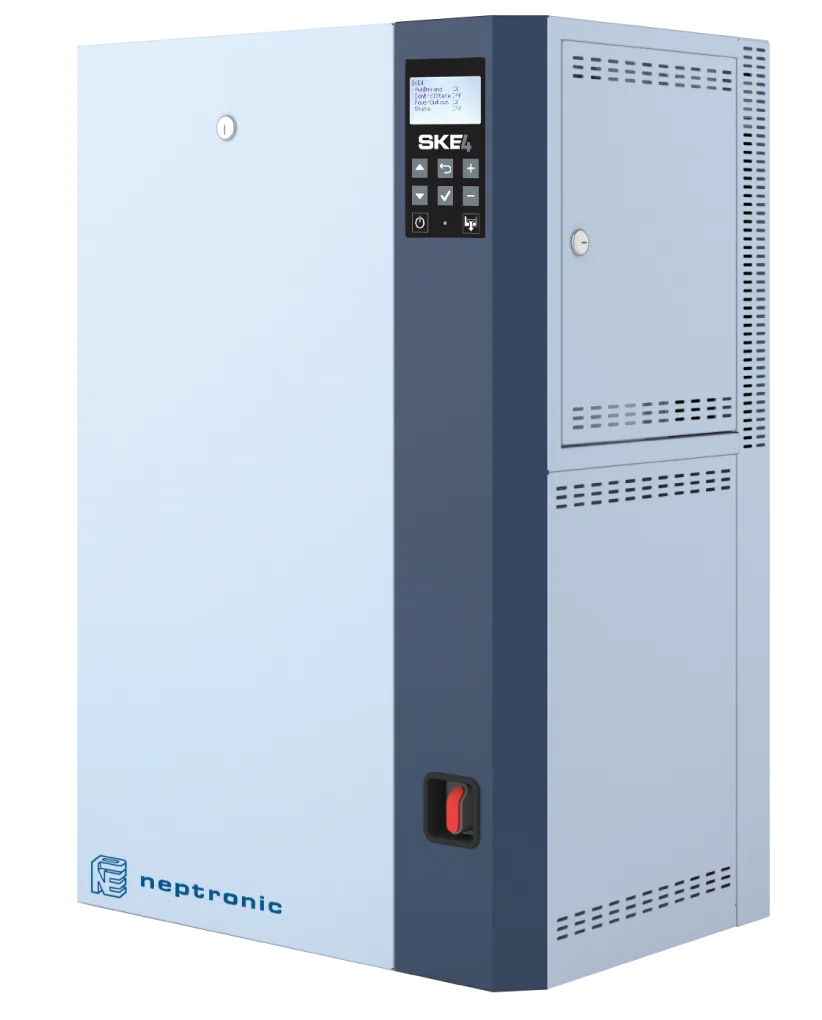
This guide is the direct English-language Turkish-industry-adapted edition of ASHRAE HVAC Applications Handbook Table 4. For most processes, ASHRAE values align with Turkish standards (TGK, TİTCK, Ministry of Health regulations, TS EN norms); for a few sectors (Oriental tobacco, hazelnut, traditional cheeses, hammams and historic buildings) local adaptation is required — in those areas NKT — Nem Kontrol Teknolojileri offers Türkiye-specific recommendations drawn from 25+ years of field practice. We keep the guide current with new standard revisions and NKT field observations.
For a sector-specific design-condition study, an on-site survey, GMP audit-preparation documentation (URS, FDS, FAT, SAT, IQ, OQ, PQ) or periodic-maintenance service, please contact the NKT engineering team; for our other guides on psychrometrics and humidity control, visit the NKT Akademi homepage. With NKT — Nem Kontrol Teknolojileri and our Neptronic Canada technology partnership, we are with you across every region of Türkiye with a field-engineer network, spare-parts inventory and remote-monitoring service.