Definition
A white layer formed on chocolate surfaces when sugar crystals dissolve and recrystallize due to moisture. Occurs when product surface temperature drops below the dew point at the cooling tunnel exit, causing condensation. Prevented by humidity control in cooling tunnels.
Detailed Explanation
Sugar bloom is a white/grayish layer that forms on chocolate and confectionery surfaces due to moisture exposure. It is visually confused with fat bloom, but the chemical mechanisms differ: fat bloom results from recrystallization of cocoa butter crystals, while sugar bloom results from sugar dissolution and recrystallization.
Mechanism: 1. Chocolate enters the cooling tunnel after hot molding/filling (~32°C, 30% RH) 2. Cools to 8–12°C in the cooling tunnel 3. If the surface temperature is sufficiently low, it is below the ambient air dew point 4. Ambient moisture condenses on the surface (microscopic water film) 5. This water film dissolves surface sugar 6. When the chocolate exits the tunnel and warms back to ambient, water evaporates 7. Dissolved sugar is left behind and recrystallizes as white/dull large crystals
Sugar bloom does not make the product unsafe; however, due to appearance, texture, and shelf-life impact, it is a reason for product rejection. In the chocolate industry, sugar bloom is one of the main production KPIs; reject rates exceeding 1% cause significant annual production loss.
Prevention: at the cooling tunnel exit, the ambient dew point must be below the product surface temperature. Typical target: product exit temperature 12°C → ambient dew point ≤ 8°Cdp.
Condensation Risk Calculation
Surface condensation criterion:
Tsurface > Tdp,ambient → safe (no condensation) Tsurface < Tdp,ambient → risk (condensation + sugar bloom)
Safety margin (NKT recommendation): Tdp,ambient ≤ Tsurface,minimum − 3°C
Determining target ambient dew point: Tdp,ambient = Tproduct,exit − ΔTsafety
Typical example values: • Chocolate bar production: Texit = 12°C → Tdp ≤ 9°Cdp • Praline/truffle: Texit = 10°C → Tdp ≤ 7°Cdp • White chocolate (high sugar, sensitive): Texit = 14°C → Tdp ≤ 11°Cdp • Cold filling (mousse, cream-coated): Texit = 5°C → Tdp ≤ 2°Cdp
Reaching these values requires cooling tunnel + dehumidifier integration. Condensation-type units can reach down to +3°Cdp; for lower requirements, the silica gel rotor option is evaluated.
Practical Example
A chocolate bar facility resolves a sugar bloom problem:
Current state: • Product exit temperature: 11°C • Cooling tunnel internal air: 6°C, 75% RH (Tdp ≈ 1.8°Cdp) — theoretically safe • Packaging area at tunnel exit: 22°C, 60% RH (Tdp ≈ 14°Cdp) — CRITICAL • Problem: after exiting the tunnel, the product stays in the 22°C environment for 1–2 minutes before packaging; the 11°C product surface is below the 14°Cdp ambient dew point → condensation → sugar bloom • Reject rate: 2.3% (a significant share of production is lost)
Improvement — air conditioning of the pre-packaging area: Conditioning ambient: 18°C, 40% RH → Tdp ≈ 4°Cdp ✓ Safety margin: 11 − 4 = 7°C → strong margin
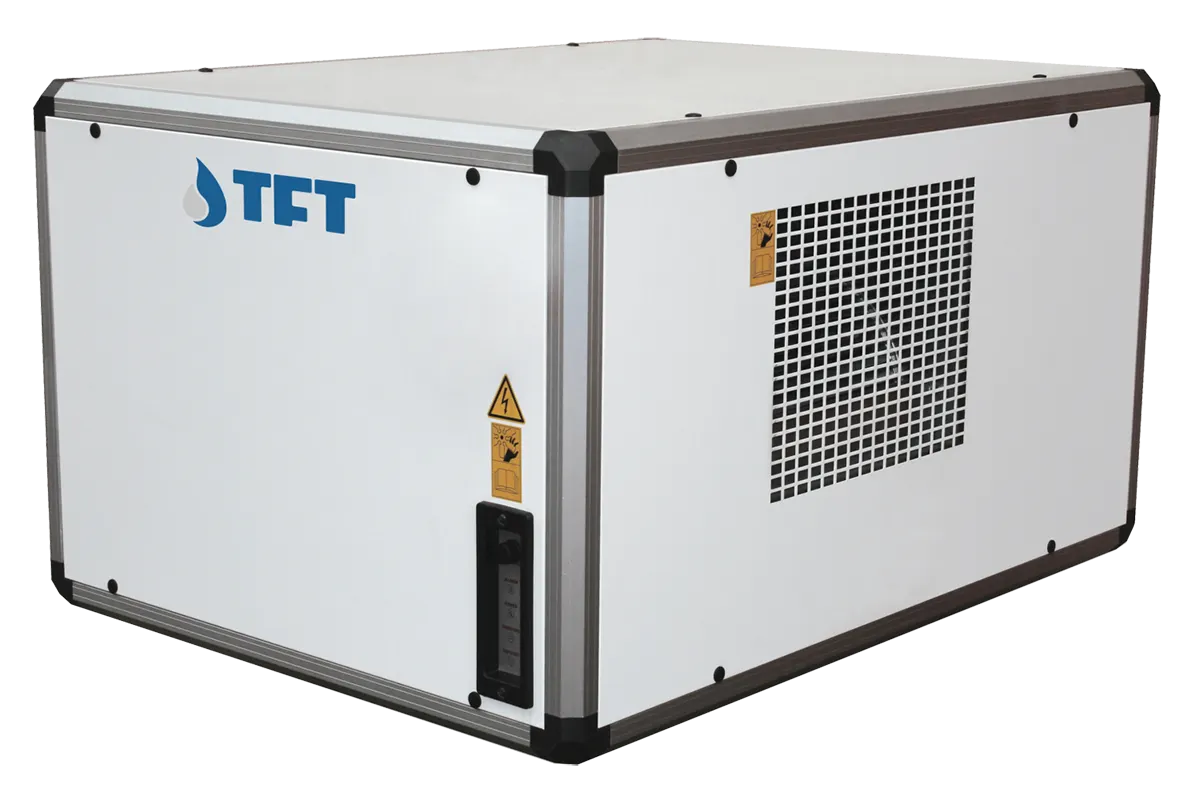
Dehumidifier selection: • Area: 200 m³, circulation 30 ACH = 6,000 m³/h • Summer peak load (with outdoor infiltration): ≈ 18 kg/h • Selection: NKT condensation-type CD400 model + steam humidifier (for winter RH lower limit)
Result: • Sugar bloom reject rate: 2.3% → 0.2% (12-fold reduction) • Production gain: ~2.1% of sellable product is recovered (directly raises margin per packaged unit) • Additional energy load: dehumidification system adds ~25–35 MWh/year (typically 5–8% of the recovered value) • Investment payback: 4–6 months (based on product quality + production efficiency gains)
This example demonstrates the direct economic impact of humidity control on food quality.
Engineering Note
Considerations in humidity control strategy at chocolate/confectionery facilities:
• Continuous chain monitoring — the principle that product temperature > ambient dew point must be maintained throughout the cooling tunnel + packaging + storage chain; a single weak point puts the entire batch at sugar bloom risk. • Seasonal variation — summer outdoor air infiltration increases moisture load 3–5×; the system should be sized for summer peak with modulation capacity for winter. • Personnel management — transitions from high-humidity areas (production line, protective garment change area) to low-humidity areas are contamination sources; air showers or anterooms should be planned. • Storage room — packaged product storage conditions are critical; temperature fluctuations (day/night) create sugar bloom risk. Stable RH < 50% and temperature tolerance ±2°C are recommended. • Material selection — packaging materials with moisture barriers (aluminum film, polypropylene) partially prevent sugar bloom but do not stop condensation during production. • Monitoring system — multi-point dew point sensors (packaging area, storage, store) integrated with BMS for alarms; visual analysis dashboards similar to the Sterling Chart improve operational efficiency.
In its food sector applications, NKT designs sugar/fat bloom prevention humidity control systems for chocolate, confectionery, halva, Turkish delight, and ice cream production facilities; reference projects include major chocolate brands.