Steam humidifier specifications usually start with capacity, control interface and price. The single infrastructure input that actually drives equipment lifetime, maintenance cadence, production stability and the sustainability scorecard is something else: feedwater quality. Water in a steam humidifier is not a passive raw material, it is an electrical component, the source of scale-formation rate, and the parameter that shapes the device architecture itself. This guide treats water as an engineering input and explains how parameters such as electrical conductivity, water hardness and TDS affect electrode and resistive steam humidifiers in fundamentally different ways.
Why Water Is Not a Simple Raw Material
In a steam humidifier, water is not a passive fluid undergoing a phase change. The dissolved-ion concentration, total dissolved solids and scale-formation potential of the water act directly on the device\'s working principle and service life. Therefore in steam humidification, water must be treated as an engineering input, as decisive a parameter as thermal load, airflow or set point.
Two common assumptions fail in the field. First: "water is water, all units perform the same." Second: "let me buy a cheap unit, I\'ll fix the water later." Both fail. If equipment is not chosen for the water profile, it either does not run, fails early, or produces excessive maintenance load. The correct sequence is: (1) water analysis → (2) equipment-type selection → (3) pre-treatment decision → (4) commissioning.
Turkey\'s water profile varies by geography: Marmara networks typically 8–18 Fr° (medium-hard), Central Anatolian spring water 20–35 Fr° (hard / very hard), Aegean and Mediterranean coast 12–22 Fr°. Conductivity ranges from 250 to 1,500 μS/cm. This variability rules out a "one device fits all" approach; every project requires a site-specific water scorecard.
Key Water Parameters
For steam-humidifier selection, seven feedwater parameters must be evaluated. Each acts on the device through a different mechanism; parameters are not meaningful in isolation and must be evaluated together.
Figure 1: Water Parameter Scorecard for Steam Humidification
pH (Acidity / Alkalinity)
The acidity or alkalinity of the water. The ideal range for steam humidification is 6.5–8.5 (near neutral). Below 6.5 corrosion accelerates on stainless-steel chambers and piping; above 9 scale and mineral precipitation increase. Typical Turkish mains water sits at pH 7.2–7.8.
Hardness
The combined concentration of calcium and magnesium ions. As steam-generation water heats to 100°C, calcium-bicarbonate solubility falls and CaCO₃ scale precipitates onto the chamber. Below 7 Fr° is soft; 7–14 medium; 14–25 hard; above 25 very hard. Hardness directly drives chamber-cleaning intervals.
Electrical Conductivity
The water\'s ability to conduct current (μS/cm), directly proportional to dissolved-ion concentration. Pure water ≈ 0.055 μS/cm, RO outlet 5–25 μS/cm, mains water 250–700 μS/cm, hard well water 800–1,500 μS/cm. Conductivity is the mathematical basis of electrode-humidifier operation, making it the most critical parameter for equipment selection.
TDS (Total Dissolved Solids)
The combined mass of all dissolved salts and organic matter (mg/L ≈ ppm). Conductivity-to-TDS conversion: TDS ≈ Conductivity × 0.5–0.7. The WHO and TS 266 drinking-water ceiling is 500 ppm; for steam humidification, sites above 500 ppm should consider RO pre-treatment.
Alkalinity
The water\'s bicarbonate (HCO₃⁻), carbonate (CO₃²⁻) and hydroxide (OH⁻) buffer capacity (reported as mg/L CaCO₃). High alkalinity (>200 mg/L) increases scale formation and may cause foaming. Evaluated together with hardness.
Chloride
Cl⁻ ion concentration (mg/L). High chloride (>250 mg/L) creates stress-corrosion (pitting) risk on stainless-steel chambers and heating elements. Coastal regions and ageing municipal infrastructure require attention.
Silica
Dissolved silicon dioxide (SiO₂, mg/L). High silica (>30 mg/L) deposits a "glass-like" hard scale on the chamber surface that resists mechanical cleaning. Volcanic-rock regions of Turkey (e.g. Cappadocia) can show elevated silica.
What Happens to Water Inside a Steam Humidifier?
The fundamental thermodynamic fact of steam generation: when water vaporises, only H₂O leaves; dissolved salts, minerals and solids remain behind in the chamber as mass. This is an inevitable chemical equilibrium. The design question is not how to prevent scale but how to manage it.
One litre of 14 Fr° (typical mains) water leaves about 140 mg of CaCO₃ + other minerals after vaporisation. A 50 kg/h humidifier running 24 hours processes ≈ 1,200 L of water and produces ≈ 168 g of scale. Annually (7,200 operating hours), ≈ 50 kg of scale build-up is typical. This deposit either remains on the chamber surface (mechanical maintenance) or is rejected via blowdown, water waste plus energy loss.
Steam-generation energy balance: ≈ 0.75 kWh of electricity to vaporise 1 kg of water (atmospheric pressure). A 100 kg/h device draws ≈ 75 kW at nominal load. Water quality does not change energy consumption directly; but high-TDS water increases blowdown frequency, which costs energy (every blowdown discards hot water; loss ≈ 3–8%).
How Electrode Steam Humidifiers Work
The basic idea of an electrode steam humidifier is simple: make the water itself part of the electrical circuit. Two stainless-steel electrodes are immersed in a disposable plastic cylinder; 200–400 V alternating current is applied between them. Dissolved ions (Ca²⁺, Mg²⁺, Na⁺, HCO₃⁻, Cl⁻) carry the current; Joule heating against the water\'s resistance brings it to a boil.
In this architecture water is not a passive fluid; it is an active electrical component. By Ohm\'s law (current = voltage / resistance), as conductivity (1/resistance) drops the current drops and steam output falls; as conductivity rises, current can run away. This is why electrode units are restricted to a "conductivity window", typically 125–1,250 μS/cm.
Capacity control is indirect: the device modulates the cylinder water level, increasing the cross-section of the conductive path so current and steam output rise; for low capacity, the level drops. Because this control mechanism is conductivity-dependent, device behaviour shifts when water quality changes seasonally or by source.
Cylinders are disposable: when scale build-up coats the electrodes, conductivity is lost, the cylinder is removed and replaced. Typical cylinder life is 6–18 months; hard water (>20 Fr°) can shorten it to 3–6 months. The disposable plastic cylinder adds a waste line item to the sustainability scorecard.
Why Conductivity Is Critical in Electrode Humidifiers
In an electrode system, conductivity is not a "performance parameter", it is an absolute prerequisite for operation. The typical manufacturer band is 125–1,250 μS/cm; outside this window, the device either fails to run or runs out of control:
- Conductivity < 125 μS/cm: Current cannot flow; the device sits at 5–20% of nominal capacity. RO/DI water is in this category, electrode systems DO NOT operate on RO/DI.
- 125–250 μS/cm: Low-performance band; capacity 30–60% of nominal, control band wide.
- 250–800 μS/cm: Optimum band; near-nominal performance, reasonable cylinder life.
- 800–1,250 μS/cm: High band; performance is good, but scale build-up accelerates and cylinder life shortens.
- Conductivity > 1,250 μS/cm: Current runs out of control; over-current protection trips or cylinders fill within 3–6 months.
Figure 3: Conductivity Range and Humidifier-Type Compatibility Bands
How Resistive Steam Humidifiers Work
The resistive steam humidifier is built on a different engineering philosophy: do not include the water in the electrical circuit, just heat it. Stainless-steel (Incoloy 800 or AISI 316) immersed resistive elements sit inside an AISI 304 stainless-steel evaporation chamber. Current driven through the elements (typically zero-cross controlled via SCR / SSR) raises the surface temperature to 110–130°C; the surrounding water boils into steam.
In this architecture water is not part of the electrical circuit; conductivity can be 0 or 5,000 μS/cm, steam output is unchanged. The device transfers heat to the water directly from the element surface (thermal conduction + convection). This difference makes the resistive system independent of water quality.
Capacity control is direct, by modulating the current applied to the elements (zero-cross switching gives 1%-resolution proportional control). This is the ideal condition for ±1% RH or precise dew-point control, and the reason resistive is the default choice for sensitive print rooms, hospitals, museums and pharma facilities.
The chamber is permanent and tool-free to clean: scale collects on the stainless-steel floor, the chamber is removed or opens via a hatch, sediments are swept out and the chamber is closed. Typical cleaning interval is once a year on soft water and twice a year on hard water; ≈ 30 minutes of technician labour per cleaning. There are no disposable plastic cylinders, the waste line item is zero.
Figure 2: Electrode vs Resistive Working Principle Comparison
Neptronic SKE4 Positioning
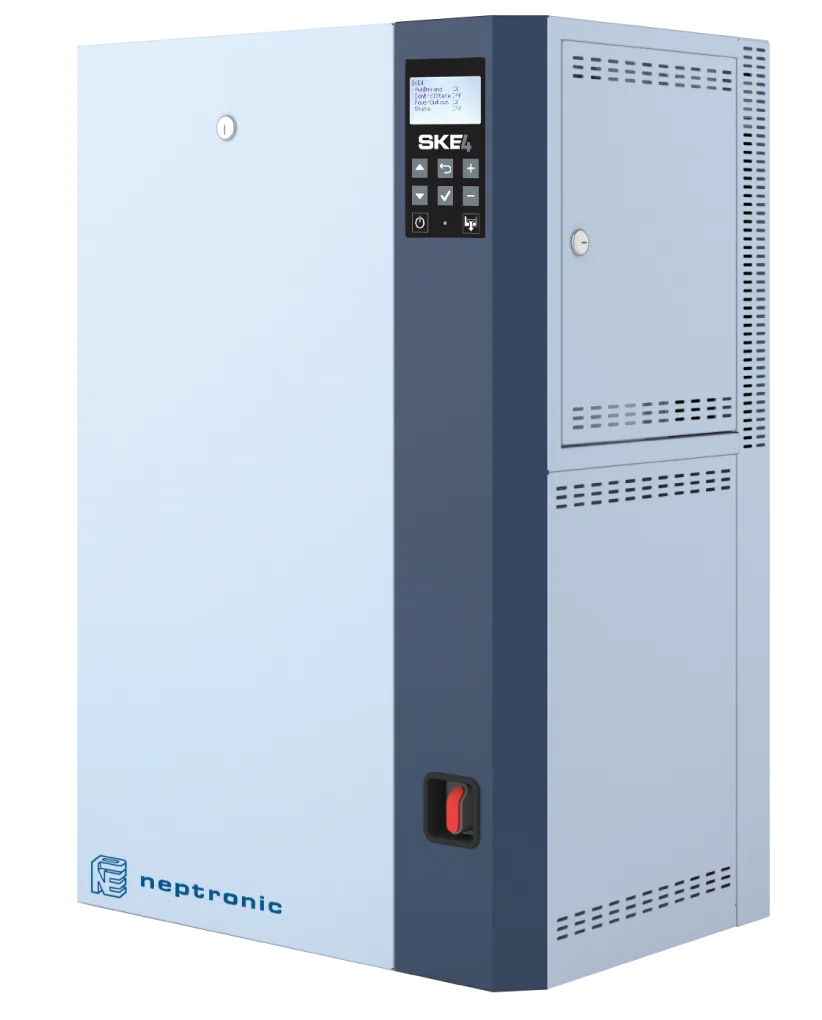
Because the Neptronic SKE4 resistive steam humidifier delivers steam through heat from a resistive element rather than through the electrical conductivity of the water, it returns the same performance on RO/DI water, hard water, soft water and mains water. The AISI 304 stainless-steel permanent evaporation chamber, Incoloy 800 immersed resistive elements and tool-free maintenance hatch take the water-quality discussion off the project agenda.
Key SKE4 features: 2.7 – 136 kg/h capacity ±1% RH control band RO/DI compatible No plastic cylinder BACnet / Modbus Outdoor option. Mineral-free, odourless, sterile steam makes it the natural choice for hospital operating theatres, pharmaceutical facilities, sensitive print rooms, and museum/archive spaces.
The patented Anti-Foaming Energy Conservation (AFEC) system, dual independent water-level sensors and the LCD menu-driven maintenance interface simplify field operation. The fully-insulated outdoor enclosure (anti-freeze + overheat protection) gives installation flexibility without a plant room. BACnet MS/TP, Modbus or optional Ethernet (BACnet IP / Modbus IP web services) for BMS integration is standard.
Electrode vs Resistive Comparison
The table below compares the two technologies across 11 engineering criteria. Cells avoid "good/bad" labels and instead describe each technology\'s structural behaviour in technical terms. The decision flows from matching this behaviour to the facility\'s profile (water quality, precision needs, sustainability criteria, sectoral mandates).
| Criterion | Electrode Steam Humidifier | Resistive Steam Humidifier (SKE4) |
|---|---|---|
| Working principle | Water is part of the electrical circuit; Joule heating via ion current. | Resistive element transfers heat directly to water; water is passive. |
| Dependence on conductivity | High, 125–1,250 μS/cm window required. | None, conductivity is not an input parameter. |
| Low-conductivity water (< 125 μS/cm) | Won\'t run or capacity collapses to 5–20%. | Operates at nominal capacity. |
| RO / DI water compatibility | Incompatible, RO/DI disables the device. | Ideal feedwater, scale effectively zero. |
| Cylinder / chamber maintenance | Disposable plastic cylinder, replaced every 6–18 months. | Permanent stainless chamber, tool-free 1–2 cleanings per year. |
| Capacity stability | Drift with water-conductivity changes. | Stable, water-quality-independent capacity. |
| Water-quality tolerance | Narrow band, hardness and conductivity windows mandatory. | Wide band, soft, hard, RO/DI all served. |
| Suitability for sensitive processes | Typically ±5% RH band; comfort applications. | ±1% RH band; printing, museum, pharma, hospital. |
| Initial investment | Lower (device-price focused). | 15–30% higher; SKE4\'s built-in disconnect closes the gap on installation. |
| Maintenance predictability | Cylinder life depends on water and may shift unexpectedly. | Planned annual maintenance; surprise failures minimal. |
| Typical use case | Office, commercial, warehouse, comfort applications (medium water, ±5% RH). | Hospital, pharma, sensitive printing, museum, data centre, hygienic facility. |
Which Water for Which Humidifier?
The site water profile is the primary determinant of equipment selection. The decision matrix below maps a pre-commissioning water analysis to the appropriate type; the final call is always confirmed by site engineering.
| Water Profile | Conductivity (μS/cm) | Hardness (Fr°) | Recommended Unit | Notes |
|---|---|---|---|---|
| Purified (RO / DI) | 5–25 | 0–1 | Resistive (SKE4) | Electrode does not run. SKE4 ideal, minimal maintenance. |
| Soft (rainwater / softener outlet) | 50–200 | 1–7 | Resistive (SKE4) | Electrode capacity low; resistive stable. |
| Typical city mains | 250–700 | 8–18 | Either is feasible | Decision driven by precision, waste and TCO. |
| Hard mains / well | 700–1,250 | 18–28 | Resistive (SKE4) preferred | Electrode cylinder life 4–8 months; resistive cleans annually. |
| Very hard / mineral-rich well | > 1,250 | > 28 | Resistive + RO pre-treatment | Electrode trips on over-current; not applicable. |
| Hygienic facility (hospital / pharma) | Post-RO 5–25 | 0–1 | Resistive (SKE4) + RO | Mineral-free steam mandatory (HEPA, GMP). SKS4 steam-to-steam is an alternative. |
Most Common Field Issues
From the NKT project portfolio, typical field issues with electrode systems and their causes:
1. Cylinder filled in 3 months instead of 6
Cause: Mains hardness or conductivity exceeded the project assumption. Typical triggers: well-water use, mains source change, seasonal drought. Fix: Water softener + tight periodic analysis or migrate to resistive.
2. Device runs at half nominal capacity
Cause: Conductivity below 125 μS/cm. Typical triggers: soft mains, RO commissioning, rainwater feed. Fix: Mandatory migration to resistive (electrode does not work on these waters).
3. Mineral dust accumulating in steam distribution
Cause: With high-TDS water, steam carries a mineral aerosol; white-dust build-up on HEPA. Typical triggers: TDS > 700 ppm + continuous operation. Fix: RO pre-treatment + resistive system (mineral-free steam).
4. Tight RH control required, system runs at ±5%
Cause: Electrode control logic relies on water-level modulation, slow response, wide band. Fix: Resistive (SKE4), SCR/SSR zero-cross control delivers the ±1% band.
5. RO commissioned, the existing electrode unit stopped working
Cause: RO outlet conductivity 5–25 μS/cm; below the electrode window. Fix: Migrate the electrode unit to resistive (SKE4 returns ideal performance on RO with zero scale).
NKT Approach: Water Analysis Before Equipment Selection
NKT (Humidity Control Technologies opens every project with a feedwater quality analysis) before equipment selection. This sequence removes 80% of the field problems described above. The standard NKT proposal package includes:
- Site water sample: A sample taken at the commissioning point is analysed at a certified lab (pH, hardness, conductivity, TDS, alkalinity, chloride, silica).
- Typical-band measurement: Where possible, two-season measurements are taken, Turkish water conductivity can swing 30–50% over the year.
- Water Quality Scorecard: The seven parameters are reported on one page + a treatment recommendation (softener / RO / DI required?).
- Equipment-type selection: Profile + application (precision, hygiene class, capacity, sustainability) maps to resistive (SKE4), steam-to-steam (SKS4) or atomisation (SKH).
- 10-year TCO analysis: Initial investment + maintenance + waste + energy line items, transparent comparison.
- Commissioning + performance validation: Trend log analysis after 6 months, parameter fine-tuning if required.
The approach is more an engineering service than equipment supply; the right decision underwrites 10+ years of operating reliability. For sensitive printing, hospitals, pharma, museums and data-centre facilities, Neptronic SKE4 stands out as the primary recommendation; SKS4 (where facility steam already exists) and SKH (atomisation, for high-volume + adiabatic-cooling benefit) are complementary solutions.
In steam humidifier selection, water quality is the primary engineering input that drives equipment-type choice. Electrode systems can serve typical mains-fed, medium-precision comfort applications inside the 125–1,250 μS/cm conductivity window, but they are disabled by RO/DI feed, tight RH control bands (≤±2%), hygienic facility requirements, or soft / very-hard water.
Resistive systems (represented by the Neptronic SKE4 family in the NKT catalogue) operate independently of water quality, deliver a ±1% RH control band, generate no disposable plastic cylinders and provide 10+ years of service life. Against modern equipment-selection criteria (sustainability, precision, water flexibility, maintenance predictability), these structural advantages make resistive the default choice for sensitive and hygienic facilities.
For the right decision, water analysis must precede equipment selection. As Neptronic\'s official Turkish distributor, the NKT engineering team delivers the water analysis → equipment selection → commissioning → periodic maintenance chain end to end; every project is documented with a site-specific Water Quality Scorecard and a 10-year TCO analysis.