Definition
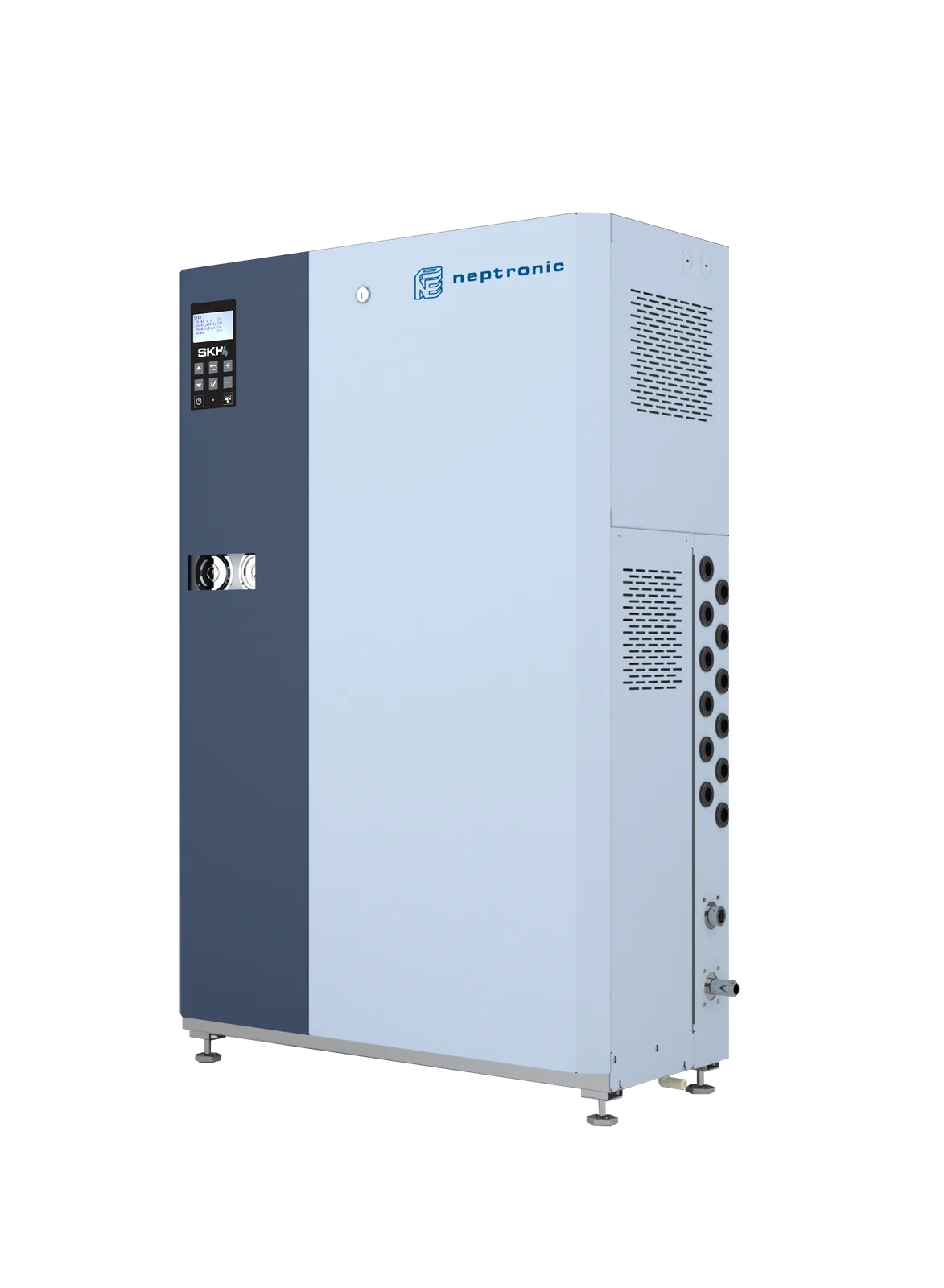
An industrial humidifier that produces steam by heating water in a stainless-steel cylinder with resistive immersion elements. Compatible with DI/RO/hard mains water, ±1% RH precision, no disposable plastic cylinder. Neptronic SKE4 is the industry leader; first choice for offices, hospital corridors, tight-RH print rooms, museums and 24/7 production lines.
Detailed Explanation
A resistive steam humidifier is the gold standard of modern industrial humidification technology. Its operating principle:
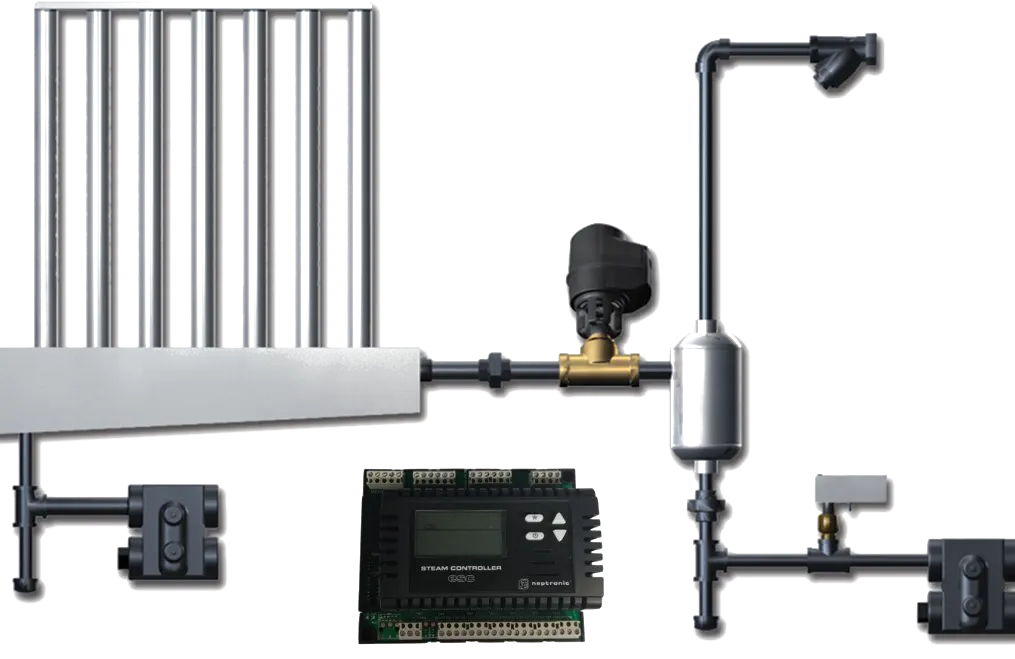
1. Water enters the cylinder (304L or 316L stainless steel) through the fill solenoid valve. 2. 1-12 immersion heater elements submerged in the cylinder (resistive elements, stainless-steel sheathed) heat under electric current. 3. Joule heating brings the water to boiling (100°C at atmospheric pressure); it evaporates. 4. The generated steam flows from the cylinder top outlet pipe to a steam absorption manifold (SAM-e) or in-room dispersion tube. 5. It mixes with the supply air stream in the AHU, raising 2-4% RH; reaches the space with ±1% RH precision control.
Advantages: • Independent of water type — compatible with DI, RO, demineralised, distilled and hard mains (1-50°dH hardness); electrode systems do not work with DI/RO, making the resistive system the only option for pharma and clean rooms. • Hygienic, mineral-free steam — minerals are flushed out via blowdown; outlet steam is mineral-free; ideal for pharma, hospitals, food processing and electronics manufacturing. • Long life — stainless-steel cylinder 8-15 years, heater elements 5-7 years; 85% less consumption than the 6-18 month disposable cylinders of electrode systems. • Zero plastic waste — recyclable stainless-steel body; 30-50% lower carbon footprint in sustainability reporting. • ±1% RH precision — modulating control, SCR/SSR power regulation, sharp PID response; stability guaranteed in sensitive processes. • Modular capacity — 5-180 kg/h per cylinder, 1,000+ kg/h with multi-cylinder configurations; future capacity additions are easy.
Disadvantages: • Initial investment 20-30% higher than electrode systems • Requires DI/RO water preparation (already required in most applications)
Why It Matters
A resistive steam humidifier is virtually the only option in five critical application areas:
1. Hospitals and healthcare — operating theatres, ICU, maternity, isolation rooms require hygienic steam. Nozzle or cylinder scale spreads Legionella, Aspergillus and NTM (non-tuberculous mycobacteria); these infections account for 3-5% of hospital mortality. DI/RO + stainless cylinder = zero microbiological risk.
2. Pharmaceutical manufacturing and sterilisation — GMP clean room Class A/B/C/D; cylinder water must be FDA + EU cGMP compliant. Plastic cylinders pose BPA leaching and product-contamination risk; resistive stainless steel is the only validation-ready technology for IQ/OQ/PQ.
3. Electronics manufacturing (SMT, semiconductor) — silicon wafer fabrication, PCB assembly, semiconductor lithography; mineral release from the cylinder causes clean-room contamination. ESD 50% RH requirement is met with DI water + stainless steel.
4. Museums and archives — UNESCO standard 21°C ± 1, 50% RH ± 3; for preserving wood, paper, leather and textile artefacts. Plastic-cylinder BPA and mineral contamination cause long-term damage; resistive stainless is the standard.
5. 24/7 production lines (printing, textile, automotive) — cylinder-replacement downtime is unacceptable. Electrode systems incur 30-45 min downtime every 12-18 months; resistive systems require 1 h of element check every 5 years.
Energy and Operations Insight: • Modulation precision 1-100% — 15-25% annual energy savings vs traditional staged (1/3, 2/3, 1/1) control • SCR/SSR power regulation → no mechanical contactor → fewer failures → MTBF 50,000+ hours • Predictive maintenance with NKT - Climate Track — trend analysis on element resistance change, blowdown frequency, water consumption; warning ahead of failure
Practical Example
Consider an Istanbul biopharmaceutical plant. 4,500 m² Class C clean room, biological vaccine fill line, 24/7 operation. Design inputs:
• Set point: 22°C ± 1°C, 50% RH ± 3 (cGMP) • Air change rate: ACH 25 (Class C) • Total supply air: 4,500 × 3 × 25 = 337,500 m³/h • Minimum makeup: 30% (ASHRAE 170 healthcare standard) • Winter peak (January, -5°C/2.1 g/kg): humidification load ~370 kg/h
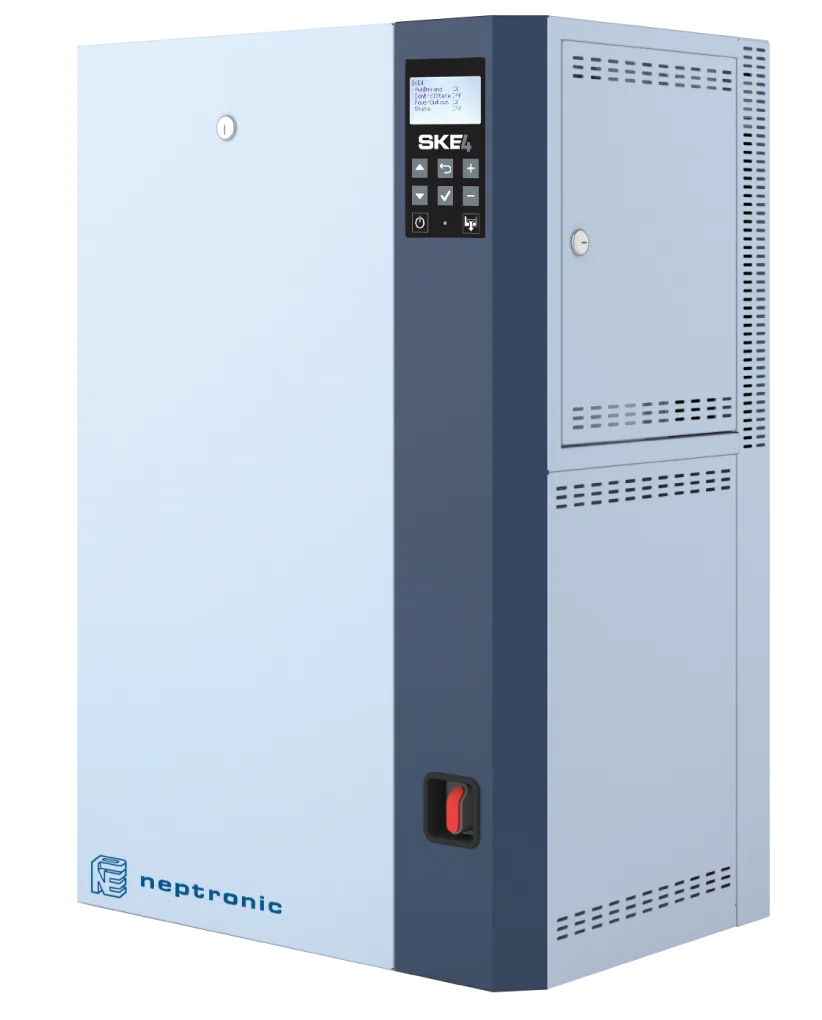
NKT engineering selection: 5 × Neptronic SKE4 80 kg/h (400 kg/h total, 8% margin)
Configuration details: • Water system: RO + EDI, outlet conductivity <0.5 µS/cm, UV-C lamp • Steam distribution: 5 × SAM-e in-duct manifold, ±2% RH homogeneity • PID control: NKT - Climate Track Industrial, ±1% RH precision, dew-point setpoint • Backup: with 4 of 5 units running 320 kg/h, winter peak 86% met (acceptable) • Validation: IQ/OQ/PQ documentation, FDA + EU GMP compliant
Financial analysis (10-year TCO): • Capex: 5 × SKE4 80 kg/h units + RO/EDI + distribution = 220,000 USD • Annual energy (50% avg load): 320 × 0.77 kWh/kg × 24 × 365 × 0.5 = 1,080 MWh × 0.18 USD/kWh = 194,000 USD • Annual maintenance (elements + cleaning): 12,000 USD • 10-year TCO: 220,000 + 10×206,000 = 2,280,000 USD
Electrode alternative comparison: • 10-year TCO: ~3,150,000 USD (cylinder replacement + plastic waste + downtime) • Savings: 870,000 USD + 240 cylinders of plastic waste eliminated
The customer selected the SKE4 system; the resistive + DI-water configuration scored highly in FDA inspection and reduced validation time by 30%. The NKT engineering report was the decisive argument in the investment committee.
Engineering Note
Engineering criteria for resistive steam humidifier design and commissioning:
• Water-quality requirement — DI water (conductivity <1 µS/cm) extends cylinder life to 15+ years; running on hard mains (>20°dH) causes element scaling, halving element life. • Element watt-density selection — low watt density (15-25 W/cm²) extends element life and reduces scaling; high watt density (40-50 W/cm²) gives fast steam production but requires more frequent cleaning. Low is preferred in hygienic applications. • Modulation strategy — SCR (Silicon Controlled Rectifier) provides continuous power and ±1% RH precision; SSR (Solid State Relay) offers time-ratio modulation, simpler but ±2-3% precision. • Steam distribution losses — typical condensation loss in 5-15 m of pipe from cylinder to AHU is 5-10%; can be reduced to 2-3% with insulation and correct slope. • Commissioning test — 24-h load test on cylinder, element current balance, water-level sensor calibration, blowdown interval setting, alarm setpoint verification, PID tuning. NKT commissioning report standard. • Annual maintenance protocol — 1) visual element inspection, 2) cylinder interior cleaning (scale, minerals), 3) electrode connector torque, 4) distribution pipe drain, 5) sensor calibration, 6) safety valve test, 7) NKT - Climate Track report review. • Emergency procedures — cylinder overtemperature (>110°C) → automatic power cut, alarm + valve; low water level → automatic refill + alarm; element current imbalance → fault alarm. • Spare-parts inventory — 1 element set per year, 1 cylinder body for 2-3 years (large facility), spare contactors + sensors + valves. • Training — 4 h operations team, 8 h maintenance team, emergency drills every 6 months; NKT training material standard.
NKT Application Link
NKT is the Türkiye authorised distributor and engineering partner for the Neptronic SKE4 and SKS4 resistive steam humidifier product family:
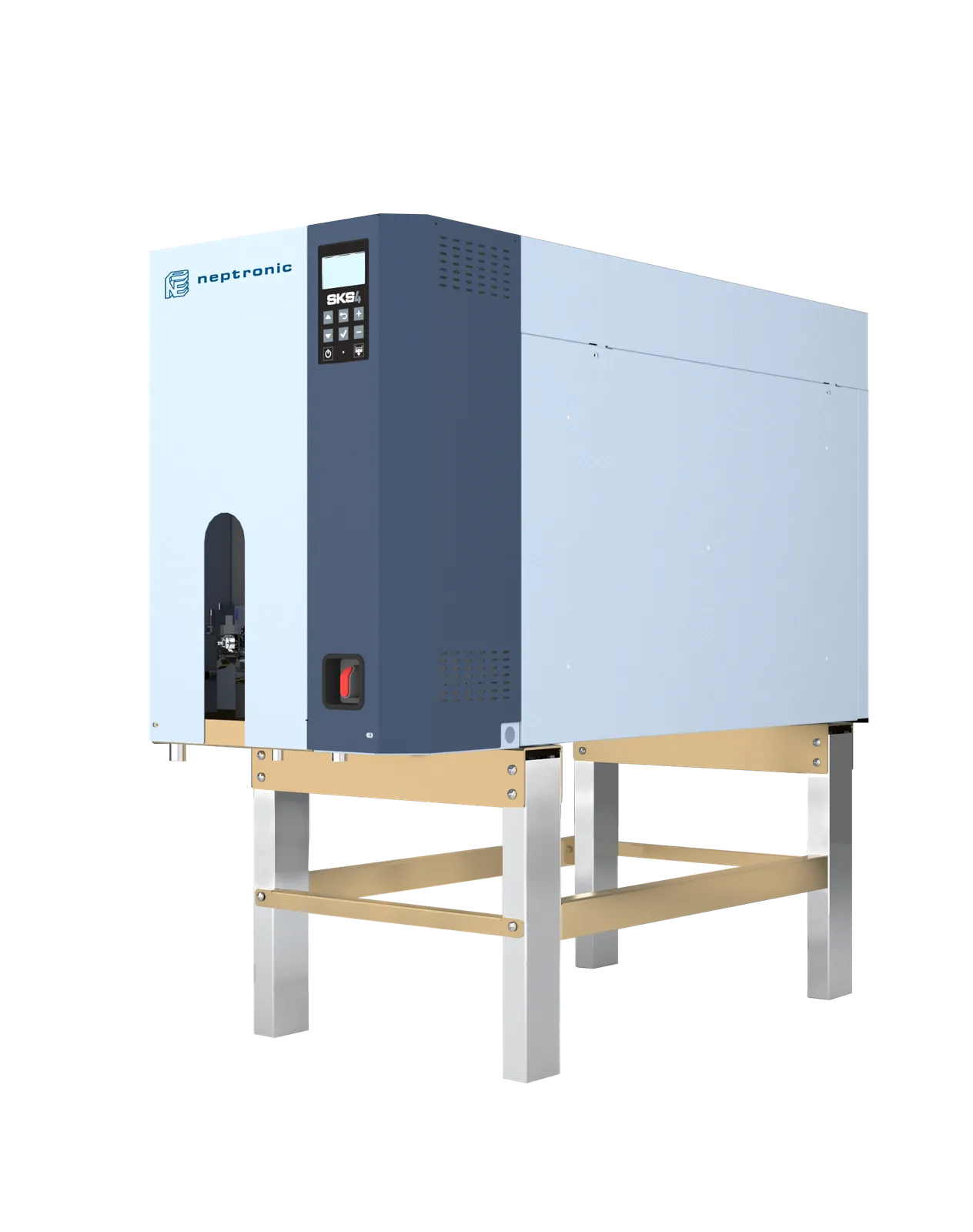
1. Neptronic SKE4 — 5-80 kg/h per cylinder, compact, for office/hospital/lab, ±1% RH precision, modular capacity expansion. 2. Neptronic SKS4 — 80-180 kg/h per cylinder, large industrial use, pharma/electronics/clean room, multi-cylinder cascade, redundancy support. 3. Water-preparation package — RO + EDI system, UV-C lamp, conductivity monitoring, NKT integration. 4. Steam absorption manifold (SAM-e) — Neptronic proprietary manifold, in-duct distribution, ±2% RH homogeneity, zero condensation. 5. NKT - Climate Track Industrial — real-time monitoring, predictive-maintenance algorithm, BMS/SCADA Modbus integration, mobile + web dashboard. 6. Validation support — IQ/OQ/PQ documentation, FDA + EU GMP compliance report, calibration certificates. 7. Maintenance contracts — annual + 4-year plans, remote diagnostics, 24/7 support, 5-year extended warranty.
Sample configuration: 4,500 m² Class C clean room (370 kg/h load): 5 × SKE4 80 kg/h, RO+EDI water, SAM-e distribution, NKT - Climate Track 24 points, IQ/OQ/PQ validation, 5-year extended warranty. Capex 220,000 USD, 10-year TCO 2.28 M USD; 28% savings vs the electrode alternative, zero plastic waste, extra credit during FDA inspection.
Related Academy Articles
- Electrode vs. Resistive Steam Humidifier: Technical and Cost Comparison
- The Importance of Industrial Humidity Control, A Decision Guide for Production Managers
- How to Calculate Humidification Load, A Technical Guide with Türkiye Climate Data
- Water Quality in Humidifiers: Key Differences Between Electrode and Resistive Steam Humidifiers
- Sectoral Relative Humidity Design Conditions Guide, ASHRAE Table 4 Adapted for Türkiye Industry
Related Products
NKT products related to this term