Definition
The combined mass of all dissolved inorganic salts and organic matter in a water sample, reported in mg/L (≈ ppm). For steam humidification, TDS is the single-number summary of feedwater quality; combined with conductivity and hardness, it directly drives equipment selection. Low TDS (post RO/DI, < 50 ppm) disqualifies electrode systems, while a resistive humidifier works across the full TDS range.
Detailed Explanation
TDS is determined by evaporating a defined volume of water at 180°C and weighing the dry residue (gravimetric), or by conductivity-to-TDS conversion (TDS ≈ Conductivity × 0.5–0.7). Standard classes: 0–50 ppm "purified" (RO/DI), 50–250 ppm "soft", 250–500 ppm "typical mains", 500–1,000 ppm "hard", and 1,000+ ppm "very hard / well water."
The WHO and TS 266 drinking-water standards recommend a TDS ceiling of 500 ppm; above 1,500 ppm is unsuitable for drinking. In steam humidification, TDS is not just a quality indicator but a direct lever on equipment life and maintenance frequency.
Why It Matters
During steam generation, dissolved solids do not vapourise with the water — steam is pure water molecules. As a result the TDS load either deposits in the chamber/cylinder (as scale) or is rejected via blowdown (drain). High-TDS feedwater accelerates scale build-up, raises chamber liquid level, increases blowdown frequency, and wastes energy (every blowdown discards hot water).
In a resistive humidifier the chamber-floor sediment is removed tool-free; the unit keeps running at any TDS, only the maintenance interval shortens. In an electrode humidifier high TDS both shortens cylinder life (frequent replacements) and can push conductivity above the design window (loss of capacity control). The two technologies' response to high TDS is asymmetric — resistive is resilient, electrode is fragile.
Practical Example
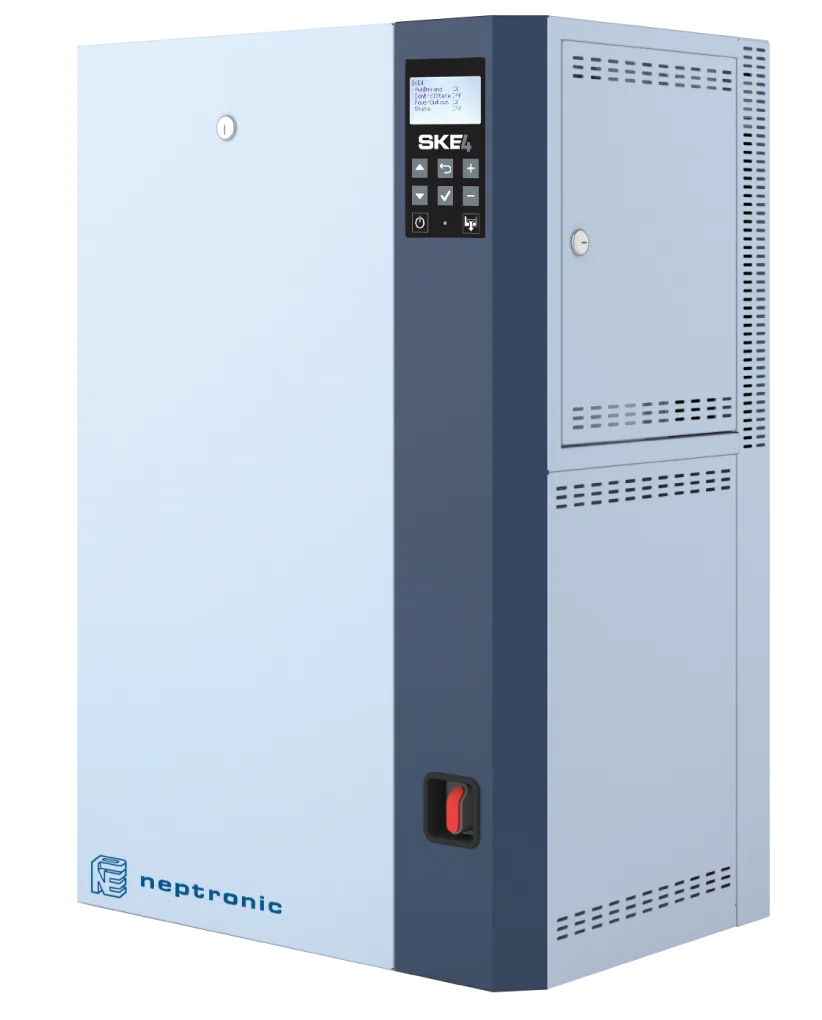
A pharmaceutical plant has an existing RO system feeding the sterile area: RO outlet TDS 12 ppm, conductivity 18 μS/cm. These values fully disqualify an electrode humidifier (conductivity below the operating window). Solution: a Neptronic SKE4 resistive steam humidifier fed directly from the RO outlet. Chamber scale build-up is effectively zero; the maintenance plan reduces to an annual visual inspection.
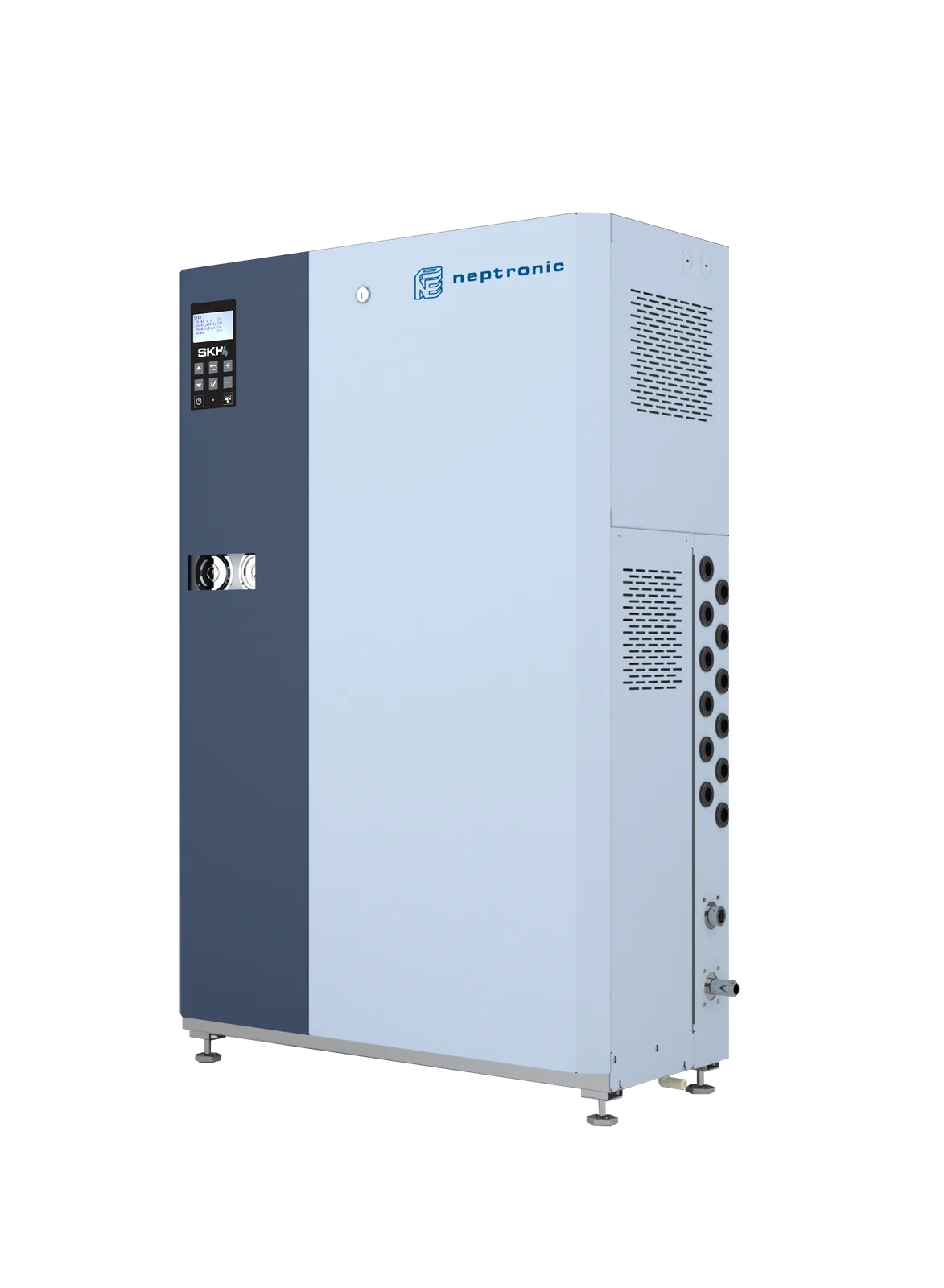
Another case: an Anatolian textile plant on well water; raw TDS 1,150 ppm, hardness 38 Fr°. RO pre-treatment was added for the atomisation lines (RO outlet TDS 28 ppm), and a Neptronic SKH high-pressure atomisation unit was commissioned. The combination prevented nozzle clogging and eliminated mineral dust dispersion in the space. NKT proposals report TDS at two points: raw water and post-treatment.
Engineering Note
TDS and conductivity are separate lab-standard measurements; in the field, portable TDS pens (typically 0–9,990 ppm) read conductivity and convert to TDS with a fixed factor — typical tolerance ±5%. For precise validation a TS EN ISO 17025-accredited lab gravimetric analysis is preferred.
NKT proposals stress that TDS is not meaningful alone; it is evaluated together with conductivity + hardness + alkalinity + chloride + silica. In particular, high silica values (SiO₂ > 30 mg/L) produce a "glass-like" hard scale on the steam chamber surface that resists mechanical cleaning; in such cases RO pre-treatment and continuous blowdown are mandatory.
NKT Application Link
Every NKT engineering deliverable opens with a "Water Quality Scorecard": raw-water TDS, conductivity, hardness, chloride, silica + recommended treatment scheme (softener / RO / DI) + selected Neptronic equipment + expected annual maintenance cost. The scorecard serves both as a commissioning guide on site and as a decision-support document for the customer.
Related Academy Articles
Related Products
NKT products related to this term