
Condensing Dehumidifiers
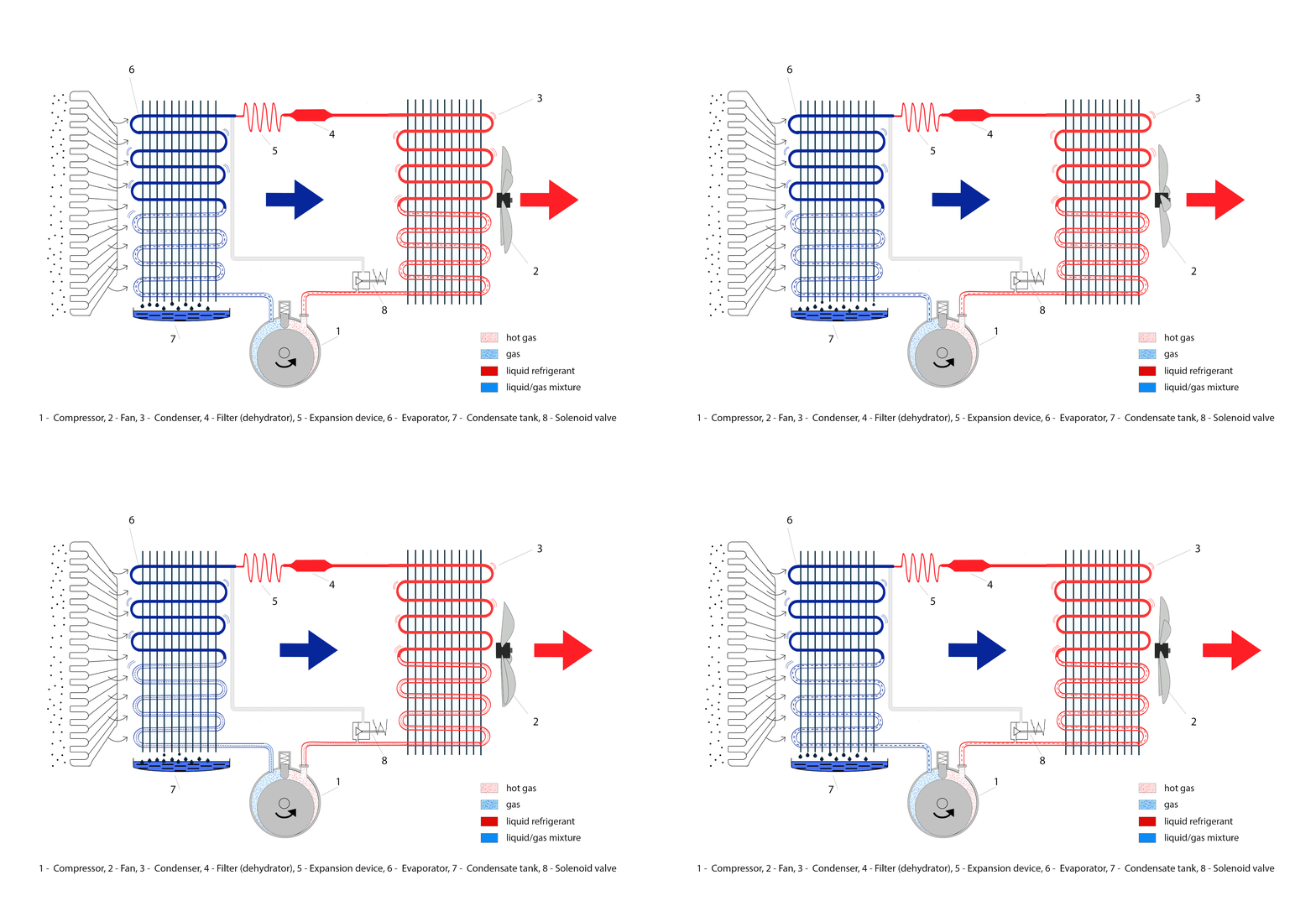
Employs a vapour-compression cycle with R410A/R32 refrigerant to cool process air below its dew point; condensed moisture is collected in a condensate tank while the dried airstream is reheated across the condenser and returned to the process.


How it works
Condensing dehumidifiers work on the refrigeration cycle principle. The compressor chills the evaporator coil; as humid air passes over this cold surface, water vapour condenses and is drained away — giving a directly measurable and controllable moisture removal rate. The remaining dry air is gently reheated across the condenser before being returned to the space, minimising heat rejection to the surroundings. Operating efficiently between +10 °C and +40 °C, these units offer a reliable solution for a wide range of commercial and industrial applications.
Models & Technical Data



* Capacity values measured at 32 °C / 90% relative humidity.
Materials & Structural Features
Application Areas
When is a condensing (compressor) dehumidifier the right choice?
A condensing dehumidifier cools air below its dew point on the evaporator coil, condenses the water vapour and drains it away. It is the most economical solution for warehouses, production areas, archives and plant rooms above roughly 15 °C with a target of 45–50 % RH or higher, protecting packaging, cardboard and metal goods from moisture damage.
The key point is the condition at which catalogue capacity is quoted. It is usually measured at high temperature and humidity; as the room gets cooler and drier, water removal falls. Select from the performance curve at the room's real condition and check the defrost function for low-temperature duty.
Request Product Selection Support
Share your process conditions and our engineering team will help you select the correct model, airflow and regeneration configuration.