Definition
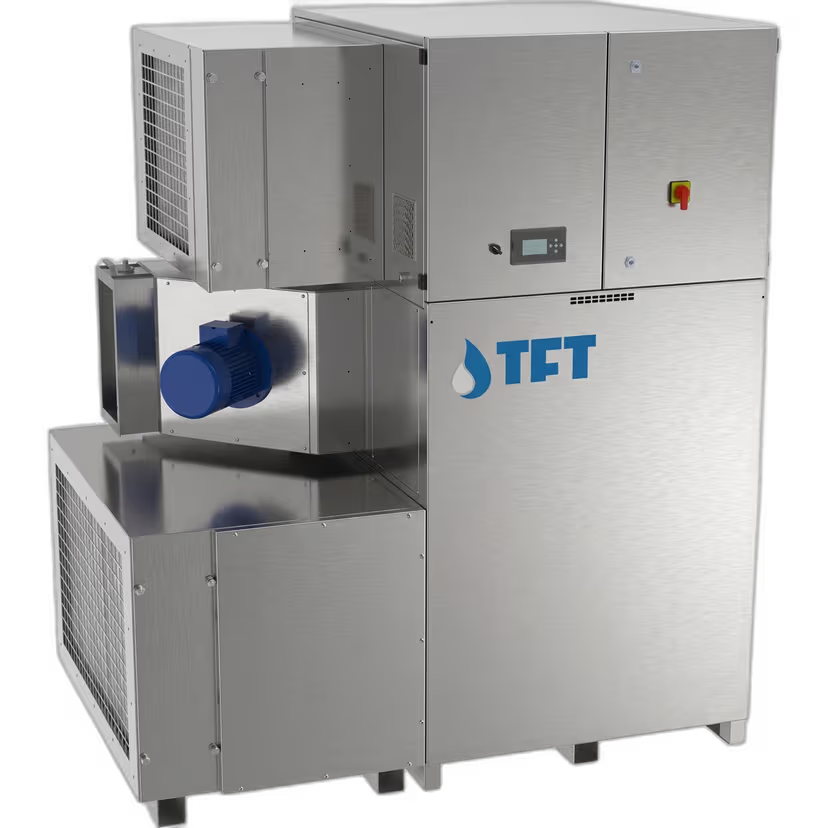
Specially controlled environments where very low humidity levels (<1% RH, -40°C to -60°C dew point) are continuously maintained. Primarily used in lithium battery production during electrode coating and cell assembly stages. Requires multi-stage silica gel rotor dehumidification systems, airlocks, and continuous pressurization.
Detailed Explanation
A dry room is an enclosed industrial environment where indoor air moisture content is continuously maintained below 1% RH or at a dew point between −40°Cdp and −70°Cdp. The difference from a standard HVAC environment is not just humidity, but the entire facility design philosophy: sealed walls, airlock entries, positive pressurization, contamination-controlled garments, and continuous monitoring systems.
The most common application is lithium-ion battery production. Lithium metal reacts violently with atmospheric moisture (forming LiOH and H₂); therefore, electrode coating, cell assembly, electrolyte filling, and sealing must be performed in humidity-controlled environments. Typical requirements:
• Anode coating (graphite): −20 to −40°Cdp • Cathode coating (NCM, NCA, LFP): −40 to −50°Cdp • Cell assembly (calendering, cutting): −45 to −55°Cdp • Electrolyte filling: −55 to −70°Cdp (critical stage) • Lithium metal anode (next generation): below −70°Cdp, certified
Other dry room applications: semiconductor lithography, freeze-dryer storage, GMP lyophilization, museum archives (paper/film), pharmaceutical granulation, aerospace composite manufacturing (defense industry), ALD/CVD equipment loading areas.
Design Parameters
Typical dry room design criteria:
Dew point: −40 to −70°Cdp Temperature: 21–25°C (process-dependent) Pressurization: +15 to +25 Pa (relative to adjacent standard environment) Air changes per hour (ACH): 30–60 (within the dry room) Particle class: ISO 7 or 8 (optional cleanroom integration) Wall type: sandwich panel, ≥100 mm insulation, airtight Envelope leak rate: ≤ 1% volume/hour
Moisture load calculation: • Personnel: 50–100 g/h per person (moderate activity) • Airlock crossings: 200–500 g/crossing (depending on door size and crossing speed) • Equipment heat load: indirect (condenser conditioning) • Building diffusion: negligible (sealed design)
Capacity rule of thumb: the dehumidification system must reach 5–10°C below the target dew point; this safety margin ensures performance under outdoor extremes.
Practical Example
Dry room design for a cathode coating line at a lithium battery facility:
Inputs: • Volume: 600 m³ (20 × 12 × 2.5 m) • Target: −45°Cdp, 23°C • Air changes: 40 ACH (circulation) • Personnel: 6 people × 80 g/h = 480 g/h • Airlock: 4 crossings/hour × 300 g = 1,200 g/h • Equipment/process-related: 200 g/h • Total load: ~1,880 g/h ≈ 2.0 kg/h
Selection and architecture: 1. Pre-dehumidification stage: NKT condensation type (CD400) → +5°Cdp 2. Main stage: NKT silica gel rotor AD800-1100 model → −50°Cdp 3. Reactivation: 110°C with condenser heat recovery 4. Circulation fans: 24,000 m³/h circulation (40 ACH × 600 m³) 5. Airlock: 6 m² antechamber, double-door interlock, pressure balancing 6. Monitoring: 4-point dew point sensors, 2-hour trend graphs, BMS alarms
Investment class: dry room envelope + AHU + rotor system integration, medium-to-high CAPEX category Annual energy consumption: ~520 MWh (with condenser heat recovery) Guaranteed dew point: −45°Cdp, ±2°C
In such a project, NKT engineering team prepares specifications compliant with ASHRAE Applications Handbook and IEC 62133 lithium battery safety standards.
Engineering Note
Most common mistakes in dry room design:
• Insufficient envelope sealing — wall penetrations (cables, pipes), door gaskets, and panel junctions create continuous leaks. ACH50 (air changes per hour at 50 Pa pressure) should be measured ≤ 0.5. • Airlock design — single-door entry = continuous contamination. Double-door interlock + antechamber pressure should be maintained at an intermediate level between the main environment and atmosphere (cascaded pressure). • Personnel management — dry skin, static electricity, fatigue from dry air. Antistatic ESD garments, time-limited work shifts, and continuous water intake are essential. • Equipment selection: single-stage rotor is insufficient — for below −45°Cdp, a two-stage system (pre-rotor at −25°Cdp + main rotor at −50°Cdp). Forcing a single rotor multiplies energy consumption and still fails performance. • Return air filtration — process solvents, particles, and VOCs shorten rotor life. F7 + activated carbon pre-filter + daily differential pressure check. • Commissioning tests — balanced operation between empty room and full load is mandatory. Dew point response time, recovery time, and uniformity tests should follow ASHRAE 145.1.
In NKT lithium battery dry room projects, design, manufacturing, commissioning, and training services are provided from a single source; additionally, an annual periodic maintenance contract guarantees certified dew point performance.