Definition
The sudden release of stored electric charge between two charged bodies or surfaces. In low relative humidity environments (< 35% RH), static charge accumulation accelerates; these discharges cause micro-damage to electronic components, fire risk on production lines, and operator discomfort. Industrial humidifiers maintaining ambient humidity at 45–55% measurably reduce ESD risk.
Detailed Explanation
ESD occurs through three primary mechanisms: (1) triboelectric charging via friction, (2) inductive charging, and (3) direct transfer via conduction. Carpets, polymer films, plastic components, and dry textile surfaces show the highest triboelectric productivity. As relative humidity drops, the thin film of water molecules on surfaces weakens; this film normally allows charges to dissipate from the surface and flow to ground.
Below 30% RH, the human body can charge to 10,000 V from walking, while above 50% RH the same motion produces only 1,500 V. Most modern integrated circuits begin to suffer damage below 100 V; some MOSFET and RF components have a 30 V threshold. For this reason, in electronic manufacturing, semiconductor assembly, pharmaceutical cleanrooms, and explosive-atmosphere facilities, humidification is not a comfort feature but a mandatory engineering control.
Charge–Humidity Relationship
A practical engineering estimate:
Vbody ≈ k × (1 / RH)
Vbody: peak voltage accumulated on the human body (V) k: coefficient depending on environment and clothing (≈ 200,000 for standard synthetic carpet / polyester clothing) RH: relative humidity (%)
Example: 20% RH → ~10,000 V; 50% RH → ~4,000 V; 60% RH → ~3,300 V
IEC 61340-5-1 specifies a maximum 100 V body voltage for ESD-protected areas (EPA). Achieving this threshold via passive grounding/footwear alone is difficult; humidity control is an integral part of the durable solution.
Practical Example
On an SMT (Surface Mount Technology) line, ambient humidity drops to 22% RH in winter. The quality team detects 80–120 ppm defective components per batch in post-pick-and-place testing. An ESD audit shows operator body voltage in the 4,500–7,000 V range — well above critical for sensitive BGA packages.
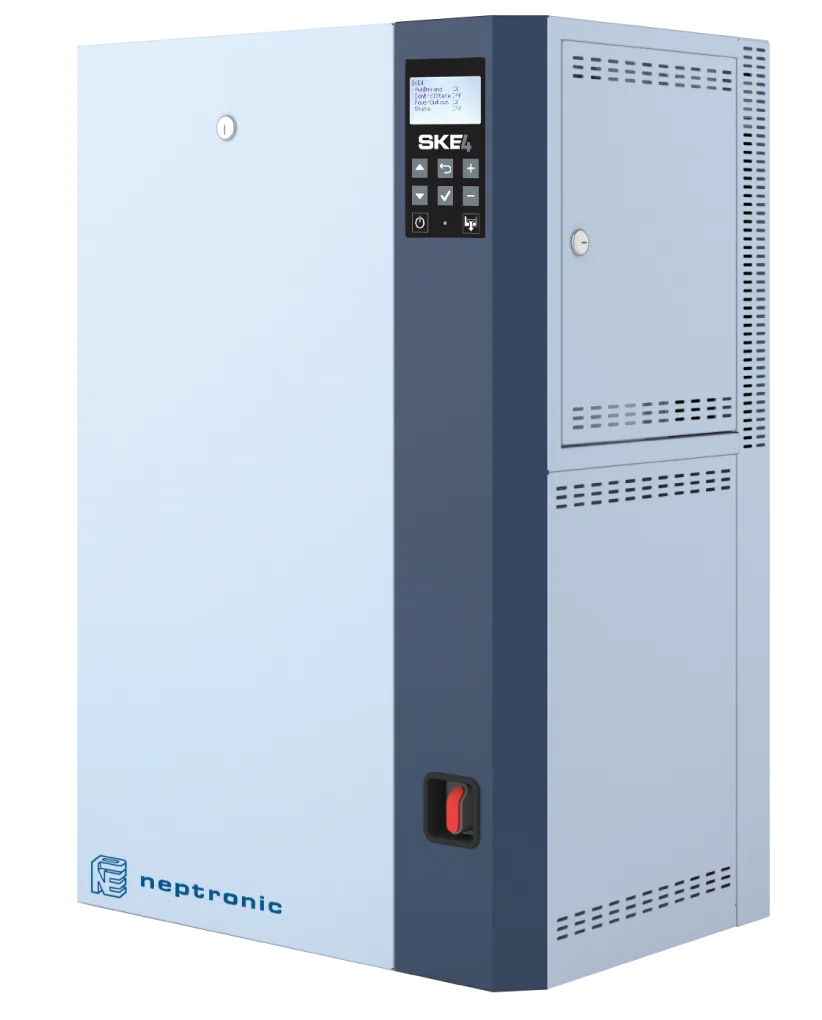
Intervention: four Neptronic SKE4 electric steam humidifiers installed along the line. Setpoint 48% RH ± 3, with continuous BMS monitoring. Result: within 6 weeks, ESD-related defects per batch dropped from 80–120 ppm to 8–14 ppm; payback period for the humidifier investment is roughly 5 months.
Cost comparison: humidifier investment + installation + 1 year OPEX ≈ 18% of the lost-product + rework cost. This example shows how ESD control is financially intertwined with humidity management.
Engineering Note
ESD control is a multi-layer discipline; humidity control alone is not sufficient but is indispensable.
Layers: 1. Grounding — conductive flooring (10⁶–10⁹ Ω/sq), wrist straps, ESD footwear 2. Ionization — open-air ionizing fans create neutral zones 3. Humidity control — 45–55% RH band physically reduces charge accumulation 4. Material selection — antistatic bench coatings, ESD protection bags 5. Training and audit — procedures aligned with IEC 61340-5-1
Critical humidification system design decisions: • Steam humidification is preferred (mineral-free, microbiologically clean) • Tight setpoint band: 45–55% RH ± 3 (ICH Q1A allows pharma 40–60% ± 5) • Sensor placement: at production-line level, not near fresh-air supply diffusers • Redundancy: N+1 humidifiers for critical EPA (a single failure must not breach the ESD threshold) • Control: PID + BMS integration, alarm if setpoint deviation exceeds ±5
Extra care for MSL (Moisture Sensitivity Level) components: very high humidity (above 70%) can cause "popcorn effect" during reflow soldering. The optimum band for ESD protection overlaps with the optimum band for MSL protection: 45–55% RH.
Related Academy Articles
Related Products
NKT products related to this term