Definition
The air-flow velocity inside an HVAC duct (m/s); directly affects steam absorption distance, sensor performance and noise levels.
Detailed Explanation
Duct velocity is the speed of air through an HVAC duct cross-section; computed as flow (m³/h) / area (m²). Unit m/s. Typical industrial HVAC ranges: main supply ducts 5–9 m/s, branches 3–6 m/s, room terminal diffusers 1–3 m/s, return ducts 4–7 m/s. Too low → larger duct + cost, settling; too high → noise, pressure loss, higher fan energy.
Why It Matters
Duct velocity has three critical effects in steam-humidification design: (1) ABSORPTION DISTANCE — low velocity (<1.5 m/s) extends the steam-air mixing time and lengthens the absorption distance 2–3×; high velocity (>4 m/s) increases turbulence and shortens it. (2) SENSOR ACCURACY — capacitive RH sensors above 5 m/s suffer turbulence errors; above 3 m/s, placement is unstable. (3) MIST/DROPLET CARRYOVER — at low velocity, steam exits and droplets hit the duct wall, condensing; at adequate velocity the air carries them. Optimum: 2.5–4 m/s at the manifold location.
Practical Example
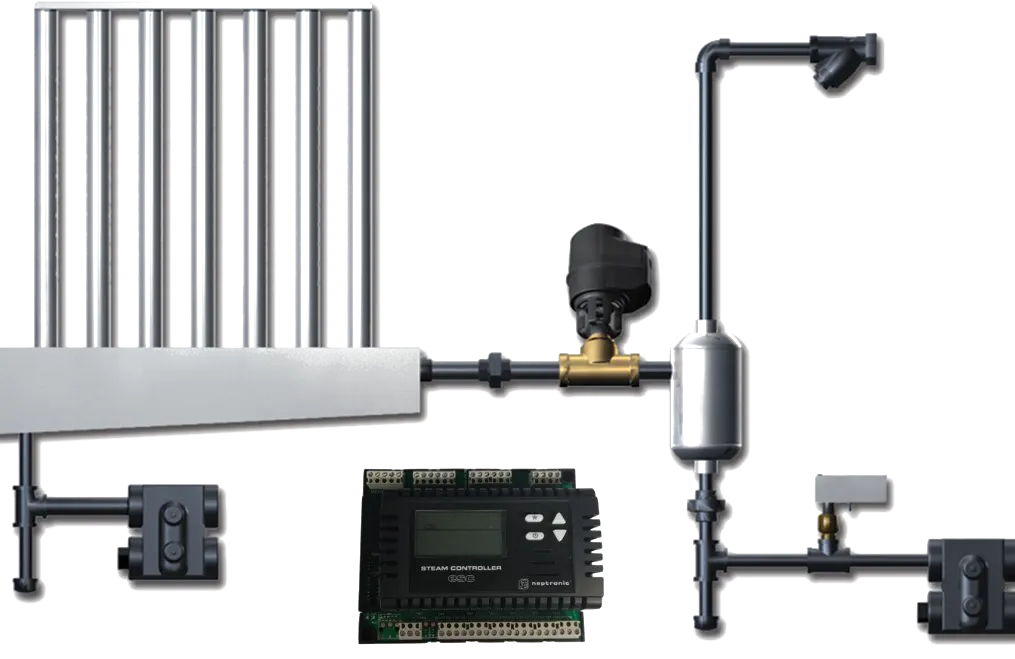
A bakery storage AHU in Eskişehir: 1500×600 mm duct at 8,000 m³/h → 2.5 m/s (healthy). A Neptronic SKD manifold + 1.7 m absorption distance was a successful design. But a side branch with 600×400 mm at the same flow ran at 9.3 m/s — the downstream sensor downstream of the manifold suffered turbulence errors. Fix: the branch restriction was removed, dropping velocity to 4 m/s; sensor accuracy returned to normal and absorption distance was 1.9 m. Commissioning RH band ±2%.
Engineering Note
Velocity calculation: V = Q / (3,600 × A); Q in m³/h, A in m², V in m/s. In manifold selection, OEM tools (Neptronic Distance, humidifier control software) use velocity as an input to the absorption-distance table. Field measurement: pitot tube or thermal anemometer; average 3–5 points instead of one (Log-Tchebycheff method). In high-velocity zones, acoustic dampers or duct expansion may be needed for noise control; standard limit is 35 dBA for sensitive zones (hospital OR, office), 45 dBA for industrial.
NKT Application Link
In NKT projects, duct velocity is a mandatory input on the manifold-selection form; below 1.5 m/s or above 5 m/s triggers a design warning and coordination with the AHU vendor is recommended. During commissioning, the pitot measurement is reported and added to the manifold documentation. The NKT - Climate Track platform trends fan speed + pressure drop — duct velocity is followed indirectly.
Related Academy Articles
Related Products
NKT products related to this term