Definition
A gram-negative bacterium that lives in water; multiplies rapidly in stagnant water at 25–55°C, transmits to humans via respirable aerosol (mist, not vapour), and causes Legionnaires' disease. The primary motivation behind water treatment and hygiene design in adiabatic humidification systems.
Detailed Explanation
Legionella pneumophila is a bacterium present at low concentrations in natural water; the human immune system usually controls it. Risk rises under: (1) Water temperature in the 25–55°C band — optimum growth at 35–37°C. (2) Stagnant water — tanks without circulation, dead legs, undrained systems. (3) Biofilm presence — provides nutrients and shelter. (4) Aerosolisation — misting nozzles, cooling towers, showers. Steam humidification (100°C+) carries no Legionella risk — the temperature kills the bacterium. Adiabatic humidification, with low water temperature plus aerosol generation, requires an active risk profile.
Why It Matters
Aerosol from a Legionella-contaminated adiabatic system can be inhaled by occupants; Legionnaires' disease is a serious pneumonia-like respiratory infection. WHO and TS EN 16798 require a Legionella risk assessment for buildings. Adiabatic humidification systems are typically built with five layers of hygiene protection: (1) RO/DI pre-treatment → reduces bacterial nutrients (minerals); (2) UV disinfection → DNA inactivation with ≥ 99.9% kill rate; (3) Continuous circulation → no stagnant water; (4) Auto drain/purge → the system empties when idle; (5) Periodic maintenance + microbiological testing — biannual sampling and post-incubation CFU/L analysis. With this combination, risk is practically zero.
Practical Example
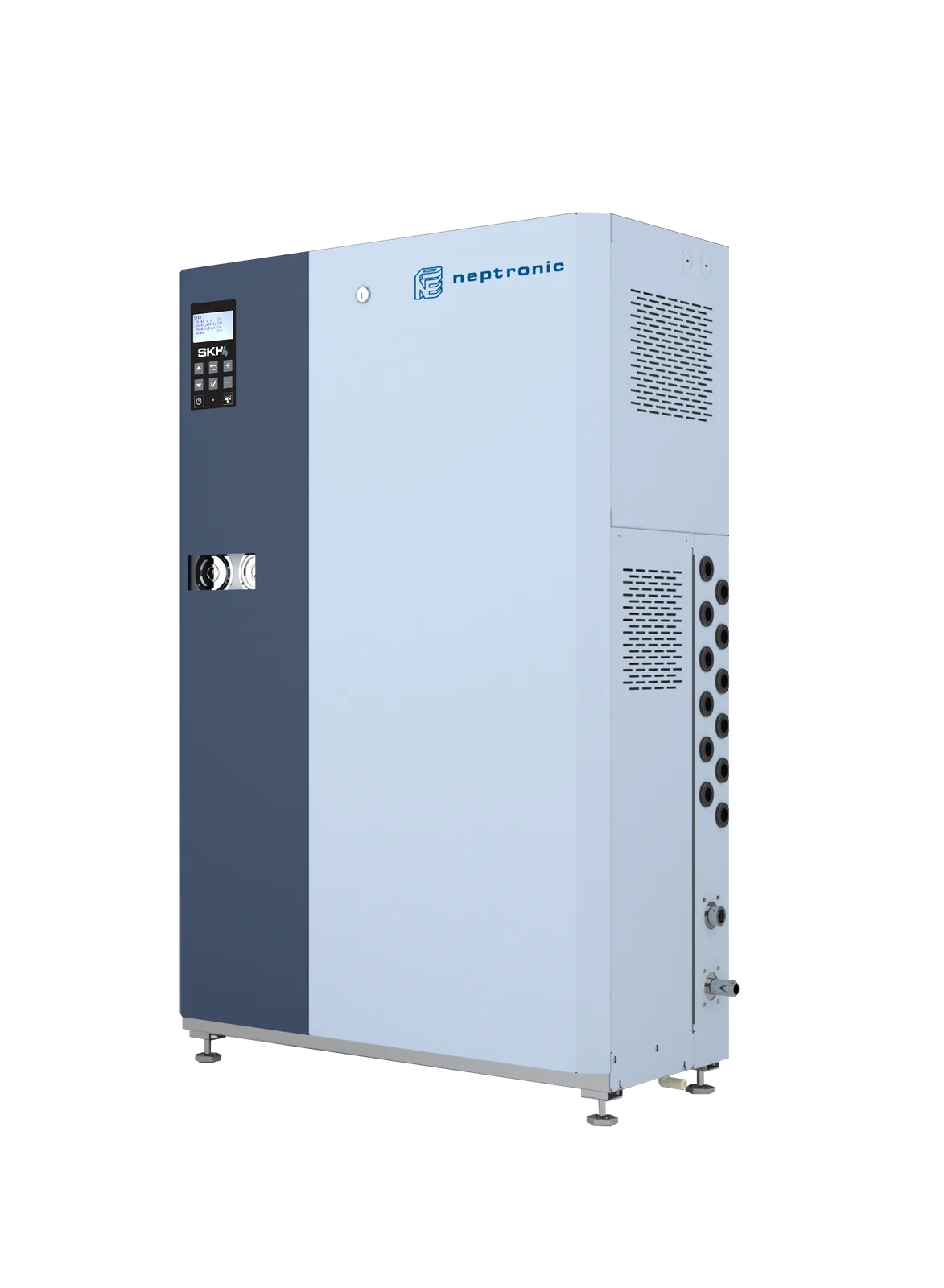
A private hospital in Ankara wanted evaporative humidification in a pre-OR corridor. After a hygiene risk assessment, the Neptronic SKH system was designed with: 2-stage RO + UV-C steriliser (≥30 mJ/cm²) + 24/7 tank recirculation + nightly auto-purge (03:00, 15 min) + biannual microbiology test (PCR + culture). Over the 5 years after commissioning every Legionella test returned "0 CFU/L". Hygiene certification became a standard step in the hospital's accreditation.
Engineering Note
The gold standard for Legionella control is "defence in depth": no single measure is enough. UV is powerful but with no pre-treatment, biofilm shadows it. RO reduces minerals but without UV does not kill bacteria. Without circulation, UV works in one zone while water stalls in another. Without drain/purge, the system becomes risky during idle periods. Hygienic adiabatic humidification is therefore a design philosophy, not a single component. Capital cost is typically 30–40% higher but Legionella zeroing and insurance-premium reduction pay back within 5 years.
NKT Application Link
For hospital, pharma, food and hygienic-zone facilities, NKT delivers Neptronic adiabatic humidification with the five-layer hygiene architecture; post-commissioning 6-month microbiological validation and an annual periodic-maintenance contract are standard. The NKT - Climate Track platform continuously monitors water temperature, recirculation flow, UV-lamp status and drain logs; anomalies are pushed to the operator and the NKT service team.