Definition
A polysaccharide hydrocolloid composed of galacturonic acid units, naturally found in plant cell walls. Depending on sugar content and pH (typically pH 2.8–3.5 and 60%+ Brix), it gels to form structure in jams, jellies, and fruit fillings. HM (high methoxyl) and LM (low methoxyl) types have different gelling mechanisms; HM forms its network through sugar bridges while LM forms it through calcium bridges.
Detailed Explanation
Pectin is the most widely used structuring hydrocolloid in jelly and confectionery after gelatin. It is extracted from citrus peels (lemon, orange) and apple pomace; the backbone consists of D-galacturonic acid (polyuronic acid) units whose carboxyl groups are partially methyl-esterified. The Degree of Esterification (DE) divides pectin into two types:
• HM Pectin (DE > 50%) — gels in high-sugar (>60% Brix) and low-pH (3.0–3.5) environments; citrus jelly, jam, hard jelly • LM Pectin (DE < 50%) — gels in the presence of calcium ions, suitable for low-sugar applications; diet products, fruit fillings, glazes
Gelling mechanism: For HM pectin, in a high-Brix environment water molecules are "bound" by sucrose, and hydrogen bridges between pectin chains form a network. In LM pectin, calcium ions bridge two carboxyl groups in an "egg-box" structure.
Critical parameters for proper gelling: • Brix: 65–80 (HM) • pH: 3.0–3.5 • Temperature: deposit at 60–70°C after cooking • Pectin dose: 0.3–1.2% (dry weight) • Buffer salts (sodium citrate, calcium lactate) for pH/Ca balance
Why It Matters
Pectin directly determines product texture, shelf life, and process yield:
1. Texture quality — a uniformly distributed pectin network produces a firm, elastic, and clear gel; missing or incorrect pectination yields soft/runny or brittle/fragmented gels. 2. Water-holding capacity — pectin gels retain 70–85% water; this water is microbiologically "bound" and contributes to lower aw. A poorly gelled product weeps water (syneresis), giving a wet, tacky surface. 3. Mogul shape retention — if pectin gelling is insufficient, the mass deposited into the starch tray fails to take shape and deforms upon tray inversion. 4. Sensitivity to stove-room ambient — at high RH the pectin gel rapidly absorbs moisture (cap), and at low RH the surface dries and triggers case-hardening. A correct aw–ambient RH balance is essential. 5. Cost — pectin is an expensive raw material (€10–18/kg); minimum-dose use under correct temperature and pH is critical.
Climate-critical point: a pectin jelly's mogul stove-room ambient must be controlled by dew point. Even if temperature drifts, a stable dew point keeps the pectin gel's equilibrium moisture content unchanged; classical RH-based control falls short here.
Practical Example
HM pectin-based citrus jellybean recipe (1,000 kg batch):
• Sucrose: 480 kg • Glucose syrup DE 42: 380 kg • Water: 180 kg (pre-cook) • HM pectin (DE 72%): 8.5 kg • Citric acid solution (50%): 6 kg • Sodium citrate buffer: 2 kg • Flavour and colour: 3.5 kg
Process steps: 1. Water + glucose syrup + pectin pre-mix (60°C, 5 min dispersion) 2. Add sucrose, heat the cooking tank to 105°C (or 95°C under vacuum) 3. Target Brix: 80 °Bx (measured online by refractometer) 4. Cool to 75°C after cooking, add citric acid + buffer (pH 3.3) 5. Mogul depositor at 70°C deposits into the starch tray (5–7% moisture) 6. Stove room: 32°C / 25% RH (dew point 9°C) → 36 h conditioning 7. Starch separation + sugar coating or oiling
Gel formation control: pH measurement is critical; below pH 3.2 the setting rate is too fast (depositor blockage), above pH 3.5 no gel forms. The NKT mogul climate system holds the 32°C / 9°C dewpoint target continuously within ±0.5°C / ±0.3°Cdp; thanks to this, waste per 1,000 kg batch drops from 35 kg to 8 kg.
Engineering Note
Five engineering-critical points in pectin processes:
• Pectin dispersion — pectin powder is prone to lumping due to its high-viscosity nature. Dispersion via dry pre-mix (with sucrose) or a high-shear disperser at 60–70°C is required. • Water hardness — high Ca/Mg water causes premature gelling of HM pectin; demineralised water or ion-exchange pretreatment is recommended. • Acid-addition timing — adding citric acid before cooking causes acid hydrolysis of pectin (DE drops, gel weakens). It must be added post-cook at 70–75°C. • Stove-room dew point control — practical band for pectin gel surface moisture balance is 8–10°Cdp; this must be held season-independent, otherwise capping (surface moisture pickup) or case-hardening occurs. • Cold-wall condensation — wall surface temperatures in transition zones must never drop below ambient dew point; otherwise condensate droplets fall onto the product, triggering tack/mould. Thermal insulation + interior RH control are important.
Quality indicator: pectin gel "gel strength" (Bloom-like test) should be 200–400 g, with syneresis below 2%.
NKT Application Link
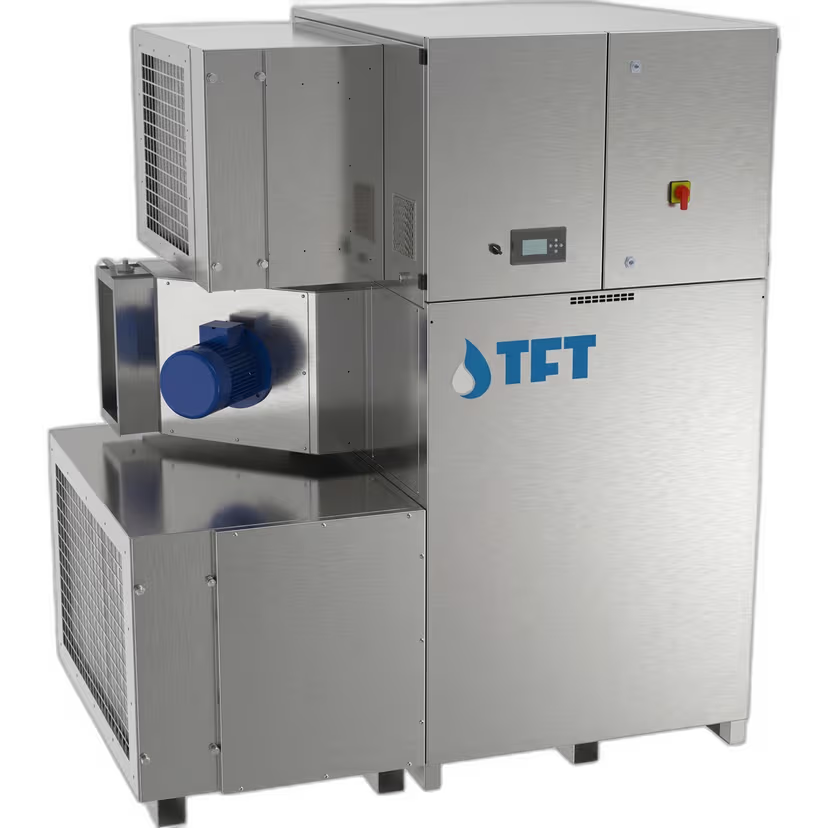
For pectin-based jelly and confectionery plants, NKT designs mogul stove-room and conditioning-tunnel climates around the product ERH target. For a typical 80 °Bx HM pectin jellybean, the stove-room target is 32°C / 25% RH (dew point 9°C); NKT ADP series silica gel rotor units hold this target year-round within ±0.5°C and ±0.3°Cdp.
A typical NKT engineering package in pectin plants: 1. Recipe-driven climate selection — pectin type (HM/LM), Brix, pH, and aw drive the mogul ambient target 2. Dual-zone climate — cooking and depositor area at 22°C / 50% RH for personnel comfort, mogul stove room at 32°C / 25% RH for product; vestibule transition 3. Dew-point-based control — product ERH balance independent of RH drift 4. Hygienic design — stainless steel inner casing, food-grade gaskets, fully cleanable filter cassette 5. NKT - Climate Track monitoring — hourly dew point / RH / temperature reports, deviation alarms, energy performance tracking
This approach lifts texture stability above 96% in pectin products and minimises waste and syneresis losses.