Definition
Reverse osmosis (RO) water is produced by forcing feedwater through a semi-permeable membrane under pressure, removing 95–99% of dissolved salts, ions, organics and microorganisms. Outlet conductivity 5–25 μS/cm, TDS 5–30 ppm. Deionised (DI) water is RO water further polished with ion-exchange resins (conductivity < 1 μS/cm, ultra-pure grade). For steam humidification, RO/DI feedwater is ideal for a resistive humidifier — scale practically never forms — while an electrode humidifier cannot use it.
Detailed Explanation
Reverse osmosis is a pressure-driven filtration that overcomes osmotic pressure: feedwater is pushed through a polyamide composite membrane at 8–15 bar; water molecules pass, salts and ions are rejected as a concentrate (brine). A typical industrial RO operates at 75% recovery (100 L feed → 75 L permeate, 25 L reject).
DI water is produced when residual ions in the RO permeate are exchanged on cation (R-H) and anion (R-OH) resins; H⁺ and OH⁻ recombine into H₂O. DI systems serve labs, microelectronics, generator cooling and pharmaceutical manufacture. EDI (Electrodeionisation) is a modern continuous-production variant. For steam humidification the default is RO; DI is reserved for ultra-hygienic sterile-pharma areas.
Why It Matters
RO/DI water as humidifier feed offers two core advantages: (1) Scale build-up is effectively zero — chambers run for years without cleaning; (2) Steam is mineral-free — does not clog HEPA filters, does not deposit mineral dust into the space, preserves hygiene class. These two attributes combined make the RO + resistive pairing the standard industry practice for hospital operating theatres, pharmaceutical facilities, sensitive print rooms and museum/archive spaces.
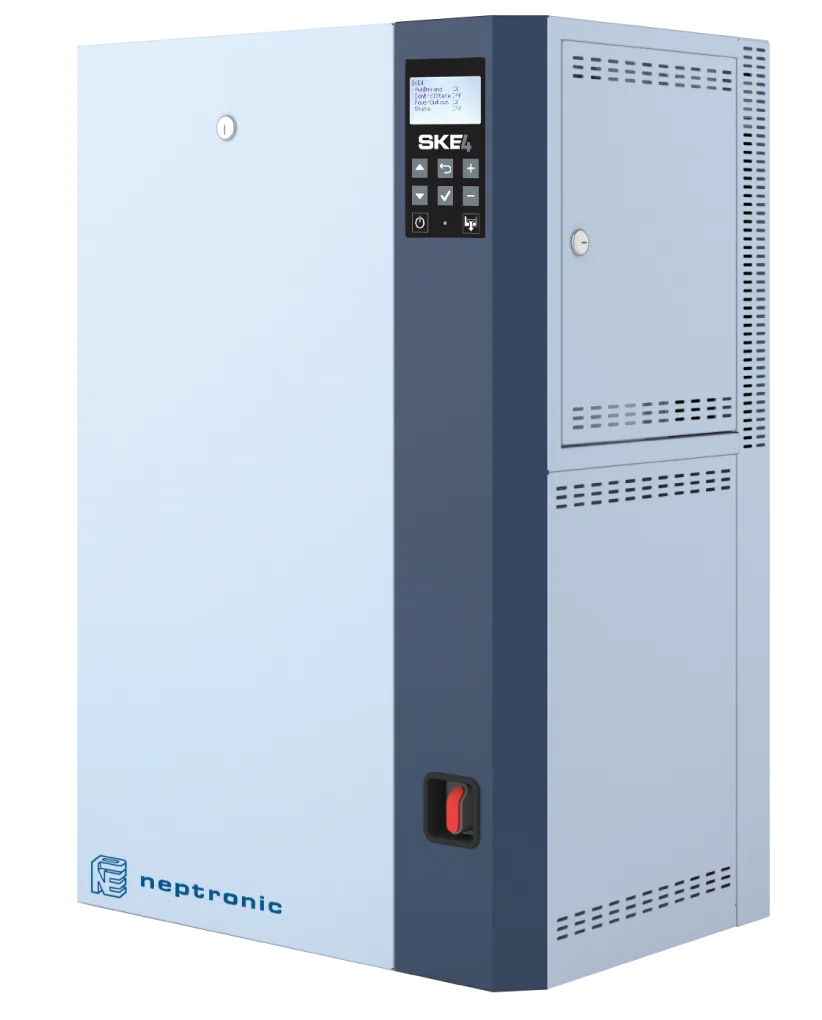
The critical limitation: RO/DI water disables electrode humidifiers. Below 25 μS/cm an electrode unit will not operate at all; at ~50 μS/cm it operates at degraded capacity. The rule "if you have RO, you cannot select electrode" is firm. Conversely: any facility investing in RO must also replace any existing electrode humidifier — a natural migration path to a resistive unit (Neptronic SKE4).
Practical Example
In an Istanbul private-hospital renovation, the legacy system was 6 electrode steam humidifiers (total 80 kg/h) with separate cylinder changes every 4 months, €22,000 annual cylinder spend and 144 kg of plastic waste per year. City water hardness was 14 Fr°, TDS 480 ppm, conductivity 720 μS/cm.
New hygiene-class requirements (ASHRAE 170 + Ministry of Health Hygienic Class) demanded mineral-free steam and a ±2% RH band. Solution: facility-level RO integration (250 L/h, RO outlet TDS 18 ppm) + 2 Neptronic SKE4 resistive humidifiers (total 100 kg/h, with high redundancy). Electrode units would not run on RO water anyway, so the resistive migration was non-negotiable. 5-year net savings (cylinders + waste + maintenance labour): €140,000.
A second case: a Marmara biotechnology lab built entirely on RO+DI utilities. Humidification defaulted to Neptronic SKE4 — cylinders, plastic waste and conductivity tracking never appeared on the project agenda.
Engineering Note
An RO system is a small fraction of the humidifier investment (typically €8,000–25,000 for 100–500 L/h capacity), but its operating advantages repay the investment many times over a 10-year horizon. For RO retrofits there are two pre-checks: (1) Footprint (RO + tank + pump need ≈ 4–8 m², depending on building pressure); (2) Drain capacity for the reject stream.
DI/EDI systems are reserved for ultra-pure applications; standard steam humidification is well served by RO alone. RO membrane life is 3–5 years; pre-filters (5 μm sediment + activated carbon) are replaced every 6 months. NKT proposes RO integration as an optional package and supports the decision with a site-specific TCO calculation.
NKT Application Link
NKT triggers RO integration automatically when: (a) a tight RH band (≤±2%) is required, (b) hygiene-class requirements apply (ASHRAE 170, GMP, ISO 14644), (c) mains water hardness exceeds 25 Fr°, or (d) TDS exceeds 500 ppm with continuous operation. The selected resistive humidifier (Neptronic SKE4) is fed from the RO outlet; the maintenance plan drops to an annual visual inspection.
Related Academy Articles
Related Products
NKT products related to this term