Evaporative (adiabatic) humidification adds moisture by contacting water directly with the airstream and evaporating it without first heating the water to its boiling point. Unlike steam systems, the bulk of electrical energy is not spent boiling water but instead on a high-pressure pump or a low-pressure pump + wetted-media loop. This structural difference makes evaporative systems consume roughly 10× less electricity per kilogram of moisture added; on top of that, the adiabatic evaporative cooling effect drops air temperature by 4-12 °C in the same step, delivering measurable cuts in cooling capex and opex. This guide reads the evaporative energy balance from thermodynamic first principles all the way to HVAC-level balance, pump and fan energy, hygiene acceptability and a numerical comparison.
What Is Evaporative Humidification?
Evaporative humidification raises relative humidity and absolute humidity by evaporating water into the air directly, without first boiling it. The process is thermodynamically adiabatic: the latent heat required for evaporation is drawn from the air itself, the air cools, and water moves into the vapour phase. Steam (isothermal) systems use electrical energy to drive water to 100 °C and supply the latent heat externally; evaporative systems take that same latent heat from the sensible heat already present in the air, and that is the root of the energy gap.
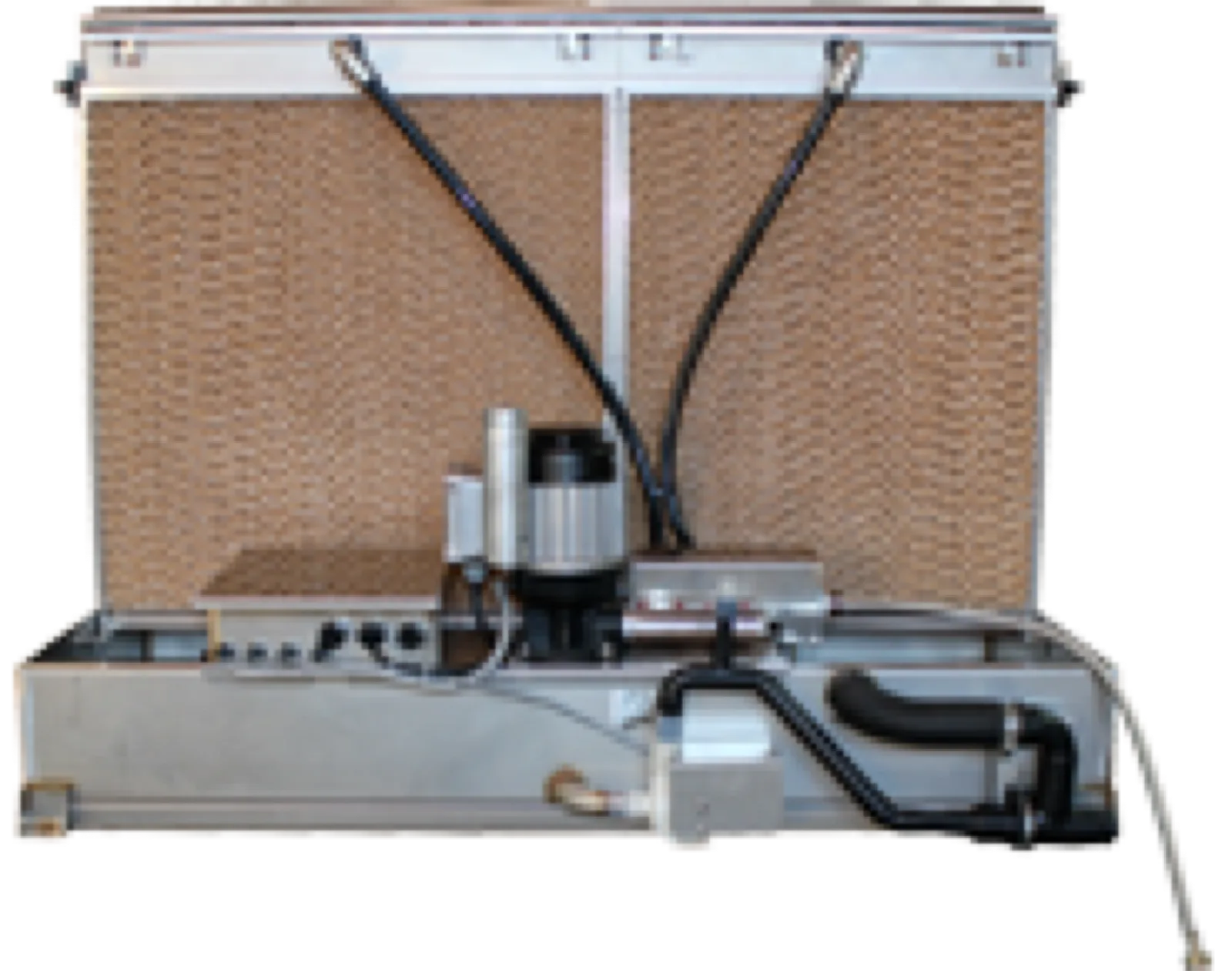
Evaporative humidification is built on four core architectures. High-pressure atomisation (misting) pushes water through nozzles at 70-100 bar to produce 5-15 µm droplets; as droplet size shrinks, evaporation surface multiplies. Low-pressure spray + wetted media (evaporative cooler) circulates water across a ceramic or synthetic media at low pressure for natural evaporation over a large surface. Ultrasonic atomisation uses piezoelectric vibration to produce 1-5 µm mist, suiting smaller volumes and tight RH bands. Pad-type in-duct evaporative humidifier is the AHU-integrated form of the low-pressure design.
Figure 1. Steam vs Evaporative: Energy Flow Schematic
Where the Energy Comes From
The energy budget of an evaporative system splits three ways. First, pump electricity: in high-pressure atomisation the positive-displacement pump supplying 70-100 bar draws roughly 50-100 W per kilogram of moisture added. In low-pressure wetted-media systems this drops to 25-50 W/kg; ultrasonic transducers run at 80-130 W/kg. Second, water-treatment electricity: producing RO water with a booster pump across the RO membrane consumes roughly 1-3 kWh/m³. Third, often overlooked, fan adder: wetted-media systems add airflow resistance that lifts fan consumption by 5-15%; atomisation systems add 2-5%.
The structural difference versus steam systems is whether energy is used for phase change. In a steam system, heating 1 kg of water from 20 °C to 100 °C takes ≈ 95 kJ, and vaporising it at 100 °C takes ≈ 2,260 kJ, total 2,355 kJ or 0.654 kWh. With device efficiency at 85-95%, the practical figure settles at ≈ 0.75 kWh/kg. In an evaporative system, none of that 2,260 kJ of latent heat comes from the outside; it is drawn from the sensible heat in the air. The device's electrical load is only for atomising or pumping water to the media. That single fact makes the ≈ 7-15× gap per kilogram structural, not anecdotal.
Energy Difference vs Steam
The energy gap between steam and evaporative cannot be reduced to a single number, climate, run-hours, airflow and capacity all amplify it. The table summarises typical electrical consumption at common industrial capacities.
| System | Typical W/kg | For 100 kg/h | For 500 kg/h | Annual (3,000 h) |
|---|---|---|---|---|
| Steam electrode / resistive | ≈ 750 | 75 kW | 375 kW | 1,125 MWh |
| Steam gas-fired (gas-primary) | ≈ 60 (elec.) + gas | 6 kW + gas | 30 kW + gas | — |
| Evaporative high-pressure (SKH) | ≈ 50-100 | 5-10 kW | 25-50 kW | 75-150 MWh |
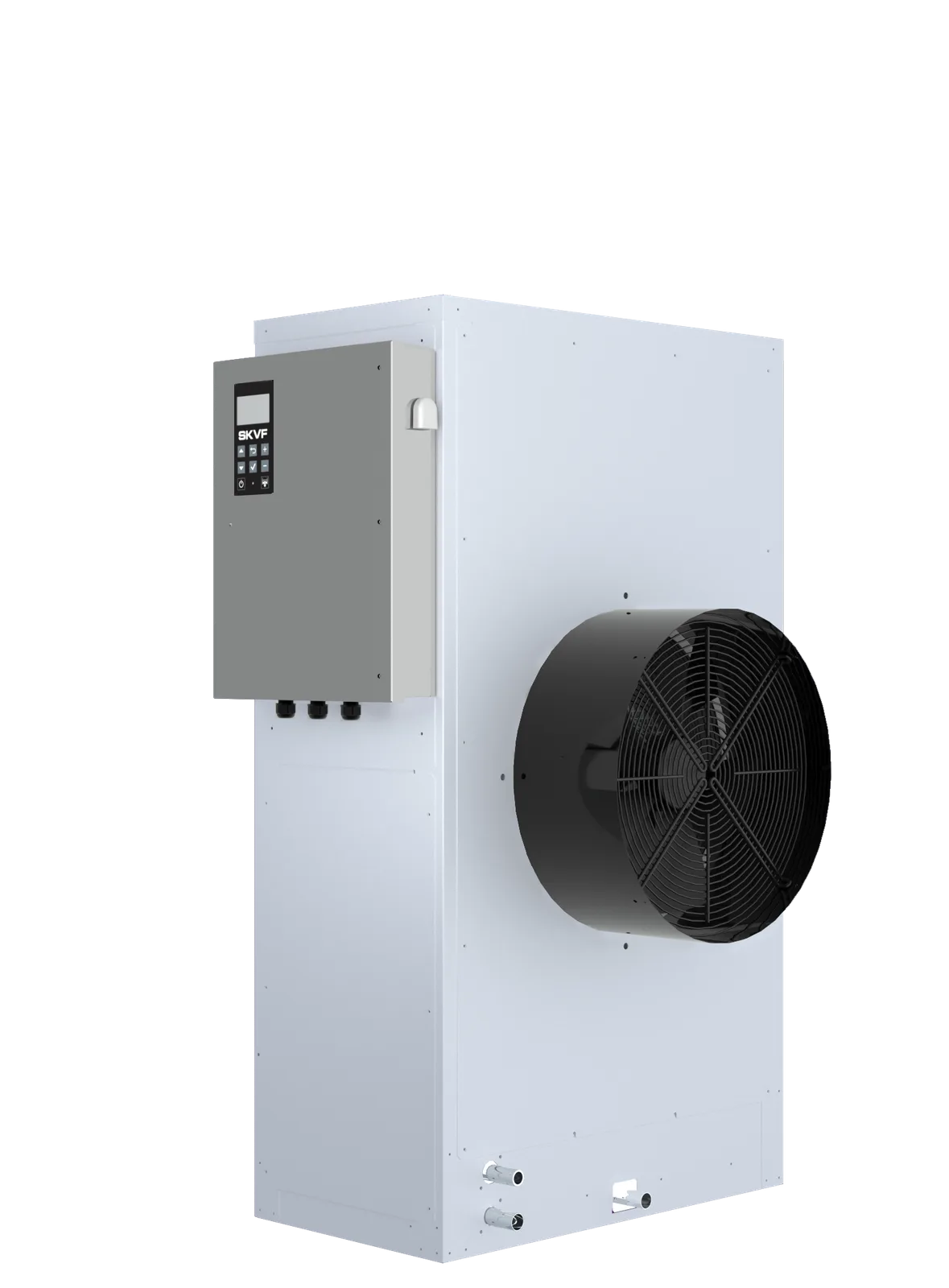
| Evaporative low-pressure (SKVF) | ≈ 25-50 | 2.5-5 kW | 12.5-25 kW | 37.5-75 MWh |
| Ultrasonic | ≈ 80-130 | 8-13 kW | (rarely sized this high) | — |
For a 500 kg/h textile weaving facility, steam consumes ≈ 1,125 MWh/year while high-pressure atomisation makes do with 75-150 MWh, ≈ 975 MWh/year of saving. Translated at typical Turkish industrial electricity tariffs, the gap on opex runs into six-figure euros. The ratio holds across capacities, but the absolute gap grows with kg/h, and that is the real reason evaporative becomes nearly mandatory at large capacities.
Evaporative Cooling Effect
The second line item in the evaporative energy equation is the adiabatic cooling side benefit. Because the 2,260 kJ of latent heat required to evaporate 1 kg of water is taken from the air, the same process both adds moisture and cools the airstream. The amount of cooling depends on airflow and on the absolute-humidity addition; a quick estimate is ΔT (°C) ≈ Δw (g/kg) × 2.5. A system that adds 5-10 g/kg in summer can cool air by 12-25 °C; in practice, sizing is done from a psychrometric chart and a typical real-world figure is 4-12 °C depending on inlet dryness.
This side benefit reduces the cooling load directly. For a Bursa weaving floor (30,000 m³/h airflow) a 6 °C summer adiabatic cooling step is equivalent to ≈ 60 kW of chiller capacity, i.e., 60 kW removed from chiller sizing. That cuts both capex and opex. A quick estimate: 60 kW × 2,000 h/year ÷ COP 3.5 → ≈ 34 MWh/year saved on cooling electricity. Add that to the evaporative system's own 75 MWh/year consumption and the total energy balance falls far below the steam alternative.
Figure 2. Summer Adiabatic Cooling: Psychrometric Cycle
The psychrometric pattern shows the evaporative system effectively acting as a low-COP direct evaporative cooling unit on top of its humidification duty. For textile, food processing, greenhouse, print and data-centre pre-cooling, that single property is by itself a design rationale.
HVAC Energy Balance
A facility's true energy balance is read at the HVAC level, not the device level. Four line items move together: heating (winter), cooling (summer), humidification (winter + shoulder seasons) and outdoor-air conditioning (year-round). Evaporative humidification affects two of them: its own demand (humidification) is low and its side benefit (cooling) is high. Steam does the opposite: its own demand is high, it adds nothing to summer cooling and (equally) adds no unwanted heat to winter heating but provides no summer cooling assist either.
Seasonally the balance shifts. In winter the system focuses on humidification; pulling heat from the air is unwanted because we are already heating. So in winter steam runs "cleaner" by design, the energy supplied turns into moisture without affecting temperature. Evaporative in winter adds a cooling load that the heating coil must compensate for. On a purely winter design profile, the energy balance favours steam. In summer the balance flips: extra cooling is valuable and evaporative's side benefit reduces chiller load directly.
In shoulder seasons (spring-autumn) and at sites with free-cooling / economiser cycles, evaporative pulls clearly ahead. In free-cooling mode the AHU draws 100% outdoor air; dry-but-cool outdoor air absorbs moisture and the system delivers both cooling and humidification in one step. This mode can run 1,500-3,000 h/year and forms a large line item in the annual balance at most sites.
Pump, Fan and Water Treatment Energy
Evaporative consumption is not just the device nameplate; three adders feed the real total. Pump energy is the backbone: high-pressure atomisation (SKH family) runs a positive-displacement pump that draws 50-100 W/kg at 70-100 bar; low-pressure wetted-media circulation (SKVF family) sits at 25-50 W/kg. Pump efficiency determines the device's overall energy figure; an IE3/IE4-class pump can shift annual consumption by 10-15%.
Fan adder comes from airflow resistance. Wetted media adds 30-80 Pa of pressure drop and increases AHU fan demand by 5-15%. High-pressure atomisation places a nozzle array in the duct with 10-30 Pa drop and a 2-5% fan adder. Ultrasonic systems offer essentially no airflow obstruction and therefore no fan adder, a real advantage in retrofits where the duct cannot be modified.
Water-treatment energy is nearly mandatory in evaporative systems. Hygienic atomisation and media systems run on RO feed; an RO unit consumes 1-3 kWh/m³. A 100 kg/h atomisation system running 3,000 h/year processes ≈ 300 m³ of RO water and consumes ≈ 600 kWh, about 4% of the main unit's 15,000 kWh annual figure. The RO reject stream sits at 30-40% of the input and adds to drainage load. Soft-water regions (Izmir, Antalya coastline) keep this burden low; hard-water regions (Central Anatolia) push it higher.
Hygiene Matters Too
The energy equation must not be read without acknowledging one of the evaporative system's structural limits, the hygiene perspective. Because water enters the air as a liquid droplet, Legionella and bacterial risk become engineering items that must be managed in design; in a steam system this risk is removed structurally because water is already at 100 °C. That difference defines where the energy-saving argument does and does not dominate.
A practical decision matrix: rooms with low-to-medium hygiene class (textile, print, greenhouse, food processing general floor, data-centre cooling) suit evaporative and energy saving is usually the primary driver. Rooms with high hygiene class (operating theatres, pharma cleanrooms, museum collection spaces, hospital sensitive rooms) should go to steam; here the energy gap sits below the hygiene assurance. Intermediate rooms (food packaging halls, precision electronics manufacturing, precision print rooms) can take a hybrid, evaporative for the bulk load + steam for tight-band finishing.
The engineering management of hygiene constraints (RO + UV + filtration + drainage + biofilm control) is the topic of a separate guide and covered in detail elsewhere in the adiabatic hygiene series. The take-away here: evaporative's energy advantage is structural and large, but it is meaningful only in the right application profile.
When Steam Is More Appropriate
In the following application profiles, steam is the structurally correct choice despite the energy gap:
- Hospital operating theatres and hygienic corridors: ASHRAE 170 and the Turkish Ministry of Health Hygienic Class regulation require mineral-free, microbiologically clean steam.
- cGMP pharma cleanrooms (Annex 1): ±5% RH tolerance + mineral-free steam, bands at which evaporative cannot operate structurally.
- Museum collection spaces: ISO 11799 conservation standards specify 45-55% RH with a ±5% RH/24 h change limit; resistive steam + RO feed meets that.
- Sensitive electronics manufacturing (cleanroom Class 7-8): tight-band control + particulate-free air.
- Data-centre sensitive rooms (Tier III/IV, ASHRAE TC 9.9): ±2% RH band and condensation-free operation; steam is the natural pick.
- Winter-dominant climate profile: sites whose annual run-hours are mostly winter benefit more from steam's isothermal winter advantage than from evaporative's summer cooling side benefit.
- Low capacity (< 50 kg/h): high-pressure atomisation is not economical at small capacities; resistive steam or direct steam injection takes over.
When Evaporative Is More Appropriate
In the following profiles evaporative dominates on both energy balance and side benefit:
- Textile weaving and spinning floors (500-1,500 kg/h): high capacity + high RH target (65-80%) + the need to reduce summer chiller load. SKH high-pressure atomisation is the primary pick.
- Greenhouses and vertical farms: large volume + summer cooling demand + 80%+ RH target; the SKVF wetted-media system is the economical lead.
- Print and packaging halls: ±5% RH is enough, capacity is medium-high (200-800 kg/h), energy saving is meaningful.
- Food processing general floors (excluding cheese ripening) for main production: medium hygiene class; RO + UV + drainage combinations make evaporative viable.
- Data-centre free-cooling / pre-cooling: 2,000-3,000 h/year of adiabatic chiller operation delivers a high effective COP.
- Economiser cycle in AHUs: in shoulder seasons, 100% outdoor-air mode combines evaporative cooling and humidification in a single step.
- Industrial floor pre-cooling: 5-10 °C summer pre-cool reduces chiller load.
Simple Energy Comparison Example
Take a typical 300 kg/h textile weaving floor and compare annual energy. Site profile: Bursa, 30,000 m³/h airflow, RH target 75%, annual run-hours 3,500 (winter 2,000 h, summer 1,500 h), average European industrial electricity tariff.
| Line item | Steam (resistive) | Evaporative (SKH high-pressure) |
|---|---|---|
| Device consumption (W/kg) | ≈ 750 | ≈ 80 |
| Device consumption (kW) | 225 kW | 24 kW |
| Annual device consumption (3,500 h) | 787.5 MWh | 84 MWh |
| Pump/treatment adder | ≈ 0 MWh (none) | ≈ 8 MWh (RO + auxiliary pump) |
| Fan adder | ≈ 5 MWh (manifold resistance) | ≈ 6 MWh (nozzle array) |
| Summer adiabatic cooling side benefit (chiller saving) | 0 | −45 MWh (negative load) |
| Total annual net electricity | ≈ 793 MWh | ≈ 53 MWh |
| Difference | — | ≈ 740 MWh/year saved |
This example uses a single capacity and climate profile; real projects price the site's hourly load profile, capacity distribution, water quality and maintenance lines into the analysis. The order of magnitude, however, is clear: at high capacity, evaporative produces multi-hundred-MWh-per-year savings; payback typically lands in the 2-4 year range.
NKT Approach
NKT, Humidity Control Technologies covers the wide capacity-application matrix of the evaporative family with four product lines. SKVF, the evaporative cooler, is the energy-saving backbone with its low-pressure wetted-media architecture; it is the primary pick for medium-large textile, greenhouse, industrial-floor pre-cooling and free-cooling applications. SKH, high-pressure atomisation, is the main product where narrow droplet distribution (5-15 µm), homogeneous in-duct distribution and large-volume applicability matter; designed for textile weaving, print, packaging and large industrial sites.
SKV, the evaporative humidifier, is used for in-space humidification, data-centre corridors, print-floor zone humidification and per-unit-area greenhouse applications. SKD, direct steam injection, fits as the economical evaporative alternative on sites with available facility steam.
NKT's engineering process for an evaporative selection runs four threads in parallel: (1) the site's annual load profile and seasonal distribution, (2) hygiene class and RH tolerance band, (3) water-quality analysis and the water-treatment decision, (4) the numerical value of the adiabatic cooling side benefit in the HVAC total. With these four inputs, the proposal lands as an evaporative/steam/hybrid recommendation together with a 10-year TCO report and a 6-month post-commissioning trend-log validation plan.
Evaporative humidification is a product family that consumes roughly 7-15× less electricity per kilogram of moisture added, delivers adiabatic cooling as a by-product, and produces MWh-scale annual savings at high industrial capacities. The "steam vs evaporative" answer is not a single number; it is an engineering decision shaped by climate profile, capacity, hygiene class and seasonal load distribution. Textile weaving, greenhouses, print, large industrial floors and data-centre pre-cooling favour evaporative clearly; hospital, pharma cleanroom, museum and sensitive-electronics manufacturing favour steam structurally.
The right choice answers three questions together: (1) What is the site's annual humidification load and seasonal distribution? (2) Does the application's hygiene class and RH tolerance band suit evaporative? (3) How much does the adiabatic side-cooling reduce summer chiller load? NKT's engineering approach answers these three with site data + psychrometric analysis + 10-year TCO; the technology selection comes out of the engineering analysis, not the nameplate.