Definition
The process of conditioning water entering a humidification system to suit the equipment; includes filtration, softening, reverse osmosis (RO), deionisation, UV disinfection and chemical dosing layers.
Detailed Explanation
Water treatment is the set of technical layers that prepares feedwater for the humidifier. Standard layers: (1) FILTRATION (5–25 μm) — mechanical particle removal; (2) SOFTENER — sodium-resin ion exchange, swapping hardness (Ca + Mg) for sodium; (3) RO (REVERSE OSMOSIS) — 95–99% mineral retention, TDS 500 → 25 mg/L; (4) DEIONISATION (DI) — ion-exchange resin, < 5 μS/cm conductivity; (5) UV DISINFECTION — microbiological control; (6) DOSING — pH or corrosion inhibitor as needed. Layer combination varies by device type: electrode = softener is enough, resistive = optional RO, adiabatic = all layers mandatory.
Why It Matters
Water treatment drives five key performance metrics: (1) CAPACITY — wrong treatment runs the unit below nameplate (e.g. RO water on electrode = 5% capacity); (2) MAINTENANCE FREQUENCY — hard waters shorten cylinder/chamber life 3–5×; (3) HYGIENE — untreated water in adiabatic = Legionella risk; (4) ENERGY — scale insulation lowers heat transfer, adding 15–25% energy; (5) EQUIPMENT LIFE — chloride + acid causes stainless-steel pitting. Capex is typically €3,000–25,000 (by capacity and layers); ROI is 2–4 years. Selecting equipment without water analysis is the most expensive engineering mistake.
Practical Example
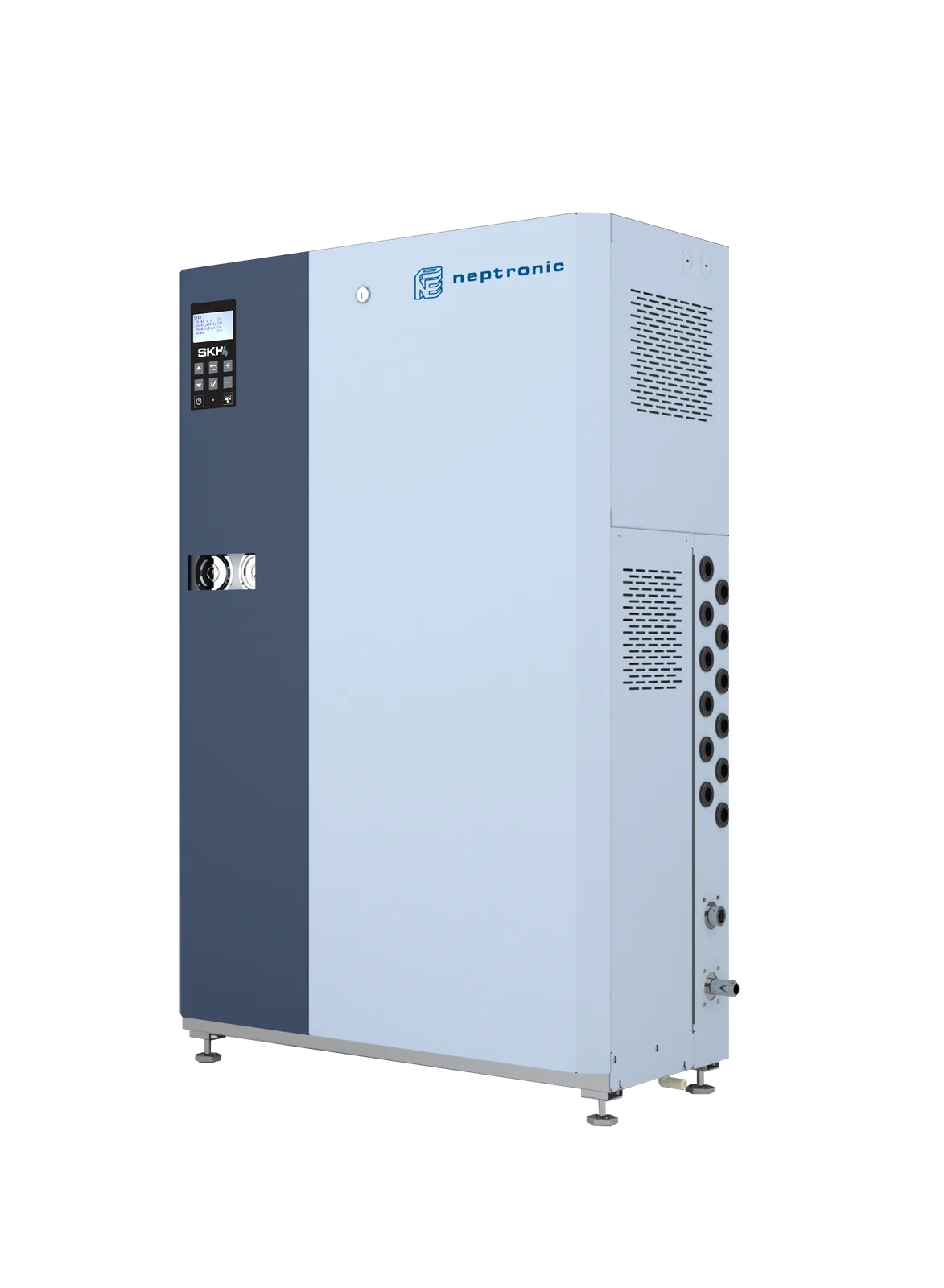
A textile plant in Bursa commissioned a Neptronic SKH high-pressure misting system on hard well water (28 fH, TDS 720 mg/L, chloride 180 mg/L) with only a 25 μm filter. After 3 months 30% of nozzles were clogged, 4 mm of deposit on the tank floor, and microbiology returned 180 CFU/L of Legionella. NKT installed a full treatment package: 3-stage filtration + sodium softener + RO (TDS 720 → 30) + UV-C + a 200 L stainless tank + recirculation. Capex €18,500. Over the next 24 months: zero clogs, zero CFU, nominal performance — ROI 18 months (cylinder + maintenance + labour savings).
Engineering Note
Treatment sizing rule: peak flow × daily operating hours × 1.5 safety factor = daily water requirement; this drives RO + tank + pump sizing. Optimum RO recovery is 50–75%; classic 50%, modern high-recovery 75%. Softener regeneration every 24–48 h (by hardness); salt consumption 1.5–3 kg/m³ of softened water. UV dose ≥ 30 mJ/cm² for Legionella, ≥ 40 mJ/cm² for hygienic facilities. The whole system runs PLC-monitored, with alarms on pressure, flow, conductivity and UV intensity.
NKT Application Link
NKT supplies the complete water-treatment station with Neptronic humidification packages, either as an option or as standard (per application). Standard package: filtration + softener or RO + UV + tank + recirculation pump + PLC control panel. All components are stocked in Turkey; commissioning + 6-month performance validation + annual periodic-maintenance contract are standard. The NKT - Climate Track platform continuously monitors water-quality parameters (conductivity, pressure, temperature, UV intensity).
Related Academy Articles
Related Products
NKT products related to this term