Definition
A drying defect in which excessively rapid surface drying creates a hard, low-permeability outer skin while the interior remains high in moisture and tacky. Moisture trapped below the crust cannot escape, leading to internal stress, cracking, deformation, or microbiological risk. It is the most common quality defect in confectionery, cheese, sausage, wood, and ceramic drying.
Detailed Explanation
Case hardening is a classic drying defect that occurs when the moisture mass-transfer rate at the surface exceeds the internal diffusion rate. The mechanism:
1. High air velocity or very low dew point causes excessive evaporation at the product surface. 2. Water molecules at the surface depart quickly; simultaneously the protein, gel, or starch structure densifies and capillary pores shrink. 3. This densified layer becomes a barrier to moisture migration from the interior; permeability drops. 4. The high interior moisture (30–60%) becomes trapped; internal stress, cracking, deformation, and long-term microbiological risk follow.
Visible/sensory indicators: • Kaşar cheese: hard, grey outer rind, wet and tacky inside; surface cracks on cutting • Sausage: dull, wrinkled exterior, honey-like inside; the "ring" defect • Jelly/confectionery: glassy, brittle surface, ungelled interior • Wood: dry surface, interior still at 20%+ moisture; later cracking and deformation
The scientific basis of the defect lies in the ratio of "moisture diffusion coefficient" to "surface mass transfer coefficient". Ideal drying belongs to the regime where both rates are balanced.
Why It Matters
Case hardening creates multifaceted losses for both product quality and food safety:
1. Trapped moisture creates microbial risk — high interior aw + temperature + nutrient is an ideal incubator for moulds, yeasts, and pathogenic bacteria (e.g. Listeria monocytogenes in cheese, Salmonella in sausage). 2. Texture and sensory degradation — kaşar receives "raw inside", "rubbery surface" comments in consumer tests; sellable yield drops. 3. Shelf-life reduction — moisture imbalance between surface and interior causes rind cracking and interior mould over time; products spoil within 30 days. 4. Waste — case hardening produces second-grade product; in the best case it is sold at discount, in the worst it is discarded. Typical loss is 3–12% per plant. 5. Energy waste — additional "rest" cycles or re-wetting are required to rebalance moisture after case hardening; this is energy and time lost. 6. No reworkability — fermented products (kaşar, sucuk) cannot be reprocessed; they go directly to sale.
From a regulatory standpoint, EU 2073/2005 and the Turkish Food Codex consider case-hardening-driven pathogen contamination as a HACCP critical control point.
Practical Example
Problem analysis at a Thrace kaşar cheese plant:
Baseline: • Maturation room: 12°C / 75% RH (dew point 7.8°C) • Air velocity: 0.8 m/s at the surface (high) • Maturation period: 90 days • Case hardening rate: 18% (sold as second grade)
Observation: a 5–7 mm hard grey outer layer formed; the interior remained 48% moist and tacky, with surface cracks on slicing.
Root-cause analysis: • Surface evaporation rate (~140 g/m²·day) much higher than interior diffusion rate (~85 g/m²·day) • 75% RH alone is insufficient; 0.8 m/s velocity over-dries the surface • Rind pore size dropped from 28 µm to 6 µm (per SEM analysis)
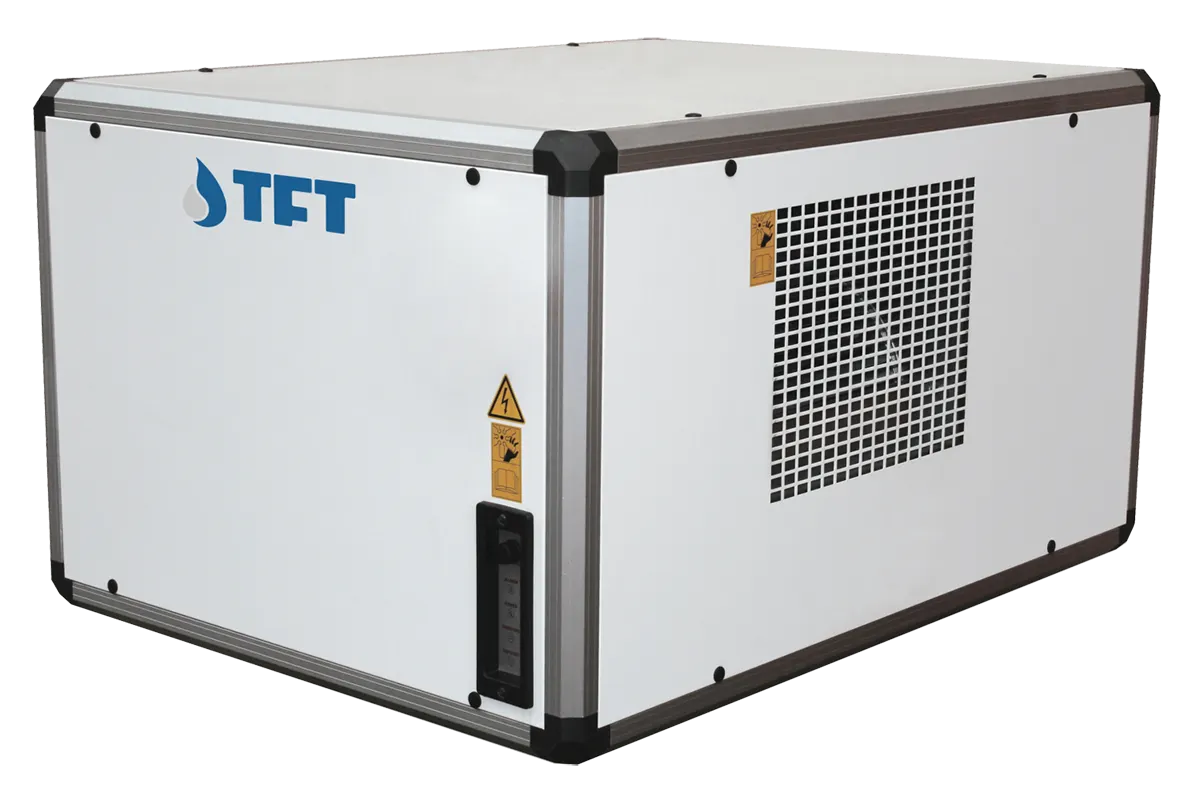
Solution: ambient redesigned with an NKT CD160-980 condensation dehumidifier: • Target: 12°C / 88% RH (dew point 10.1°C, higher) • Air velocity: 0.3 m/s at the surface (reduced, multi-return pattern) • Maturation period: down to 75 days (interior diffusion balanced) • Case hardening: 18% → 2.5%
Financial impact: in 320 t/year output, Grade-1 yield rose from 82% to 97.5%; additional annual revenue ≈ 580,000 USD; energy use unchanged.
Engineering Note
Six core engineering principles for preventing case hardening:
• Dew point balance — for moisture transfer between surface and interior, ambient dew point should sit 2–4°C below product surface temperature; wider gaps mean over-evaporation. • Air velocity control — 0.2–0.5 m/s at the product surface is ideal; high velocities (>1 m/s) blast surface evaporation. Multiple low-flow returns > one high-flow return. • Stepped drying — start at high RH (88–92%) and step down over time (to 75–80%); this profile gives interior diffusion time to keep up. • Temperature homogeneity — if ambient varies more than ±1°C, "cold spots" cause condensation and "hot spots" cause case hardening. Ceiling destratification fans are required. • Internal diffusion tracking — periodic moisture analysis (probe or NMR) should track surface-vs-interior moisture difference; >15% difference = case hardening beginning. • Feedback loop — VFD-driven fan + PID control should continuously tune dew point and air velocity; response to load profile must be near-instant.
Measurement: surface and interior moisture differential should be reported on a dry-matter basis (%); daily logs are required for HACCP.
NKT Application Link
For maturation rooms, jelly stove rooms, fermented sausage conditioning tunnels, and confectionery dehumidification lines with high case-hardening risk, NKT provides dedicated climate solutions. Typical architecture:
1. Dew-point-based PID control — independent of RH drift, mapped to product surface temperature 2. Low velocity + multi-point air distribution — laminar flow, 0.2–0.4 m/s at the surface 3. Condensation + silica gel rotor combination — broad dew-point band (−5 to +15°Cdp) 4. NKT - Climate Track monitoring — product surface sensor, interior probe sensor, dew point deviation alarm 5. VFD-driven fans — instant response to load profile, 30%+ energy savings
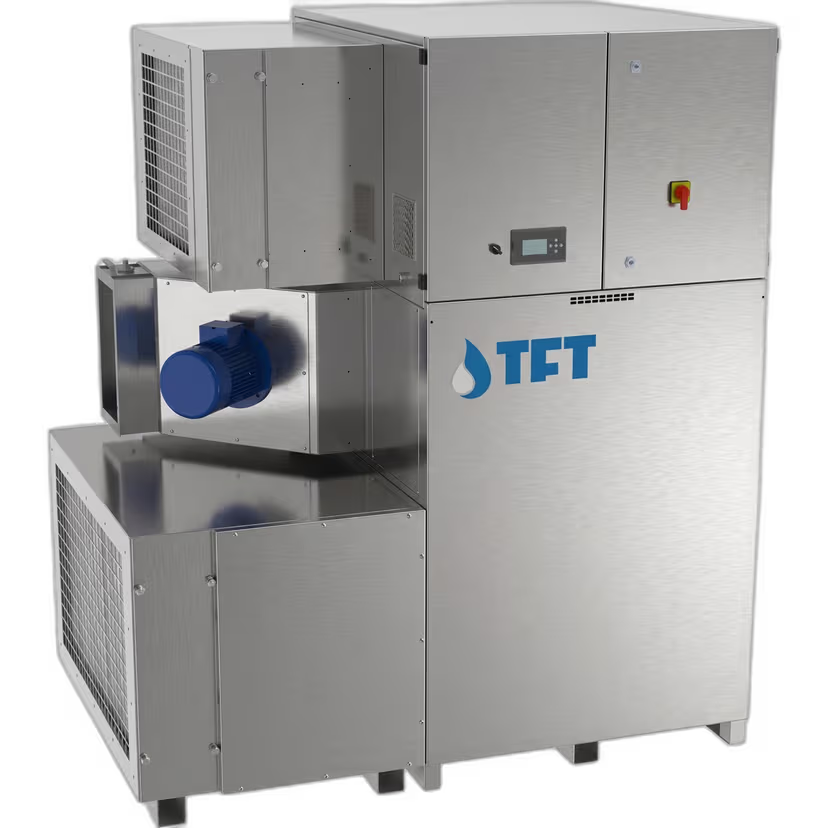
Sample product configurations: • Mid-scale kaşar maturation: NKT CD160-980 condensation type • Jelly stove room: NKT ADP2000-9500 silica gel rotor • Fermented sausage: NKT CD1200-3000 condensation type
Post-commissioning, the NKT engineering team tracks the product surface/interior moisture differential over three weeks and tunes setpoints; through this, case hardening drops from 15–20% to 1–3%.