Definition
A process in which powder is enlarged into larger and more uniform granules through particle agglomeration. Wet granulation involves spraying a binder liquid onto the powder bed followed by drying in a fluidized bed dryer; dry granulation uses high pressure (roller compaction). It is a fundamental step in tablet, capsule, dietary supplement, and powdered beverage manufacturing.
Detailed Explanation
Granulation is a fundamental step in pharmaceutical, dietary supplement, powdered beverage, and chemical industries. It aims to produce more uniform, free-flowing, and compressible granules from powdered raw materials. Three main methods:
1. Wet granulation — binder solution (aqueous PVP, HPMC, gelatin) is sprayed onto powder in a high-shear mixer; the agglomerated product is dried to 1–3% moisture in a fluidized bed dryer. Most common method. 2. Dry granulation — powder is passed through a high-pressure roller compactor to form ribbons; these are then milled into granules. For water-free, heat-sensitive products. 3. Direct compression — powder is tabletted directly without granulation; only for raw materials with suitable flow and compressibility.
Granule quality criteria: • Particle size distribution (PSD): typical d50 = 200–800 µm, narrow distribution (span < 1.5) • Flowability index: Carr index <18% (good flow) • Compressibility: Hausner ratio 1.1–1.2 (good) • Moisture content: 1–3% (post-wet-granulation) • Friability: <1%
Granulation ambient humidity is the most critical process variable: high humidity (high RH or high dew point) increases granule size, causes agglomeration, and reduces flowability. NKT silica gel rotor systems control the granulation environment.
Why It Matters
Granulation quality directly determines final product performance and regulatory compliance:
1. Tablet integrity — poor granule flow causes irregular tablet press feeding; tablet weight may drift ±5%; FDA/EMA does not accept this (limit ±5% or ±2.5%). 2. Active ingredient homogeneity — if granules clump, the API is not evenly distributed, and dose can vary tablet to tablet; clinical efficacy loss + safety risk. 3. Dissolution profile — granule size and moisture content determine tablet dissolution rate; out-of-spec dissolution = product rejection 4. Shelf life — high-moisture granules + packaging → tablet hardness changes over time, efficacy declines 5. Production efficiency — poor granules = frequent tablet press stops, more rework, batch rejection
Granulation ambient humidity impact: PSD width is 40% larger when granulation is performed at 50% RH versus 25% RH. This directly translates into tablet quality variation. Additionally, hygroscopic actives (e.g. metformin, acetylsalicylic acid) absorb moisture under high RH, causing granule agglomeration and batch rejection.
From a regulatory standpoint, USP <1058> and EU GMP Annex 1 require continuous monitoring and recording of granulation ambient; dew point and temperature must be continuously logged, with deviations root-cause analysed.
Practical Example
An Ankara pharmaceutical plant produces 500 mg metformin tablets. Granulation ambient design:
Product properties: • API: metformin HCl (highly hygroscopic) • Target granule moisture: 2.0% ± 0.3 • Target granule size: d50 = 400 µm, span <1.3 • Batch size: 250 kg • Annual batches: 3,500
Baseline issue: • Granulation room: 22°C / 45% RH (dew point 9.5°C) • Summer granule agglomeration, batch rejection rate 8% • Tablet weight variation: ±6% (violates FDA ±5% limit) • 280 batches rejected per year: 70 t × 25,000 USD/t = 1.75 M USD loss
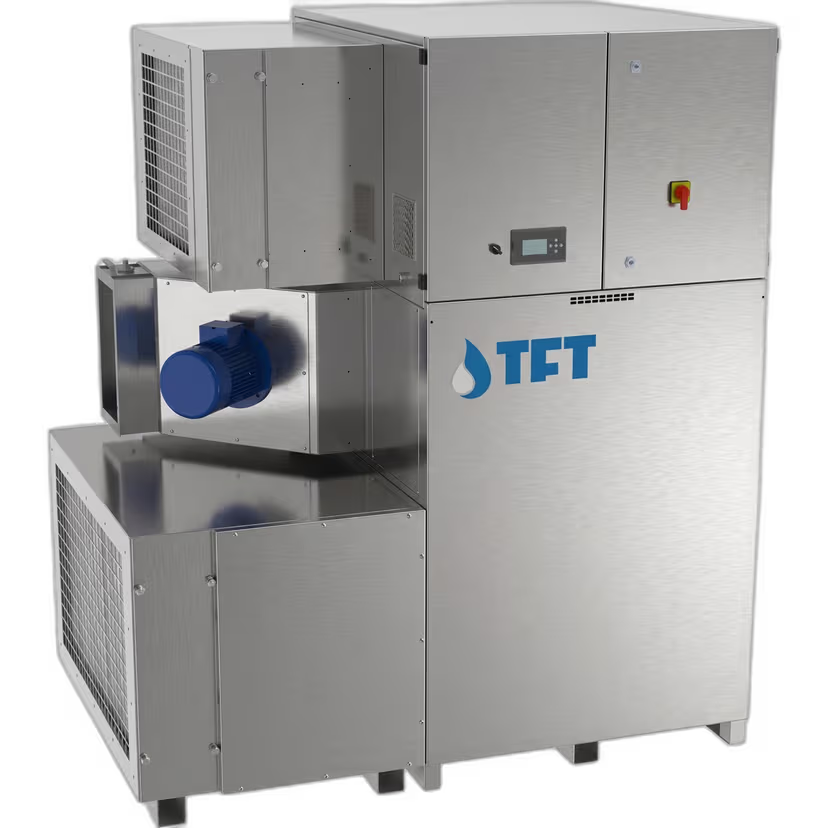
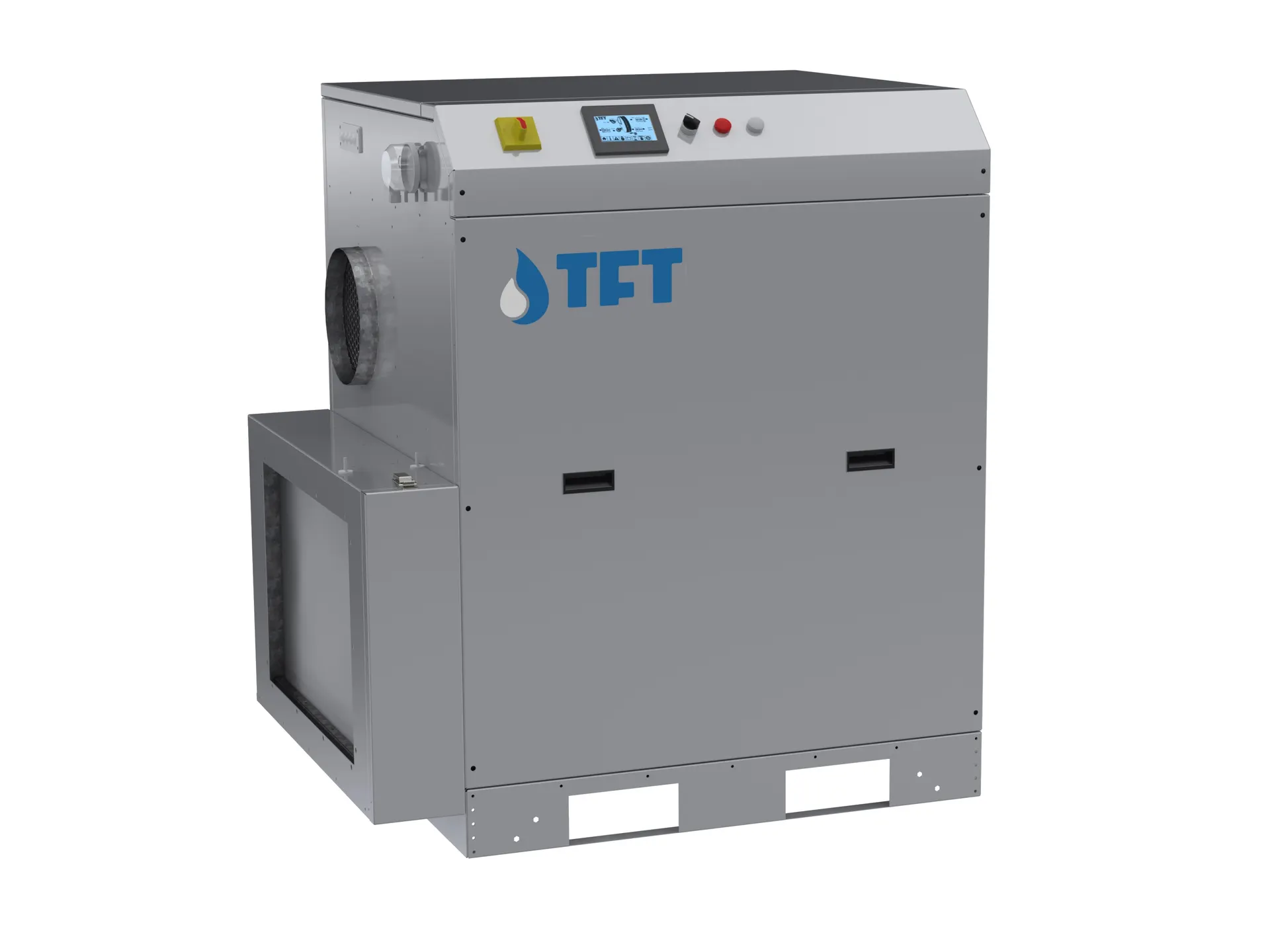
NKT Solution: • AD1000-3100 silica gel rotor unit, AD1500 model • Granulation room: 22°C / 25% RH (dew point 0.5°C) • Process capacity: 1,500 m³/h • Reactivation: 25 kW electric • ATEX Zone 22 compliant (metformin dust) • HEPA filter + stainless steel body (GMP requirement)
Post-commissioning performance: • Granule d50 stability: 400 ± 12 µm (previously ±40) • Tablet weight variation: ±2.8% (within FDA limit) • Batch rejection rate: 8% → 0.3% • Annual savings: 1.75 → 0.06 M USD = 1.69 M USD • Additional energy: 45 MWh/year • Regulatory compliance: USP <1058>, EU GMP Annex 1, FDA inspection passed • ROI: <1 month
Engineering Note
Eight critical engineering criteria for granulation facility design:
• Dew-point setpoint — chosen by product hygroscopicity; <10°Cdp for low-hygroscopicity products, <0°Cdp for high-hygroscopicity (metformin, vitamin C, caffeine) • Temperature homogeneity — ambient variation within ±1°C; otherwise "cold spots" create condensation • Air change rate (ACH) — 8–15 ACH for granulation rooms; particle removal + humidity control • Positive pressure — +10 to +20 Pa over corridor and outdoor (prevents reverse contamination) • Vestibules — separate vestibules for raw material entry, personnel entry, product exit; prevents cross-contamination • Filtration — HEPA H13 (>99.95% efficiency) mandatory; prevents API cross-contamination • ATEX compliance — Zone 21–22 for products with dust-explosion risk; rotor + fan + panel must be ATEX certified • Validation — IQ/OQ/PQ documentation; validation of dew-point and temperature alarm setpoints
Quality indicators: granulation ambient RH stability ±2%, dew point ±0.5°Cdp, batch-to-batch granule quality repeatability 98%+.
NKT Application Link
NKT provides fully GMP-compliant climate solutions for pharmaceutical granulation facilities. Typical project package:
1. Silica gel rotor dehumidifier (AD1000-3100 or ADP2000-9500 series) — low dew point (−15 to +5°Cdp), GMP stainless steel casing 2. HEPA H13 filtration — prevents active pharmaceutical ingredient cross-contamination 3. ATEX Zone 22 compliance — for explosive dust environments (rotor, fan, panel certified) 4. NKT - Climate Track monitoring — continuous dew point, temperature, RH, differential pressure; alarm setpoints 5. SCADA/MES integration — connects to plant systems, batch ambient conditions auto-recorded 6. Validation documentation — IQ/OQ/PQ, FAT/SAT, USP <1058>, EU GMP Annex 1 compliance
Sample configurations: • Small scale (100–250 kg batch): NKT AD1000-3100 series AD1000–AD1500 • Mid scale (500–1,000 kg batch): NKT AD1000-3100 series AD2000–AD3100 • Large scale (1,500–3,000 kg batch): NKT ADP2000-9500 series ADP3500–ADP6000
NKT has commissioned this architecture in 50+ pharmaceutical granulation plants; references brought batch rejection rates from 8% to below 0.5% and successfully passed FDA/EMA inspections. NKT - Climate Track reports provide monthly batch ambient analysis.