Definition
A material that absorbs moisture from or releases it back to the surrounding air; typical examples include paper, wood, textiles, granular products (flour, sugar, lithium salts), films, leather, and food products.
Detailed Explanation
A hygroscopic material is any substance whose molecular structure (typically hydroxyl groups, polar bonds, or porous structure) lets it absorb water vapour from ambient air or release it back. Typical examples: cellulose-based materials (paper, board, wood, cotton, linen), textile fibres (wool, silk, viscose), food products (flour, sugar, chocolate, spices, coffee), chemical products (lithium salts, sodium chloride, calcium chloride), films/foils, and leather.
A hygroscopic material's moisture balance (Equilibrium Moisture Content, EMC) depends on ambient RH and Tdb; every material has its own sorption isotherm. Paper at 22°C / 50% RH has an EMC of ≈ 7–8%, 4% at 20% RH, and 12–15% at 80% RH. EMC change leads to dimensional change (1–3% in size or thickness), sheet curl, wood cracking, textile shrinkage, print drift, and shifts in food shelf life.
Why It Matters
The sensitivity of hygroscopic materials to RH change is the primary driver of industrial humidification/dehumidification. Three typical problems: (1) DIMENSIONAL CHANGE — paper moving from 50% to 30% RH shrinks 0.5–1%; offset prints drift in colour, digital prints fail at the mesh, board boxes warp. (2) MECHANICAL STRENGTH LOSS — textile fibres become brittle at low RH, generate static, and break 10–30% more often during weaving. (3) MICROBIAL/CHEMICAL CHANGE — food products mould at high RH, dry out and lose shelf life at low RH; lithium-battery salts absorb moisture and damage the electrolyte.
During NKT projects the material's hygroscopic characterisation (sorption isotherm) is the design starting point; the facility's target RH and Tdb band is set on the "stable region" of that isotherm.
Practical Example
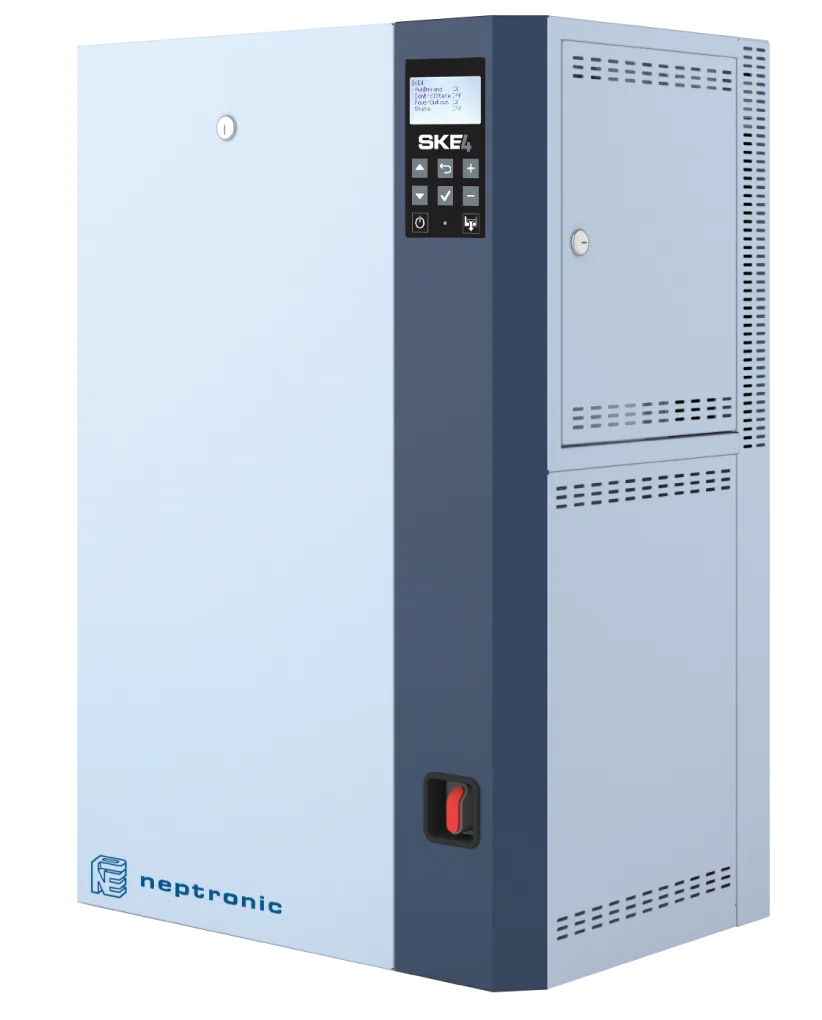
A paper-printing facility in Istanbul: 35% RH in summer (no AC) and 22% RH in winter (heated, no humidifier). Paper produced about 40% of all four-colour offset output in Türkiye; registration accuracy is ±0.1 mm. Seasonal RH swings caused continuous misregistration, generating ≈ TRY 1,200,000 of scrap per year. NKT design: a Neptronic SKE4-150 with an SKD-CK manifold set, stabilising 22°C / 50% ± 3% RH; one line at 40,000 m³/h covers the 8,500 m² print room. Over the 14 months after commissioning, scrap dropped 78% and ROI was 14 months.
Engineering Note
Hygroscopic-material design inputs: (1) sorption isotherm — from the material vendor or a standard reference (TAPPI for paper, ISO 6741 for textile); (2) target EMC band — set by the process (±0.5% EMC for offset printing, ±1% for weaving, ±2% for museums); (3) target RH band — derived from the isotherm; (4) buffer time — the material takes 6–72 hours to reach a new RH and this lag must be planned for.
The "stable region" of the target RH band is where dEMC/dRH is smallest — typically the 40–60% RH band. There a ±5% RH swing yields a ±0.3–0.5% EMC change; in extreme zones (20% or 80%) the same ±5% swing can yield ±2–3% EMC change.
NKT Application Link
In NKT designs the facility's key product is characterised hygroscopically (paper grade, textile fibre, food matrix, chemical granule) from the supplier's datasheet or an ASHRAE/standard reference; the target RH band is set on the sorption isotherm. The NKT - Climate Track platform continuously trends RH+Tdb; deviation alarms (outside the ±3–5% RH band) are pushed to the operator instantly. For traceability-critical batches, NKT - Climate Track data can be integrated into the product traceability record — particularly important for pharma (GMP), food (HACCP), and museum-conservation standards.
Related Academy Articles
Related Products
NKT products related to this term