Definition
During heating/evaporation, dissolved minerals (mainly calcium carbonate and magnesium hydroxide) precipitate as a hard layer on hot surfaces; this directly reduces humidifier efficiency and equipment life.
Detailed Explanation
Scaling — the precipitation of minerals on a hot surface — is a natural consequence of steam humidifiers. As water evaporates, the dissolved-mineral concentration rises; when it exceeds saturation, calcium carbonate (CaCO₃) and magnesium hydroxide (Mg(OH)₂) precipitate as a hard layer. It builds on heating-element surfaces (resistive), electrode surfaces (electrode), cylinder/tank walls and drain piping.
Why It Matters
Scale produces three main problems: (1) HEAT-TRANSFER LOSS — a 1 mm layer on a heating element lowers heat transfer 15–20% and reduces capacity. (2) CURRENT INSTABILITY — when electrodes are scaled in an electrode system, conductivity becomes irregular and current control suffers. (3) MAINTENANCE BURDEN — cleaning is done with acid (5–10% citric), each clean takes 30–90 min of technician labour; on hard scale, mechanical scraping or part replacement is required. Preventive measure: hardness monitoring + suitable pretreatment (softening, RO).
Practical Example
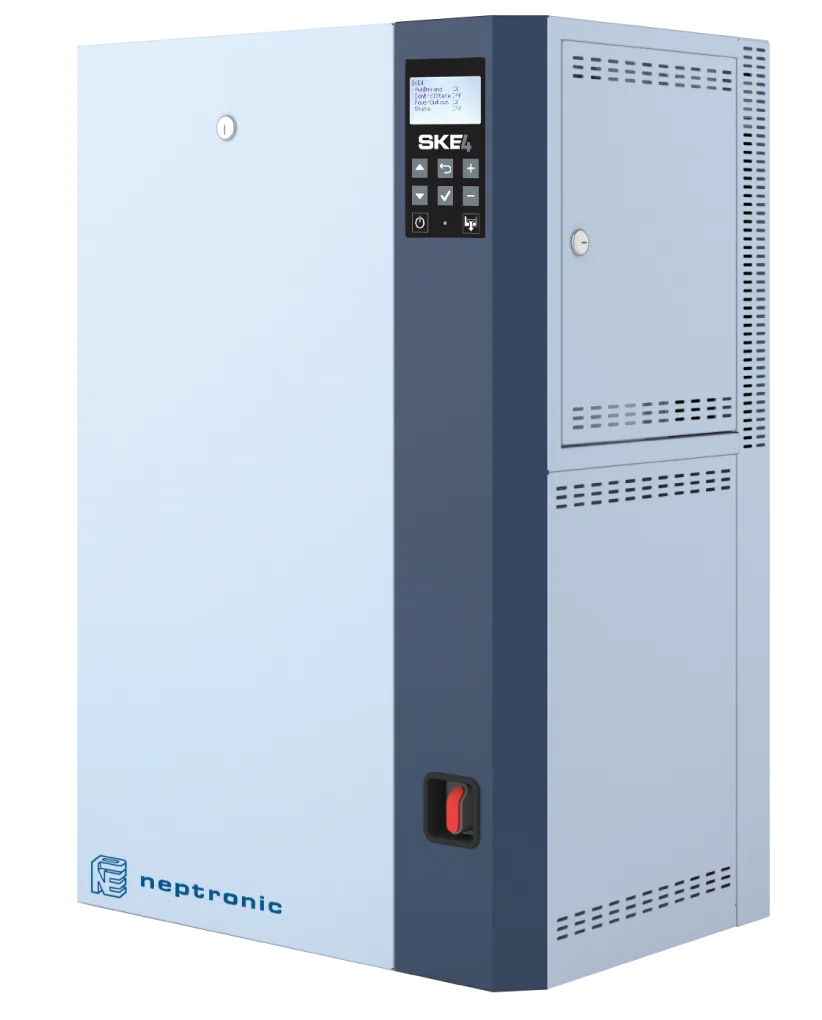
A printing plant in Ankara fed an electrode humidifier with 28 Fr° hard mains water; 6 mm of scale + alkaline deposit built on cylinder surfaces in 4 months and capacity dropped 40%; annual cylinder-replacement cost reached €8,500. NKT analysis showed high hardness + high alkalinity (LSI +1.4 aggressive scaling). The solution: a softener (hardness lowered to 4 Fr°) plus a resistive Neptronic SKE4 (stainless chamber, tool-free cleaning). Afterwards, 1–2 chamber cleans per year and zero cylinder cost.
Engineering Note
Scaling rate ≈ (hardness × capacity × runtime) / drain ratio. Soft water (<5 Fr°) plus adequate drain (20% tank refresh every 50–100 hours) keeps annual cleaning to once. Medium hardness (5–15 Fr°) needs 2 cleans per year; very hard (>20 Fr°) requires 4+ cleans per year or softening. Acid cleaning procedure: stop unit → drain tank → 5% citric acid for 2 h → brush → rinse → recommission. AISI 304L stainless has lower acid tolerance than 316L; element-cleaning instructions must be followed.
NKT Application Link
In NKT's annual periodic-maintenance contract, tank cleaning + heating-element inspection + scaling-rate measurement are standard steps. The Neptronic SKE4 stainless chamber is tool-free; typical technician time is 30 min. For high-hardness sites NKT offers a softener option; long-term it reduces cylinder cost and improves uptime.
Related Academy Articles
Related Products
NKT products related to this term