Definition
Steam reverting to liquid water on contact with a cold surface; in humidification ducts, an unwanted liquid-water droplet formation caused by insufficient absorption distance or a cold surface.
Detailed Explanation
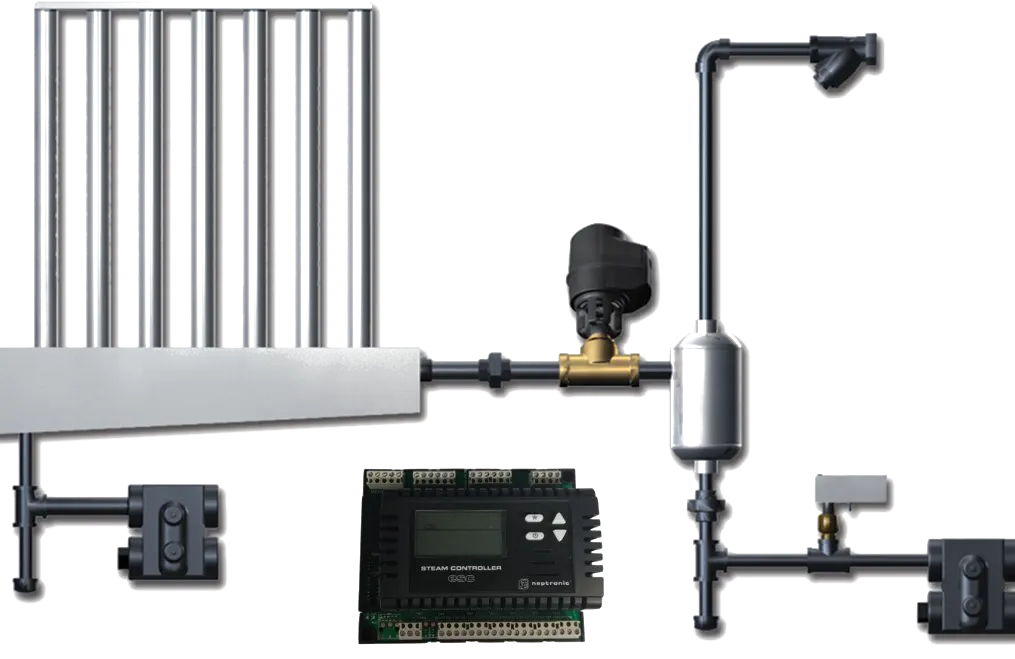
Condensate is gas or vapour reverting to liquid as it cools below saturation. In steam humidification it forms in two places: (1) Steam piping between the unit and the distribution manifold — long or uninsulated runs lose 5–20% of steam. (2) Downstream of the manifold, on duct walls, elbows, filters or cold surfaces — when the absorption distance is short. In both cases condensate appears as liquid-water droplets that affect equipment and hygiene.
Why It Matters
Condensate creates three main problems: (1) HYGIENE — liquid water is a breeding medium for Legionella, Pseudomonas and other pathogens; the risk is highest at 25–55°C. Critical for hospitals, pharma and food. (2) CORROSION — condensed water carries high mineral concentration on hot surfaces, leading to long-term corrosion on stainless duct walls, dampers and coil faces. (3) PROCESS PERFORMANCE — condensed steam comes off the delivered capacity; the humidifier cannot reach target RH; typical loss 5–20%. Solution: correct absorption distance + steam-pipe insulation + drain slope (>1%) + condensate trap.
Practical Example
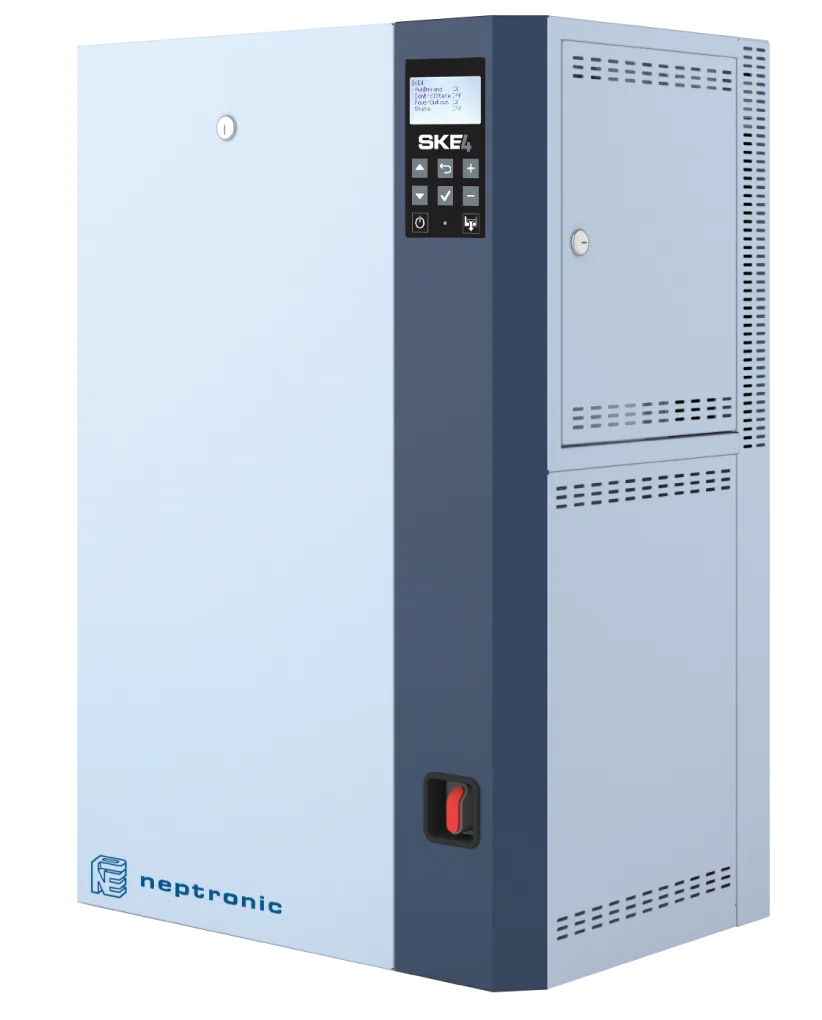
An Istanbul hospital surgical-block AHU had a Neptronic SKE4-90 + 14 m of uninsulated steam piping + a Neptronic SKD manifold. Post-commissioning RH was 43% against a 50% target; the downstream sensor was correct but the humidifier was running at full capacity. NKT analysis: 18% condensate loss in 14 m of uninsulated piping, dropping 16 kg/h before the manifold. Solution: full pipe insulation (50 mm rock wool + aluminium cover) and a sloped condensate-return line connected to drain. Afterwards RH stabilised at 50.5–51.5%.
Engineering Note
Condensate management rules: (1) 1% slope per metre of steam pipe for condensate return; max 30 m unbroken before a trap. (2) Insulation: minimum 25 mm rock wool or glass wool + aluminium or thick PVC cover; 50 mm on runs > 6 m. (3) Trap: heat-resistant steel thermodynamic or thermostatic; a manual drain valve is not enough. (4) Steam distribution manifold (SKD) should be jacketed — particularly when duct temperature is below manifold temperature. (5) Absorption-distance calculation prevents condensate as a design parameter.
NKT Application Link
Condensate check is a mandatory step in NKT's commissioning protocol: insulation inspection on the steam pipe + thermal-camera scan (is pipe temperature uniform) + droplet check downstream of the 2 m zone. The Neptronic SKD manifold family has a jacketed variant to minimise condensate risk; the SKE4 ships with its own condensate-return line. The NKT - Climate Track platform continuously trends downstream RH, catching condensate-driven drops early.
Related Academy Articles
Related Products
NKT products related to this term