Definition
In electrode steam humidifiers, the period a disposable plastic cylinder lasts before replacement under operating conditions; typically 6–18 months, depending on water quality and usage intensity.
Detailed Explanation
Cylinder life is the operating period an electrode steam humidifier's disposable plastic cylinder lasts before replacement. The cylinder serves as the water reservoir between electrodes; minerals, scale and electrode wear progressively take it out of service. Typical life is 6–18 months; with highly variable water quality it can fall below 3 months, and under very favourable conditions it can exceed 24 months.
Why It Matters
Cylinder cost is the largest item in an electrode humidifier's total cost of ownership (TCO). For a 50 kg/h unit, a cylinder costs €350–550 and 1–3 replacements per year is typical; over 5 years the cylinder cost reaches 60–120% of the unit price. Add plastic-waste cost (recycling is difficult; most jurisdictions classify it as "hazardous waste"), labour (30–60 min per swap) and downtime (replacement cannot proceed during production). So cylinder life = operating-budget driver.
Practical Example
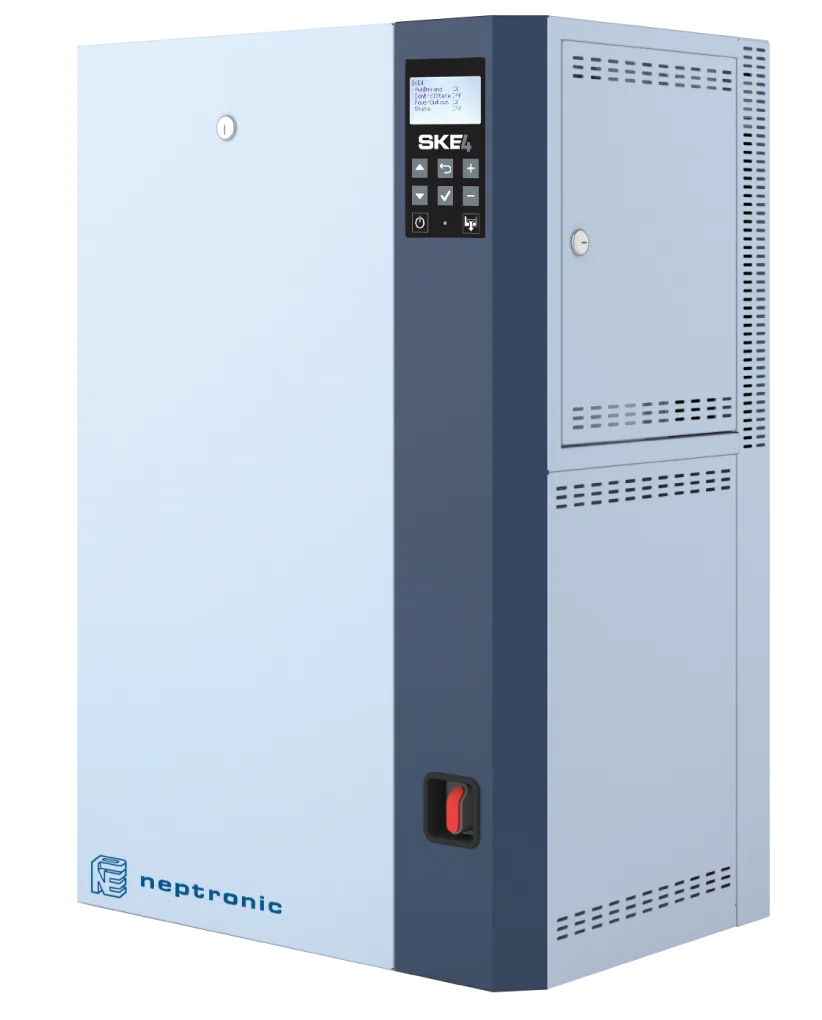
A printing plant in Istanbul runs an 80 kg/h electrode humidifier for 2,000 h/year. Water hardness 14 Fr° (medium), TDS 380 mg/L. Average cylinder life is 8 months → 1.5 cylinders/year × €450 = €675 + 4 h labour × €50 = €200 + 3 kg plastic waste. 5-year TCO: €4,375 cylinders + €1,000 labour + waste disposal = €5,500. NKT alternative proposal: resistive Neptronic SKE4 (110 kg/h, permanent stainless chamber) — 1 chamber clean/year × €50 labour; 5-year extra cost €250. ROI difference: €5,250 saved over 5 years.
Engineering Note
A rough estimation: cylinder life (months) = K × (capacity × runtime × hardness × conductivity_factor)⁻¹. K varies by brand; OEM tools (humidifier monitoring software, Neptronic Calc) give site-specific estimates. Strategies to extend cylinder life: (1) Softening → hardness <5 Fr° → life increases 1.5–2×. (2) Optimum drain algorithm → mineral-concentration control. (3) Use of modulation → less wear than running 24/7 at full capacity. (4) RO pre-treatment → risky for electrodes (drops outside the conductivity window), ideal for resistive.
NKT Application Link
For sites with electrode units, NKT includes a cylinder-life expectation + TCO calculation as a standard part of the proposal. With the user's usage profile + water analysis, 5–10-year cylinder cost is computed and compared with a resistive Neptronic SKE4 alternative. Under high usage or hard water, a resistive switchover typically pays back in 12–18 months; the calculation is shared transparently. The NKT - Climate Track platform monitors cylinder-life trends live, providing early warning when deviations occur.
Related Academy Articles
Related Products
NKT products related to this term