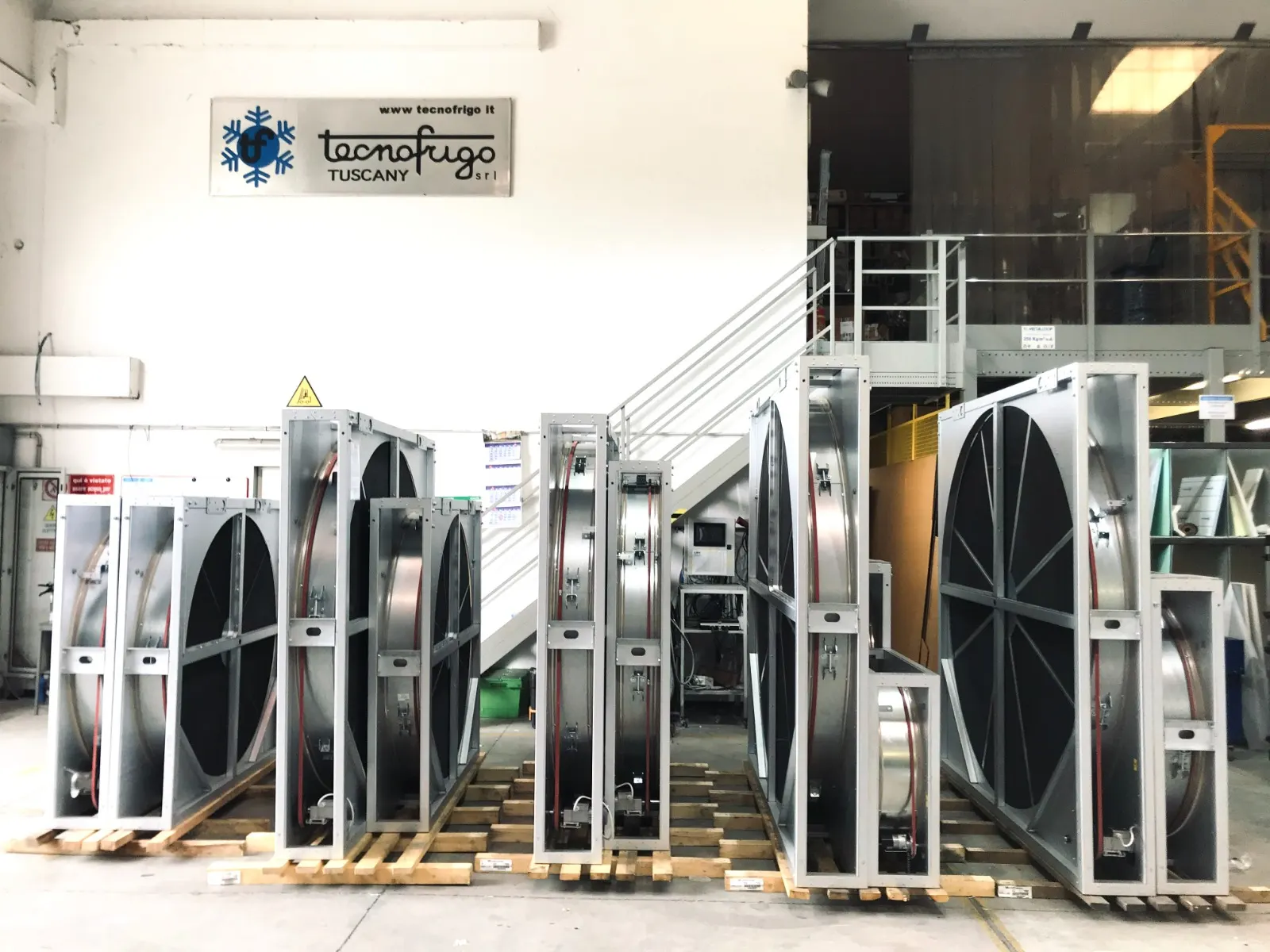
Definition
A rotating rotor structure coated with sodium silicate-based desiccant material. Adsorbs water molecules from air in the dehumidification zone and releases moisture by heating in the reactivation zone. Can achieve dew points as low as -60°C. The heart of industrial dehumidifiers.
Detailed Explanation
A silica gel rotor is a continuously rotating honeycomb structure. The honeycomb cells are coated with a high-surface-area desiccant material based on sodium silicate (SiO₂·nH₂O). 1 gram of silica gel has ~600–800 m² of surface area; this massive internal surface is the foundation of adsorption capacity.
The rotor is divided into two distinct zones: the dehumidification (process) zone and the reactivation (regeneration) zone. Typically 75% of the rotor is used for process and 25% for reactivation. The rotor passes through these zones at a rotation speed of 8–20 rev/hour:
• In the process zone: humid process air passes through the rotor, water molecules are adsorbed onto the silica gel, and the air exits dry (inlet −10 to +10°Cdp). • In the reactivation zone: reactivation air heated to 100–140°C passes in the opposite direction, "drying" the silica gel and expelling moisture.
The outlet dew point can be adjusted between −10°C and −70°C depending on rotor efficiency, flow ratio, and reactivation temperature. Far below the practical limit of condensation systems (+5°Cdp), these values make silica gel rotors uniquely suited for lithium battery dry rooms, pharmaceutical granulation, freeze-dryer storage, and low dew point gas drying applications.
Performance Parameters
Typical silica gel rotor performance:
Process air capacity: 100–25,000 m³/h per single rotor Reactivation air ratio: 25–35% of process air Reactivation temperature: 100–140°C (for silica gel), 180–220°C (for zeolite/molecular sieve)
Outlet dew point bands: • −10 to −20°Cdp: standard silica gel + 110°C reactivation • −30 to −45°Cdp: high-capacity silica gel + 120°C reactivation • −50 to −70°Cdp: zeolite/3A molecular sieve + 180°C reactivation
Reactivation Energy Ratio (RER): RER = Qreact / mu (kJ/kg of moisture removed) Typical 4,500–8,500 kJ/kg (pure evaporation is 2,501 kJ/kg). RER < 4,000 kJ/kg in high-COP rotor systems.
Practical Example
A lithium battery cell production facility in Türkiye is setting up a −40°Cdp dry room. Design inputs:
Room volume: 1,200 m³ Target dew point: −40°Cdp (≈ 0.8% RH @ 23°C) Personnel infiltration: 3 kg/h moisture (8 people, airlock crossings) No outdoor air mixing (closed circulation)
Selection: NKT AD3000-6500 series silica gel rotor dehumidifier, AD5000 model Process capacity: 5,000 m³/h Reactivation heater: 90 kW electric (alternatively: natural gas) Outlet dew point: −45°Cdp (below target for safety margin)
Estimated annual energy consumption: • Process fan: 11 kW × 8,760 hours = 96 MWh • Reactivation heater: 90 kW × 0.7 average load × 8,760 = 552 MWh • Reactivation fan: 5.5 kW × 8,760 = 48 MWh • Total: ~696 MWh/year
With reactivation heat recovery, total consumption drops to ~520 MWh (25% savings). The NKT energy simulation tool performs this calculation on an hourly basis.
Engineering Note
Critical points in silica gel rotor selection and operation:
• Rotor filtration — silica gel is extremely sensitive to dust and oil vapors. F7 class or higher filtration + optional activated carbon pre-filter can change rotor life from 2–3 years to 10+ years. • Reactivation energy source selection — electricity has high OPEX; natural gas has low OPEX but adds flue/combustion equipment; waste heat (cogeneration, boiler return) is the most economical but site-specific. • Dew point control — modulating reactivation temperature (PID control) saves 15–25% energy versus fixed temperature; over-drying is prevented during low-load periods. • Two-stage systems — a single rotor is insufficient below −55°Cdp; a pre-rotor (−30°Cdp) + main rotor (−60°Cdp) serial configuration is standard. • Sealing — the rotor edge gasket prevents reactivation air from leaking into the process side; a 2% leak raises the dew point by 8–10°C.
NKT silica gel rotor units (AD/ADP/ADIO/ADE series) are designed according to these engineering principles, with field references in pharmaceutical, lithium battery, and low dew point applications.