Definition
A confectionery process in which a centre product (biscuit, wafer, marshmallow, nougat) is conveyed under a curtain of molten, tempered chocolate that completely coats the surface. After enrobing, the product is stabilised at 12–15°C in a cooling tunnel; the chocolate transitions to Form V cocoa butter crystals, gaining gloss and snap. Dew point control inside the tunnel is critical to prevent white/grey defects (fat bloom, sugar bloom).
Detailed Explanation
Enrobing is the most widely used coating technique in the chocolate sector. The line has three main zones: the enrober, the cooling tunnel, and storage/packaging. The centre product (biscuit, wafer, marshmallow, nougat, hazelnut bar) moves on a conveyor at 6–18 m/min; tempered chocolate (29–32°C) is poured over it as a curtain, fully coating the surface. Excess chocolate is removed by a draining belt and air knives below.
The "wet" coated product enters a 30–60 m cooling tunnel. The tunnel temperature profile is typically three-zone: • Zone 1 (inlet): 14–16°C, chocolate viscosity still low, forming begins • Zone 2 (middle): 8–12°C, Form V crystal growth peaks • Zone 3 (outlet): 14–18°C, product equilibrates with ambient and goes straight to packaging
Total tunnel time is 6–14 min; duration depends on chocolate thickness and centre-product heat capacity.
Desired output properties: glossy surface, snap (clean break), uniform shell thickness, 4–6 month shelf life. These targets are achievable only with correctly tempered chocolate + correct tunnel climate; if tunnel humidity control is neglected, sugar bloom and fat bloom defects appear.
Why It Matters
Enrobing quality is a consumer-visible attribute directly affecting brand value. With deficient tunnel climate control, four primary defects appear:
1. Sugar bloom — moisture condenses on the product surface, dissolves sugar crystals, and after drying leaves a whitish, non-glossy crystalline film. Irreversible — the product cannot be sold. 2. Fat bloom — cocoa butter migrates to the surface as grey patches or a full white film. Caused mainly by tempering errors + tunnel temperature shocks. 3. Matte finish — poor crystal structure (Form III/IV), gloss loss; no snap, soft texture. 4. Sticking — sticking to packaging, with shell delamination during shelf picking.
Financially these defects typically generate 3–10% waste; premium brands have a tolerance below 1%. By comparison: in a 5,000 t/year output, every 1% waste rise equals roughly 250,000–500,000 USD additional loss (at finished product cost).
Keeping tunnel ambient dew point below product surface temperature is not optional but mandatory; otherwise every droplet inside the tunnel becomes a potential sugar-bloom defect. For this reason, chocolate enrobing facilities operate with silica gel rotor dehumidifiers in a low-dew-point environment.
Practical Example
A Marmara chocolate plant produces 4,500 t/year of enrobed chocolate biscuits. Current issue: from May–September, sugar bloom rate is 4.2%; in winter, 1.1%.
Diagnosis: • Cooling tunnel ambient: 11°C / 70% RH (dew point 5.8°C) • Product surface temperature in Zone 2: 8°C • Critical finding: ambient dew point (5.8°C) appears below product surface (8°C), but tunnel door openings let outdoor air (summer 30°C/70% RH = dew point 24°C) cause short dew-point spikes; momentary condensation at product surface + sugar bloom
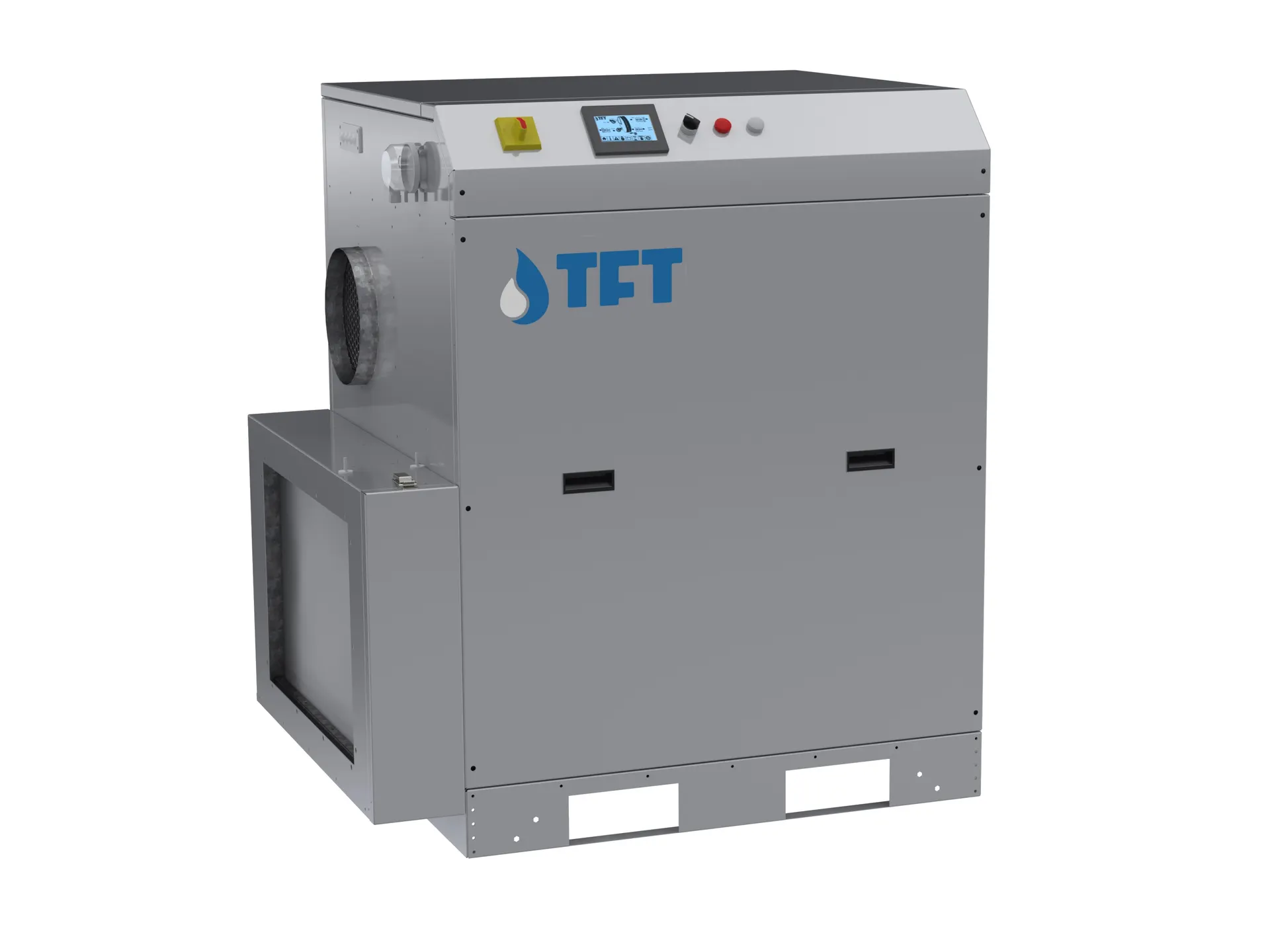
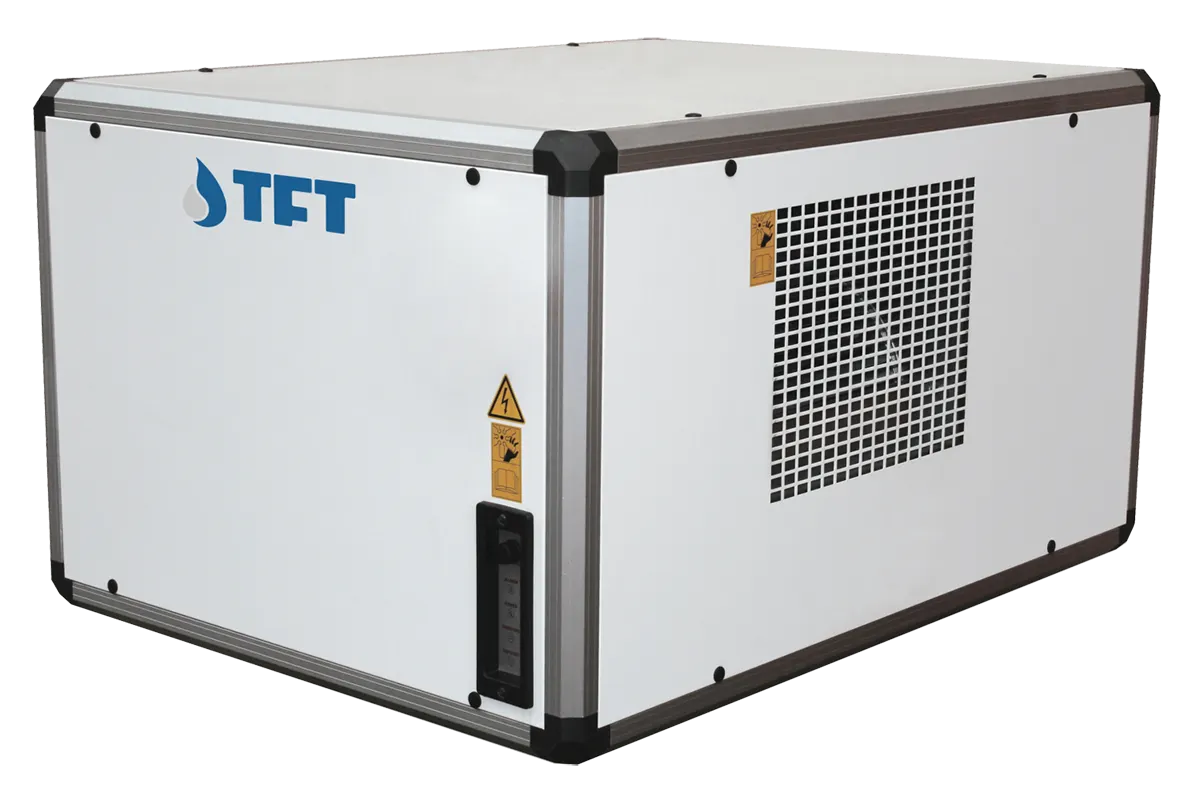
Solution: • NKT AD1000-3100 series silica gel rotor unit, AD2000 model • Process capacity: 2,000 m³/h • Outlet dew point: 0°Cdp • Additional vestibule at tunnel entrance (3 m length, air curtain) • Tunnel ambient redesigned: 11°C / 50% RH (dew point 1.2°C) • Vestibule: 16°C / 45% RH (dew point 4°C)
Six-month post-commissioning tracking: • Sugar bloom: 4.2% → 0.3% (summer) • Total waste: 2.8% → 0.5% • Additional annual revenue: 4,500 t × 2.3% × 8,500 USD/t ≈ 880,000 USD • Additional energy: 75 MWh/year (rotor reactivation); ROI 4 months
Engineering Note
Seven engineering criteria for enrobed chocolate line design:
• Warm-air infiltration — even in winter, outdoor-air infiltration causing summer sugar bloom must be minimised at tunnel entries/exits via vestibules (door count, air curtain, stepped heating). • Dew-point setpoint — at least 3°C margin below product surface temperature; in practice tunnel ambient dew point sits between 0 and 3°Cdp. • Temperature-shock prevention — transitions between Zones 1, 2, 3 must be gradual; abrupt temperature change (>5°C/m) disrupts Form V crystal growth and increases fat-bloom risk. • Belt hygiene — chocolate residues and dust on the conveyor pose tunnel-hygiene and product-contamination risk; automatic belt brushing is recommended. • Airflow pattern — laminar (parallel-flow rather than cross-flow) is ideal for Form V crystal growth; turbulence causes uneven heat transfer at the surface. • Cooling capacity reserve — 20–30% reserve is needed for summer peak load; otherwise the temperature setpoint drifts on hot days. • Monitoring — ambient temperature + dew point measured at 4–6 points along the tunnel; product surface temperature measured by IR; data trended via SCADA.
In a properly designed system, total waste falls below 1%.
NKT Application Link
NKT specialises in cooling-tunnel climate solutions for enrobed chocolate lines. Typical architecture:
1. Silica gel rotor dehumidifier (AD/ADP series) for low dew point (−2 to +5°Cdp) 2. Two-stage cooling + reheat for a stepped temperature profile 3. Vestibule design — air curtain + sequential doors + controlled ambient at tunnel entries/exits 4. NKT - Climate Track monitoring — dew point + temperature + RH at 6 points along the tunnel; product surface IR measurement; deviation alarms 5. VFD-driven process fan — airflow modulation by load profile, 30%+ energy savings
Typical NKT project package: • Design: tunnel load analysis, outdoor-air impact modelling, dew-point target selection • Commissioning: 6-week ambient monitoring, setpoint optimisation • Training: operator training, seasonal setpoint tuning • Service: annual preventive maintenance, rotor performance testing, pre-season check
NKT has commissioned this architecture in 30+ enrober plants; we have references that brought sugar bloom rates from 4–5% down to below 0.5%.