Definition
An inventory principle in which the oldest batch/lot is always used or shipped first in stock management and production flow. It is mandatory in food, pharmaceutical, chemical, and cold-chain logistics to preserve shelf life and product traceability. FEFO (First Expired First Out) is its expiration-date-focused derivative, preferred for matured cheese, fresh dairy, and pharmaceuticals.
Detailed Explanation
FIFO (First In First Out) is one of the foundational principles of modern inventory management. It guarantees that the oldest batch is used or shipped first in raw material, intermediate, and finished product stocks. Three main variants:
1. Classic FIFO — entry-date focused; the oldest production-date batch is used first. General food, chemical, plastic raw materials. 2. FEFO (First Expired First Out) — expiration-date focused; the batch nearest expiration is used first. Pharmaceutical, fresh dairy, meat, frozen food. 3. LIFO (Last In First Out) — last in first out; accounting-focused, rarely applied physically (prohibited for food/pharma).
FIFO implementation methods:
1. Physical rack layout — in cold storage, pallets are arranged back-to-front; new pallets at the back, old pallets pulled from the front. Gravity-flow racks (sloped rollers) facilitate this. 2. Colour-coded labelling — different colour every week/month; oldest visually recognised at a glance. 3. Barcode/RFID tracking — every pallet barcoded; WMS (Warehouse Management System) auto-allocates the oldest pallet. 4. Dated lidded containers — internal package date tracked in open packaging; oldest dates moved to the front in retail.
In cold-chain and food operations, FIFO + temperature-humidity control + continuous monitoring work as a whole. NKT condensation-type dehumidifiers keep warehouse ambient stable while the FIFO system guarantees product rotation.
Why It Matters
When correctly applied, FIFO directly affects six critical operational metrics:
1. Product quality — fresh product always goes to market, consumer satisfaction is high; old product left in storage = quality loss + returns 2. Shelf-life utilisation — with FIFO each product uses its maximum shelf life; FIFO violation forces products to be discarded pre-expiry (waste) 3. Microbial safety — long storage extends microbial risk, especially for cold-tolerant pathogens like Listeria and moulds. FIFO + ambient control is mandatory in combination 4. Regulatory compliance — EU Reg. 178/2002 (food traceability), 2073/2005 (microbiological criteria), USP <659> (pharma shelf life) all mandate FIFO 5. Inventory value loss — old stock sells below balance-sheet value; FIFO violation = inflated balance sheet + real loss 6. Recall traceability — when a problem batch is identified, FIFO + lot tracking lets affected products be quickly traced; recall is possible within hours
FIFO's critical complement is environmental control: correct ambient (temperature, dew point, RH) makes FIFO shelf-life estimates work. Example: if matured kaşar is labelled with a 6-month shelf life, this holds when the warehouse is kept at 13°C / 88% RH; but exposure to 18°C / 75% RH spoils the product in 3 months, the FIFO assumption collapses, and the product reaching the customer is spoiled.
For this reason FIFO + continuous ambient monitoring + WMS integration is the standard combination in modern food/pharma plants. The NKT - Climate Track system continuously logs warehouse ambient, generates deviation alarms, and provides the foundational data for the FIFO system.
Practical Example
An Istanbul kaşar cheese distribution warehouse runs an integrated FIFO + climate control project:
Facility data: • Cold storage volume: 2,400 m³ (40 × 20 × 3 m) • Storage temperature: 13°C • Target RH: 88% (dew point 11°C) • Product: matured kaşar, 6-month shelf life, 1,200 t/year turnover • Pallet count: 400 (500 kg each) • Rotation rate: 4 weeks
Baseline issue: • Manual FIFO, pallets are mixed up • In summer, warehouse temperature reaches 16°C and RH drops to 75% • Average product shelf life: 4.5 months instead of 6 • Annual discard rate: 4% (48 t × 18,000 USD/t = 864,000 USD) • Customer complaints: taste variation, rind mould
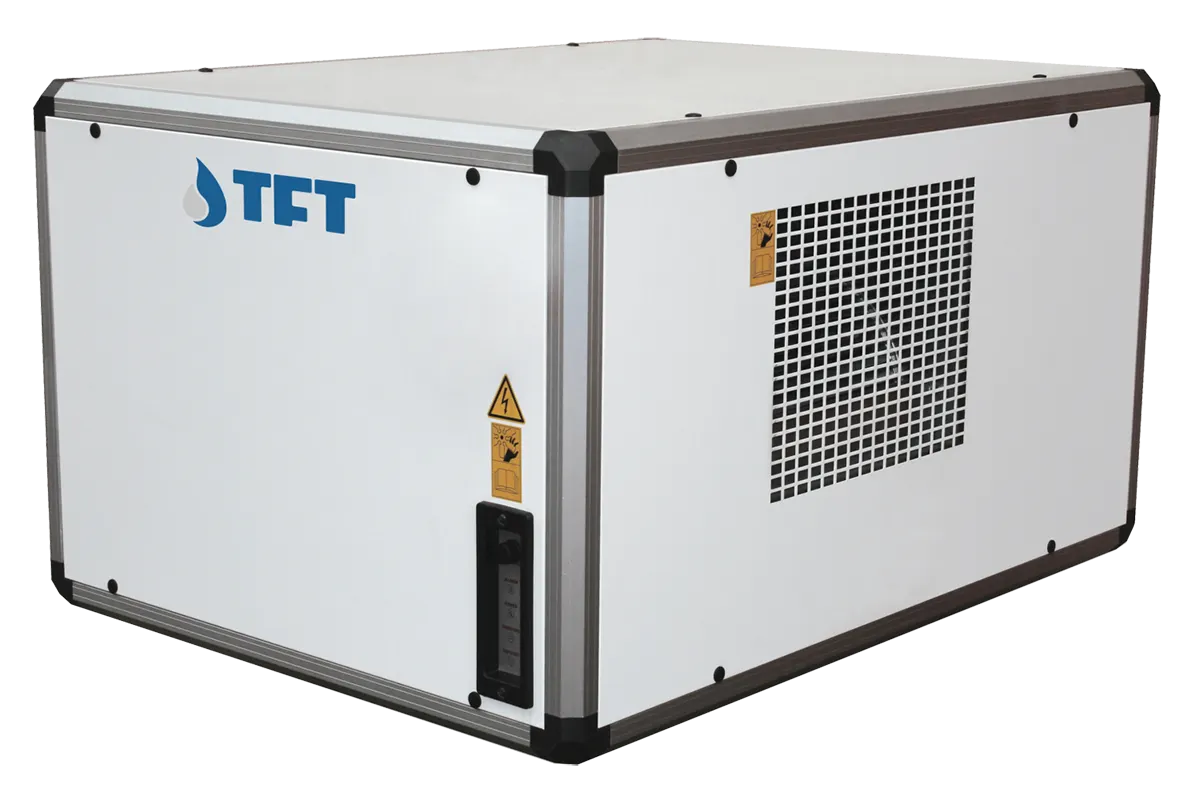
NKT Integrated Solution: • CD1200-3000 condensation-type dehumidifier, CD1500 model • Temperature + RH control: 13°C ± 0.5 / 88% ± 2 RH, year-round stable • NKT - Climate Track system → WMS integration • Gravity-flow rack system (existing racks converted) • RFID-tagged pallets + automatic FIFO allocation in WMS • Hourly dew point + temperature + RH fed into WMS; shelf-life estimate dynamically updated
Twelve-month post-commissioning tracking: • Warehouse ambient stability: 95%+ hours within target (previously 55%) • Actual product shelf life: 6 months (on target) • Annual discard rate: 4% → 0.4% • Customer complaints: 2.8% → 0.3% • Annual savings: 864,000 USD × 90% reduction = 778,000 USD • Entered premium market: 4 new retail chains, 12% price premium • Additional annual revenue: 1,200 t × 12% × 18,000 USD/t = 2.6 M USD
Engineering Note
Eight critical criteria for FIFO + climate control integrated design:
• Ambient stability — warehouse temperature + dew point within ±1°C / ±0.5°Cdp; otherwise actual product shelf life deviates from label, invalidating FIFO assumptions • Temperature distribution — ±1°C max variation in the warehouse; hot spots cause mould, cold spots cause condensation • Dew-point management — warehouse ambient dew point must be below wall, fan blade, and drain surface temperatures; otherwise condensation + product damage • Air distribution pattern — multi-zone air distribution; no stagnant zones; 0.2–0.4 m/s between racks • Rack design — gravity-flow racks or FIFO-optimised standard racks; new pallet → back, old pallet → front • WMS integration — NKT - Climate Track data fed into WMS; dynamic shelf-life estimation, automatic FIFO allocation • Vestibules — vestibules at warehouse entries; prevent temperature-RH shock during transfers • Monitoring — temperature, RH, dew point, differential pressure, door openings, pallet movements continuously logged; annual report for HACCP
Quality indicators: hours outside target band <2%/year, FIFO violations <0.5%/year, actual product shelf life above 95% of labelled.
NKT Application Link
NKT provides fully integrated climate solutions for FIFO-focused cold storage, logistics centres, and distribution warehouses. Typical project package:
1. Condensation-type dehumidifier (CD160-980 or CD1200-3000 series) — keeps warehouse ambient stable year-round 2. PID dew-point control — independent of RH drift, balances product shelf life 3. Multi-zone air distribution system — ±1°C temperature homogeneity, ±2% RH 4. NKT - Climate Track monitoring + WMS integration — hourly data flow, dynamic shelf-life estimation, automatic FIFO allocation 5. Vestibules — prevent temperature-RH shock at warehouse entries/exits 6. Condenser heat recovery — integrated with building heating, 15–25% annual energy savings 7. Hygienic design — stainless steel inner casing, antimicrobial coating; food HACCP-compliant
Sample configurations: • Small distribution warehouse (500–1,500 m³): NKT CD160-980 series CD400–CD800 • Mid-scale (1,500–4,000 m³): NKT CD1200-3000 series CD1500–CD2500 • Large logistics centre (5,000+ m³): NKT CD1200-3000 series CD3000, multi-unit
NKT has commissioned this architecture in 35+ cold storage and logistics centres; references brought annual product discard from 4% to below 0.5%, customer complaints from 2.8% to 0.3%, and enabled premium market entry. NKT - Climate Track reports detail monthly shelf-life performance + FIFO violation trends.