Definition
An industrial unit in which granular or powdered product is propelled upward by a high-velocity air stream so it behaves as a fluid, ensuring maximum drying contact at every particle surface. It typically operates at a superficial air velocity of 0.5–3 m/s; heat transfer is 5–10× more efficient than in static-bed dryers. It is widely used in pharmaceutical granulation, food spices, and polymer drying.
Detailed Explanation
A fluidized bed dryer (FBD) is the industrial drying technology with the highest specific drying performance. Operating principle:
1. Product (granules, powder, crystals — particle size 50 µm – 5 mm) is dropped onto a distributor plate at the bottom of the drying chamber. 2. High-velocity dry air (0.5–3 m/s superficial velocity) is blown from below the plate; particles lift and behave as a "fluid". 3. The large contact area between air and particles (e.g. 5–50 m² surface in 1 g of granules) maximises heat and mass transfer. 4. A cyclone or filter bag captures product at the top while moist air goes to exhaust.
Typical FBD components: • Air pre-heater (40–80°C) • Air pre-dehumidifier (silica gel rotor unit, dew point between −10°C and +5°C) • Distributor plate (perforated, mesh, or bubble cap) • Drying chamber (stainless steel for food/pharma) • Filter/cyclone (dust capture) • Exhaust fan (VFD-driven flow modulation)
Drying time is typically 15–60 min; 5–10× faster than static-bed dryers. Energy efficiency is high, but dryness of the supply air is critical: an FBD fed humid air stalls drying, lowers product quality, and extends process time.
Why It Matters
Six core reasons FBDs are widespread in industry:
1. High capacity — 50–5,000 kg/h drying capacity; 5–10× more than a same-size static-bed dryer 2. Uniform drying — each particle sees equal air contact, so moisture distribution is within ±2%; static-bed dryers show 15–25% variability 3. Precise temperature control — outlet setpoint can be held within ±2°C; critical for heat-sensitive products (probiotics, vitamins, pharma intermediates) 4. Product quality preservation — low bed temperatures (35–60°C) and short drying time preserve nutritional value, colour, aroma, bioactive compounds 5. Hygienic design — stainless steel chamber, CIP capability; meets pharma GMP requirements 6. Energy efficiency — specific energy consumption 1,500–3,500 kJ/kg of water removed; with advanced heat recovery, <2,500 kJ/kg
Process inlet-air dew point and temperature directly determine drying performance. For example, an FBD running on summer 28°C / 70% RH outdoor air (dew point 22°C) dries 30–50% slower than in winter. Therefore professional FBD plants always feed inlet air through a desiccant dehumidification system that reduces it to a low dew point (<5°Cdp). This eliminates seasonal performance variability; production planning and quality consistency remain stable year-round.
Practical Example
An Istanbul pharma plant runs tablet granulation drying in a 200 kg/batch FBD. Current issue and solution:
Baseline: • FBD: 200 kg granules, 15% moisture → 2% moisture (water removed: 26 kg/batch) • Inlet air: outdoor air + pre-heater 60°C • Summer batch time: 65 min; winter batch time: 38 min (71% seasonal swing!) • Annual batches: 4,200 (below production target) • Outdoor dew point: summer 22°Cdp, winter 0°Cdp
Root cause: summer inlet enthalpy is high and moisture-removal capacity is low; the FBD essentially stalls when it reaches "equilibrium".
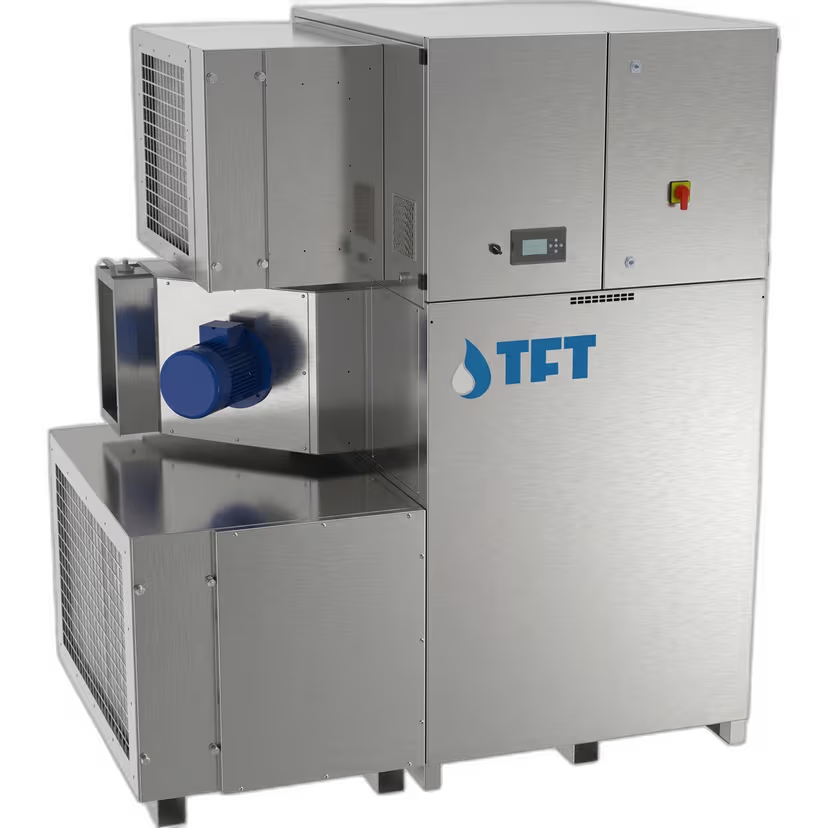
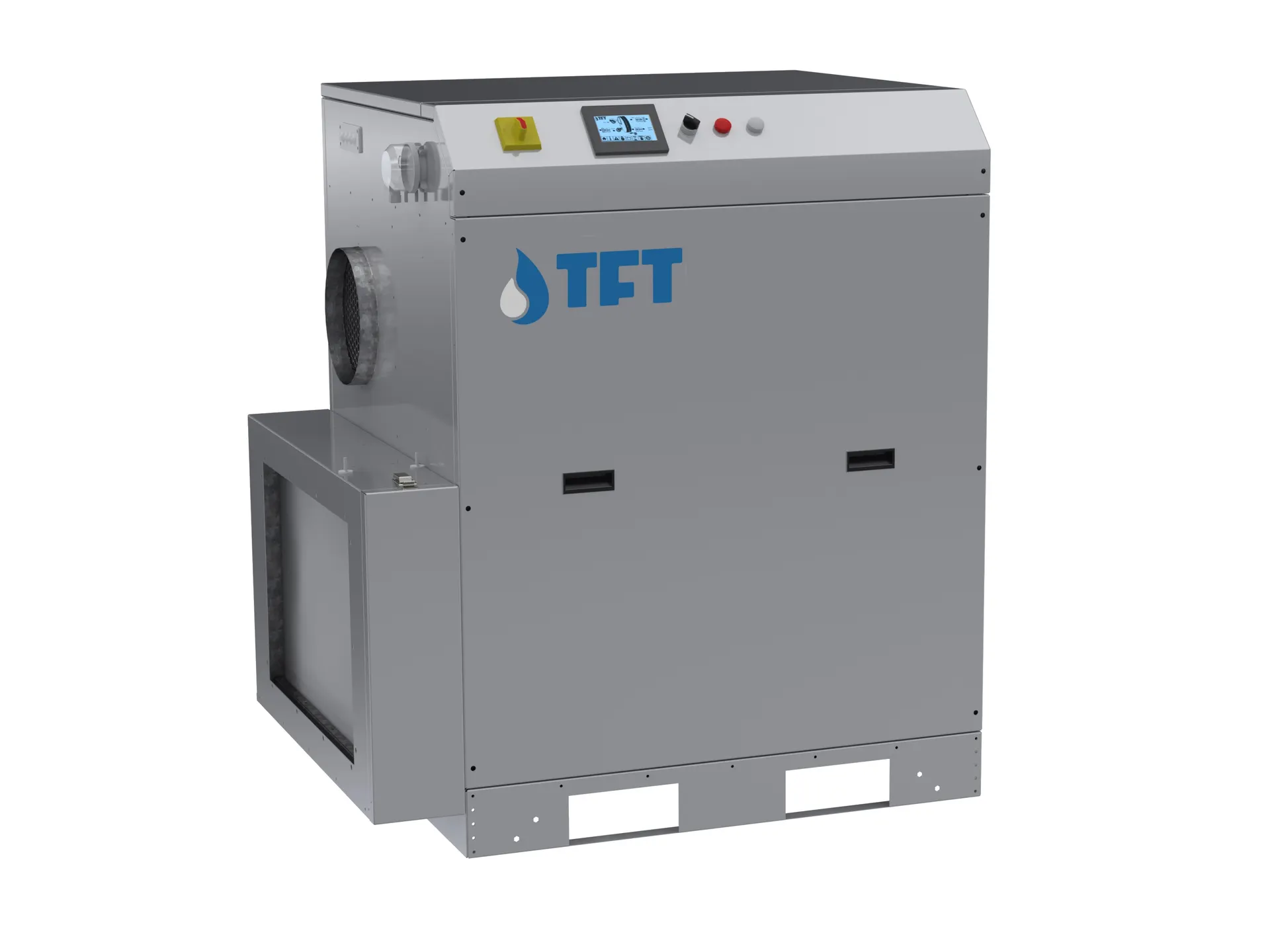
NKT Solution: • ADP2000-9500 silica gel rotor unit, ADP3500 model • FBD inlet supply: 22°C / −5°Cdp (constant, season-independent) • Process capacity: 3,500 m³/h • Reactivation: 50 kW electric • Heat recovery: rotor reactivation exhaust connected to FBD pre-heater (15 kW saved)
Post-commissioning performance: • Batch time: 38 min (constant year-round, ±2 min) • Annual batches: 4,200 → 6,600 (+57%) • Granule moisture homogeneity: 2% ± 0.3 (previously ±1.2) • Annual additional output: 480 t × 12,000 USD/t ≈ 5.8 M USD • Additional energy cost: 90 MWh/year • ROI: 3 weeks
Engineering Note
Seven engineering criteria for FBD inlet-air system design:
• Dew-point setpoint — linked to target product moisture; for 2% moisture target use dewpoint ≤ 0°Cdp; for 0.5% target use ≤ −15°Cdp • Pre-heater temperature — air is heated after dehumidification; typical 50–80°C; for heat-sensitive products 35–50°C • Airflow — sized by FBD properties (60–200 m³/h per kg granule typical); low flow under-fluidises, high flow elutriates particles • ATEX requirements — for dust-explosion-prone products (lactose, fructose, magnesium stearate) Zone 21–22 classification; rotor enclosure, fan, and panel must be ATEX-compliant • Heat recovery — silica gel rotor reactivation exhaust (110–130°C) can feed the FBD pre-heater, saving 15–25% energy • Filter protection — F7 + F9 pre-filter protects rotor life; HEPA is required especially in environments with active pharmaceutical ingredients • Monitoring — inlet dew point, temperature, flow; outlet moisture (online NIR), batch time; trend analysis via SCADA
Quality indicator: granule moisture mean within ±0.3% standard deviation, batch-to-batch repeatability 95%+.
NKT Application Link
NKT is a specialist supplier of FBD inlet-air systems in Turkey and export markets. Typical project package:
1. Silica gel rotor dehumidifier (ADP2000-9500 or AD1000-3100 series) — low dew point (−15 to +5°Cdp), VFD-driven process fan 2. Reactivation heat recovery — FBD pre-heater integration, 15–25% energy savings 3. ATEX Zone 22 compliant design — for explosive dust environments such as lactose, fructose, magnesium stearate 4. NKT - Climate Track monitoring — inlet dew point, outlet moisture (NIR), batch time, energy consumption; seasonal performance comparison 5. SCADA/Modbus integration — connects to plant MES, batch reports auto-generated 6. GMP/HACCP compliance — stainless steel body, fully cleanable filter cassette, validation documentation
Sample configurations: • Small-scale FBD (100–200 kg batch): NKT AD1000-3100 series AD1000 • Mid-scale (300–500 kg batch): NKT AD1000-3100 series AD2000–AD3100 • Large scale (800–2,000 kg batch): NKT ADP2000-9500 series ADP3500–ADP6000 • Mega plant (multi-FBD, parallel lines): NKT ADP series multi-unit configuration
NKT has commissioned this architecture in 35+ FBD plants; references brought seasonal batch-time variation from 70% to below 5% and increased annual output by 30–60%.