Definition
Breaking water molecules into 5–10 micron droplets via special nozzles at 70–100 bar pressure, then rapidly evaporating in air to add moisture. An adiabatic humidification technology that is an alternative to steam humidification; 85–90% lower energy consumption than steam systems, but reverse osmosis (RO) water is required for mineral control.
Detailed Explanation
High-pressure atomization sprays water through specialized stainless-steel nozzles via a high-pressure pump (typically a piston pump, 70–100 bar) to produce micro-droplets of 5–10 µm size. Because these droplets have an extremely high surface-area/volume ratio, they evaporate in air upon contact (sub-second). The evaporation heat is drawn from the surrounding air — making this an adiabatic process: air temperature drops (~6°C), humidity rises, and total enthalpy stays constant.
Example of a 200 kg/h capacity system: • Pump power: 5 kW (vs 150 kW in a steam system) • Energy savings: 96% (pump power only) • Cooling side effect: 200 kg × 2,500 kJ/kg = 500,000 kJ/h ≈ 140 kW of free cooling • Nozzles: 8–16 units, each 12–25 g/min
Atomization systems have three main components: 1. High-pressure pump (70–100 bar) + frequency inverter 2. Water preparation module: RO (reverse osmosis) + UV sterilization + softening 3. Nozzle matrix (in-duct or direct space)
Most common applications: textile mills, printing facilities, warehouses, greenhouses, animal husbandry, cooling towers.
Practical Example
A 5,000 m² textile weaving hall humidification project comparison:
Requirement: 65% RH ± 5, year-round, 8,000 hours Moisture load: summer 50 kg/h, winter 200 kg/h (average 150 kg/h)
Option A — Steam humidification (Neptronic SKE4): • CAPEX: €18,000 • Energy: 0.75 kWh/kg × 150 kg/h × 8,000 h = 900,000 kWh/yr • Cost: 900,000 × €0.12 = €108,000/yr • Water consumption: 1,200 tons/yr • Cooling side effect: none
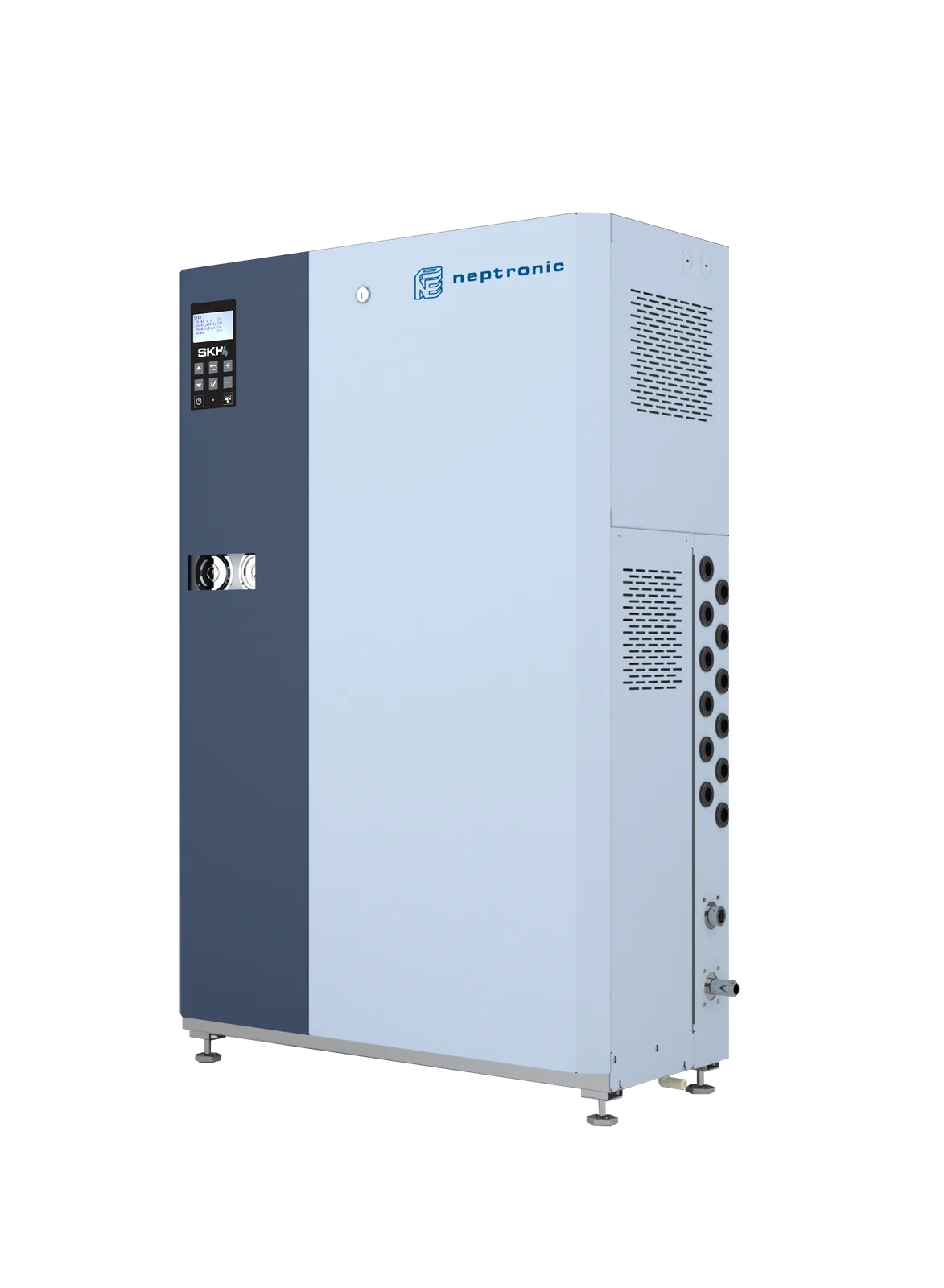
Option B — High-pressure atomization (Neptronic SKH): • CAPEX: €28,000 (pump + RO + nozzle matrix) • Energy: 0.05 kWh/kg × 150 × 8,000 = 60,000 kWh/yr • Cost: €7,200/yr • Water consumption: 1,500 tons/yr (including RO reject) • Cooling side effect: ~100 kW free cooling (summer AC load drops 25% = additional €15,000/yr savings)
10-year TCO comparison: • A (steam): CAPEX €18K + 10×€108K = €1,098,000 • B (atomization): CAPEX €28K + 10×€7.2K + 10×(–€15K AC) = –€50,000 (negative → savings)
Atomization saves €1,148,000 over 10 years. Payback: 4–6 months.
Note: Atomization is not suited to every application — droplet carryover in low-ceiling (< 4 m) spaces, mineral/microbiological contamination risk in pharma GMP are blockers.
Engineering Note
Six important decisions in high-pressure atomization design:
1. Water quality — RO + UV sterilization is mandatory; lime buildup clogs nozzles (within weeks), and microbiological load (Legionella risk) is a health threat. Target RO water hardness < 5 ppm. 2. Ceiling height — minimum 4 m recommended; in low ceilings, droplets fall to the floor before evaporating (wet floor + slip risk + humidity distribution issues). 3. Nozzle placement — airflow pattern must be considered; CFD simulation is standard in large spaces. Inadequate distribution = local dry/wet zones. 4. Temperature effect (free cooling) — extra advantage in summer, can be a disadvantage in winter (room may over-cool). Heat-recovery integration should be considered. 5. Maintenance — nozzle inspection every 6 months (pressure drop + leak check), filter replacement every 3–6 months, RO membrane every 24–36 months. A maintenance contract is essential. 6. Acoustics — 70–100 bar pumps can be loud (75–85 dB); an isolation cabinet may be needed.
At NKT we offer design, RO integration, commissioning, and periodic maintenance for Neptronic SKH and other high-pressure atomization systems; we have reference projects in textile, printing, and large-volume storage applications.