Definition
The mass of water a humidifier can add to the airstream per hour, expressed in kg/h (or l/h); calculated from airflow, absolute-humidity difference (Δx), and air density.
Detailed Explanation
Humidification capacity is the maximum mass of water a unit can deliver to the airstream per hour. Industrial steam systems typically offer 5–1000+ kg/h; adiabatic atomisation systems can reach 50–2000+ kg/h. Units are kg/h (SI) or lb/h (Imperial); with the 1 kg ≈ 1 L approximation, l/h is also used.
Fundamental formula:
m_water (kg/h) = ρ_air (kg/m³) × V_air (m³/h) × Δx (kg_water/kg_dry_air)
Here ρ_air ≈ 1.2 kg/m³ (sea-level standard), V_air is the airflow being humidified, and Δx is the difference between target and current absolute humidity. Correct capacity calculation is the single most critical step in equipment selection; an error can produce a 30–100% sizing mismatch.
Why It Matters
Undersizing causes the facility to miss its winter RH target — leading to yarn breakage in textile, print drift in printing, or artefact cracking in museums. Oversizing brings (a) unnecessary CAPEX (price, installed power, cable cross-section); (b) poor part-load behaviour (most units modulate 20–100% and become unstable below 5%); (c) on electrode and steam-to-steam units, accelerated mineral concentration that shortens cylinder/chamber life.
The three most common sizing mistakes: (1) sizing by room volume alone (wrong — airflow is the primary input); (2) treating an RH difference as a water mass (wrong — use absolute-humidity difference); (3) ignoring outdoor-air fraction (wrong — it drives capacity). NKT formally requests all of these inputs at design time.
Practical Example
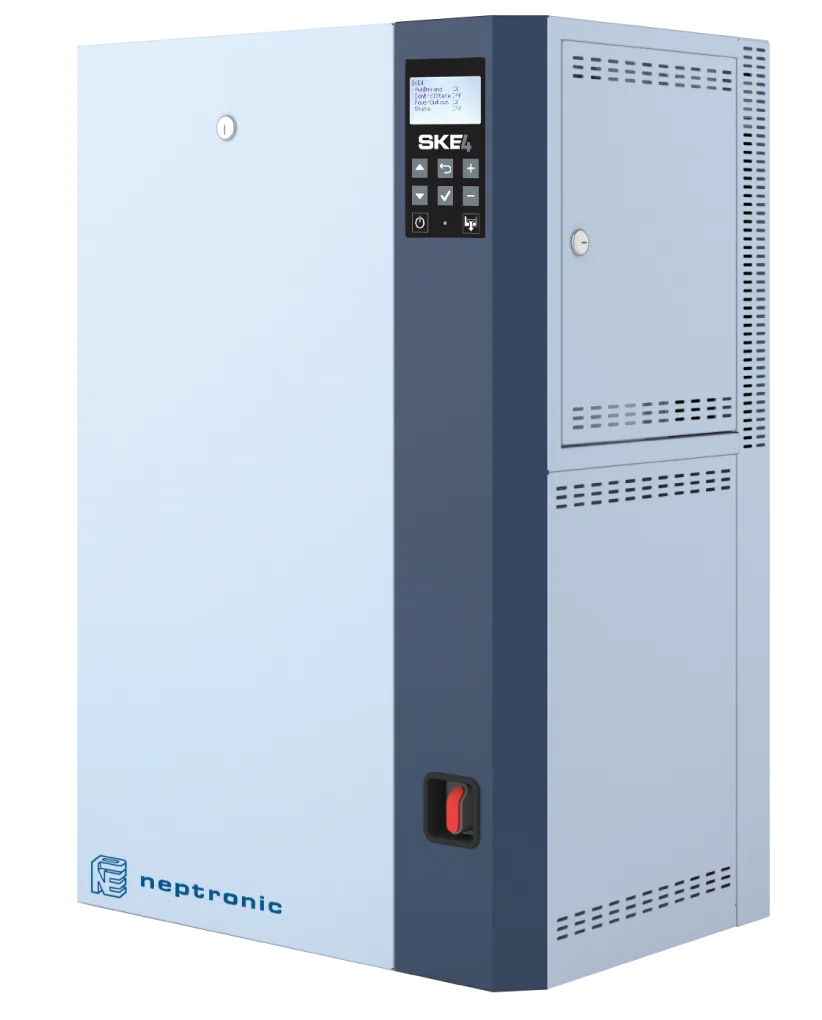
A printing house in Konya: 3 lines, total 30,000 m³/h supply, 40% outdoor + 60% return. January design outdoor air is −7°C / 75% RH (≈ 1.8 g/kg), indoor target 21°C / 50% RH (≈ 8 g/kg). Mixed-air state ≈ 0.4×1.8 + 0.6×8 = 5.5 g/kg. Δx = 8 − 5.5 = 2.5 g/kg = 0.0025 kg/kg. Capacity = 1.2 × 30,000 × 0.0025 = 90 kg/h. With a 15% safety margin → 105 kg/h, leading to a Neptronic SKE4-110 resistive (110 kg/h nominal). The unit runs at roughly 85–95% — inside its modulation band, enabling precise RH control.
Engineering Note
Use a psychrometric chart or calculation tool (NKT Portal, humidifier control software, Trane Trace) for Δx; hand approximations introduce 5–10% error. Air density (ρ) is 1.2 kg/m³ at sea level but drops by 15–20% above 1500 m — Erzurum, Kayseri, and Konya require an altitude correction.
A safety factor of 10–20% is recommended: 10% for modulation stability, 20% for outdoor extremes (using ASHRAE 1% instead of 0.4%), process load growth, or 5–10-year plant expansion. Above 30% safety factor the unit runs at low modulation and electrical efficiency suffers.
NKT Application Link
In NKT proposals the capacity calculation requires 7 standard inputs from the facility: airflow (m³/h), outdoor-air fraction (%), indoor target Tdb and RH, outdoor design Tdb and RH, altitude, production profile (continuous/shift), annual operating hours. From these inputs the kg/h capacity, installed electrical power, annual energy consumption, and annual operating cost are computed via the psychrometric chart and the Portal calculator. Three scenarios are offered: economy / mid-range / precision. Post-commissioning, NKT - Climate Track trends actual capacity usage and a revision recommendation is issued at year-end if needed.
Related Academy Articles
Related Products
NKT products related to this term