Definition
The international classification standard for airborne particle concentration in cleanrooms and controlled environments. Defines 9 classes from ISO 1 (cleanest, semiconductor) to ISO 9 (loosest, hospital corridor). Each class is achieved by airborne particle count + ACH + filtration + humidity/temperature control. HVAC and humidity-control design differs for each class.
Detailed Explanation
ISO 14644-1 defines cleanroom airborne particle concentration limits. Classes are based on 0.5 µm particles/m³:
• ISO 1 — 10 particles/m³ (semiconductor wafer fab) • ISO 2 — 100 particles/m³ • ISO 3 — 1,000 particles/m³ • ISO 4 — 10,000 particles/m³ • ISO 5 — 100,000 particles/m³ (sterile pharma fill) • ISO 6 — 1,000,000 particles/m³ (pharma compounding) • ISO 7 — 352,000 particles/m³ at 0.5 µm + 8,320 at 5 µm (pharma production) • ISO 8 — 3,520,000 + 83,200 (pharma packaging) • ISO 9 — non-classified (similar to hospital corridor)
HVAC design parameters per class: • ISO 5 — ACH 240–480, ULPA H14 filter, unidirectional flow 0.36–0.54 m/s • ISO 7 — ACH 30–60, HEPA H13 filter, turbulent flow • ISO 8 — ACH 20–30, F9 + H13 filter
Humidity control design typically: • 45–55% RH ± 5 (sterile product + stability) • 22°C ± 1 (operator + equipment optimum) • Negative pressure (preventing contamination spread) • Independent PID loop per zone
At NKT, on ISO 14644-compliant cleanroom projects, we offer design + equipment + commissioning services.
Engineering Note
Five important decisions in ISO 14644 design:
1. Correct class selection — over-specifying (ISO 6 instead of ISO 7) gives 50% CAPEX + 35% OPEX savings if relaxed. Question the spec.
2. Recovery time test — air cleanliness must recover < 20 min after a contamination event. Inadequate ACH or wrong filtration = non-compliance.
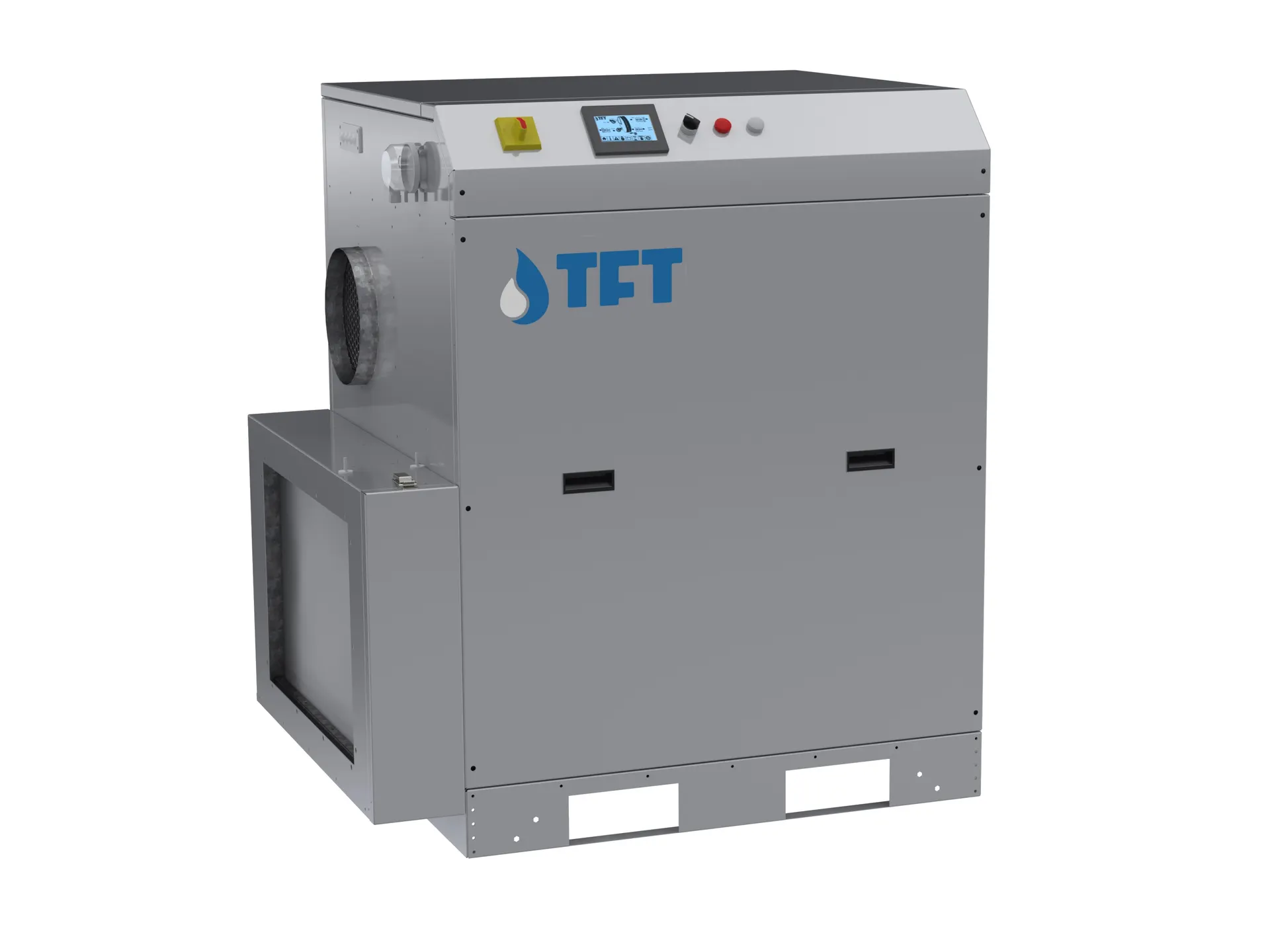
3. Compatibility with humidity control — all equipment in ISO 5/6 cleanrooms must be low particulate-emitting; HEPA layer is mandatory in silica gel rotor units (micro-particles from the rotor).
4. Operational vs at-rest — class testing is done at-rest (empty room), but particulates rise 30–50% during operation (operators + production). Design should be 1–1.5 classes above the at-rest spec.
5. Annual recertification — per ISO 14644-2, annual (6-monthly for critical) particulate + filter + flow certification is mandatory. Missing documentation = audit fail.
At NKT we deliver complete solutions for ISO 14644 cleanroom projects: TFT silica gel rotor + HEPA filter + particle counter + certification packages.