Definition
A facultative anaerobic, gram-positive rod-shaped bacterium capable of proliferating in cold environments (-1.5°C to +45°C). It causes listeriosis in dairy products, ripened cheeses, meat processing facilities, and ready-to-eat foods, posing severe infection risk especially to pregnant women, the elderly, and immunocompromised individuals. EU and Turkish Food Codex regulations place it in a "zero tolerance" category, making it a critical control point in food safety.
Detailed Explanation
Listeria monocytogenes is one of the most challenging pathogens in the food industry. It evades most general microbiological control strategies:
1. Cold tolerance — proliferates between −1.5°C and +45°C; cold storage, maturation rooms, refrigeration (4°C) provide no protection 2. Broad pH tolerance — survives pH 4.4–9.4; proliferates even in fermented products 3. Salt tolerance — active in 10% NaCl solution; salted cheeses, brined products 4. Low aw tolerance — proliferates down to aw 0.92; matured cheese, dry sausage 5. Biofilm formation — forms persistent biofilms on equipment surfaces, drains, cold-storage corners; standard cleaning is insufficient 6. Anaerobic tolerance — facultative anaerobe; risk even in vacuum-packed products
Sources: • Raw materials — raw milk (especially raw cheese), raw meat, raw fish • Environmental contamination — cold storage, drains, refrigeration systems, door gaskets • Personnel — shoes, gloves, uniforms • Equipment — belts, slicers, packaging
Disease (listeriosis) profile: • In healthy individuals: gastroenteritis (usually mild) • In pregnancy: abortion, stillbirth, neonatal meningitis • In elderly: septicaemia, meningitis, encephalitis • Mortality (high-risk group): 20–30%; one of the highest mortality rates
Regulation: • EU Reg. 2073/2005 — <100 CFU/g in RTE (ready-to-eat) foods at end of shelf life, or absent at production for sensitive groups • Turkish Food Codex 2011/29 — same standard • FDA/USDA — "zero tolerance" in RTE foods — any detection = product rejection + plant closure
Why It Matters
Listeria is the most devastating contamination source food facilities face. Its importance can be assessed in six dimensions:
1. Human health — globally 23,000+ cases and 5,500+ deaths annually (WHO, 2017) 2. Plant shutdown — detection in one batch = whole plant inspected, 2–8 weeks of production downtime possible 3. Recall cost — major recall operations cost 10–100 M USD; the 2011 Jensen Farms (cantaloupe) outbreak in the US exceeded $400M 4. Brand reputation — brand equity is permanently damaged; consumer trust takes 5+ years to recover 5. Legal liability — product liability suits, multi-million USD damages per fatality 6. Regulatory penalties — FDA Form 483s, EU RASFF notifications, export bans
Critical control points: • Raw material intake — pathogen testing of raw milk/meat • Processing — pasteurisation, heat treatment, fermentation (LAB competition) • Maturation room — temperature, dew point, airflow • Cold storage — temperature, dew point, drain cleaning, continuous monitoring • Packaging — vacuum, MAP (modified atmosphere packaging) • Personnel + equipment hygiene — regular sanitation, swab testing
Environmental control is critical: Listeria is most commonly found in equipment and floor biofilms. Positive samples around drains, on cooling fan blades, and on door gaskets in cold storage floors are common. NKT condensation-type dehumidifiers minimise condensate by controlling RH in cold storage; this is the main Listeria risk zone around drains.
Practical Example
In 2024 a Turkish cheese plant tested positive for Listeria in an export batch. Case analysis and remediation:
Incident: • Product: matured kaşar, EU export • Test result: 12 CFU/g Listeria monocytogenes (limit 100 CFU/g, but EU zero tolerance for sensitive groups) • Batch affected: 24 t (450,000 USD value) • Outcome: batch return, EU RASFF notification, 4 weeks production inspection • Estimated loss: product 450,000 USD + downtime 1.2 M USD + inspection 0.2 M USD = 1.85 M USD
Root-cause analysis (8-week investigation): • Raw milk pathogen testing clean • Pasteurisation validation appropriate • Maturation room environmental swabs: 4 points around drains positive for Listeria • Cold-storage environmental swabs: door gasket and fan blades positive • Root cause: condensation in 92% RH maturation room + drain biofilm + spread via cold-storage infiltration
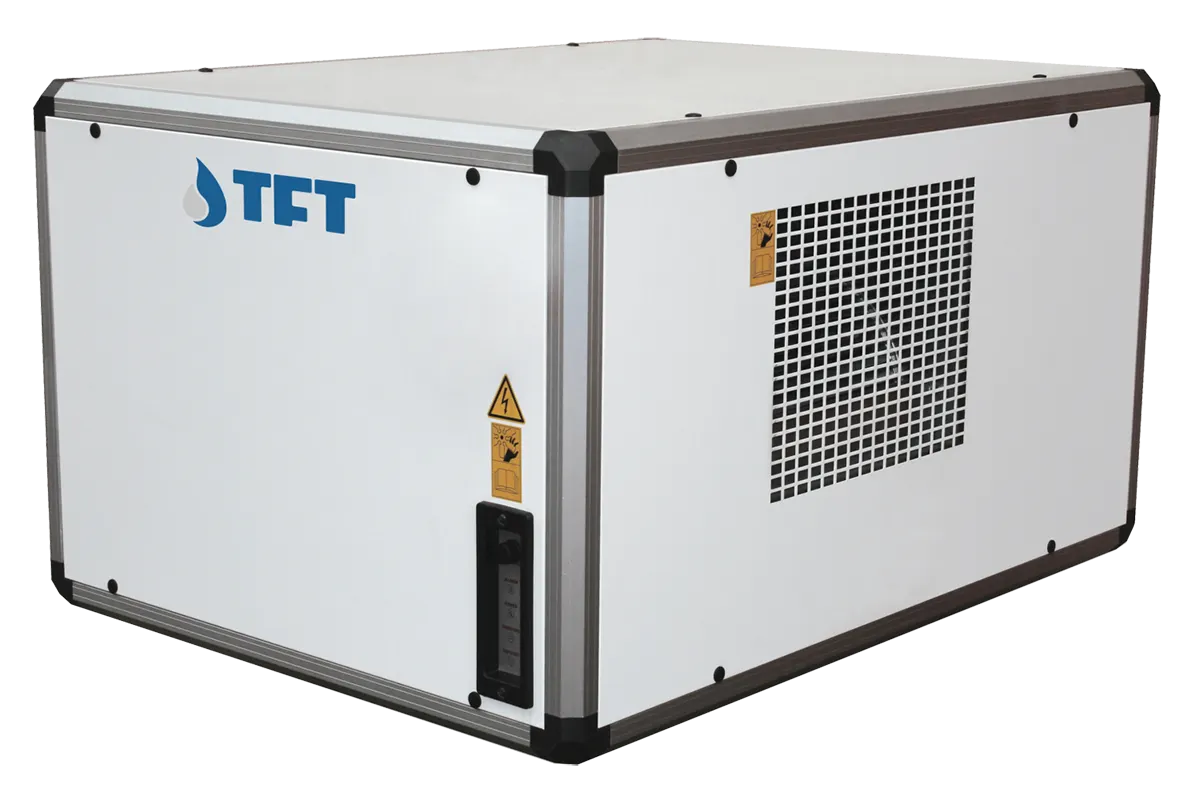
NKT Remediation Solution: • CD1200-3000 condensation-type dehumidifier, CD2500 model • Maturation room RH: 92% → 88% (dew point 11°C, constant) • Condensate minimisation, drain water down 70% • CD600 added unit in cold storage, no condensation around doors • Vestibule added (prevents contamination during cheese transfer) • NKT - Climate Track integration — continuous dew-point monitoring + alarms
Twelve-month post-commissioning tracking: • Listeria environmental swabs: 100% negative • Matured cheese pathogen testing: 100% clean • Annual export: 850 t (previously 600 t, increase via hygiene certification) • 4 new EU brands added to customer portfolio • ROI: <2 months (prevented loss + additional revenue)
Engineering Note
Eight engineering criteria for Listeria-preventive facility design:
• Condensation control — condensation on cold surfaces (door gaskets, fan blades, around drains, wall corners) = Listeria spread route. Ambient dew point must remain below all cold surface temperatures. • Drain design — drain slope ≥1/100, no water retention, easy cleaning. Drain plastic should be antimicrobial; prevents biofilm formation. • Vestibules — vestibules at cold-storage and maturation-room entries; prevents cross-contamination • Positive pressure cascade — +10 to +15 Pa toward the sensitive side; particles + microorganisms blocked • Filtration — F7 + HEPA filter on fresh-air supply; particle + microparticle barrier • Air velocity — no stagnant air zones at surfaces; prevents microorganism accumulation • Sanitation protocol — daily surface cleaning + weekly deep clean + monthly ATP/swab testing • Monitoring — ambient dew point, surface temperature, differential pressure continuously logged; deviation alarms
Critical testing programme: monthly environmental swabs (drains, fan blades, door gaskets, floor), product intake + output pathogen testing, intensive 100+ point screening in case of outbreak.
NKT Application Link
NKT specialises in Listeria-prevention-focused facility climate solutions. In sensitive environments such as maturation rooms, cold storage, meat processing, and cheese plants, 7 core architectural features:
1. Condensation-type dehumidifier (CD160-980 or CD1200-3000 series) — prevents condensation on cold surfaces; cuts the Listeria spread route 2. PID dew-point control — independent of RH drift, ambient dew point held constant below all cold surface temperatures 3. Vestibule design — prevents cross-contamination; two-stage airlock for transfers 4. Positive pressure cascade — blocks external contamination ingress into sensitive zones 5. Hygienic design — stainless steel inner casing, antimicrobial coating, easy-clean filter cassette 6. NKT - Climate Track monitoring — continuous dew point, temperature, RH logs; record-keeping for HACCP; alarm setpoints 7. F7 + HEPA filtration — microparticle barrier on fresh-air supply
Sample configurations: • Small cheese plant (50–200 t/year): NKT CD160-980 series CD400–CD600 • Mid-scale (300–800 t/year): NKT CD1200-3000 series CD1500 • Large plant (1,000+ t/year, export): NKT CD1200-3000 series CD2500–CD3000 + vestibule + NKT - Climate Track
NKT has commissioned this architecture in 40+ cheese, meat, and cold-storage plants; references brought Listeria environmental swab positivity from 2.5% to below 0.1% and successfully passed EU/FDA inspections. NKT - Climate Track reports provide monthly environmental risk assessments.