Definition
A humidifier's ability to vary its capacity continuously (typically 0–100%) rather than on/off; together with PID control it delivers a stable ±1–3% RH band and avoids the swing + condensation problems of on/off control.
Detailed Explanation
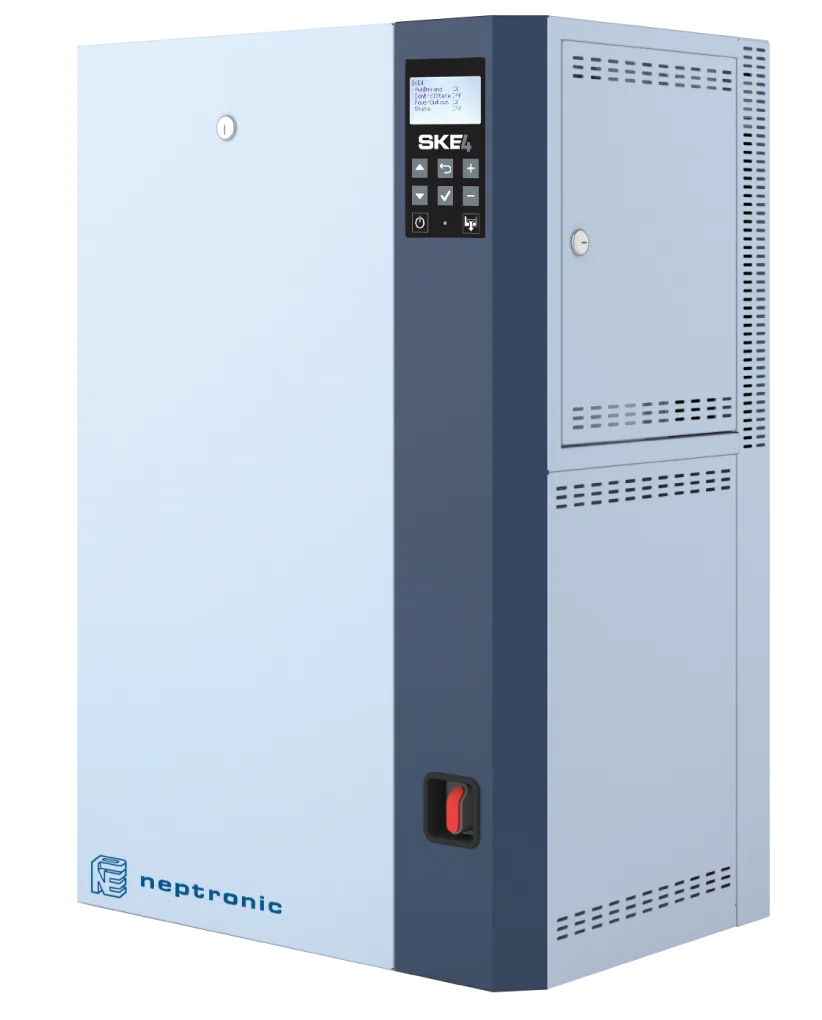
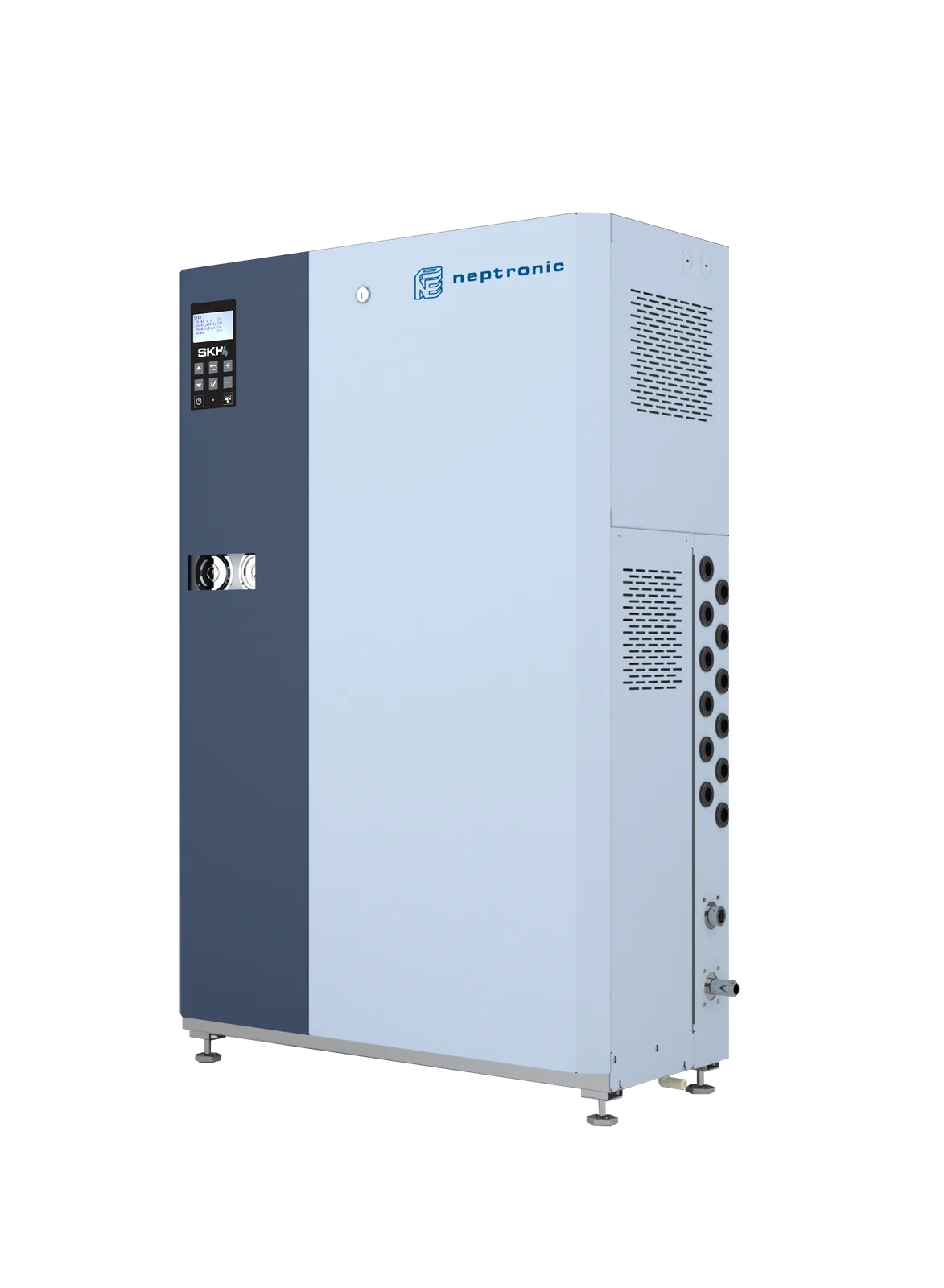
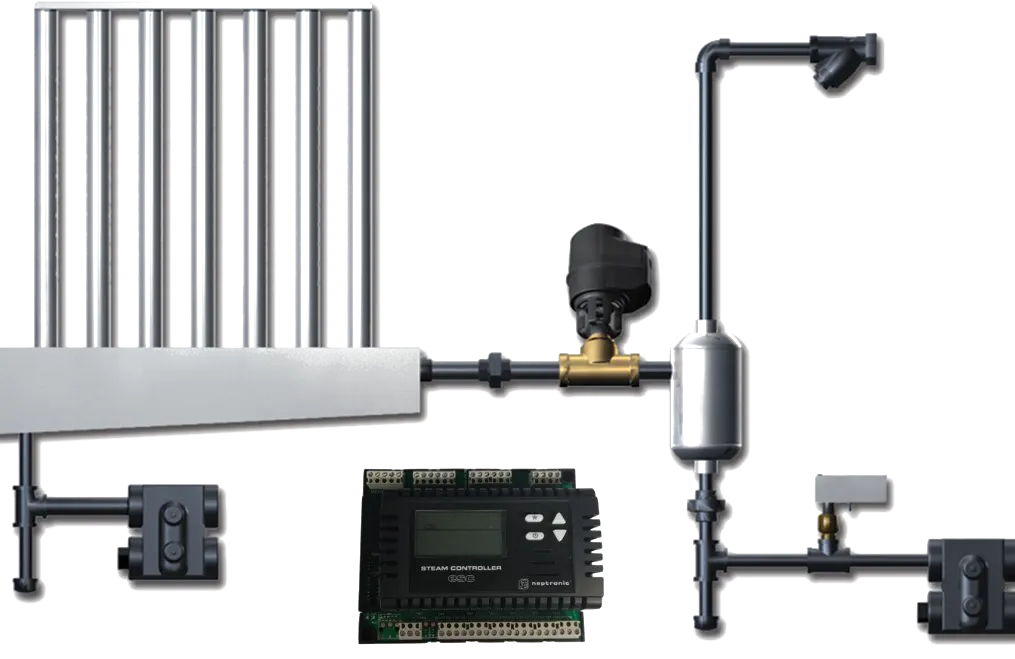
Modulation lets modern humidifiers vary their capacity proportionally to a PID signal. Three main technologies: (1) SCR/SSR SWITCHING — for resistive steam (Neptronic SKE4); zero-cross switching gives continuous 0–100% via pulse-width modulation; (2) PROPORTIONAL STEAM VALVE — for SKS4; a modulating steam valve achieves ±1% precision; (3) VARIABLE-FREQUENCY PUMP — for adiabatic misting (SKH); pump speed follows RH demand, modulating flow and pressure together. Unlike on/off, modulation cuts RH swing from 5% to 1% and eliminates overshoot risk.
Why It Matters
Without modulation (on/off control) a humidifier creates four main problems: (1) RH SWING — oscillation of ±5% around setpoint; insufficient for critical processes. (2) OVERSHOOT + CONDENSATE RISK — after the system turns off, residual heat keeps producing steam; supply RH overshoots 5–10% and condenses. (3) ENERGY WASTE — constant cycling burns fan/pump pull-down energy each time. (4) MECHANICAL WEAR — relays, solenoids, heating elements wear 2–3× faster under continuous cycling. Modern industrial humidification always uses modulation; on/off is an economy choice only for comfort applications.
Practical Example
A pharma stability chamber in Ankara ran with an on/off unit at setpoint 50%, swinging 46–54% — right on the EU GMP Annex 1 ±5% limit. The customer migrated to a Neptronic SKE4 (SCR modulation + PID) targeting ±2%. Afterwards RH stabilised at 49.5–50.5%. Side benefit: annual electricity dropped 18% (no overshoot energy).
Engineering Note
Modulation performance parameters: (1) Range — typically 5–100% capacity (no operation below 5%); (2) Resolution — 1% steps or continuous (analog 4–20 mA preferred); (3) Response time — 5–30 s (adequate for PID); (4) Linearity — capacity × control-signal curve should be flat within 5%. Tuned with PID: Kp = 1–3, Ti = 60–300 s, Td = 0 (humidification is slow). For units with a narrow modulation range, a parallel two-unit setup handles high/low load best.
NKT Application Link
NKT recommends modulating units for every facility with tight RH requirements; Neptronic SKE4 (SCR), SKS4 (proportional valve) and SKH (VFD pump) are all modulating by default. Commissioning tunes PID parameters per site, with first-week trend-log analysis for fine-tuning. The NKT - Climate Track platform tracks modulation-capacity trends — frequent on/off cycling is a sign of performance drift.
Related Academy Articles
Related Products
NKT products related to this term