Definition
The mass of water vapor per unit mass of dry air (g/kg dry air). Shown on the y-axis of psychrometric charts. Dehumidifier performance is calculated using this value: the difference between inlet and outlet gives the amount of moisture removed.
Detailed Explanation
Moisture content — known in thermodynamic literature as specific humidity, humidity ratio, or W — is the ratio of water vapor mass in air to the mass of the dry air component. Its unit is g water vapor per kg dry air. It is the standard y-axis of psychrometric charts and forms the foundation of all HVAC calculations.
The most important property of specific humidity is that it remains constant when an air stream is only heated or cooled (without phase change). Therefore W does not change at a heating coil, but it does drop at a cooling coil when air falls below its dew point (through condensation). The capacity and energy performance of dehumidifiers are calculated directly from the inlet–outlet W difference.
Reference values: at 25°C, 50% RH, W ≈ 9.9 g/kg; at 30°C, 70% RH, W ≈ 18.9 g/kg; at 18°C, 50% RH, W ≈ 6.5 g/kg.
Calculation
W = mv / mda = 0.622 × Pv / (Patm − Pv)
W: specific humidity (kg water vapor / kg dry air) mv: mass of water vapor (kg) mda: mass of dry air (kg) Pv: partial pressure of water vapor (Pa) Patm: atmospheric pressure (Pa) — 101,325 Pa at sea level 0.622: ratio of water vapor to dry air molecular mass (Mv/Mda = 18.015 / 28.966)
Practical Example
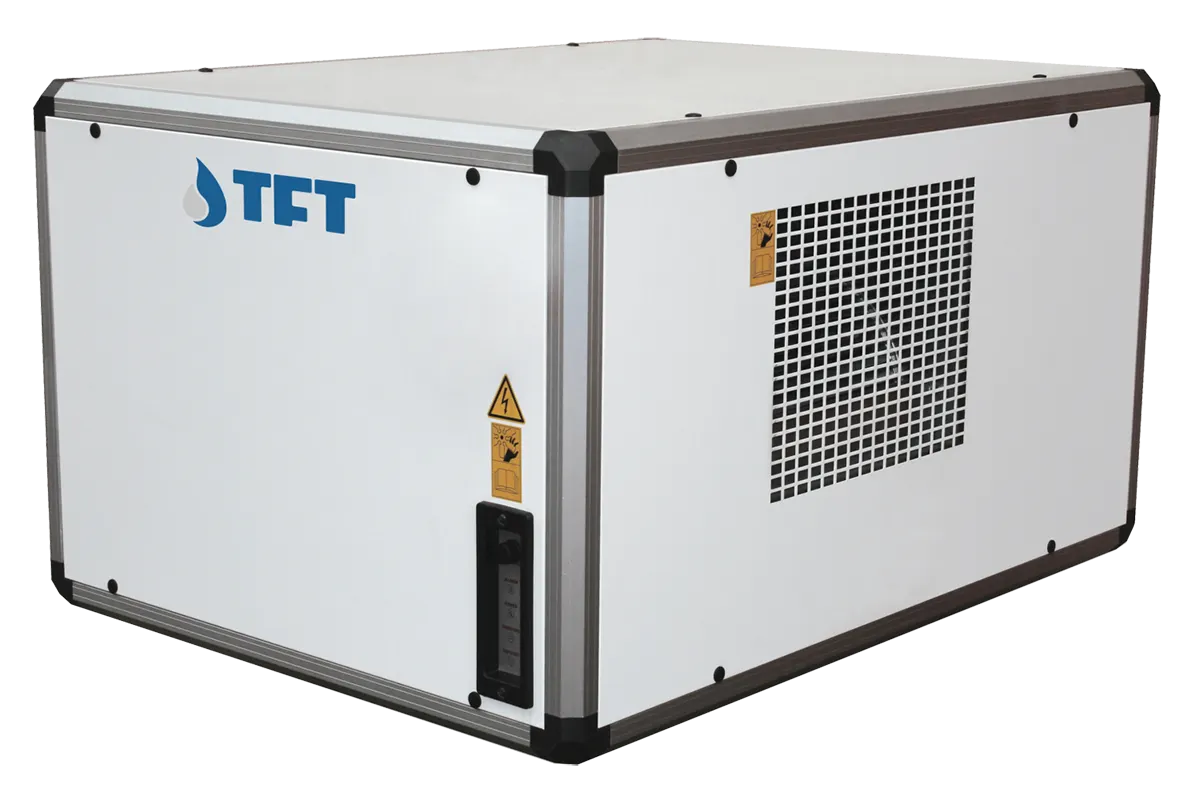
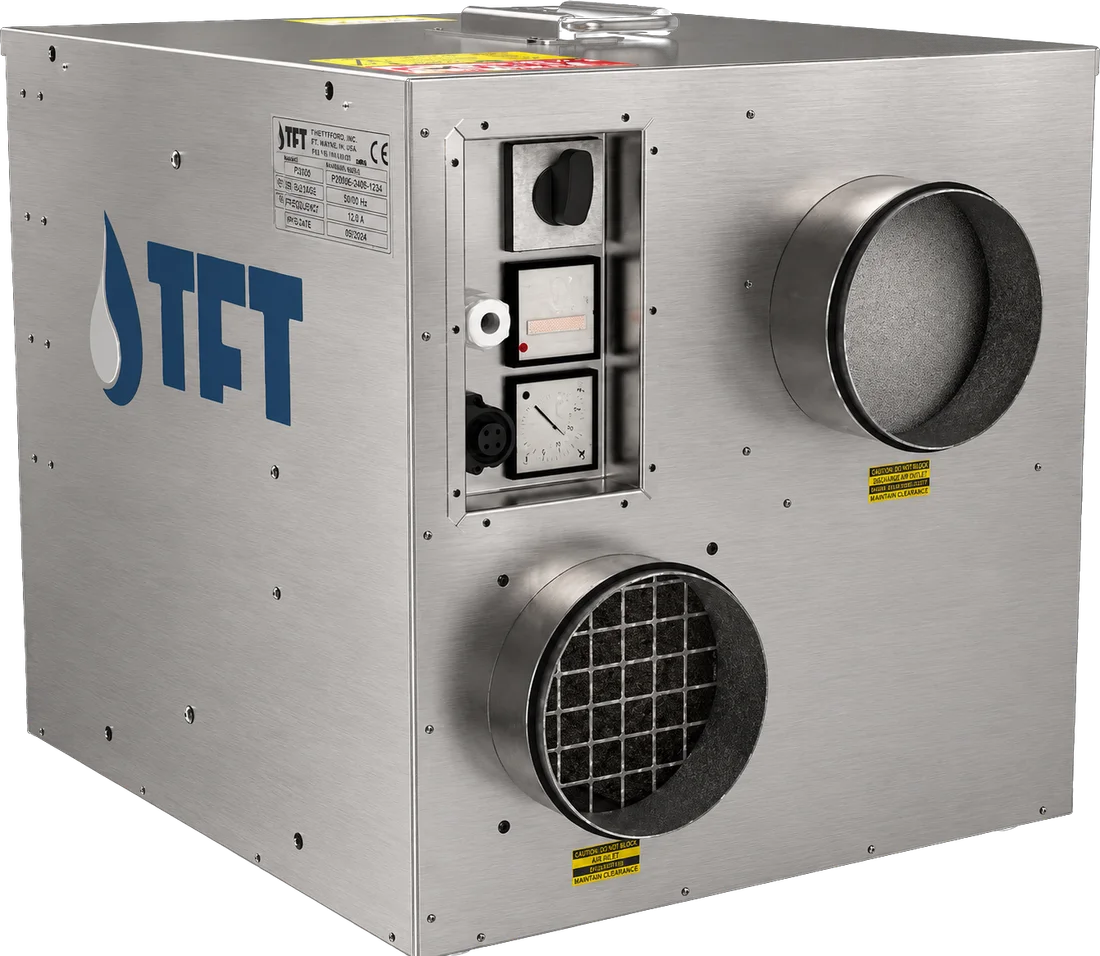
Let us calculate the performance of an industrial dehumidifier. Suppose 5000 m³/h of air passes through the device (approximately 6000 kg/h of dry air).
Inlet air: 30°C, 70% RH → W₁ = 18.9 g/kg Outlet air: 25°C, 35% RH → W₂ = 7.0 g/kg ΔW = W₁ − W₂ = 11.9 g/kg
Total moisture removed: 6000 kg/h × 11.9 g/kg = 71,400 g/h ≈ 71.4 kg/h
This is the effective dehumidification capacity of the device. Manufacturer catalog values are typically given at a reference point such as 30°C, 60% RH; if the actual inlet conditions differ, recalculation through W is required. Otherwise the selection error can reach 20–40%.
Engineering Note
Psychrometric chart selection is a regional convention:
• Mollier chart (European standard): x-axis is specific humidity (W), y-axis is temperature. • ASHRAE psychrometric chart (American standard): x-axis is temperature, y-axis is specific humidity (W).
Both charts contain the same thermodynamic information, only the axes are swapped. Software outputs (Carrier, Daikin, NKT calculator tools) should indicate which convention they use.
In terms of measurement, specific humidity is not measured directly; it is calculated from dew point, dry/wet bulb temperatures, or RH+temperature readings. The NKT psychrometric calculator performs these conversions in line with ASHRAE 2017 Fundamentals correlations. In processes requiring high accuracy (pharmaceutical, lithium battery, calibration laboratories), dew point should be the reference parameter.