Definition
The total amount of moisture entering a space in a given time period (g/h or kg/h). Includes all sources such as outdoor air infiltration, personnel, product processes, door openings, and moisture transfer through building elements. It is the fundamental parameter in determining dehumidifier capacity.
Detailed Explanation
Moisture load is the fundamental engineering parameter that determines the dehumidifier capacity required for a space. The total load comes from five independent sources:
1. Infiltration — load from outdoor air entering through door/window openings, building leaks, and ventilation imbalances. 2. Personnel — moisture from respiration and perspiration; 50–100 g/h per person at moderate activity. 3. Process sources — fermentation, wet product surfaces, open baths, vegetable washing, livestock, etc. 4. Building diffusion — slow but continuous moisture transfer through building materials (concrete, wood, plaster). 5. Thermal load conversion — condensation load that appears when air is cooled below its dew point in cooling systems.
For accurate capacity selection, these five components must be calculated separately, peak load determined under summer outdoor design conditions (DOC), and a 15–25% safety factor added. An underestimated moisture load causes not only loss of comfort or product quality, but also structural mold growth and equipment corrosion.
Calculation
Total load: Mtotal = Minf + Mppl + Mproc + Mdif
Infiltration load: Minf = ACH × V × ρa × (Wout − Win)
ACH: air changes per hour (1/h) V: space volume (m³) ρa: dry air density (≈ 1.2 kg/m³ at standard conditions) Wout: outdoor specific humidity (kg/kg dry air) Win: indoor target specific humidity (kg/kg dry air)
Personnel load: Mppl = N × mperson N: number of people, mperson: moisture generation per person (≈ 80 g/h at moderate activity)
Practical Example
Consider a 500 m² meat processing facility with a 4 m ceiling height.
Inputs: • Space volume: 500 × 4 = 2000 m³ • ACH: 0.5/h (moderate door circulation) • Summer outdoor: 32°C, 65% RH → Wout = 19.5 g/kg • Indoor target: 8°C, 85% RH → Win = 5.7 g/kg • Personnel: 8 people × 100 g/h (heavy physical work) = 800 g/h • Process (surface evaporation from meat): approximately 1500 g/h
Infiltration load: Minf = 0.5 × 2000 × 1.2 × (19.5 − 5.7) g/kg = 16,560 g/h ≈ 16.6 kg/h
Total load: 16.6 + 0.8 + 1.5 = 18.9 kg/h With a 20% safety factor → 22.7 kg/h
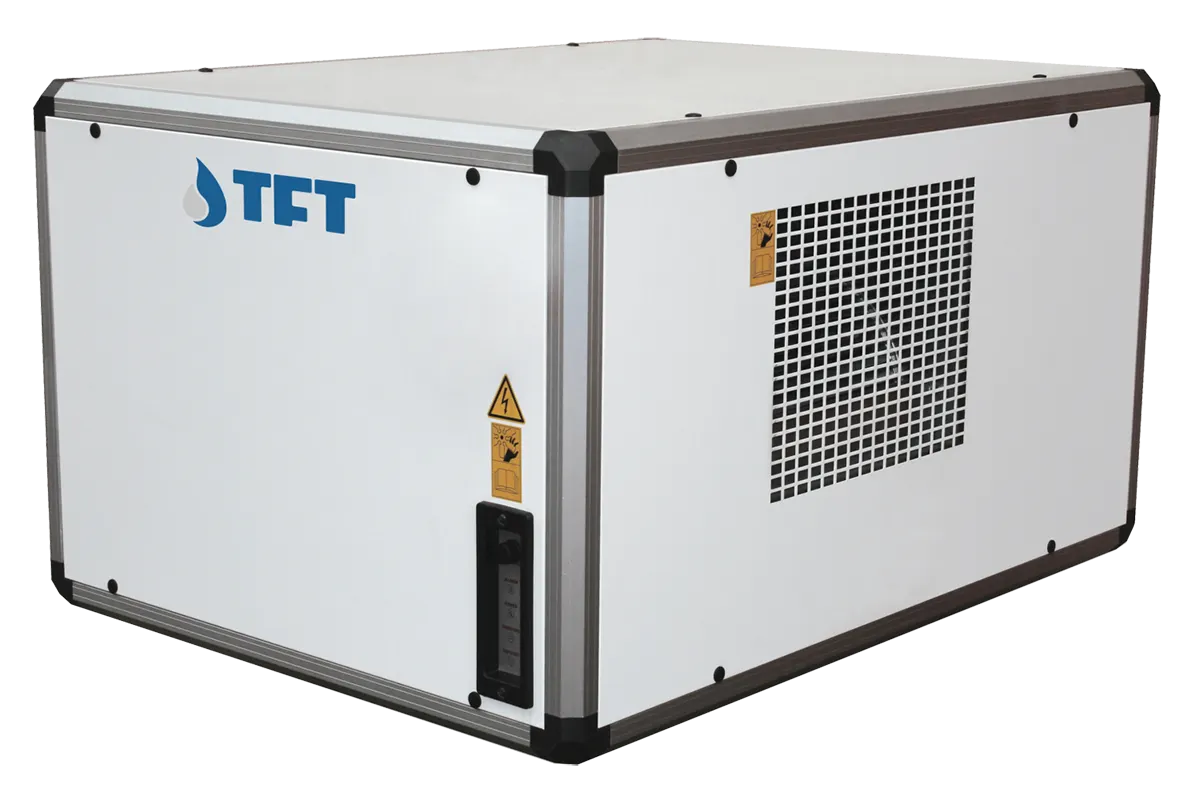
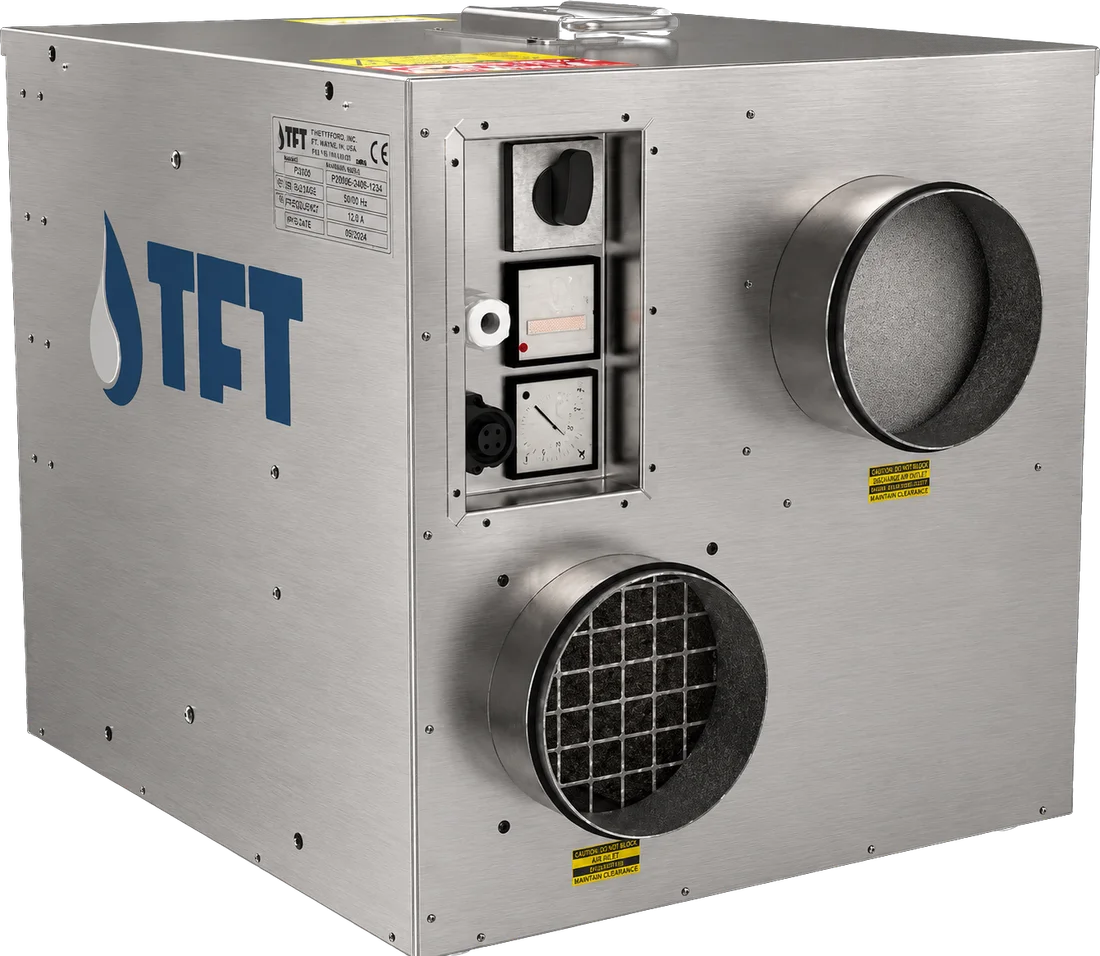
A suitable selection at this capacity is the NKT CDP series condensation-type dehumidifiers. If the dew point target is low, a silica gel rotor system should be considered.
Engineering Note
In cold storage and freezer applications, door infiltration can account for 40–60% of the total moisture load. For this reason, the payback period for air curtains, high-speed industrial doors, or airlock solutions is typically 1–3 years.
Other points to consider:
• Peak load ≠ average load — shift changes, production peaks, and outdoor extremes must be included in the design load. • For intermittent processes (seasonal, campaign production), equipment selection is based on peak conditions, but energy simulation uses average load. • Building diffusion is negligible in most HVAC designs, but can be the dominant load in museum, archive, library, and storage applications. • ASHRAE 0.4% annual exceedance frequency is the accepted standard for outdoor design conditions, representing the extreme exceeded for 35 hours per year.
The NKT energy simulation tool generates an hourly moisture load profile from annual outdoor weather data and provides both peak and annual energy consumption estimates.