Definition
An HVAC design metric expressing how many times the entire air volume of an enclosed space is exchanged per hour. ACH = (Airflow rate m³/h) / (Room volume m³). Comfort applications 4–8 ACH; ISO 7-class pharmaceutical cleanroom 30–60 ACH; ISO 5 class 240–480 ACH. High ACH values improve particulate control and humidity stability but increase energy consumption.
Detailed Explanation
ACH is the ratio of total air supplied to a volume divided by that volume's capacity. 1 ACH means "the air of the room was completely exchanged once per hour." In HVAC design, the ACH value is set by application requirements:
• Residential: 0.5–2 ACH (including hidden infiltration) • Comfort office: 4–6 ACH • Meeting room, classroom: 6–10 ACH • Restaurant kitchen: 15–30 ACH • ISO 9 cleanroom: 5–10 ACH • ISO 8 cleanroom (pharma packaging): 20–30 ACH • ISO 7 cleanroom (pharma production): 30–60 ACH • ISO 6 cleanroom: 90–180 ACH • ISO 5 cleanroom (sterile product): 240–480 ACH • Semiconductor fab: 600+ ACH (unidirectional flow) • Hospital operating room: 20–25 ACH • Cold storage: 0.2–0.5 ACH (depending on door opening frequency)
In moisture-load calculation, ACH determines the additional outdoor moisture brought in via infiltration and ventilation. High ACH = high outdoor moisture load = larger dehumidifier capacity required.
Calculation
ACH = Q / V
Q: airflow rate (m³/h) V: room volume (m³) ACH: air changes per hour (1/h)
Relationship with moisture load:
Lmoist,inf = ACH × V × ρair × (Woutdoor − Windoor)
Lmoist,inf: infiltration-driven moisture load (g/h or kg/h) ρair: air density ≈ 1.2 kg/m³ Woutdoor, Windoor: outdoor and indoor specific humidity (g/kg dry air)
Example: 500 m³ room, 20 ACH, outdoor 18 g/kg, indoor 8 g/kg → Lmoist = 20 × 500 × 1.2 × (18 − 8) g/h = 120,000 g/h = 120 kg/h
This load is a direct input to dehumidifier capacity selection.
Practical Example
Two cleanroom comparison:
Project A — ISO 7 pharmaceutical granulation room, 200 m² × 3 m = 600 m³, 50 ACH • Q = 50 × 600 = 30,000 m³/h • Outdoor (summer): 32°C, 65% RH = 18.5 g/kg • Indoor target: 22°C, 35% RH = 6 g/kg • Moisture load = 30,000 × 1.2 × (18.5 − 6) g/h = 450,000 g/h = 450 kg/h
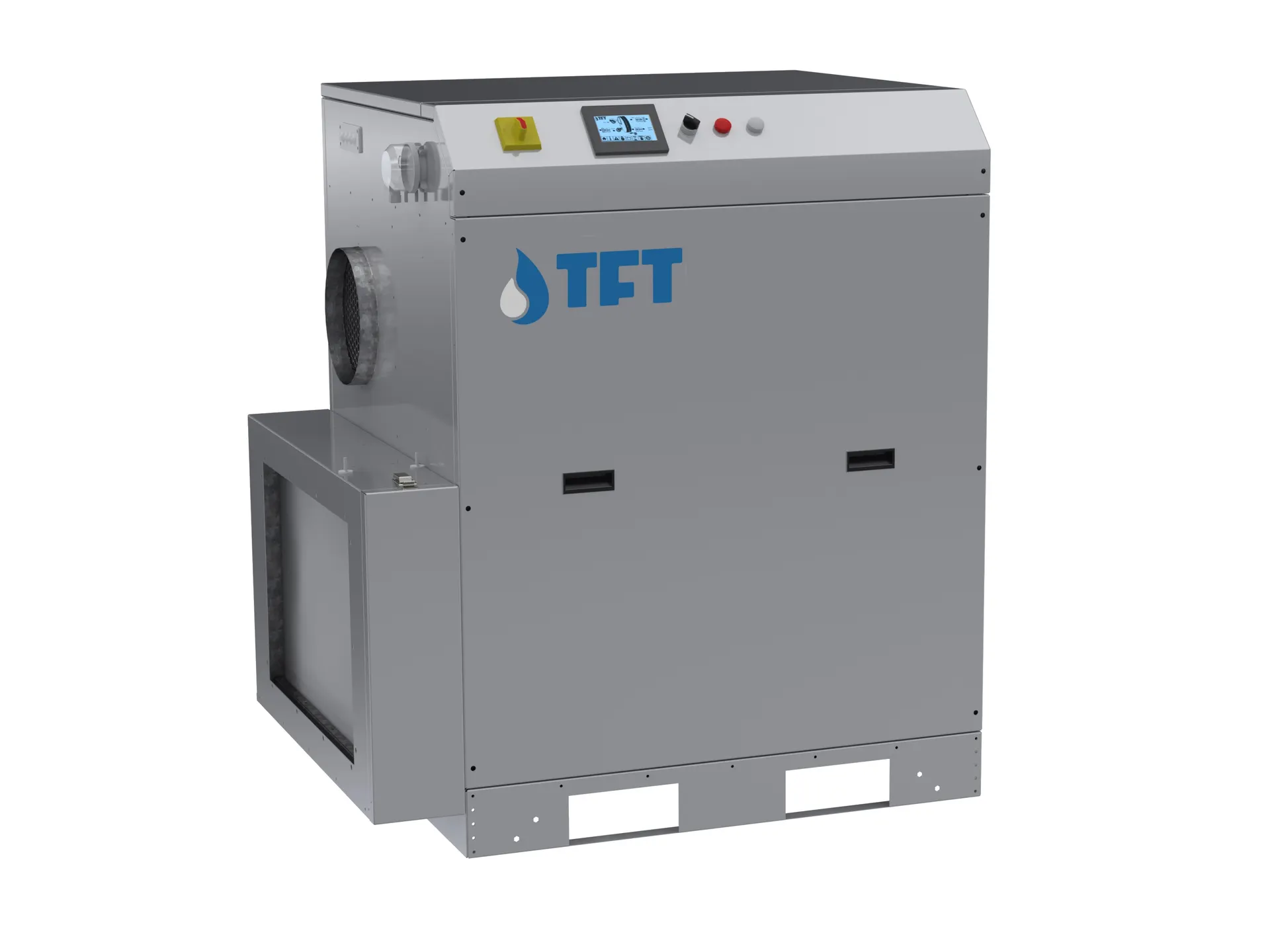
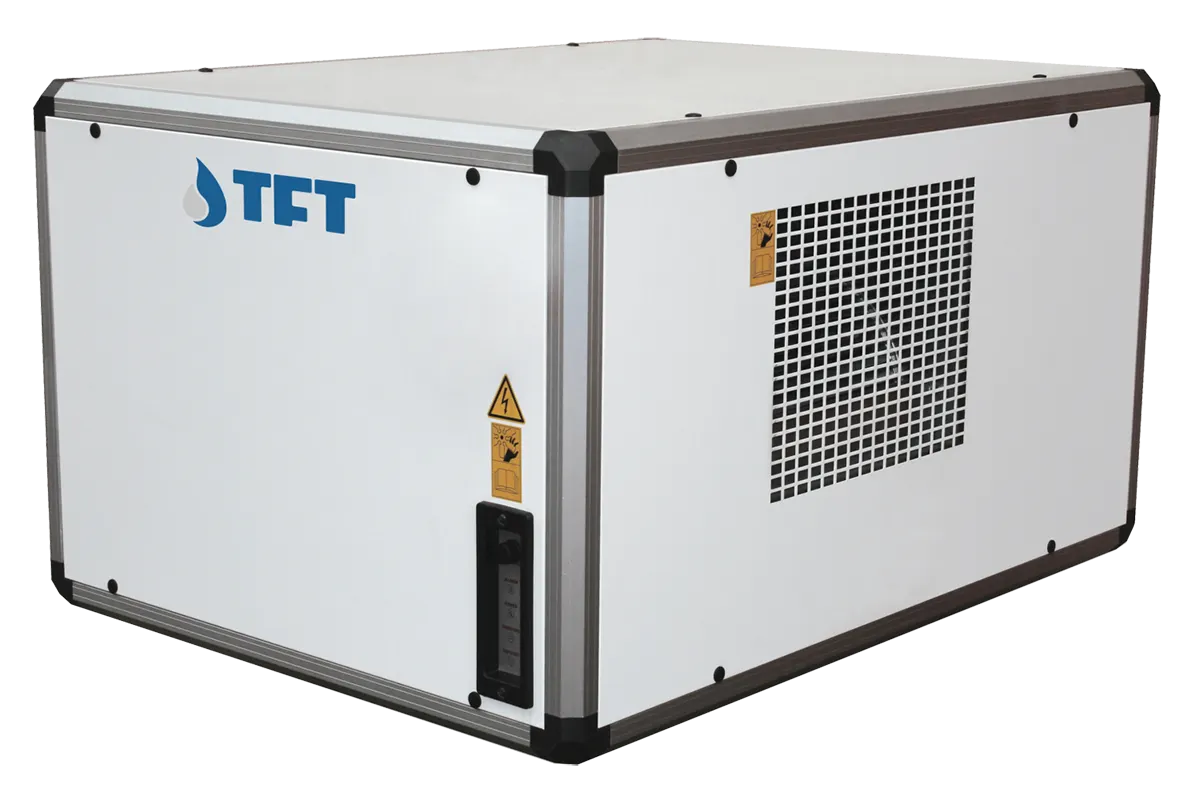
This load requires 4–5× TFT AD3000 silica gel rotors (3,000 m³/h, 100 kg/h each) or a larger single unit (ADP9500). Additional fan + reactivation energy generates ~€80,000–120,000/yr OPEX.
Project B — Same 200 m² room but ISO 8 class sufficient (30 ACH) • Q = 30 × 600 = 18,000 m³/h • Same conditions: moisture load = 18,000 × 1.2 × 12.5 = 270 kg/h • 40% less capacity, 35% less energy
Decision: Is ISO 7 truly required by the project? Should be evaluated with the GMP audit — if ISO 8 is sufficient, CAPEX drops 30% + OPEX 35%. ACH requirement is the most expensive design decision; over-specifying cleanroom class = TCO blow-up.
Engineering Note
Six important notes on ACH design:
1. ACH ≠ ventilation — total airflow is the sum of recirculation + fresh outdoor air. ACH may be 60 in a cleanroom, but fresh air is only 5–10% (3–6 ACH); the remainder is recirculation for filtration + cooling + humidity control. 2. Low ACH is special to cold storage — target ACH in cold storage is minimum (usually 0.2–0.5); via door openings + infiltration, ACH can spike uncontrollably to 1–3, which becomes the primary moisture load source. 3. Fan energy scales with ACH³ — running 60 ACH instead of 30 increases fan energy by 2³ = 8×. Over-specified ACH = over-consumed energy. 4. Local airflow pattern matters — even with adequate total ACH, poor zoning leaves "dead zones." CFD analysis is standard in large cleanrooms. 5. ACH measurement — actually achieved ACH must be measured (testing): tracer gas (SF6) method or pressure-difference analysis. Design ACH and real ACH typically differ by 15–25%. 6. Dehumidifier capacity — moisture load scales linearly with ACH; for unit selection, use realistic ACH (design + 10–15% safety factor).
At NKT we offer ACH design + moisture load calculation + dehumidifier capacity optimization as an integrated service; the facility's actual operational profile is analyzed to prevent over-design.