Definition
A confectionery process in which sugar, chocolate, or cocoa-based coatings are applied in thin layers to a centre product inside rotating, tilted drums (panning drums), gradually building a dried and thickened shell. Hard panning uses a sugar syrup, soft panning uses powdered sugar plus a binder, and chocolate panning uses melted chocolate. Between each layer, a flow of low-dew-point air is critical for a glossy, homogeneous shell.
Detailed Explanation
Panning is a batch coating process that gradually builds a pearl-like soft or hard shell on the centre product. It is carried out in tilted (30–45°) rotating copper or stainless steel pans; pans rotate at 8–18 rpm with the centre product (almond, hazelnut, coffee bean, jellybean, gum tablet, pharmaceutical tablet) tumbling inside.
Three main panning types:
1. Hard panning — sugar syrup (60–75 °Bx) is applied in thin layers and dried in parallel by dry air; this cycle repeats 30–80 times, each layer 50–200 µm. Total coating takes 6–12 hours. 2. Soft panning — powdered sugar + binder syrup is applied alternately; faster (total 2–4 hours), but the shell is softer and less glossy. 3. Chocolate panning — molten tempered chocolate is applied, followed by layering with cold air. Combined panning: a colour and gloss coating over the chocolate shell.
Coating quality depends heavily on process-air dew point: • Hard panning: −2 to +5°Cdp • Soft panning: 0 to +8°Cdp • Chocolate panning: −5 to −1°Cdp (critical for sugar bloom prevention)
Air flow into the pan ranges from 1,000–6,000 m³/h, modulated via a VFD-driven fan based on pan size and layer stage.
Why It Matters
Panning is a critical step shaping both the visual identity and physical performance of premium confectionery and pharmaceutical products:
1. Visual quality — glossy, uniform, crack-free shell → brand perception; matte, blotchy shell = low consumer preference. 2. Structural durability — the shell protects the centre from mechanical and moisture-driven impacts; in chocolate panning, 6+ month shelf life depends on coating quality. 3. Microbiological barrier — a tightly sealed sugar or chocolate shell blocks microbial ingress; critical for biscuit/marshmallow-centred chocolate panned products. 4. Flavour profile — the shell + centre combination defines consumer taste experience; too-thin shell loses flavour, too-thick masks the centre. Fine optimisation target is 2.5–4 mm. 5. Production efficiency — at the correct dew point, layer drying time drops from 30 min to 8 min; daily cycle count per pan increases 30%+.
Without humidity control: high dew point → layer cannot dry → next layer adhesion fails → shell clumps, dragees stick together inside the pan. Lower-than-required dew point → too-fast drying → shell becomes brittle with hairline cracks. The correct band: a dew-point setpoint chosen for the product, continuously stabilised by the climate system.
Practical Example
A Konya chocolate panning plant runs 8 pans of 1,500 kg capacity, producing 15 t/day of almond chocolate dragees. Ambient design:
Baseline (insufficient): • Pan feed: 16°C / 50% RH (dew point 5.8°C) • Layer drying time: 18 min • Summer sugar bloom rate: 5.5% • Daily output: 15 t (target 22 t, unreachable)
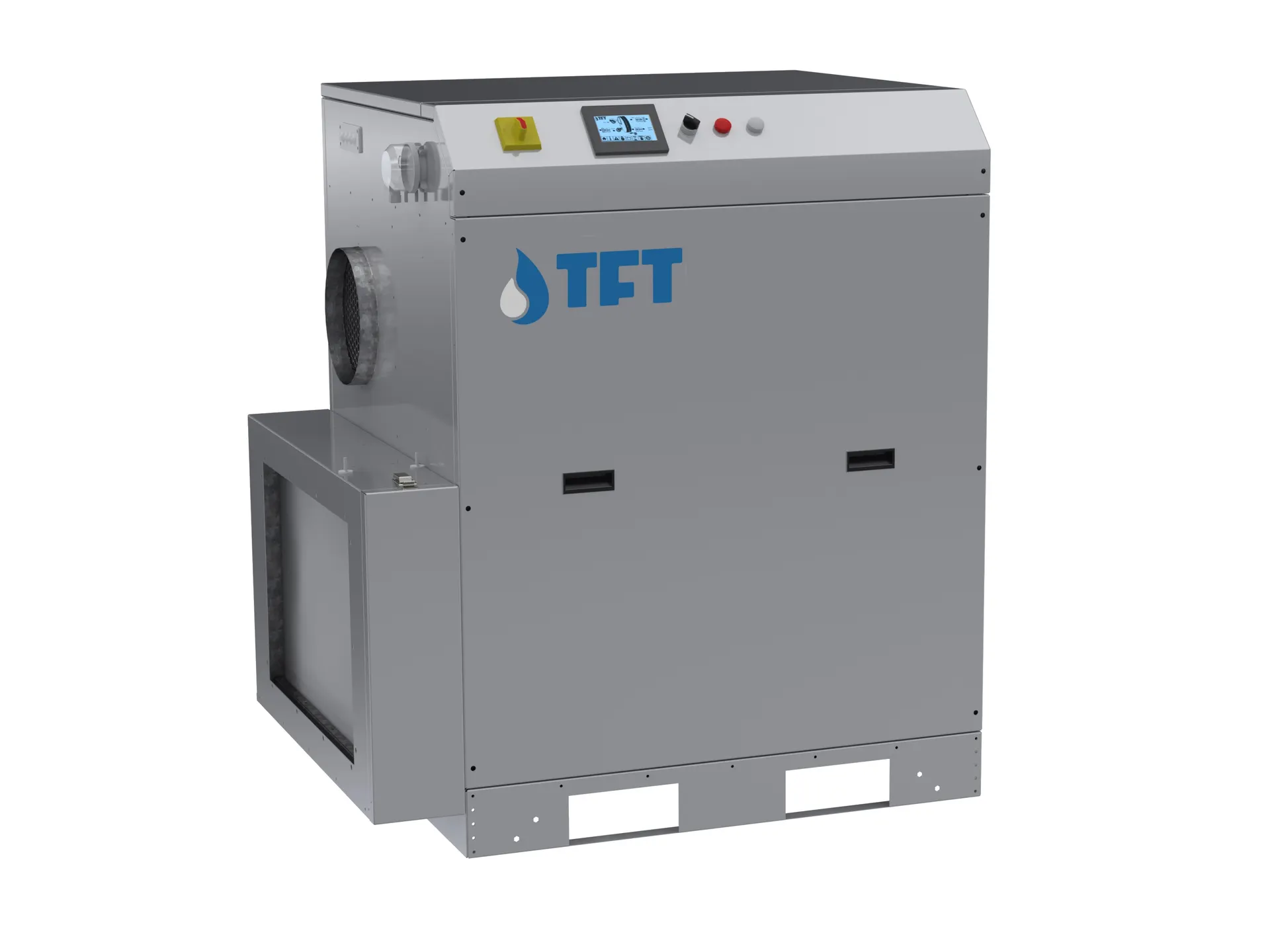
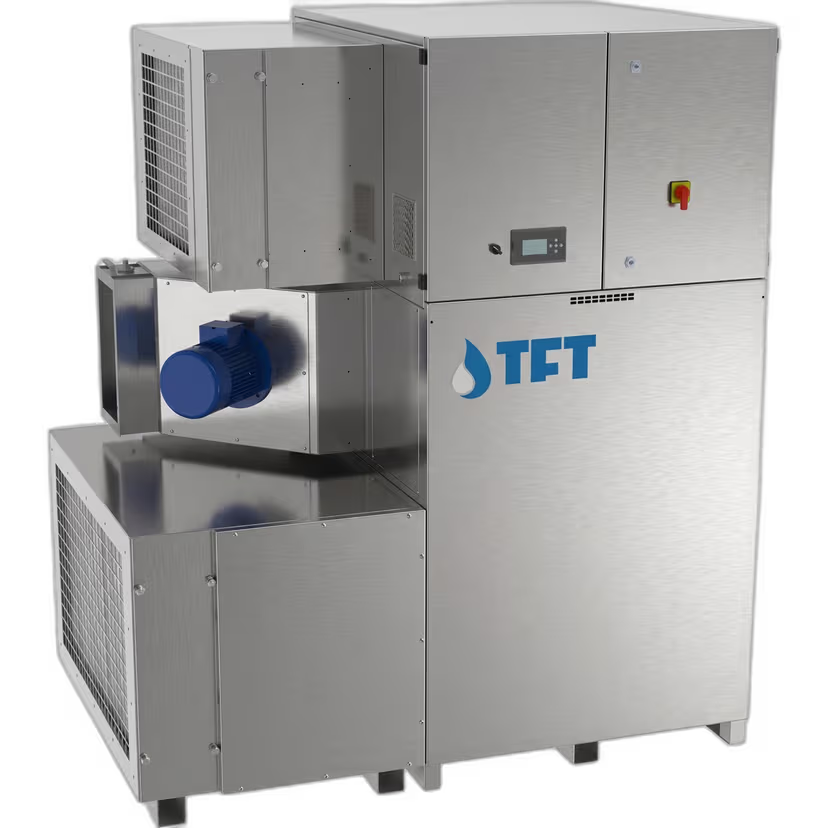
NKT Solution: • AD3000-6500 silica gel rotor unit, AD4000 model • Process capacity: 4,000 m³/h • Outlet dew point: −4°Cdp • Reactivation heat: 65 kW electric (or 7 m³/h natural gas) • Target pan feed: 16°C / 32% RH (dew point −1°C)
Post-commissioning performance: • Layer drying time: 18 → 7 min (60% reduction) • Sugar bloom rate: 5.5% → 0.4% • Daily output: 15 → 23 t (53% per-pan increase) • Annual additional revenue: 8 t/day × 280 days × 9,000 USD/t ≈ 20 M USD potential • Additional energy: rotor reactivation 110 MWh/year • ROI: <2 months
The NKT - Climate Track module reports hourly pan dew point, temperature, and layer drying time; seasonal deviations are notified to the production team.
Engineering Note
Six critical engineering criteria for panning-line climate system design:
• Per-pan airflow — each pan needs 800–1,500 m³/h; 8 pans = 6,400–12,000 m³/h, the NKT silica gel rotor unit must be sized to that load. • Layer-stage dew-point modulation — first layers (thick shell) want a lower dew point, final polishing layers a slightly higher dew point; a recipe-driven setpoint table on the PLC is recommended. • Temperature–humidity balance — process air entering the pan is preferred at 16–18°C (for almonds); warmer air (>22°C) softens chocolate, colder air (<12°C) slows drying. • Pan exhaust heat recovery — pan exhaust is moisture-laden but clean; via a heat-recovery coil it can preheat rotor reactivation air, saving 15–20% energy. • Filter selection — pan-return air may carry sugar dust, cocoa dust, almond dust; a dual-stage F7 + F9 filter protects rotor life. • Hygienic design — food-grade stainless inner casing, easy-clean filter cassette; HACCP mandates monthly cleaning records.
Quality indicators: shell gloss >70 GU at 60° geometry, shell thickness variation ±5%, sugar bloom <1%.
NKT Application Link
NKT designs fully integrated climate solutions for panning plants. Typical project scope:
1. Silica gel rotor dehumidifier (AD or ADP series) — low dew point (−5 to +5°Cdp), high airflow (2,000–10,000 m³/h) 2. Recipe-driven setpoint system — distinct dew-point profile for hard panning, soft panning, and chocolate panning 3. Multi-pan distribution system — per-pan flow modulation via VFD-driven dampers 4. Exhaust heat recovery — 15–20% energy savings 5. NKT - Climate Track monitoring — per-pan dew point, temperature, drying-time tracking; SCADA integration 6. ATEX-compliant design — Zone 22 explosion protection for sugar dust
Sample configurations: • Mid-scale (4 pans, 8 t/day): NKT AD1000-3100 series AD2000 • Large scale (8–12 pans, 20+ t/day): NKT AD3000-6500 series AD4000–AD6000 • Mega plant (16+ pans): NKT ADP2000-9500 series ADP6000–ADP9500
NKT has commissioned this architecture in 40+ panning plants; references brought sugar bloom from 4–6% down to 0.5% and increased daily output by 30–50%. NKT - Climate Track reports analyse plant energy intensity (kWh/ton) annually.