

When selecting an industrial dehumidifier you face three core technologies: silica gel rotor (desiccant) dehumidifier, condensation (mechanical) dehumidifier and pool-type dehumidifier (a specialised sub-category of condensation). All three remove moisture from air, but their mechanisms, operating temperature ranges, achievable dew points, energy profiles and ideal application areas differ fundamentally. Picking the wrong technology leads to poor performance, wasted energy and shortened compressor/rotor lifespan. As NKT, Humidity Control Technologies, we are the Türkiye representative of TFT Italy, a dehumidifier manufacturer. This guide is prepared to inform our customers step by step on each technology's working principle, advantage-disadvantage profile, the TFT product portfolio and the decision logic for correct industrial dehumidifier selection.
Below are three technology-application mismatches we most frequently encounter in the field:
- Applying a condensation-type unit to a low dew-point target. Condensation systems remove moisture by condensing it on a cold surface. When the target dew point falls below +12°C, that surface begins to ice over and the unit enters frequent defrost cycles; in this state the equipment may deliver only around half of the dehumidification capacity stated on its nameplate.
- Specifying a silica gel rotor for a comfort-level application. For shops, offices and typical storage areas, a silica gel rotor is often a more advanced solution than required. This choice may unnecessarily increase the initial investment and lead to higher electricity consumption throughout operation.
- Installing a standard condensation unit in a swimming pool environment. Chlorine vapour combined with high humidity can quickly corrode the copper tubing and metal components of a unit not designed for these conditions. Without appropriate coatings and materials, the service life is often limited to 1–2 years.
Choosing the right technology not only delivers the targeted performance, it is also a decision that directly determines the equipment's service life and total cost of ownership.
Overview of the 3 Dehumidifier Technologies
Before going into detail, placing the basic parameters of all three technologies side by side clarifies the picture. As the table shows, each technology is optimised for a specific application band, none is "better than the other"; the right one in the right context is what matters.
| Feature | Silica Gel Rotor | Condensation (Mechanical) | Pool Type |
|---|---|---|---|
| Mechanism | Adsorption (chemical) | Condensation (mechanical cooling) | Condensation + corrosion-resistant casing |
| Dew point | −60°Cdp ↔ +20°Cdp | +12°Cdp ↔ +20°Cdp | +8°Cdp ↔ +18°Cdp |
| Optimum temperature | −20°C ↔ +40°C | +15°C ↔ +40°C | +20°C ↔ +35°C |
| Typical capacity | 100 – 25,000 m³/h air | 20 – 3,000 L/24h | 40 – 1,000 L/24h |
| Energy sources | Electric / steam / natural gas | Electricity only | Electricity only |
| Ideal application | Low dew-point industry (lithium battery, pharma, freeze dryer) | Comfort + medium-temperature industrial | Indoor swimming pool, spa, wellness |
| Capital cost | High | Medium | Medium |
Silica Gel Rotor (Desiccant) Dehumidifiers
Working Principle
A silica gel rotor is a continuously rotating cylindrical component coated with sodium silicate (SiO₂·nH₂O)-based desiccant on a honeycomb structure.
The rotor is divided into two distinct zones: the process (dehumidification) zone and the reactivation (regeneration) zone. Typically 75% of the rotor is used for process and 25% for reactivation. The rotor passes through these zones rotating at 8–20 rev/hour:
- In the process zone: humid process air passes through the rotor, water molecules are adsorbed onto the silica gel (chemical bonding), the air exits dry (−10 to +10°Cdp).
- In the reactivation zone: reactivation air heated to 100–140°C passes in the opposite direction, "drying" the silica gel and expelling moisture.
Advantages
- Very low dew point: Can reach down to −60°Cdp. Compared to the practical limit of +12°Cdp for condensation systems, it is the only practical solution for processes requiring low dew points such as lithium battery dry rooms, freeze-dryer storage, pharmaceutical granulation.
- Performance at low temperatures: Maintains dehumidification capacity in environments at and below 0°C, condensation systems freeze at these temperatures.
- Flexible energy source: Reactivation heat can come from electricity, steam or natural gas. If steam/gas infrastructure exists at the facility, OPEX savings of up to 75% versus electricity-only systems are possible.
- Maintenance-friendly: No refrigerant, no compressor, fewer moving parts. Outside F-gas regulation scope.
- Long service life: The rotor itself offers 10+ years of service life (with proper filtration + contamination control).
Disadvantages / Limitations
- High capital cost: Can be 2–4× more expensive than a condensation unit. Without the right context (low dew point), it is not economical.
- Reactivation energy: If reactivation is electric, total energy consumption can exceed condensation. OPEX disadvantage for facilities without steam/gas alternatives.
- Contamination sensitivity: Silica gel is sensitive to dust, oil mist, organic solvents. F7+ filter + optional activated carbon pre-filter is essential; otherwise rotor life drops from 10 years to 2–3 years.
- Reactivation air exhaust: Hot + humid reactivation air requires a flue or ducted exhaust to outdoors.
Ideal Applications
- Lithium battery dry room, between −40 and −60°Cdp, to prevent the lithium + H₂O reaction.
- Pharmaceutical granulation and storage, between −20 and −40°Cdp, to protect hygroscopic actives from moisture uptake.
- Freeze-dryer storage, to prevent moisture re-uptake by vacuum-dried products.
- Cold storage (>0°C, around 4°C), fruit, vegetable, flower rooms; condensation type's defrost frequency is too high here, so silica gel rotor wins on energy and continuity.
- Cold storage (below −20°C), mandatory choice at temperatures where condensation systems cannot tolerate the defrost load.
- Ice rinks, spiral freezers, combination of low surface temperature + moisture sensitivity.
- Defence and aerospace, composite manufacturing, ballistic testing, sensitive electronics.
Capacity and Dew Point Ranges
| Dew Point Target | Reactivation Temp | Typical Sector |
|---|---|---|
| −10 ↔ −20°Cdp | 100–110°C | Cold storage, food processing |
| −30 ↔ −45°Cdp | 120°C | Pharma, freeze-dryer storage |
| −50 ↔ −60°Cdp | 130–140°C (zeolite) | Lithium battery, gas analysis |
Condensation (Mechanical) Dehumidifiers
Working Principle
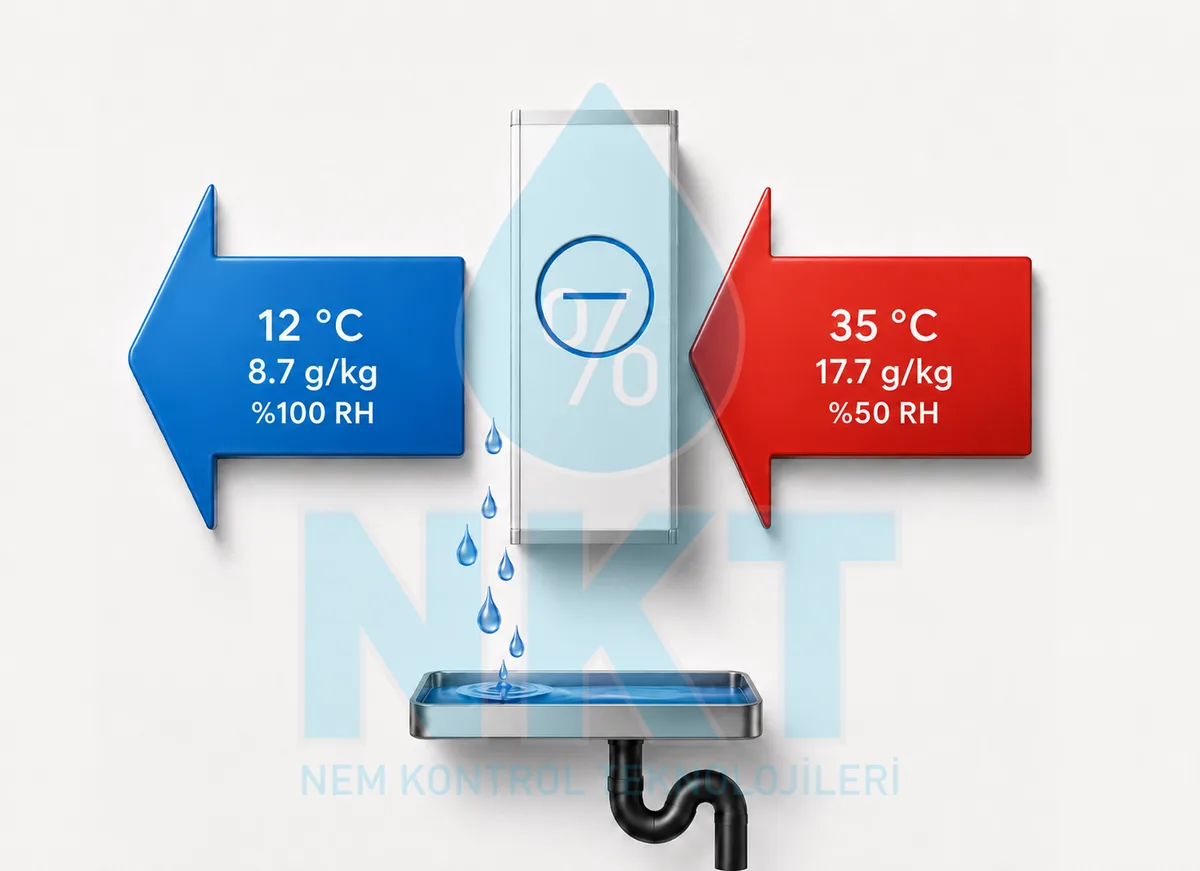
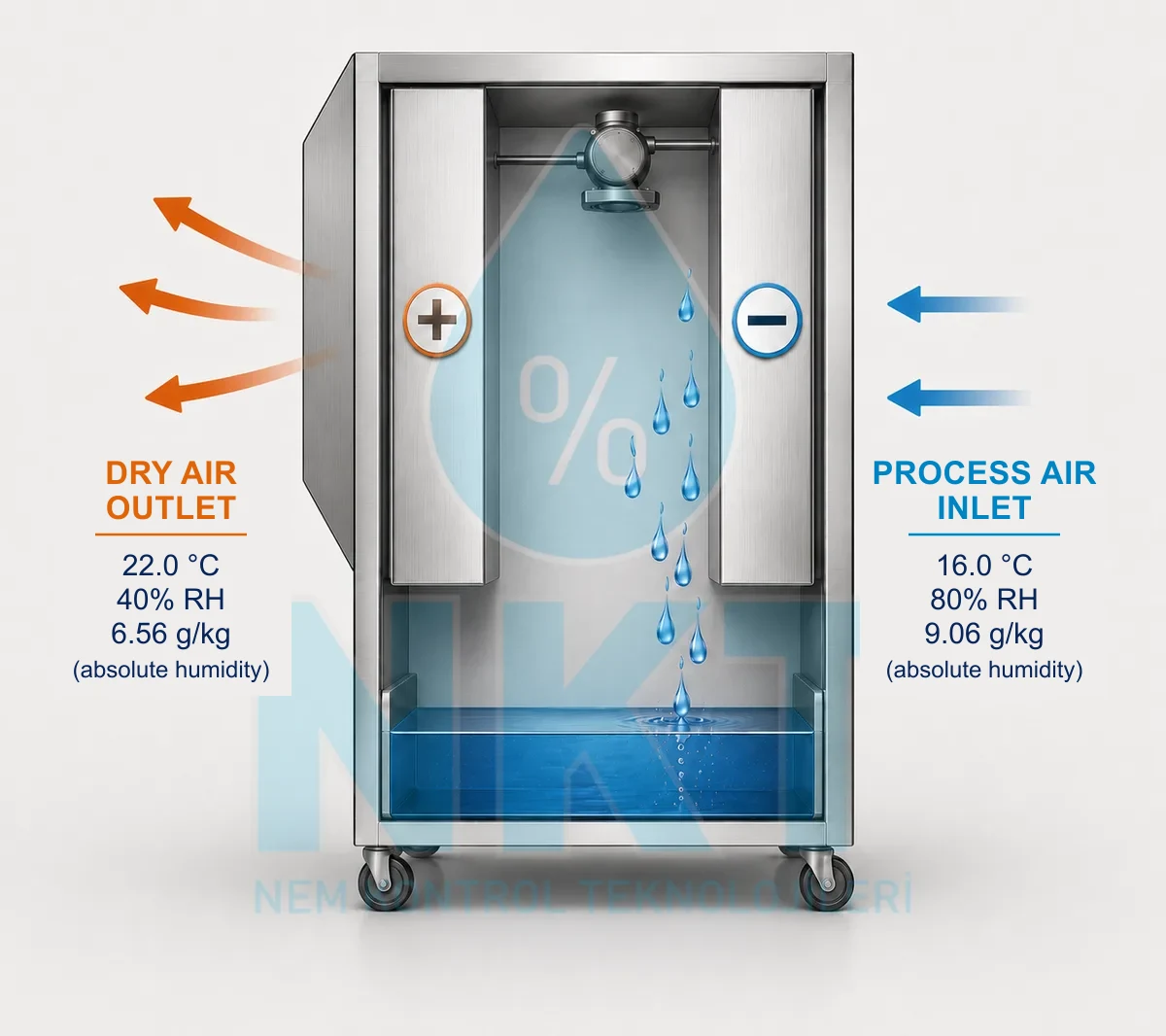
A condensation-type dehumidifier is essentially a DX (direct expansion) refrigerator: compressor, condenser, expansion valve and evaporator. The innovation is using condenser heat to reheat the air leaving the evaporator back to setpoint temperature.
Operation: (1) humid process air enters the evaporator, (2) the evaporator coil cools the air below its dew point as the refrigerant evaporates, (3) moisture on the air condenses and drains into the bottom collector pan, (4) the cooled and dried air passes through the condenser coil where it is reheated (with compressor waste heat), (5) the outlet air is returned to the room, drier and typically at the same temperature.
Advantages
- High COP: COP values of 3.5–5.0 deliver high energy efficiency in the right context.
- Low capital cost: 2–4× cheaper than a silica gel rotor system. Economical for comfort applications such as homes, offices and retail.
- Simple maintenance: Standard refrigeration knowledge is sufficient, wide service network.
- Compact build: Single integrated unit, easy installation.
- Ideal for comfort: Covers 95% of dew-point targets between +12°Cdp and +20°Cdp; which is most comfort applications.
Disadvantages / Limitations
- +12°Cdp practical lower limit: Below this, the evaporator freezes, defrost cycles reduce capacity by 30–50%. Not economical for low dew-point applications.
- Loss of efficiency below 15°C: Compressor and evaporator efficiency drop in cold environments, defrost demand rises. Condensation type is not recommended for environments below 15°C; silica gel rotor should be preferred.
- F-gas regulation: Uses refrigerant (R32, R454B, R290 etc.). EU regulations from 2024 onwards have restricted high-GWP refrigerants.
- Single energy source: Electricity only. OPEX disadvantage in countries with high electricity tariffs.
- Hygiene risk: Continuously wet surfaces (drain pan, evaporator fins) create Legionella risk, UV-C lamp or antibacterial coating required in pharmaceutical/hospital applications.
Ideal Applications
- Residential basements, warehouses, garages, preventing mould in high-RH environments.
- Office, retail, mall, comfort air conditioning (40–60% RH band).
- Food processing (>15°C areas), packaging areas, production lines.
- Data centre auxiliary spaces, technical rooms outside the server room.
- Museum, archive, library, stable RH preservation.
NKT CDP Series Performance Range
| Inlet Condition | Typical COP | Notes |
|---|---|---|
| +30°C, 70% RH (ambient) | ~5.0 | Comfort + pool, optimum point |
| +15°C, 80% RH (cold storage) | ~4.2 | Standard industrial band |
| +5°C, 85% RH (lower limit) | ~2.5 | Defrost load drops COP |
Pool Dehumidifiers: A Specialised Version of Condensation
Design Requirements Specific to Swimming Pools
Pool dehumidifiers are actually a specialised sub-category of condensation technology; but due to chlorine-laden moisture, latent-load dominance and aesthetic integration requirements they are treated as a separate category. Putting a standard condensation unit in a pool environment results in compressor corrosion and evaporator failure within 1–2 years.
Corrosion Resistance and Chlorinated Environment
In a pool space, the combination of airborne chlorine (Cl), chloride compounds (NaCl) and high relative humidity is highly aggressive. Protections used in pool-type units:
- Aluminium profile or stainless-steel housing (galvanised steel alone is insufficient)
- Epoxy-coated evaporator + condenser (so copper tubing isn't directly exposed to chlorine)
- Hermetic compressor (isolated from room air)
- Cataphoresis coating (some models, extra corrosion protection)
- Plastic fan blades, stainless screws
Evaporation Load Profile
In swimming pools, 70–95% of moisture load comes from water surface evaporation. This is a latent-load-dominant scenario. Pool-type units are sized accordingly: high latent-load capacity + condenser heat recovery contributing to room heating.
For a typical 250 m² pool, a dehumidification capacity of 8–18 kg/h is required; this corresponds to 200–450 L/24h condensation capacity. NKT's pool portfolio includes wall-type (CDP, CSW) and floor-type (Microwell) options.
TFT vs Microwell: Two Brands, Two Approaches
| Criterion | TFT (CSW, CDP) | Microwell (Dry Wave, Dry Metal Alu, Siren Eco) |
|---|---|---|
| Manufacturing origin | Italy | Slovakia |
| Housing | Galvanised steel + epoxy | Stainless / aluminium profile + premium finish |
| Capacity range | Wide (40–1,000 L/24h) | Villa-spa-mid hotel |
| Design | Functional, industrial | Aesthetic priority for visible installation |
| Ideal location | Olympic / semi-Olympic pool, fitness, mall pools | Luxury villa, boutique hotel, wellness |
Detailed Comparison Matrix
When the three technologies are placed side by side across 12 dimensions, the selection logic becomes clear.
| Dimension | Silica Gel Rotor | Condensation | Pool |
|---|---|---|---|
| Min dew point | −60°Cdp | +12°Cdp | +8°Cdp |
| Min ambient temp | −20°C | +15°C (practical) | +20°C |
| Refrigerant | None | Yes (R32 / R454B / R290) | Yes (R32 / R410A) |
| Latent load performance | Very high | High | Very high (optimised for pool) |
| Corrosion resistance | High (AISI 304) | Standard galvanised | Chlorine-specific (epoxy + alu) |
| Reactivation energy flexibility | High (electric / steam / gas) | None (electric only) | None (electric only) |
| Capital cost (relative) | High | Low–Medium | Medium |
| Operating cost (in right context) | Low (75% savings with steam/gas) | Medium | Medium |
| Maintenance frequency | Filter every 3–6 months | Annual general | Every 6 months + drain |
| Service life | 15+ years (rotor 10 years) | 10–12 years | 8–12 years (pool conditions) |
| F-gas regulation | No impact | 2024+ restrictions | 2024+ restrictions |
| Automation (Modbus/BACnet) | Standard | Standard | Model-dependent |
Which One Should I Choose? Decision Guide
The right device decision essentially comes down to two parameters: (1) target dew point and (2) ambient temperature. Other factors (capacity, automation, brand preference) follow.
| Scenario | Target RH/Dew Point | Recommended Technology |
|---|---|---|
| Residential basement, garage | 50% RH @ 20°C | Condensation (CDW, CDNP series) |
| Industrial warehouse, production | 50–60% RH @ 20°C | Condensation (CD, CDP series) |
| Cold storage (>0°C) | 70–80% RH @ 4°C | Silica gel rotor (AD series) |
| Cold storage / freezer (<0°C) | −5 ↔ −15°Cdp | Silica gel rotor (AD series) |
| Food processing + cooling tunnel | Low dew point (sugar bloom prevention) | Silica gel rotor (AD, ADP series) |
| Pharma granulation, capsule production | −20 ↔ −40°Cdp | Silica gel rotor (AD800-1100, ADP series) |
| Lithium battery dry room | −40 ↔ −60°Cdp | Silica gel rotor (ADP, ADE series) |
| Indoor swimming pool | 55–60% RH @ 28–30°C | Pool type (CDP, CSW, Microwell) |
| Museum, archive, library | 50 ± 5% RH (year-round stable) | Condensation + humidification (combined) |
Common Misconceptions
- "Silica gel is always better because it reaches lower dew points." No. If 50% RH is sufficient in a comfort application, silica gel means both excessive investment and excessive energy. Context determines.
- "A condensation unit works at any temperature." No. Below 15°C, efficiency drops sharply, evaporator freezing risk begins. Silica gel rotor is mandatory for cold storage + freezer applications.
- "Can I just install a condensation unit in a pool?" Installing standard condensation kills the unit within 1–2 years due to corrosion. Pool type is not just a "reinforced condensation" unit; it requires casing, compressor and evaporator designed for the chlorine + moisture environment.
- "Silica gel rotors are too expensive, our budget can't afford them." Capital cost may be high, but in low dew-point context there is no alternative. Steam/gas reactivation also delivers 55–75% OPEX savings; the CAPEX gap closes within 3–5 years.
- "Modern condensation units now reach very low dew points." No. The thermodynamic limit of the refrigeration cycle is +3 to +5°Cdp. Below this the evaporator freezes, physically the condensation cycle is insufficient.
- "Once installed, the unit needs no maintenance." Compressor + drain in condensation, filter + rotor cleaning in silica gel, both require annual maintenance. An unmaintained unit loses 30%+ capacity in 3–5 years.
NKT Engineering Recommendation
Correct technology selection requires a project-specific and sector-specific evaluation. As NKT, Humidity Control Technologies, we are the Türkiye representative of TFT Italy's silica gel rotor and condensation industrial dehumidifier portfolio; our expert engineering team:
- Calculates your space's moisture load (each of the 7 load items separately)
- Recommends the right TFT series (AD/ADP/ADE silica gel rotor, CD/CDP condensation, pool-type) based on target dew point and temperature band
- Optimises OPEX if reactivation energy alternatives exist (steam / natural gas / waste heat)
- Provides an annual consumption estimate via bin-hour energy simulation
- Guarantees industrial dehumidifier installation, commissioning and 10+ years of spare-parts support
For your own pre-analysis, free calculation tools:
- Moisture Load Calculation Guide, detailed 7-item walkthrough
- Psychrometric Calculator, relative humidity ↔ specific humidity ↔ dew point conversions
- Energy Efficiency Simulation, annual energy comparison: condensation vs silica gel rotor
- Pool Dehumidification Calculator
For detailed analysis and equipment selection, share your project via the contact form.
Related Glossary Terms
For deeper definitions of the technical concepts in this article, see the related pages in the NKT Glossary:


