Definition
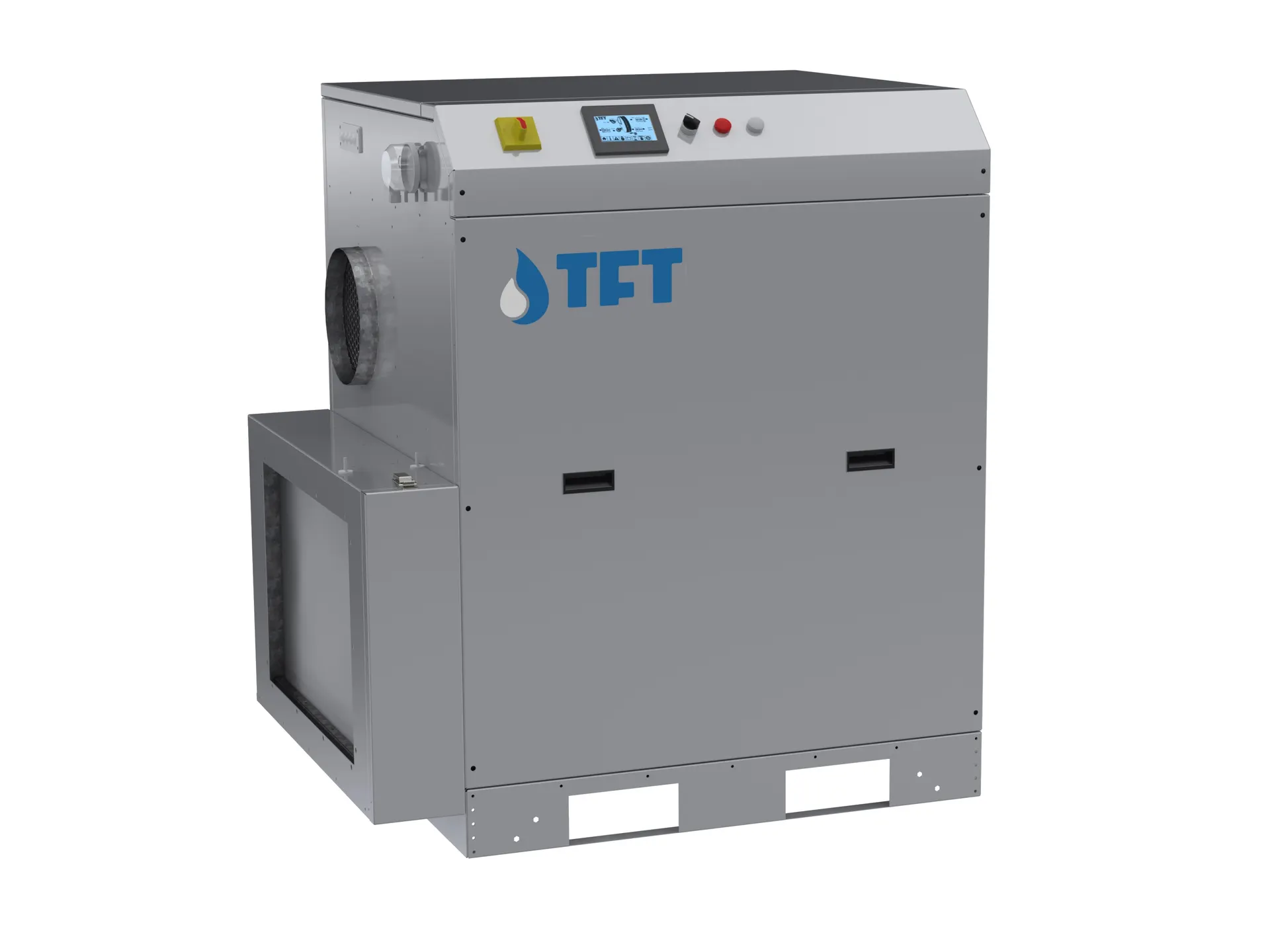
The general term for the uptake of a gas (e.g., water vapor) by a solid or liquid material. It has two subtypes: adsorption (surface adhesion) and absorption (penetration into the material). Silica gel rotor dehumidifiers operate on the adsorption principle; deliquescent materials such as sodium chloride perform absorption. The thermodynamic foundation of industrial humidity control technology.
Detailed Explanation
Sorption is a broad family of physicochemical processes:
• Adsorption — gas molecules adhere to the surface of a solid (silica gel, zeolite, activated carbon) • Absorption — gas molecules penetrate into the bulk of solid/liquid (lithium chloride solution, glycerin) • Chemisorption — adheres via chemical bond (irreversible, calcium oxide + H₂O) • Physisorption — adheres via physical forces (reversible, silica gel)
In dehumidification technologies:
• Silica gel rotor (physisorption) — silica gel surface area 600–800 m²/g; water molecules adhere via H-bond; easily released by reactivation heat (100–140°C). Reversible.
• Zeolite (physisorption) — higher selectivity than silica gel; strong attraction even at low RH. Preferred for lithium battery dry rooms (–60°C dp).
• Lithium chloride solution (absorption) — takes water mass from air into liquid solution; "liquid desiccant" systems. High CAPEX but very low OPEX.
• Activated carbon (adsorption) — only for organic vapor (VOC); not used in humidity control.
Sorption capacity depends on RH and temperature (sorption isotherm). Manufacturer curves are used in engineering design.
Engineering Note
Four important decisions in sorption technology selection:
1. Target dew point — at typical capacities: • Silica gel rotor: effective down to –10°C dp; can reach –45°C (capacity drops) • Zeolite: effective down to –60°C dp (lithium battery class) • Condensation: +12°C dp practical limit
2. Reactivation energy source — sorption technologies require heat to separate water from adsorbent; energy source choice (waste heat > steam > gas > electricity) affects OPEX 2–5×.
3. Ambient temperature — silica gel rotor outperforms condensation at low temperatures (0°C and below); condensation freezes at these temperatures.
4. Contamination sensitivity — silica gel and zeolite are sensitive to dust, oil vapor, organic solvents; F7+ filter + optional activated carbon pre-filter mandatory.
At NKT we offer sorption-based industrial dehumidification solutions: TFT silica gel rotor + zeolite variants + proper reactivation energy integration.