Definition
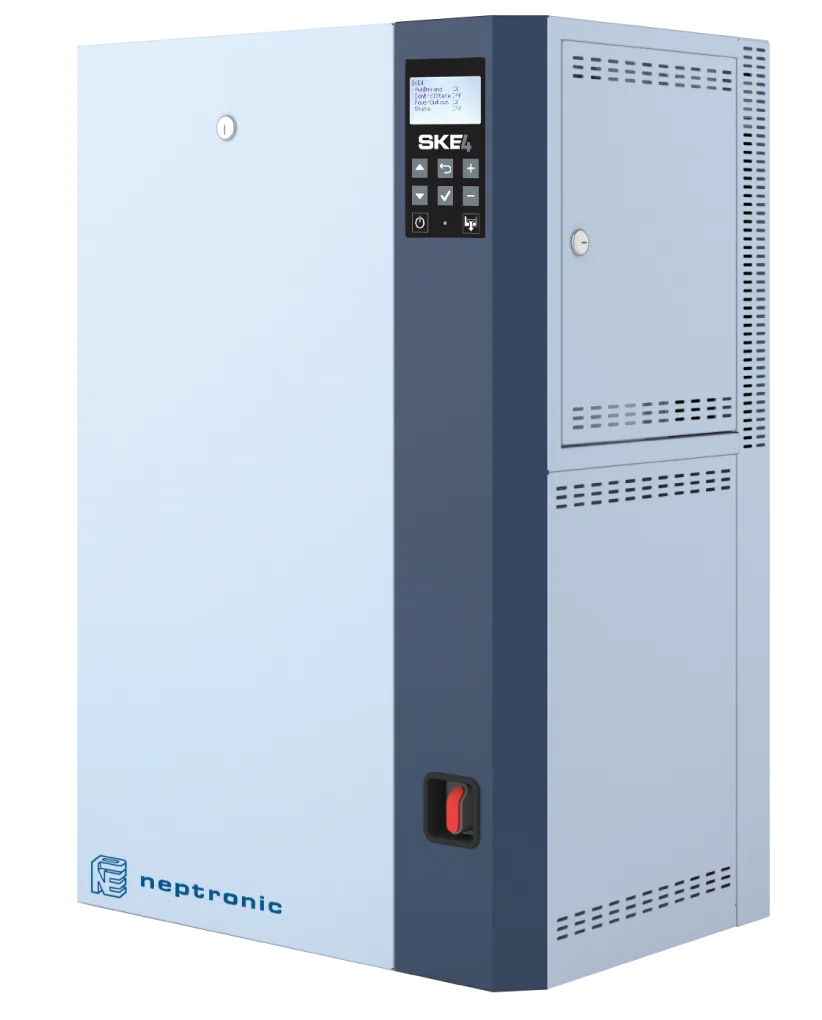
The industrial term for the replaceable vessel where steam is generated in resistive or electrode steam humidifiers. Neptronic SKE series uses a stainless-steel immersion-heater cylinder with a 5-7 year element life. Electrode systems use disposable plastic cylinders that require replacement every 6-18 months.
Detailed Explanation
A steam cylinder is the "heart" of a steam humidifier — the replaceable pressure vessel inside which water is heated and evaporated, with the resulting steam delivered to the supply duct. It takes different forms in two basic technologies:
1. Resistive cylinder (Neptronic SKE series) • Stainless-steel 304L or 316L body • 1-12 immersion heater elements inside • Water-level sensor (capacitive or conductivity) • Drain and fill solenoid valves • Life: 8-15 years body, 5-7 years heater elements • Water type: DI, RO, demineralised, hard mains (depending on pre-treatment) • Maintenance: annual interior cleaning, descaling, element check
2. Electrode cylinder (various manufacturers) • Polypropylene or polycarbonate plastic body (disposable) • Water itself acts as the resistor (high conductivity required) • Two or three stainless-steel electrodes immersed • Current passes through water, Joule heating evaporates • Life: 6-18 months (depending on water hardness and usage intensity) • Water type: hard/medium-hard mains only (will not work with DI/RO) • Maintenance: complete cylinder replacement (service 30-45 min)
Capacities range 5-180 kg/h per cylinder; multi-cylinder configuration steps to 1,000+ kg/h. Outlet steam pressure is atmospheric (>0.1 bar) or low-pressure (0.5-1.5 bar). High-pressure boiler steam is a separate technology family.
Why It Matters
Cylinder technology selection is the most decisive factor in the 10-15 year total cost of ownership (TCO) of a steam humidifier:
5-year TCO comparison for 80 kg/h capacity (Türkiye, 50% average load):
Electrode (electrode type): • Equipment capex: 14,000 USD • Cylinder replacement: 8 months × 5 years = 7 cylinders × 850 USD = 5,950 USD • Service labour: 7 × 200 USD = 1,400 USD • Water waste (high blowdown): 240 m³/year × 5 = ~3,500 USD • Electricity (50% avg load): 5 years × 1,500 USD = 7,500 USD • 5-year TCO: ~32,350 USD
Resistive (Neptronic SKE4): • Equipment capex: 18,000 USD • Cylinder replacement: none (body lifetime) • Element replacement: year 5, 1 set = 1,200 USD + 250 labour • Annual cleaning: 5 × 180 USD = 900 USD • Water waste (low blowdown): 80 m³/year × 5 = ~1,200 USD • Electricity (50% avg load): 5 years × 1,500 USD = 7,500 USD • 5-year TCO: ~29,050 USD
Difference: 3,300 USD (10%) — but the gap widens by year 10: • Electrode 10 years: ~62,000 USD (cylinder cost rises to 12,000 USD) • Resistive 10 years: ~50,000 USD • 10-year savings: 12,000 USD
Hygiene and sustainability: • Electrode plastic cylinder = ~7-8 kg/year plastic waste (50-200 cylinders in a large facility, 350-1,600 kg plastic/year) • Resistive stainless steel = zero plastic waste, 100% recyclable
DI/RO water compatibility: • Electrode systems do not work with DI/RO (insufficient conductivity) — scaling, fouling, element corrosion • Resistive systems run with any water type — the only option for high-hygiene applications such as pharma, hospitals and electronics
Practical Example
An Istanbul hospital project — 12,000 m² office and outpatient clinic block, winter peak 380 kg/h steam humidification load. The customer's initial purchase: 5 × 80 kg/h electrode-cylinder systems (400 kg/h total).
Complaints after 6 months of operation: • Cylinder replacement interval is 4-6 months instead of the expected 12 months (water hardness 35°dH, high) • Annual plastic cylinder waste: 5 × 2 replacements = 10 cylinders/year × 8 kg = 80 kg plastic • Humidity target not held during downtime • Annual maintenance cost: 18,000 USD (cylinder + labour)
NKT engineering evaluation proposed Neptronic SKE4 resistive systems as the alternative: • 5 × SKE4 80 kg/h stainless-steel cylinders • DI water integration (additional capex 2,500 USD/year) • No cylinder replacement, element checked every 5 years
5-year TCO comparison: • Existing electrode: capex 70,000 + maintenance 5×18,000 = 160,000 USD • New resistive: capex 90,000 + maintenance 5×3,500 = 107,500 USD • 5-year savings: 52,500 USD • 10-year savings: ~120,000 USD • ROI: <2 years
Additional benefits: • Plastic waste: 80 kg/year → 0 kg/year • System reliability: 92% → 99.5% • Hygiene: DI-water compatible for hospital environment
In month 12 the customer replaced the electrode system with NKT SKE4. The NKT engineering report was the decisive argument in the investment committee's approval. This example is a textbook case of the "cheap capex, expensive opex" principle.
Engineering Note
Engineering criteria in steam-cylinder selection and operation:
• Water-quality analysis — mains TDS, hardness (°dH or ppm CaCO3), pH, Cl- and SiO2 content. High hardness (>20°dH) shortens electrode-cylinder life by 50%; DI/RO pretreatment is recommended for resistive systems. • Drainage and blowdown — periodic blowdown is mandatory to remove scale and minerals at the cylinder bottom. Typical: electrode 8-15 s/day, resistive 30 s every 4-6 hours. • Drain water temperature — discharged blowdown water is 95-100°C; cannot enter sewer without cooling. A tempering valve or mix tank should bring it below 50°C. • Distribution manifold selection — for homogenous steam distribution from the cylinder into the AHU or supply duct, use a steam absorption manifold (SAM-e) or in-room dispersion tube. Inadequate distribution causes condensation and "rain". • Steam piping — 316L stainless steel or copper, target velocity 15-25 m/s; horizontal runs sloped 1/100 toward drain, vertical runs with u-trap drain recommended. • Water-level sensor quality — capacitive sensor (Neptronic) is reliable; conductivity probes are sensitive to hardness. Sensor failure → cylinder rupture or dry running. • Safety valves — overpressure protection (1.5 bar set), thermal cutoff (110°C), overcurrent fuse mandatory. UL/CE/CSA certification must be checked. • Commissioning tuning — post-startup 24-h load test, PID parameter tuning, alarm setpoint calibration, maintenance protocol training.
NKT project deliverables: cylinder configuration report, water-quality requirements, maintenance procedure, training material, 24-month warranty.
NKT Application Link
NKT delivers Neptronic SKE4 resistive-cylinder technology as standard configuration in industrial steam humidification applications requiring hygiene and long life:
1. Neptronic SKE4 product family — 5-180 kg/h per cylinder, 304L stainless-steel body, modular element design, ±1% RH PID precision. 2. DI/RO water integration — pre-project water-quality analysis, RO + EDI system recommendations, optional UV-C lamp for bacterial control. 3. Steam absorption manifold (SAM-e) — Neptronic proprietary manifold, in-duct distribution ±2% RH homogeneity, zero condensation. 4. NKT - Climate Track monitoring — cylinder temperature, element current, water level, blowdown counter, alarm history; trend analysis for predictive maintenance. 5. Maintenance contract — annual interior cleaning, element check, cylinder pressure test, full maintenance record + reporting; 5-year extended warranty option.
Sample configuration: 12,000 m² hospital (380 kg/h load): 5 × SKE4 80 kg/h, DI water, SAM-e distribution, NKT - Climate Track 16 points. Capex 95,000 USD, annual opex 8,500 USD, 10-year TCO ~180,000 USD. 38% savings vs the electrode alternative, zero plastic waste.
Related Academy Articles
Related Products
NKT products related to this term