

Military aviation platforms (including fighter jets, helicopters, and transport aircraft) are among the most technologically sophisticated and environmentally sensitive assets in any defense force. The hangars, aircraft shelters, and maintenance facilities where these platforms are stored and serviced demand precise atmospheric control, and a properly specified dehumidifier is a fundamental component of that control. Unmanaged humidity poses direct risks to avionics, airframes, and weapon systems, making humidity management a non-negotiable operational requirement.
Airframe materials used in modern military aircraft, particularly carbon fiber reinforced polymers (CFRP) and advanced aluminum alloys, are susceptible to moisture-induced degradation. Moisture absorption into composite structures can cause delamination, a reduction in tensile strength, and accelerated fatigue failure. Industrial dehumidifiers maintain hangar relative humidity within safe thresholds, protecting the structural integrity of airframes and extending the service life of these high-value assets.
Avionics systems represent one of the most moisture-sensitive categories of equipment on any military aircraft. Flight control computers, radar processing units, electronic warfare suites, and communications systems can all suffer from condensation-related short circuits, corrosion on circuit boards, and calibration drift. Military standards such as MIL-STD-810 define specific temperature and humidity envelopes for storage and operation; maintaining compliance with these standards requires continuous dehumidifier operation in all storage and maintenance environments.
Weapon systems and guided munitions stored within aircraft shelters and armament depots are equally vulnerable to moisture damage. Missile guidance electronics, thermal imaging seekers, and proximity fuze systems can malfunction or degrade when exposed to condensation over extended storage periods. A high-capacity industrial dehumidifier deployed in these storage areas ensures that sensitive ordnance remains in a mission-ready state and that pre-launch self-test failures caused by humidity are eliminated.
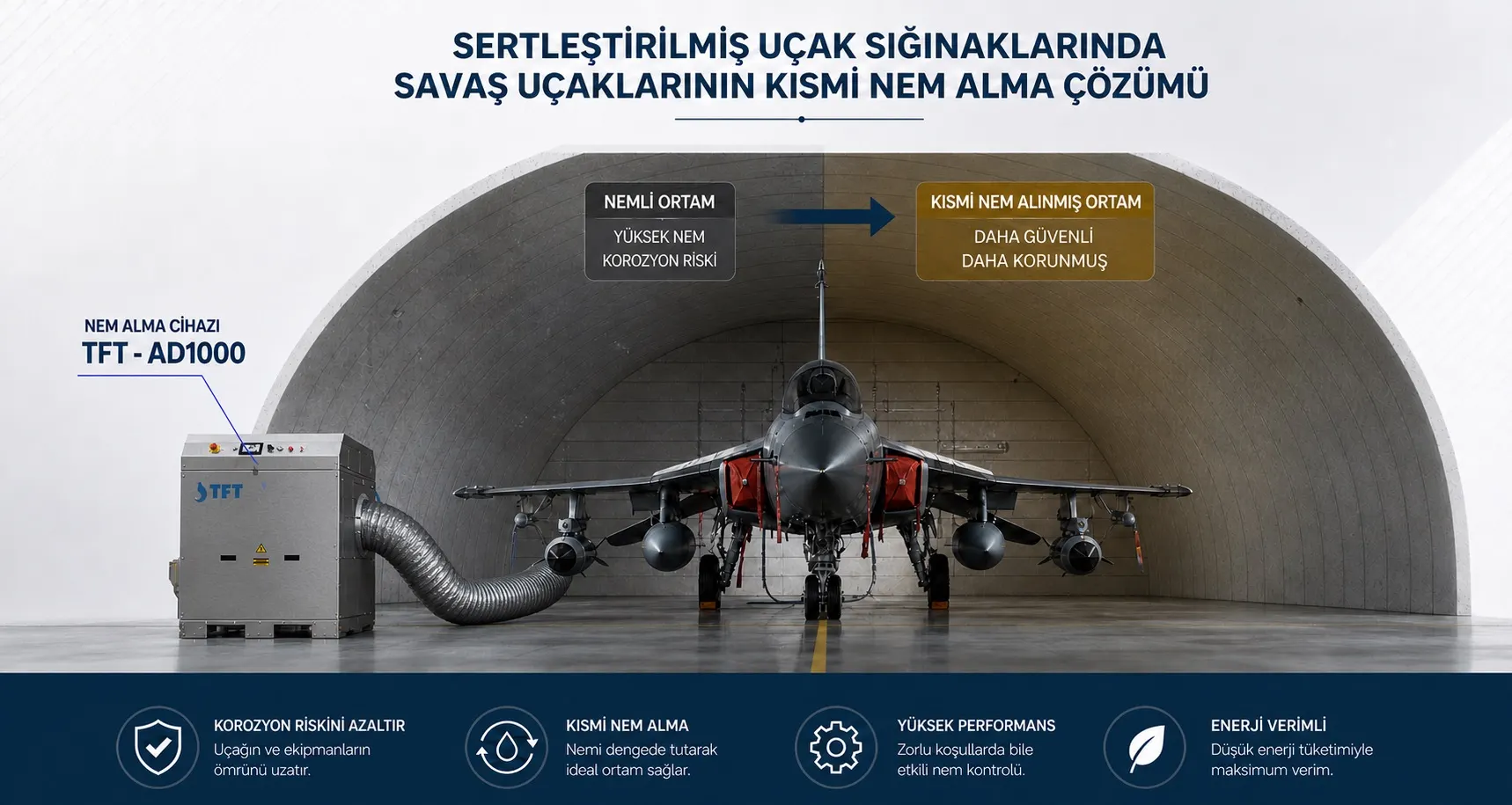
Engine bays, landing gear assemblies, and hydraulic systems undergoing scheduled maintenance in repair hangars are also at risk from humid workshop conditions. Elevated humidity accelerates corrosion on metal surfaces, degrades seals and gaskets, and contaminates lubricants. A well-sized dehumidifier in maintenance hangars not only protects the aircraft components being worked on but also improves the working environment for technicians, reducing errors caused by condensation on tooling and test equipment.
Coastal air bases, tropical theater installations, and naval aviation facilities face compound humidity challenges due to salt-laden air and consistently high relative humidity year-round. In these environments, corrosion rates can be dramatically higher than in inland locations, and the selection of the appropriate dehumidifier technology (whether desiccant or refrigerant-based) must account for the specific temperature and humidity profile of the site.
At NKT – Humidity Control Technologies, our engineering team specializes in designing and supplying industrial dehumidifier solutions tailored to the demanding requirements of military aviation facilities, ensuring that aircraft, weapon systems, and avionics remain fully operational and structurally sound regardless of ambient climate conditions. For more information, please contact us through the form below.