

Cold storage facilities are a decisive infrastructure element in many critical sectors — from food safety to pharmaceutical storage conditions and the preservation quality of historical artifacts. The cold chain logistics market is growing rapidly worldwide, and humidity control — which is as important as temperature control in cold storage, and in some applications even more so — leads to major economic losses and quality problems when the system is not correctly designed.
Humidity causes damage in cold environments through multiple mechanisms: corrosion on metallic surfaces and electronic components, mold and bacterial growth in biological materials, paper degradation in archive materials, texture deterioration in food products, and frost events. In addition, high humidity creates an unnecessary extra load on cooling systems, negatively affecting energy efficiency.
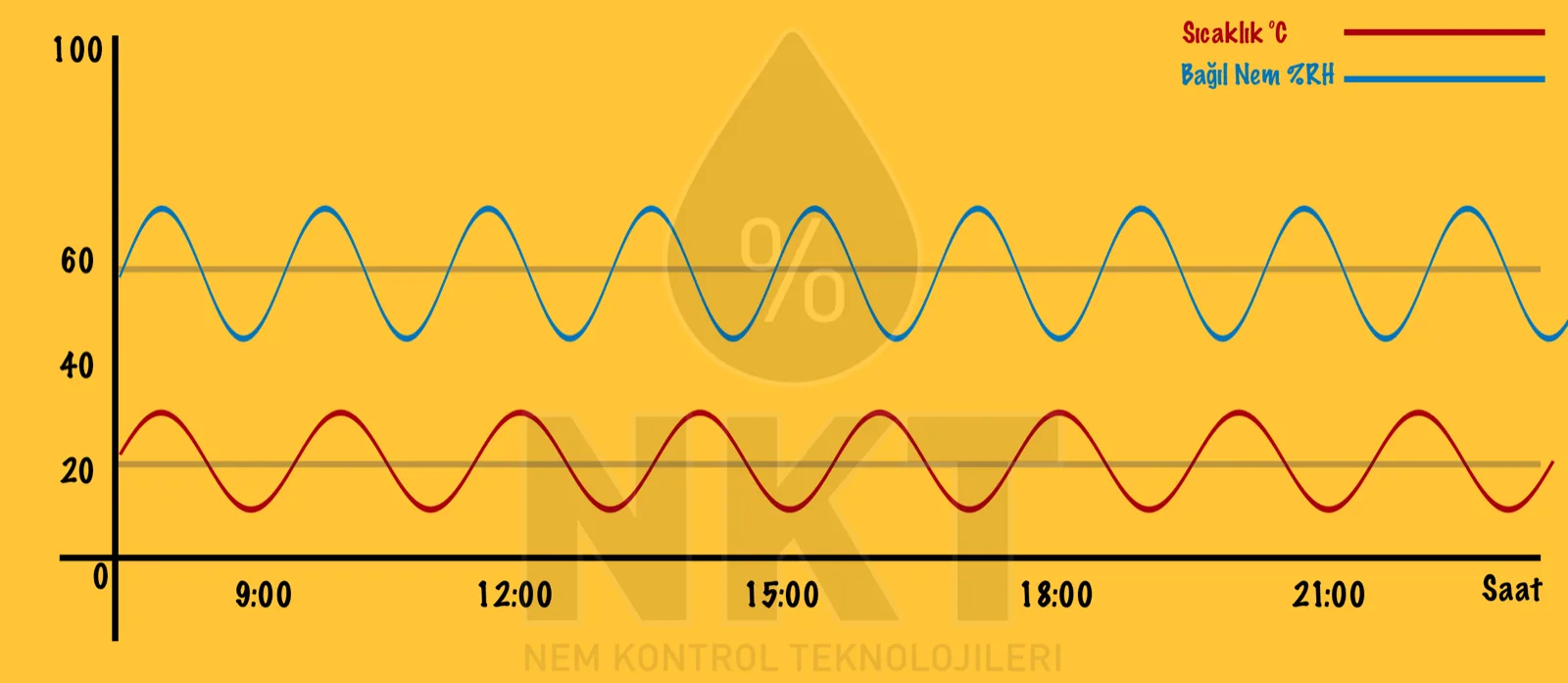
The vast majority of cold stores fall into two basic categories: static stores and dynamic stores. The difference between these two types is not limited to operating style; it also involves fundamental differences in system design philosophy, moisture load calculation method, control strategy, and equipment selection. Static stores have a fixed or barely changing moisture load, whereas in dynamic stores the moisture load fluctuates dramatically throughout the day.
Static Cold Stores
Static cold stores are facilities where internally generated moisture is minimal, door openings are kept extremely limited, and operational cycles remain largely constant. In these stores, the most significant moisture entry source is ambient air leaking through sealing gaps; for this reason, insulation quality and air tightness are among the primary design parameters.
The most distinctive feature of static stores is the requirement for high stability despite wide tolerance ranges. For example, while a 40-50% relative humidity (RH) range provides adequate protection for paper-based archive materials, a single month of exceeding 65% RH can cause permanent damage. Therefore, the system must target long-term stability rather than instantaneous deviations.
Application Areas and Humidity-Temperature Profiles
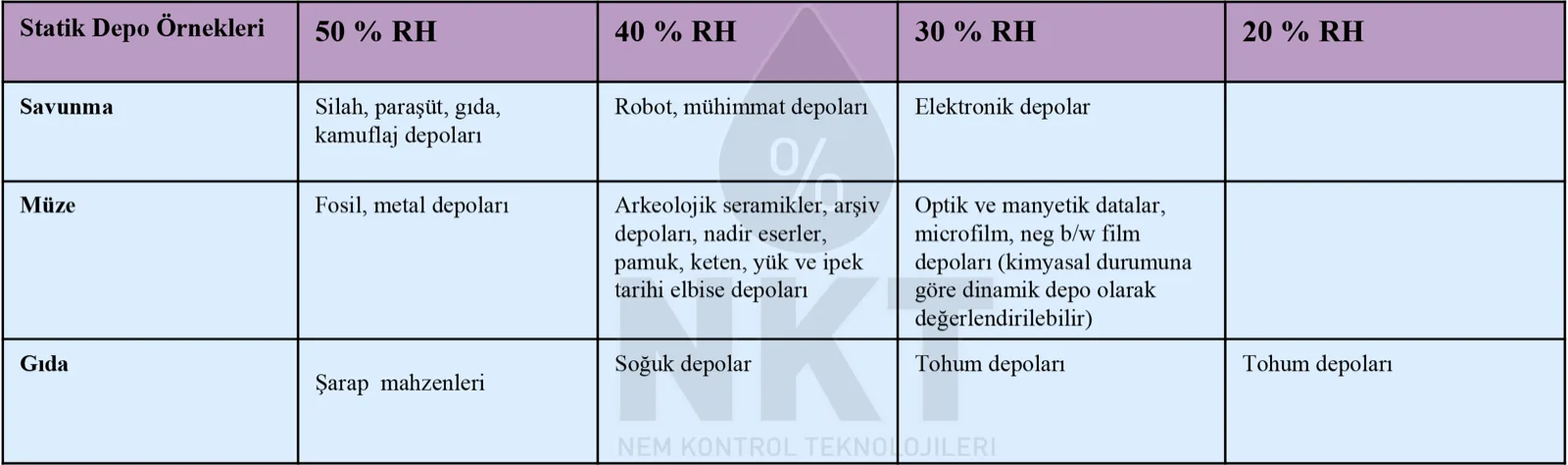
In static stores, the target humidity and temperature values vary significantly according to the type of material being stored. The table below summarizes typical design conditions and the preferred dehumidification technology for common static store applications:
| Application Area | Temperature (°C) | Target RH (%) | Tolerance (±%) | Critical Risk | Preferred System |
|---|---|---|---|---|---|
| Paper Archive / Library | 13–18 | 45–50 | ±5 | Mold, acid hydrolysis | Desiccant rotor |
| Museum / Historical Artifacts | 18–21 | 45–55 | ±5 | Dimensional change, cracking | Desiccant + cooling |
| Pharmaceutical / API Storage | 2–8 | 25–40 | ±3 | Hydrolysis, crystallization | Desiccant rotor |
| Seed Bank | −18–0 | 10–25 | ±5 | Loss of germination | Desiccant (staged) |
| Electronic Components | 15–22 | 25–40 | ±3 | Corrosion, electrostatic | Desiccant rotor |
| Lithium Battery (Li-ion) | 10–20 | 18–22 | ±2 | Capacity loss, thermal runaway | Desiccant (high precision) |
| Wine Cellar | 12–14 | 60–70 | ±5 | Cork drying, evaporation | Cooling + humidification |
| Artworks (Paintings) | 18–20 | 45–55 | ±5 | Paint cracking, running | Desiccant + cooling |
System Design Principles for Static Stores
When designing a humidity control system for a static cold store, three fundamental principles are observed:
- Minimum air leakage: Air leakage is minimized with vapor barriers and foam fill applied at wall, ceiling, and floor junctions. The ASHRAE 90.1 standard sets a target of 0.6 air changes per hour at 50 Pa differential pressure.
- Staged dehumidification: In low-temperature applications (for example −18°C), directly cooling the ambient air leads to a risk of frost. For this reason, dehumidifier systems operate in an intermediate zone between +10°C and +20°C and carry out the process in stages.
- Redundancy and monitoring: Since system failures in static stores may go unnoticed for a long time, dual-sensor monitoring and a backup dehumidifier module are standard.
Dehumidifier Selection Criteria: Desiccant or Mechanical?
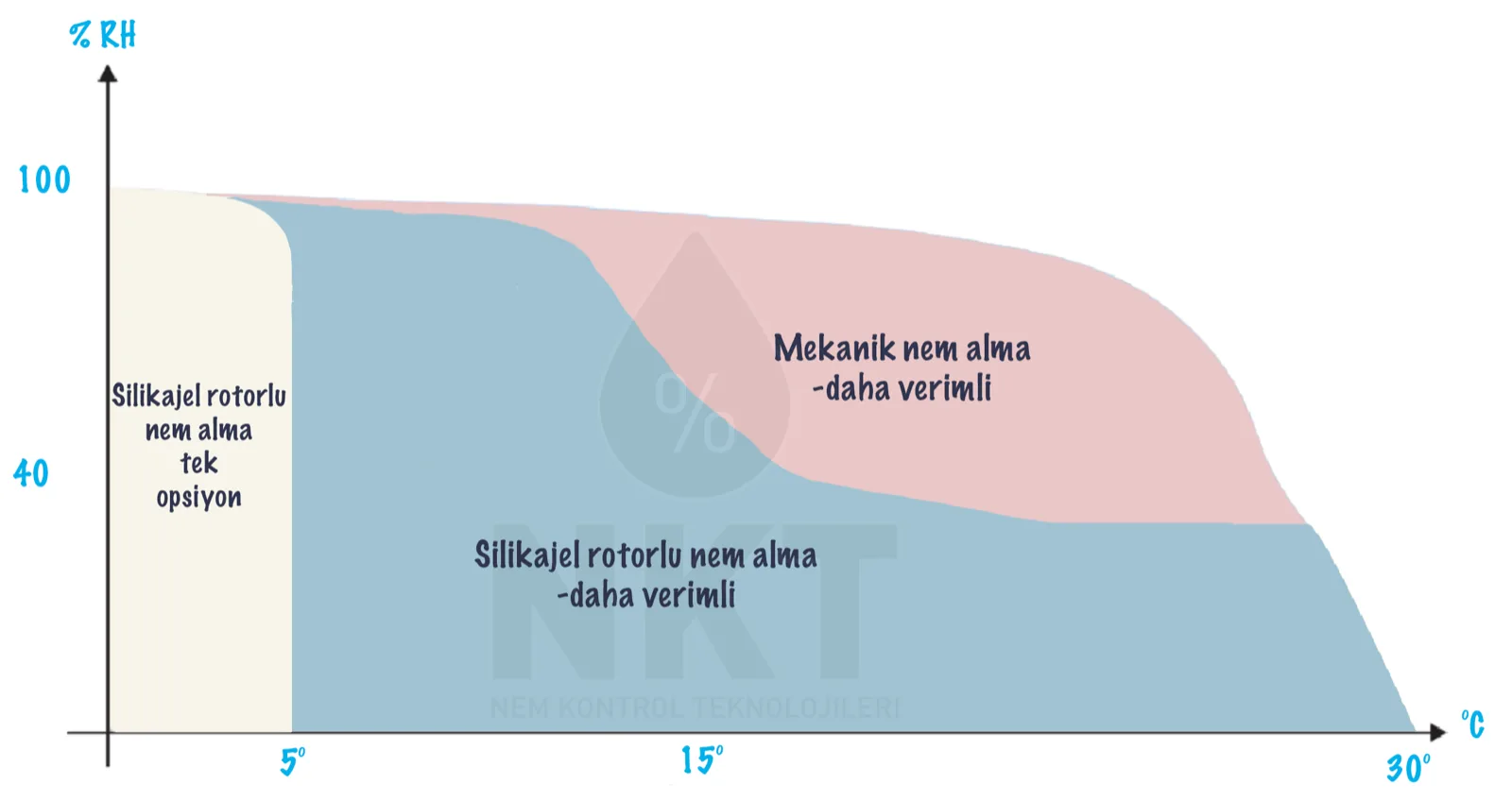
In cold storage applications, the choice of dehumidification system depends largely on the store temperature and the target humidity level. Mechanical (refrigerant) dehumidifiers are efficient when operating above the dew point temperature; however, when the store temperature drops below 15°C, ice forms on the evaporator coil and efficiency drops dramatically.
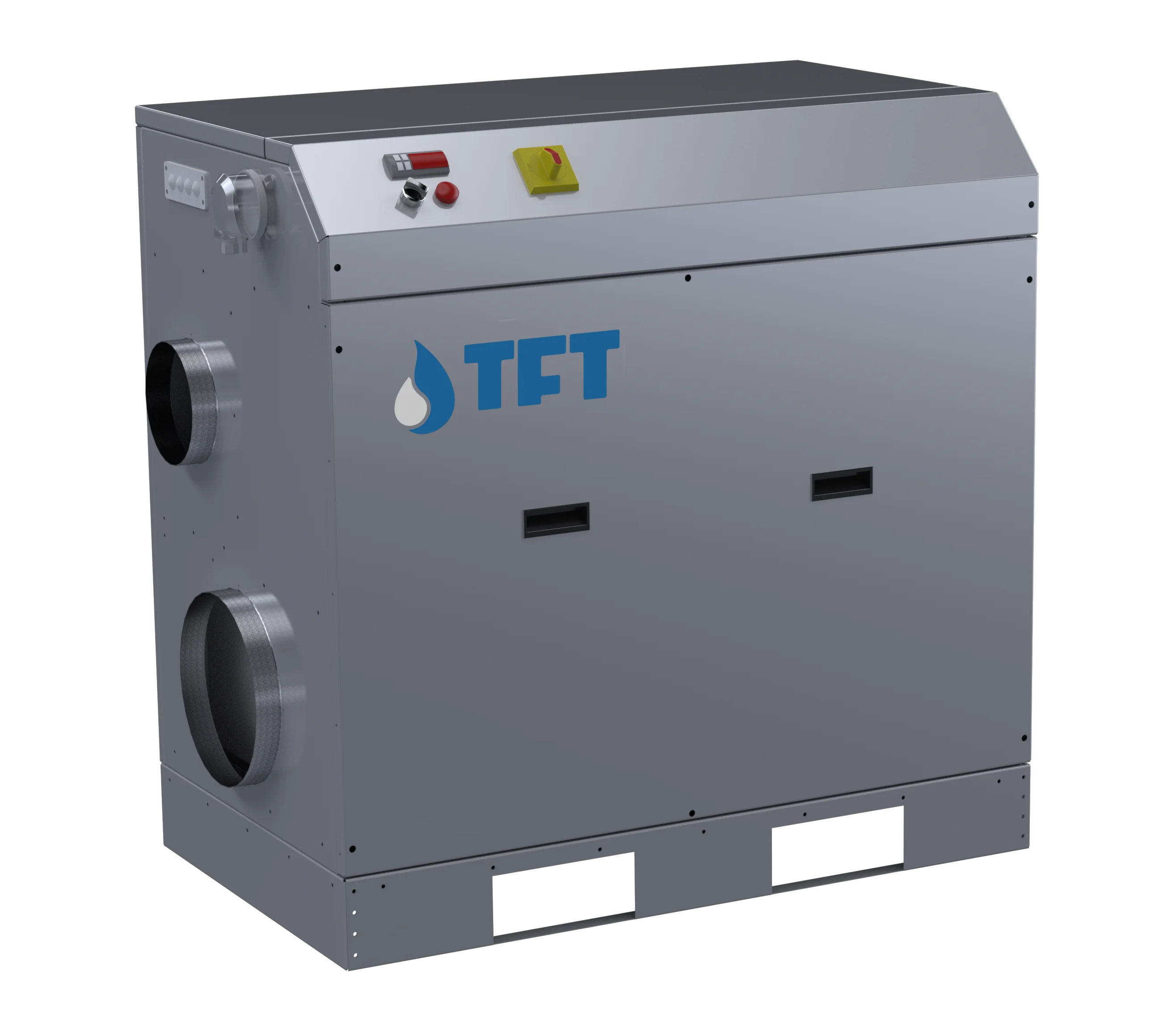
In all applications where the store temperature is below 10°C, desiccant rotor systems should be preferred over mechanical dehumidifiers. The efficiency of mechanical systems under these conditions drops to the 20-30% range, and ice formation creates a serious risk of failure.
| Criterion | Desiccant Rotor | Mechanical (Refrigerant) |
|---|---|---|
| Ideal Operating Temperature | −40°C to +40°C | +15°C to +40°C |
| Low RH Capability | Down to 1% RH | 35-40% RH lower limit |
| Energy Efficiency (High RH) | Medium | High |
| Energy Efficiency (Low RH) | High | Low |
| Maintenance Intensity | Low (rotor every 5-7 years) | High (compressor, filter) |
| Reactivation Heat | Required (140-180°C) | Not required |
Maintenance and Monitoring Protocols
In static cold stores, the effectiveness of the humidity control system depends largely on a correct monitoring infrastructure. The monitoring protocol should include at least the following elements:
- Calibration-certified RH sensors recording every 15-30 minutes (±2% RH accuracy)
- Storage of temperature and humidity data on a cloud-based or local server (minimum 1 year for ISO 17025 compliance)
- Monthly sensor check and annual calibration cycle
- Alarm thresholds: SMS/e-mail alert when target humidity exceeds by 5%
- Integrated performance tests measuring the desiccant rotor's moisture retention capacity (every 6 months)
An example application: a state archive institution with 800 m² of storage area, 4.5 m ceiling height (3,600 m³), target conditions of 16°C / 47% RH. The existing problem: humidity dropping to 38% RH in winter caused paper brittleness, while reaching 62% RH in summer created a mold risk. The implemented solution: a combination of two 450 m³/h capacity desiccant rotor dehumidifiers + direct expansion cooling, using a natural gas condensing burner as the reactivation heat source. Twelve months of monitoring data showed that the target band was held within ±3.5% RH and the previous problems were completely eliminated.
Dynamic Cold Stores
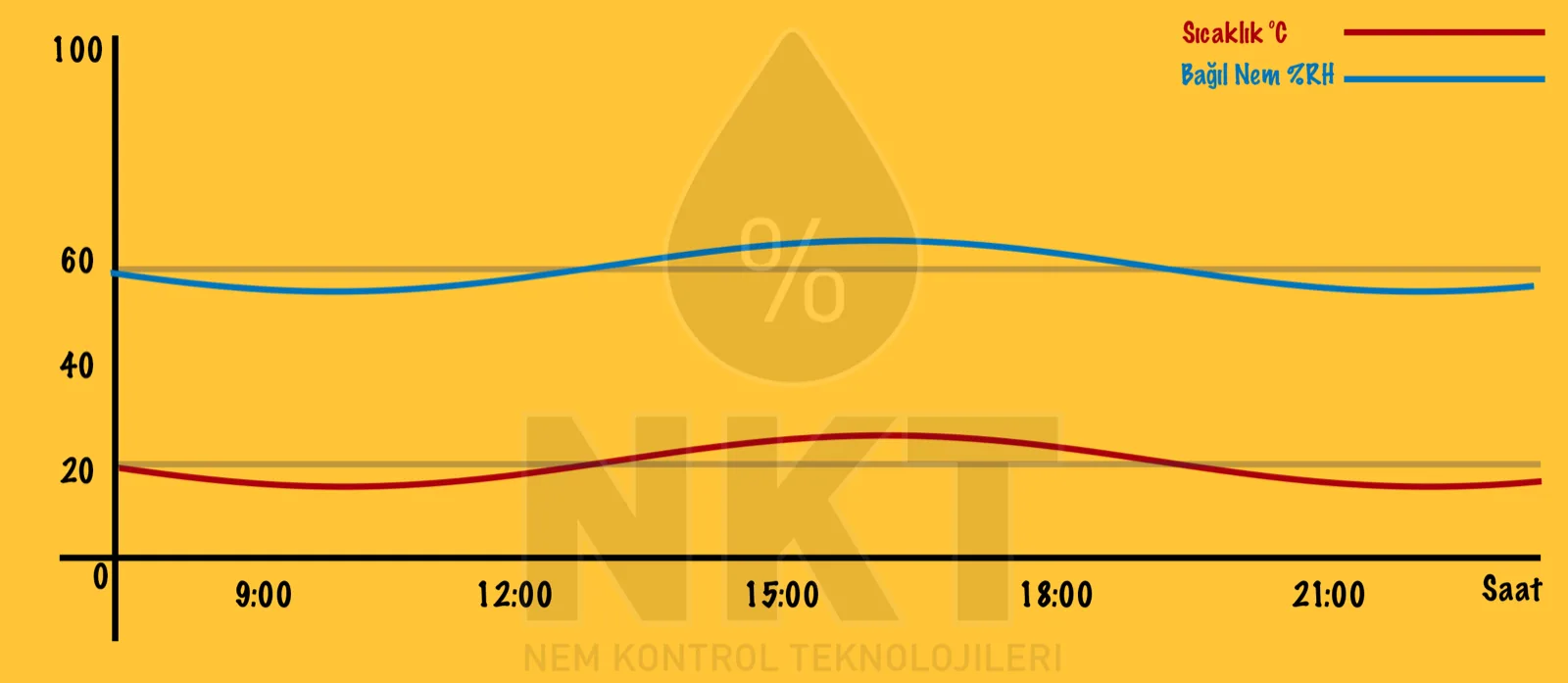
Dynamic cold stores are facilities that, as part of a production or logistics operation, host continuous material entry and exit, personnel activity, and mechanical equipment movement. In these environments, the moisture load is not just a fixed value coming from the building envelope; it is a multi-component quantity that changes hourly or even minute by minute.
The main load sources are grouped as follows:
- Door opening load: Each time the cold store doors open, warm, humid outside air enters the store. This is the largest instantaneous moisture load source.
- Personnel respiration load: Each worker produces approximately 40-60 g of water vapor per hour.
- Product cooling load: The moisture that warm products entering the store evaporate from their surface as they cool.
- Conveyors and mechanical equipment: Every energy-consuming piece of equipment produces heat and therefore evaporation.
- Loading dock infiltration: Moisture entry at the point where the vehicle door or dock meets the atmosphere.
- Washing and cleaning load: Especially in meat/dairy/seafood stores, daily washing operations leave kilogram-level moisture.
Door Opening Moisture Load Calculation
The most critical step in dynamic store sizing is calculating the door opening moisture load. For this calculation, the partial vapor pressure difference method derived from ASHRAE Fundamentals is used:
Qair = Adoor × vaverage × εflow
εflow = 0.5 × [1 − (ρin / ρout)1/3]
Wdoor = moisture load (g/h) · ρ = air density (kg/m³) · ω = specific humidity (g/kg) · Adoor = door area (m²) · topen = single opening duration (s) · Nopening = openings per hour
Door Load Calculation — Numerical Example
Conditions: Outside air 32°C / 60% RH (ωout ≈ 19.3 g/kg), store interior conditions 4°C / 90% RH (ωin ≈ 5.1 g/kg). Door size: 3 m × 3 m = 9 m². Opened 8 times per hour, each opening 45 seconds.
ρout ≈ 1.13 kg/m³ (at 32°C) · vaverage ≈ 0.8 m/s
Qair = 9 × 0.8 = 7.2 m³/s
Wsingle opening = 1.13 × 7.2 × 14.2 × 45 ≈ 5,215 g
Whourly = 5,215 × 8 = 41,720 g/h ≈ 41.7 L/h
This value shows that the hourly moisture load from a single door is equivalent to approximately 42 liters of water. In a store with 4 doors, this load reaches approximately 168 L/h — clearly demonstrating why system sizing must be based on the worst-case scenario.
Dynamic Store with Loading Dock — Example
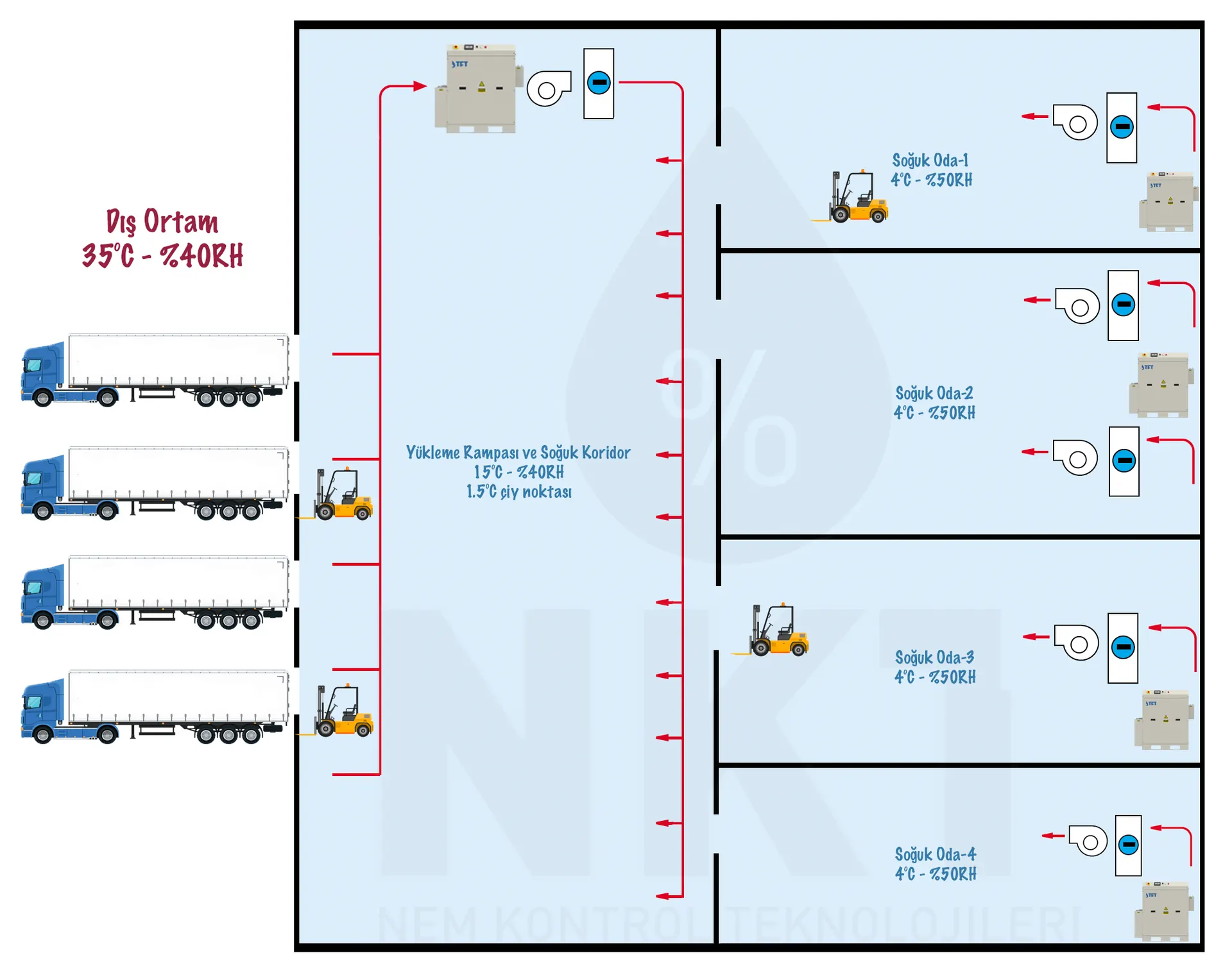
Facility details: 2,400 m² total area, 6 m ceiling height, 4 double-leaf dock doors, outside temperature above 25°C for 6 months of the year. Each dock handles 3 truck loadings/unloadings per day, with an average door-open time of 35 minutes per truck. The typical summer-peak moisture load distribution for this facility:
| Load Source | Capacity (L/day) | Percentage |
|---|---|---|
| 4 door openings (summer peak) | 1,680 | 54% |
| 12 personnel × 8 hours | 57.6 | 1.9% |
| Product cooling load (18 trucks/day) | 840 | 27% |
| Loading dock infiltration | 320 | 10.3% |
| Building envelope leakage | 210 | 6.8% |
| Total (summer peak) | 3,107.6 | 100% |
The solution selected for this facility: two desiccant systems with 1,600 L/day capacity each (total 3,200 L/day) + frequency-controlled fan modulation. The 30% reserve capacity safely covers summer-peak conditions.
Automation, Control Strategy and Energy Optimization
In dynamic stores, humidity control can never be adequately managed with a fixed-capacity system. To respond to instantaneous load changes, the system must include the following control elements:
- PID-based RH regulation: The desiccant system's operating speed is continuously adjusted with feedback from the humidity sensor.
- Variable frequency fan drives (VFD): Provide 25-40% energy savings compared to fixed-speed fans.
- Door-open detection: When door sensors are triggered, the system switches to full capacity to instantly suppress moisture entry.
- Variable capacity modulation: When the load drops at night, the system switches to economy mode, reducing energy consumption by up to 60%.
- SCADA integration: Multi-point monitoring, trend analysis, and predictive maintenance alerts.
Static vs Dynamic: Comprehensive Comparison
| Parameter | Static Store | Dynamic Store |
|---|---|---|
| Main moisture source | Envelope leakage, diffusion | Door opening, personnel, product |
| Moisture load variability | Low (±10-15%) | High (±50-300%) |
| Target RH tolerance | ±5% RH | ±2-3% RH |
| System design | Simple, fixed capacity | Variable capacity, modular |
| Control strategy | On/off or simple PID | VFD + PLC + SCADA |
| Critical calculation step | Envelope leakage analysis | Door opening load calculation |
| Reserve capacity | 20% | 30-40% (summer peak) |
| Typical application | Archive, pharma, seed bank | Food store, cold corridor, e-commerce |
Ice Formation, Defrost and Floor Safety
In dynamic cold stores, high humidity threatens not only product quality but also operational safety. Ice buildup on cooling coil surfaces lengthens defrost cycles and increases energy consumption. More critically, ice or condensation settling on the floor surface seriously raises the risk of slip accidents.
According to OSHA data, 18% of workplace accidents in cold stores are associated with wet or icy floors. Humidity control is a critical safety investment for both product quality and worker safety.
An effective defrost management strategy includes: demand-based defrost triggering — based on coil pressure and air differential measurement rather than fixed timing; hot gas defrost instead of electric heating — reduces energy by 40%; and post-defrost surface cleaning with a moisture absorption waiting period.
System Sizing Methodology
The standard approach for sizing a cold store humidity control system is a five-step process:
- Determining design conditions: Worst-case outside air conditions (winter minimum and summer maximum), interior design targets.
- Total moisture load calculation: Independent calculation of all sources and taking the sum.
- Load profile creation: Modeling the 24-hour and seasonal variation profile.
- System capacity selection: System capacity at 120-130% of the peak load, modular design.
- Control and automation infrastructure: Sensor locations, alarm levels, reporting requirements.
Humidity control in cold stores is not a one-dimensional problem. Static stores present distinct engineering challenges to be managed with stability and precision, while dynamic stores must be managed with flexibility and rapid response. Correct system selection and design requires identifying the store type, fully calculating all moisture load sources, and developing a control strategy appropriate to those loads.
As NKT - Humidity Control Technologies, we offer expert engineering analysis and a solution tailored to your system for your static and dynamic cold storage applications. Share your project with us, and let us design the right system together.


